
By: Khushbu Ahlawat, Consulting Editor, GSDN
Introduction
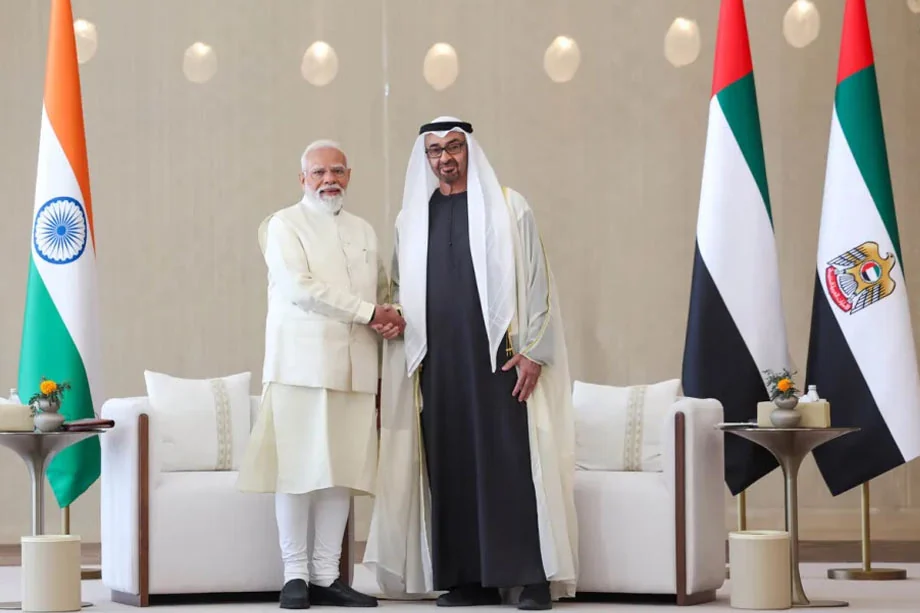
Delhi has the machines and the know-how. Abu Dhabi and Dubai have the capital and the ports. Africa has the market, the sunlight and the youth. The only thing missing is a project that puts all three in the same room. In December 2018, an agreement was signed between India and the United Arab Emirates that attracted almost no attention outside diplomatic circles. It was a short memorandum of understanding on development cooperation in Africa, approved by India’s Union Cabinet in February 2019. It promised “joint” projects shaped by African priorities, and then, for the most part, sat on a shelf. Seven years on, India and the UAE are among the most active outside players on the African continent, but they mostly act alone.
That is a missed opportunity, and a measurable one. Each country brings something the other lacks, and Africa needs exactly what each of them offers. The task now is to move from a diplomatic understanding to working projects, small enough to be finished and well enough designed to be copied. Three sectors stand out: trade and logistics, energy, and healthcare.
Why Now?
The timing has rarely been better. The UAE has made Africa a central pillar of its economic strategy. It has signed nine Comprehensive Economic Partnership Agreements with African countries, covering tariffs, services, digital trade and investment protection, and designed to complement the continent’s own free trade area. In October 2026, it pledged a further US$1 billion for an AI-focused partnership with Africa, with an emphasis on youth. India, for its part, has opened 17 new embassies across Africa since the last India-Africa Forum Summit in 2015. That summit was set to return in May 2026 after an 11-year gap, though it has since been delayed by public health concerns over Ebola in parts of the continent.
The two countries’ own relationship is also in good shape. The India-UAE Comprehensive Economic Partnership Agreement, in force since 2022, opened up market access across a range of services and investment flows. Both countries sit inside the expanded BRICS grouping, along with Egypt and Ethiopia, and India holds the 2026 chair. Trade between India and Africa, meanwhile, remains modest relative to its potential, with Africa accounting for only around 6 percent of India’s exports and 5.6 percent of its imports, according to figures cited in recent analysis.
Seen from Africa, the case is stronger still. The continent is expected to have over 60 percent of its population in working age by 2050, while India’s own demographic dividend peaks around 2041. Both want jobs, industrial capacity and reliable infrastructure. A partnership that links their strengths could speak to those needs directly.
A Simple Organising Principle
The MoU’s first article lays out the basic idea: cooperation in development projects and programmes, in line with African priorities, pooling the parties’ efforts, resources and skills for joint implementation. It sounds abstract, but it suggests a practical method. Start with a need identified by African partners. Then assemble the money, expertise and delivery capacity from the other two sides to meet it.
Take a processing business in East Africa, for instance. It might need machinery, a dependable power supply, transport to reach markets and trained staff. No single partner supplies all of these. An African firm brings production capacity and market knowledge. An Indian partner can offer machinery and technical training. An Emirati partner can provide investment or logistics. The roles shift from project to project, but the logic holds: tackle connected constraints together, rather than one at a time.
The groundwork exists. Masdar, the UAE’s clean-energy company, partnered with the infrastructure investor Africa50 in 2023 to identify and advance clean-energy projects. India’s e-VidyaBharati and e-ArogyaBharati network, launched in 2019, built experience in tele-education and tele-medicine cooperation with African countries. Together they show how infrastructure investment can be paired with skills and services.
Trade and Logistics: Cutting the Cost of Distance
The African Continental Free Trade Area aims to expand trade between African countries and build regional value chains, which gives better logistics an obvious commercial rationale. A 2020 World Bank study estimated that full implementation could raise African incomes by US$450 billion by 2035, with US$292 billion of that coming from trade-facilitation measures such as smoother customs and lower trade costs, not just tariff cuts. The gains depend on delivery. Tariff schedules on paper do not move goods across borders; efficient border procedures and reliable transport do.
The Kigali Logistics Platform, inaugurated in 2019, shows what targeted infrastructure can do. Rwanda’s Development Board reported a US$35 million investment at its launch, a fall in truck turnaround time from 10 to 14 days to three, and 667 direct and indirect jobs, 98 percent of them held by Rwandans. The platform was an Emirati-African project, and it is a useful template.
A natural next step would be a pilot linking an agricultural processing and distribution business to an inland hub of this kind. A Rwandan processor or cooperative could identify the products and volumes. An Indian equipment supplier could install processing and packaging machinery and train operators. An Emirati logistics partner could provide warehousing and transport links. A feasibility study would first have to establish demand, storage needs, border procedures and access to neighbouring markets. Financing could combine the firms’ own equity with lending against credible sales contracts. The aim would be to raise the share of value retained by African producers while giving all participants sustained business.
The commercial architecture is already being built. India and DP World, the Dubai-based ports operator, have launched a trade ecosystem aimed at doubling India-Africa trade through logistics, export finance and certification services. Linking that effort to specific African hubs would turn a general ambition into something concrete.
Energy: Where the Sun Meets the Factory Floor
Africa’s energy problem is a paradox. The International Energy Agency’s 2024 assessment found that around 600 million Africans lack access to electricity, even though the continent holds about 60 percent of the world’s best solar resources. Reaching universal access under the agency’s Sustainable Africa Scenario would require roughly US$22 billion a year between 2023 and 2030. The shortfall is not a lack of sunlight. It is a lack of capital, of bankable projects, and of customers able to pay tariffs that make power plants viable.
That last point matters most. Electricity projects fail when there is no one to buy the power. The strongest cases are ones anchored in productive demand, such as factories, processing plants and cold chains, which need reliable electricity to operate and can pay for it.
The UAE is already committed. In September 2023, Masdar announced a US$10 billion commitment to deliver 10 gigawatts of clean energy in Africa by 2030, made up of US$2 billion in equity and US$8 billion in project finance. Its partnership with Africa50 is aimed at identifying, accelerating and scaling projects.
A specific trilateral pilot could build on that: a solar-and-battery-storage system powering an African agro-processing cluster. The industrial operator and the local utility would set demand, connection requirements and power-purchase terms. An Emirati developer could lead investment and project development. Competitively chosen Indian engineering firms could supply equipment, installation and maintenance training, with local contractors and a technical college supporting construction and operations. Success would be measured in practical terms: fewer outages, lower energy costs and stronger local maintenance skills. India’s own experience in solar manufacturing and its International Solar Alliance give it credibility here, and Indian firms have built a track record in African electrification and transmission work.
Healthcare and Pharmaceuticals: Making Medicines Closer to Home
The pandemic exposed how dependent Africa is on imported medicines and vaccines. According to UNCTAD, more than 70 percent of the pharmaceuticals consumed in Africa are imported. India, by contrast, is the world’s pharmacy in generics, exporting US$30.47 billion of drugs and pharmaceuticals in the 2024-25 financial year. That asymmetry suggests scope for resilient local supply.
An initial partnership could target a small set of essential generic medicines in a country with an established regulator and pharmaceutical sector. An African manufacturer would bring facilities, staff and domestic market knowledge. An Indian firm would provide production know-how, quality-control support and training. An Emirati investor or logistics company could add capital and distribution services. Product selection should follow national health priorities and real procurement demand, not what is easiest to make. Production might begin with packaging and move to formulation as scale, licensing and quality standards permit, with regional sales subject to the relevant approvals and trade rules.
Skills would be as important as capital. India’s experience through the e-VBAB programme shows the potential: its High Commission in Sierra Leone reported in 2023 that more than 14,000 scholarships had been awarded to African students against a goal of 15,000. Programmes designed with African institutions and employers could extend that experience to production skills and quality assurance, which are the weakest links in building a credible local pharmaceutical industry.
Keeping African Priorities in the Driver’s Seat
For any of this to work, Africa has to lead. The African Union’s Agenda 2063, which stresses inclusive growth and continental integration, offers the strategic frame, and national industrial, energy and health strategies should set the starting point. African governments, businesses and institutions need to shape which projects go forward, who owns them and how they are run. Early consultation helps ensure investment lines up with available infrastructure, local procurement and employment.
There is also a hard-headed point about viability. Electricity projects need credible buyers and sustainable tariffs. Pharmaceutical ventures need enough demand and regulatory compliance. Logistics projects depend on reliable throughput. Financing should match each project’s realities: development finance and technical assistance can fund preparation and training, but commercial activities need a revenue model that works. Planning for maintenance, skills transfer and local supplier participation from the start is what separates a project that lasts from one that fades once the ribbon is cut.
This is not a minor point. Africa has seen plenty of externally designed projects that left little behind. The strongest argument for a trilateral approach is that it can avoid the pattern of one-sided deals, giving African partners a say in design and a share in ownership.
Getting Started
A practical agenda would be modest. India and the UAE could use existing diplomatic channels to invite African partners to develop a small initial pipeline of proposals under the MoU framework. Each should name the institutions taking part, the constraint being addressed and the value added by joint action. A single well-prepared pilot would help build working relationships and give both sides experience.
Joint feasibility work would then define costs, financing, procurement and operating responsibilities. A project-level steering group involving all three sides could monitor delivery, alongside the financing agreements and national approvals needed. A few clear metrics, tracked against agreed baselines, would keep everyone honest: transport times and producer sales for logistics, electricity reliability and cost for energy, medicine availability and quality compliance for pharmaceuticals.
There are risks to manage. Delivering across three jurisdictions is harder than working bilaterally. Differing regulatory systems, currency and payment issues, and the usual problems of project finance in frontier markets will test any pilot. India and the UAE also compete in some areas, from ports to energy investment, and will have to be clear about where they complement each other. And the political context matters: neither Delhi nor Abu Dhabi wants to be seen as pursuing influence in Africa at the continent’s expense. Transparent selection of partners and clear local benefit are the best protection against that charge.
Conclusion
The India-UAE memorandum on Africa has waited nearly eight years for a flagship project. The conditions for one are better than they have ever been: the UAE has committed billions to African energy, trade and technology; India is rebuilding its diplomatic and development presence across the continent; and African countries are looking for partners that offer investment without strings and skills without strings attached.
The case for acting is not that this will transform Africa overnight. It is that a handful of well-chosen projects, one in logistics, one in energy and one in healthcare, could demonstrate a different way of doing development partnership: three parties, each contributing what it does best, with African priorities setting the agenda. If they work, they can be replicated and scaled. If they fail, they will at least fail small, and teach something useful.
The alternative is to leave the memorandum where it has been, as a signature on a page, while each country pursues its African interests separately. That would be easier, but it would waste a rare alignment of capabilities and ambitions. A well-run pilot is the next step, and the sooner it begins, the sooner the three corners of this partnership can show what they can build together.


