
By: Khushbu Ahlawat, Consulting Editor, GSDN
Introduction
Production figures and export orders tell one half of the Atmanirbhar Bharat story. The other half is about who is doing the building, and the answer is changing faster than most people realise. When India’s defence minister announces a record year, the numbers arrive in a familiar order: production worth about US$19 billion (₹1.78 lakh crore) in FY 2025-26, exports at an all-time high of roughly US$4.1 billion (₹38,424 crore), another list of items barred from import. These are the metrics by which defence self-reliance is normally judged, and they matter. But they say almost nothing about the people behind them: the engineers who design the missiles, the managers who run the shipyards, the founders who start the companies that supply the fuses, drones and sensors that make a modern military function.
Look at those people more closely and a pattern emerges. Women are now leading flight tests of intercontinental-range missiles, heading major public-sector manufacturers and founding firms in fields as unlikely as landmine detection and munition fuses. They are still a minority in the sector, and the gap is real. But the trajectory is worth understanding, because a defence industry that wants to export, innovate and reduce its dependence on foreign suppliers cannot afford to leave half its talent pool on the sidelines.
The Backdrop: A Sector That Needed Everyone
The Atmanirbhar Bharat campaign, announced in 2020 when the pandemic exposed how fragile global supply chains had become, set out to reduce imports and expand domestic production. In defence, where India had long been one of the world’s largest arms importers, that meant pushing indigenous manufacturing, opening the sector to private firms and putting import-substitution lists into force. The record production and export numbers suggest the push is working.
Growth on this scale opens room. New companies need founders, new programmes need leaders, and expanding factories need engineers and managers. The question is who fills that room. For decades the Indian defence establishment, from laboratory to shop floor, was overwhelmingly male. The change underway is not just a matter of fairness, though it is that too. A sector aiming to become a significant exporter and a frontier technology developer needs the full depth of the country’s talent, and India produces a lot of it.
The Laboratory: From “Missile Woman” to Mission Divyastra
DRDO, the state’s central defence research body, offers the clearest examples. The pioneer is Dr Tessy Thomas, widely known as India’s “Missile Woman.” She served as associate project director for Agni-III, project director for Agni-IV and mission project director for Agni-V, which made her the first woman scientist in India to lead a major missile development project. In 2018 she became Director General, Aeronautical Systems.
What she began has multiplied. In March 2024, Mission Divyastra, the first flight test of the Agni-V with MIRV technology, in which a single missile carries multiple warheads that can be directed at different targets, was led by Sheena Rani as programme director, with Shankari Chandrasekaran as project director. The test placed India among the small group of countries with this capability, and two women were at the centre of it.
Aviation tells a similar story. Dr K. Rajalakshmi Menon, Director General of DRDO’s Aeronautics Cluster, worked as a systems engineer on the Netra airborne early warning and control programme, taking it from concept to induction. The system made India the fifth country with an indigenous airborne early warning capability based on active electronically scanned array radar. In 2026, she presented the programme’s development journey when Netra received its Final Operational Clearance certificate from the Indian Air Force. Dr Chandrika Kaushik has worked on speeding up the induction of DRDO-developed systems into the armed forces and on transferring DRDO technologies to Indian industry for production, the unglamorous but critical link between a prototype and a product in service.
The Factory Floor: Shipyards, Electronics and Boardrooms
Designs are only worth something if they become hardware, which is where the defence public sector undertakings come in. Women have been reaching senior positions there as well. In 2016, Anandi Ramalingam, who had earlier headed the military communication business unit at Bharat Electronics Limited, became the company’s first woman full-time director. BEL is a Navratna public enterprise and among the country’s largest defence manufacturers.
Shipbuilding, perhaps the most traditionally male corner of the industry, is shifting too. In June 2026, Mazagon Dock Shipbuilders, which builds many of the Navy’s warships and submarines, promoted Devi Nair to General Manager (Technical).
The private sector has its own examples. Rekha Murthy Rangarajan co-founded Data Patterns, now a listed defence electronics company supplying radars, electronic warfare suites, avionics and small satellites, with work on programmes including the Tejas light combat aircraft. A newer generation is building on that foundation. In Bengaluru, Priyanka Singhal, a former DRDO intern, founded Ammunic Systems to develop advanced electronic fuses, warheads and munition integration technologies, and won the Society of Indian Defence Manufacturers’ Women Innovator of the Year award. Dr Sarita Ahlawat, co-founder and managing director of BotLab Dynamics and its defence vertical Vayudh, builds indigenous nano-surveillance drones and has been recognised with an aviation achievement award.
Manufacturing has seen its own firsts. In 2019, Preiti Patel and Kalpana Patel set up Raspian Enterprises, an all-women factory making revolvers, pistols and shotguns. In the Uttar Pradesh Defence Corridor, Vijayan Trishul Defence Solutions, co-founded by Sahil Luthra and Prikansha Luthra, supplies small arms, ammunition, protective equipment, drones and anti-drone systems, and firms such as Alerta Defence Technologies and ZMotion Autonomous Systems add further depth.
The startup scene shows similar momentum. Mrinal Tayal, a Mohali-based entrepreneur, was among the winners of a 2023 Indian Navy challenge under the iDEX programme to develop unmanned seaplanes. Rithika Mohan co-founded the drone maker Garuda Aerospace, and Shreya Rastogi founded SR Aerospace Solutions, which designs propulsion systems for unmanned aerial vehicles. And women are shaping strategy from the boardroom: Divya Goel and Urmila Devi are directors at Aerosearch Technologies, which uses multi-sensor AI to detect landmines; Rashmi Gupta directs Tactical Response Automation, which builds autonomous defence systems; and Aparna Singh holds a directorship at drone maker Vymanik Aerospace.
There is a useful historical parallel. In the armed forces, women moved from support roles to command over a generation. Today’s directors and managers in the industrial sector are gaining the experience that will make them tomorrow’s founders.
A Longer Road: What the Armed Forces Showed
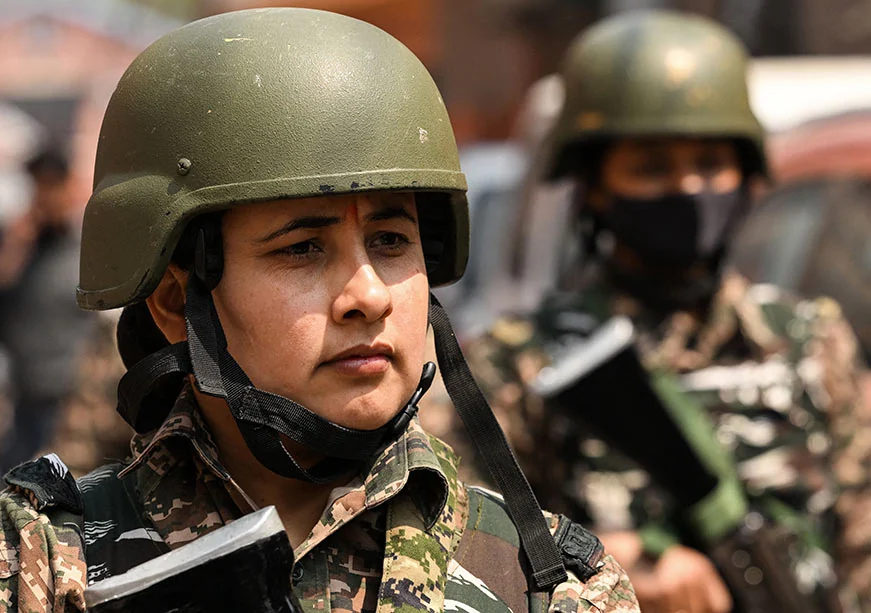
That parallel is worth dwelling on, because the armed forces have already run a version of this experiment, and it was neither quick nor easy. Women were first granted permanent commissions in limited branches in 2008. It took a Supreme Court ruling in February 2020, in the Babita Puniya case, to extend permanent commission to women officers in the Army more broadly, and the judgment specifically noted the record of Colonel Sofiya Qureshi. Women cadets were admitted to the National Defence Academy from 2022, and in 2025 the first batch of 17 women graduated from it. Overall, the number of women officers in the armed forces is reported to have grown from around 3,000 in 2014 to more than 11,000 today.
The visibility of that change was on display in May 2025, when India launched Operation Sindoor after the Pahalgam terror attack. The official military briefing was led by Colonel Qureshi of the Corps of Signals and Wing Commander Vyomika Singh, a helicopter pilot who received her permanent commission in 2019. It was the first time two women officers had jointly fronted the official briefing on a major military operation. The point is not symbolism for its own sake. It is that something that was legally barred a few years earlier had become, almost without comment, part of how India communicates about war. The industrial side of defence is, in many respects, a few steps behind the same arc.
An Ecosystem More Ready Than the Numbers Suggest
For a woman with a defence technology idea today, conditions are better than they have ever been, and four strengths stand out.
The first is a set of schemes aimed at defence innovators: iDEX, its ADITI programme, DRDO’s Technology Development Fund and challenges run by the defence public sector companies. They offer funding, testing facilities and, most importantly, a route to the armed forces as customers.
The second is finance. Women-led micro and small enterprises can access collateral-free loans of up to about US$21,100 under the Tarun Plus category of the MUDRA scheme for eligible repeat borrowers, and enhanced coverage under the Credit Guarantee Fund Trust for Micro and Small Enterprises. In addition, 10 percent of SIDBI’s Fund of Funds for Startups is reserved for women-led ventures.
The third is a broad entrepreneurial base. As of January 2026, 102,054 of the 212,283 startups recognised by the Department for Promotion of Industry and Internal Trade had at least one woman director or partner. At the state level, Uttar Pradesh’s Startup Policy 2026 offers eligible women-led startups an additional 50 percent on prototype grants and seed capital, and 1,441 of the 25,545 startups on the state’s portal are women-led.
The fourth, and arguably the most important, is the talent pool. Women account for 43 percent of enrolments in STEM subjects in higher education, and female PhD enrolment roughly doubled between 2014-15 and 2021-22, from 0.48 lakh to 0.99 lakh.
The Gap Between Pipeline and Leadership
Set those figures against the share of women in STEM research and development, which stands at 18.6 percent, and the problem becomes clear. The talent is entering the pipeline in large numbers, but it is not coming out the other end in the same proportion. Somewhere between a degree and a leadership role, women are being lost.
Defence has particular reasons for this. The sector is dominated by a small number of public-sector institutions with long, hierarchical career paths. Procurement is notoriously complex, and a first-time founder, regardless of gender, faces a daunting maze of testing, certification and customer approval. For women without family or professional networks in the industry, the barrier is higher, because the informal knowledge about how to navigate it tends to travel through male-dominated circles. Role models are scarce, and what is not visible often does not seem possible.
None of this is unique to India. But it means that the existing schemes, however generous, are not automatically reaching the people they were designed to help. Awareness, mentorship and access matter as much as money.
Turning Momentum into a Movement
A few targeted steps, built on institutions that already exist, could help.
A dedicated window for women-led startups within iDEX and ADITI would mirror what Uttar Pradesh and SIDBI already offer, and would signal that the defence innovation system wants these applicants. Structured mentorship, pairing aspiring founders with senior women at DRDO and the defence public sector companies, would give newcomers access to people who understand procurement, testing and certification from the inside. Networks linking women-led defence firms with women STEM graduates would let the next generation see paths others have already taken. And greater visibility for women innovators at defence expos, in industry awards and in official communication matters more than it might sound, since role models are among the strongest drivers of participation.
None of these requires new legislation or large budgets. They require attention, and a recognition that the defence ecosystem will not become inclusive by default.
Conclusion
India’s defence ambitions are large. The country wants to be a major exporter, to cut its reliance on foreign suppliers and to build frontier technologies, goals that will demand every bit of the talent it can mobilise. The women profiled here, from Tessy Thomas to Sheena Rani, from Rajalakshmi Menon to Anandi Ramalingam, from Priyanka Singhal to Sarita Ahlawat, have shown what is possible in laboratories, shipyards, boardrooms and startups. They have done so in a sector that offered them little encouragement for most of its history.
The opportunity now is to make their success the norm rather than the exception. The supportive schemes exist, the STEM pipeline is deep and the defence market is growing. What remains is the unglamorous work of connecting them, so that the next woman with an idea for a better drone, fuse or sensor finds a path that is visible, funded and open. An inclusive defence industry is more than a social aspiration. It is a practical requirement for Atmanirbhar Bharat to succeed, and the evidence so far suggests the country is better placed to deliver it than the headline numbers imply.


