
By: Khushbu Ahlawat, Consulting Editor, GSDN
INTRODUCTION
Incinerators are only as good as what is fed into them. Four decades of Delhi’s experience, from Timarpur to Okhla, suggest the real work happens long before the furnace.
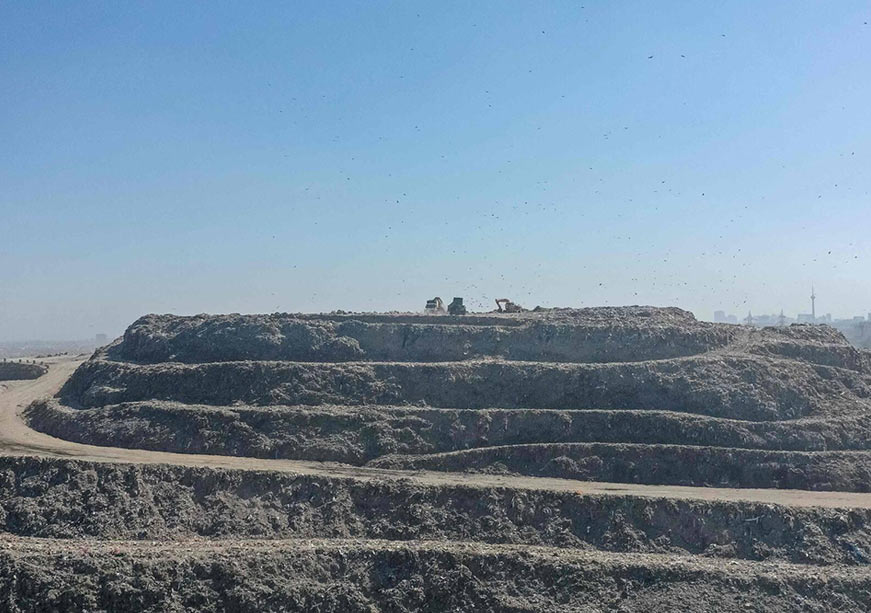
Every few months a fire breaks out at one of Delhi’s landfills, and for a day or two the city pays attention. Smoke drifts over nearby colonies, reporters stand in front of the heap, officials promise action, and then the flames die down and so does the conversation. Bhalswa, Ghazipur and Okhla, the capital’s three big dumpsites, have been through this cycle so often that it has settled into the city’s calendar, somewhere between the stubble-burning season and the first cold snap. The cause is not mysterious. Delhi generates thousands of tonnes of municipal solid waste every day, and a large share of it reaches these sites as a single mixed mass of food scraps, plastic, paper, glass, diapers and whatever else people throw out. Organic matter buried under that load rots without oxygen and gives off methane. The gas collects inside the mound until a spark or a hot summer finds it. Even when nothing burns, the heaps leak greenhouse gases and contaminated liquid into the soil and groundwater around them.
Policymakers have looked for a way out, and increasingly they have settled on waste-to-energy (WtE). The pitch is easy to like. Burn the garbage, shrink the landfill, generate electricity, and solve two problems with one plant. It is a tidy story, and it explains why large incinerators keep appearing in city plans and ministry announcements. The trouble is that the story skips its first chapter. A recent analysis by Krishna Vohra of the Observer Research Foundation, published this month, makes the point directly: a waste system succeeds or fails at its beginning, not at its end. What follows draws on that argument, on the public record of Delhi’s plants, and on what Indian cities that have got it right actually did.
What a furnace actually needs
An incinerator is not a bin with a fire in it. It is a piece of industrial equipment designed to run on fuel of a certain quality, and municipal waste only qualifies as fuel under certain conditions. The most important of these is calorific value, the amount of heat a kilogram of material releases when burned.
India’s Solid Waste Management Rules have long said that mass incineration is meant for segregated, non-recyclable waste with a calorific value of at least 1,500 kilocalories per kilogram. That figure was in the 2016 Rules and it carries over into the 2026 revision. It is not a bureaucratic flourish. Below that level a plant cannot sustain efficient combustion without extra fuel, and temperatures drop low enough that burning becomes incomplete, which is exactly when the nastiest pollutants, dioxins among them, are formed.
Now look at what Indian municipal waste is made of. A large part of it is wet: vegetable peels, cooked food, market refuse, flowers, leaves. That material is heavy with water and gives up little energy. Put it in a furnace together with plastics and paper and you get a damp, uneven feed that burns badly. The plant either struggles to produce power or compensates in ways that raise emissions.
The second problem is what should never be in the furnace at all. Batteries, discarded electronics and certain industrial residues carry cadmium, lead, mercury and other heavy metals. These do not burn away. They leave through the chimney as fine particles or settle into the fly ash and bottom ash that the plant must then dispose of safely. A facility that receives truckloads of unsorted refuse has very little control over what ends up in the fire. This is why segregation is not an add-on to waste-to-energy. It is the precondition. The 2026 Rules seem to accept this, moving from the old wet and dry split to a four-way segregation at source. Whether households and institutions can actually be made to sort into four streams is a separate question, and the answer will say more about the success of the policy than any plant specification.
Timarpur and Okhla: the same mistake, forty years apart
Delhi has tried this before. In the 1980s a waste-to-energy plant was built at Timarpur, with foreign technology and high hopes. It did not work. Contractors there were paid by the tonne, which sounds sensible until you think about what it rewards. A contractor paid for weight has every reason to deliver heavy loads, and little reason to care what is in them. Inert material such as soil, construction debris and sweepings made it to the incinerator, which was not built to burn it. The plant never delivered what was expected of it. The lesson should have been obvious. A machine designed for one kind of waste was fed another, because the system upstream was built to move volume rather than to sort it.
The plant that stands today at Okhla was built on the same site, and its story has been rougher than the promotional material suggests. A 2024 investigation by The New York Times looked at emissions around the facility over a five-year window, from 2019 to 2023. It reported stack and ambient readings that went well past permitted limits, in some cases by a factor of eight to ten, and found heavy metals and chemical contamination in the surrounding air and soil and in the plant’s leftover ash.
The figures reported are worth setting out, because they show how varied the problem is:
| Pollutant | Reported exceedance | Reference point |
| Cadmium | Up to 19 times higher | U.S. EPA safe threshold |
| Manganese | Up to 11 times higher | Standard safety limits |
| Dioxins | Up to 10 times higher | Indian regulatory limits |
| Arsenic | Up to 10 times higher | Permissible limits |
| Lead | Up to 4 times higher | Permissible limits |
| Cobalt | Up to 3 times higher | Standard safety limits |
| PM2.5 and hydrogen chloride | Regularly above limits | Indian SWM Rules |
Source: compiled from reporting by The New York Times and The Times of India.
Not every number here points to the same cause. Cadmium and lead suggest electronic and industrial waste in the feed. Dioxins point to low-temperature, incomplete combustion of mixed plastics and organics. Particulate matter and hydrogen chloride breaches go to the performance of pollution control equipment and to how seriously continuous monitoring is taken. But the common thread is hard to miss. The plant is receiving waste it was not supposed to receive, and nobody upstream is stopping it. Okhla also sits in the middle of a dense residential area, which raises the stakes. People living around the plant breathe whatever it releases. Delhi already struggles with winter air quality, so adding a stationary, high-temperature source of heavy metals and dioxins to the airshed is not a neutral decision.
Why top-down projects keep failing
The pattern is familiar enough to describe in a few steps. An authority picks a capital-intensive facility. A private operator is contracted to build and run it. Everyone assumes the waste will show up clean, dry and sorted. It does not, and the plant spends its life coping with a feed it was never designed for.
Several things sit behind this.
Incentives point the wrong way. When payment is tied to tonnage, the system rewards quantity. Quality, which is what decides whether a plant can generate power without poisoning its neighbours, goes unpaid for. Nobody in the chain earns anything by sorting well.
Imported models ignore local composition. Sweden is often held up as the example, and it deserves credit for running one of the most efficient waste-to-energy systems in the world. But Sweden’s success rests on a waste stream that is largely dry and high in calorific value, backed by strong recycling and sorting systems that take out the problem material beforehand. India’s waste is wetter and its collection chain looks very different. Copying the plant without copying the system around it does not reproduce the result.
The people who already sort the waste are pushed aside. India has an enormous informal recycling workforce. Waste pickers go through mixed refuse by hand, pulling out plastics, metal, cardboard and glass, and in doing so they divert a great deal of material from dumpsites at no cost to the city. A large incinerator that draws mixed waste straight to its gate takes away the material these workers depend on, and with it their income. It also wastes their knowledge. They know better than any engineer what a given neighbourhood’s garbage actually contains.
Funding rewards output, not inputs. If public support is linked to how much power a plant produces and not to the quality of what goes in or to whether it meets emission norms, then the stages that make good output possible stay unfunded. Segregation, collection, composting and monitoring all fall into that gap.
None of this means incineration has no place. It means the plant is the last link in a chain, and if the earlier links are weak, buying a more expensive last link does not help.
Fixing the fundamentals
The less glamorous alternatives cost much less. Clearly labelled, separate bins in homes, offices, institutions and on streets, paired with steady and repeated public communication, can lift collection quality in ways that more spending on door-to-door vehicles might not. This sounds trivial and is not. Habit change in a city of this size is slow, and it needs a visible, consistent system behind it. A household that sorts its waste only to see it tipped into one truck will stop sorting.
Organic waste deserves particular attention because it is the largest and most troublesome fraction. Composting and biomethanation at the neighbourhood or ward level can handle wet waste close to where it is produced, cutting transport costs and keeping the heaviest, wettest material out of any furnace. Treated that way, the organic fraction becomes a resource rather than a burden.
For recyclables, price signals work better than appeals. Germany’s Pfand system charges a small deposit on bottles and cans at the point of sale and gives it back when the container is returned to a shop. People do not need to be lectured about it. The money does the work. Deposit refund schemes of this kind are now being tried at different stages in several Indian states, but a straight transplant will not do. The German model was built for particular packaging streams, in a country with dense retail infrastructure, and it does not by itself address India’s wider municipal waste problem. Any Indian version has to account for collection costs and, importantly, for the livelihoods of informal workers who currently earn from those same bottles.
Then there is the sachet. Single-use packets of snacks, shampoo and tobacco are individually trivial and collectively enormous. They lie along riverbanks and mountain trails, block stormwater drains, and make monsoon flooding worse in cities that already flood easily. They are also hard to recycle economically. Producers need to be held properly accountable for collecting what they put on the market, with penalties that bite when they fall short. Citizens, for their part, need convenient places to dispose of waste. Low-cost investment in that kind of civic infrastructure can change habits gradually.
Where it works
There are Indian examples that show the approach is not just theory.
Indore is the one most often cited, and for good reason. The city’s bio-CNG plant operates under a public-private agreement in which the municipality is obliged to supply waste that is 90 percent segregated. The plant treats roughly 550 of the 700 tonnes of organic waste the city produces each day, and the gas it makes replaces diesel in the city’s public buses. What stands out is that segregation was written into the contract. It was not assumed, hoped for, or left to goodwill. If the city fails to deliver clean feedstock, that is a breach.
Pune’s SWaCH cooperative shows a different route. Waste pickers there are organised into a member-owned body that provides door-to-door collection, earning from user fees and from the recyclables they recover. Informal workers become part of the system rather than competitors to it. Bengaluru’s mix of informal collectors, NGOs and the municipality has produced similar gains in decentralised collection, though not without difficulties of its own.
None of these is perfect. Indore has had its share of criticism, and every decentralised system struggles with scale, funding and political attention. But all of them share a feature that Okhla and Timarpur lacked: the waste arrives in a state the downstream facility can actually handle, because someone designed the upstream to make that happen.
The 2026 Rules try to move in the same direction. They replace the old flat tipping fee, which was tied to the tonnage delivered, with payment linked to segregation. On paper this fixes the Timarpur problem. Whether it works in practice depends entirely on implementation, and implementation is where Indian environmental regulation has traditionally stumbled.
Accountability is the missing piece
Rules do not enforce themselves. The Central Pollution Control Board and state pollution control boards have powers to levy environmental compensation and penalties, but in practice many of these exist more on paper than in the bank accounts of the offenders. Fines get contested, delayed, reduced or quietly forgotten.
If the goal is real change, enforcement has to become automatic and personal. Environmental compensation should follow a violation without discretion, and it should fall on those who actually hold responsibility, which means municipal commissioners and not just the contractors they hire. Independent third-party audits of compliance with the 2026 Rules would remove the conflict of interest that arises when a body inspects its own performance. The same discipline needs to extend to bulk waste generators, such as large housing societies, hotels, markets and institutions, who are meant to carry responsibility for handling their own waste under the Rules. These are the sources where segregation is easiest to enforce, because the volumes are large and the generators are identifiable.
Transparency would help too. Continuous emission monitoring data from plants like Okhla should be available to the public in real time, in a form residents can read. A community that can see the numbers does not have to rely on a newspaper investigation to find out what it is breathing.
Order matters
None of this amounts to a case against waste-to-energy. Large plants may well have a role in India’s energy transition, particularly as landfill space runs out and cities keep growing. But the sequence matters more than the technology. A plant built before the basics are in place becomes an expensive way of relocating the problem from the landfill to the chimney.
The better order is the unfashionable one. Get households and institutions sorting. Pay for segregation, not just for tonnage. Treat wet waste locally. Bring waste pickers into the system on fair terms. Hold producers and local officials accountable with penalties that actually land. Then, and only then, decide how much incineration the system needs and what it should burn.
India does not have a shortage of ambitious waste projects. It has a shortage of boring, well-run collection systems that deliver clean waste at the gate. Delhi’s two incinerators, separated by forty years and joined by the same flaw, are a reminder that the best technology in the world is only as good as the bin it starts from.


