
By : Soumya Dutta, Research Analyst, GSDN
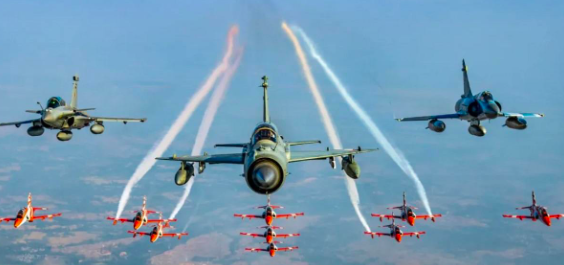
In July 2026, an aggregated ranking by the World Directory of Modern Military Aircraft (WDMMA), placed the Indian Air Force (IAF) as the third most powerful air force globally, thereby reaffirming its position as one of the critical pillars when it comes to India’s military capability and strategic posture. This comes at a time when airpower is increasingly shaping the trajectory of modern warfare, where speed, precision and the technological superiority determine the operational outcomes. By combining these factors with reach and flexibility in a way that fundamentally alters how military force is applied, it has helped states to project power rapidly across theatres and respond with minimal delay. At the same time, this capacity to protect airspace refers to not only protecting friendly forces but also restricting the ability of an adversary to operate effectively.
In the case of the Indian Air Force (IAF), this cannot be understood merely through platforms, inventories and operational successes. Instead, airpower by its nature is cumulative and doctrinal, which in the case of India has neither been linear or insulated but shaped by changing perceptions of threat, technological disruptions and the reorientation of warfare towards multi-domain integration. With a diverse inventory ranging from legacy platforms to advanced multi-role fighters, along with a growing ecosystem of indigenous capabilities, the IAF today is a blend of both continuity and transition. Understanding this trajectory is crucial, as airpower serves as a critical enabler and decisive instrument of force in contemporary times.
The Evolution from Airpower to an Aerospace Power
Established in 1932 as a small auxiliary force, the IAF began with limited aircraft and personnel. However, with the outbreak of WW2 in 1939 it was expanded gradually and during the war years grew from a handful of units to nine squadrons, including aircraft such as the Hurricanes and Spitfires. With the independence in 1947, the Royal Indian Air Force (RIAF) as it has been named so for its services during the war years, was divided between India and Pakistan, which ended up significantly reducing its strength. However almost immediately India’s airpower was put to test as both the countries clashed over the future of Kashmir. The 1950s was also the period when the IAF acquired the British and French aircraft to enhance its combat capabilities.
The evolution continued, as the 1962 tensions with China resulted in an accelerated expansion of both the Army and the Air Force, with India even procuring the MIG-21 fighters from the Soviet Union. It was during this period of ongoing expansion and transition, that in 1965 the IAF was successful in halting the offensive launched by Pakistan, but the effectiveness was largely constrained especially as technical, organizational and coordination challenges remained. Then came the 1971 Indo-Pakistani war, which marked a move towards a decisive and integrated airpower, represented by the counter-air operations and close support to ground troops. The IAF was able to achieve uncontested control of the skies and the simultaneous air campaign in both the east and west through an advanced fleet successfully absorbed and neutralized the adversarial strikes. Modernization continued during the 1990s, under Operation Safed Sagar in the backdrop of the Kargil War, which aimed to degrade enemy positions, supply lines, and logistics in coordination with the ground forces. A key feature of the campaign was the integration of reconnaissance, strike and air defence missions, especially through the role of MiG and Mirage fleets which were quite successful under demanding conditions providing the necessary tactical flexibility.
However, to develop a more systematic understanding, it is important that we examine the doctrinal evolution of the IAF which has caught up with these developments in stages rather than a single leap. The formal doctrine was released in the year 1995, followed by 2007, 2012 and recently in 2022. The IAF was the first among the three services to do so, and in the doctrine laid down the foundational aspects which included the theory of war, the defining characteristics of airpower and their integration with the broader military strategy. Building on this, the subsequent doctrines attempted to adapt rapidly to the changing strategic and technological environment. The 2012 document on Basic Doctrine was significant, as it expanded the scope of air power to include issues of intelligence, surveillance and reconnaissance (ISR), control of air and importantly the role of soft power realized through Humanitarian Air and Disaster Relief (HADR). Certain systems of modernization that have been adopted, were also mentioned such as the Air Force Network (AFNet), an encrypted network to transfer data and the Integrated Air Command and Control System (IACCS), to act as a ‘central control’ system for air defence.
In 2022, the doctrine marked a more fundamental shift in thinking, emphasized by a shift in focus towards being an ‘aerospace power’. In an address in New Delhi, the same year India’s Defence Minister Rajnath Singh, drawing lessons from conflicts in Syria, Iraq, Afghanistan and Ukraine underscored how modern technologies act as force multipliers and their integration among the armed forces enhance operational efficiency and synergy. He stated that the Indian Air Force should become an ‘Aerospace Force’ and be ready to protect the country from evolving threats. This was because of the large acceptance, that the air and space domain gets integrated at 100 km (above sea level) called the Karman line, which meant exploiting space capabilities from C3NI² (Command, Control Communication, Networks, intelligence and Interoperability) system, secure communication to threat detection, is central to future national security and military strategy. Most important were its features of reach, rapid responsiveness, offensive capability through moral ascendancy and undertaking operations across multiple domains which gave an edge to the aerospace factor in combat. A cornerstone of the document has been the No War-No Peace (NWNP) environment, where India uses calibrated kinetic and non-kinetic aerospace capabilities against adversaries while keeping below the threshold of conflict and avoiding full scale escalation. It is a scenario of persistent tension where countries are not engaged in war, but there is no peace either and for the IAF it means ensuring deterrence, rapid response and maintaining continuous readiness to avoid any outright conflict.
This meant that air power is no longer understood only in terms of aircraft and airfields but also in regard to space-enabled systems and the ability to respond across domains. The shift is important, as this shows that India now sees future conflicts not only as a contest for control of the skies alone, but also a wider struggle for information, reach, speed and coordination. This shows the basis for more assertive use of air power in recent years.
Stealth, Self-Reliance and Strategy
In a major structural change, the Aeronautical Development Agency (ADA) has issued a Request for Proposal (RFP) to develop the prototypes of the fifth-generation fighter aircraft. While Hindustan Aeronautics Limited (HAL) has been kept out, the leading contenders now include TATA group and the consortiums led by Bharat Forge and Larsen & Toubro. This marks a major push for the private defence industry, as they can transition from suppliers to central participants responsible for the end-to-end manufacturing process. The operational advantage of the fifth-gen fighters, is why there is a clear move towards acquiring these aviation assets which range from stealth to high maneuverability, their super cruise ability which helps sustain supersonic speed without the use of afterburners and advanced sensors, communication systems. At present the F-22 and F-35 of the United States, the Su-57 of Russia and the J-20 of China are part of the fifth-generation fighter jets. This reflects a shift from acquisition to building capability-based force structuring.
Conversely, the IAF’s overall fighter squadron strength is 31 and has shrunk below the targeted strength of 42. The focus has therefore been to strengthen the fleet, which includes procuring 114 Rafale jets through a major defence proposal with about 96 of them to be manufactured locally, along with 97 Tejas MK-1A Light Combat Aircraft (LCA) through a contract with HAL and even the ambitious modernization of the Sukhoi Su-30MKI fleet, dubbed the ‘Super Sukhoi’ program. This comes amid the indigenization push from developing repair and overhaul (ROH) facilities to strengthening domestic capability.
In the context of India’s evolving security environment, this becomes critical especially through the possibility of a ‘two-front war’. A scenario of this sort has been described based on the concern, that a coordinated action between China and Pakistan can be undertaken and although it not some sort of an inevitability but it means addressing simultaneous pressures along the borders. The role of the IAF will be instrumental therefore, not only for its deterrence but also for building a dissuasive posture. By projecting power across long distances, shifting assets swiftly between the fronts and providing support through joint operations where needed would make its role critical to managing evolving security challenges. Simultaneously, as the character of conflict becomes increasingly multi-domain, the effectiveness of airpower will be determined not in isolation, but by its ability to operate as part of a more integrated framework.
A Joint Approach to Battlespace
Modern warfare now consistently underscores integration, and with airpower acting in a unified strategy with the land and maritime capabilities, it would allow the optimal use of the distinct advantages of each domain. This logic of integration also reflects the unique NWNP environment that characterizes India’s security landscape. Within this context, the Balakot air strikes were an important turning point, where air power was used against an adversary under sub-conventional conditions. Six years later under the ‘Op Sindoor’ this trajectory was further reinforced, as previous operational lessons highlighted the limitations of using airpower in relative isolation and thereby underscoring the need for tighter cross-domain coordination. Consequently, what has emerged is the multi-domain operations (MDO) whereby capabilities across air, land, maritime, cyber and space are being synchronized with the IAF acting as a critical enabler of this approach. Through these concrete developments, alongside the broader movement towards jointness, the gradual integration of air and space and the emergence of an aerospace power construct within the broader MDO framework, now shapes the IAF’s strategic outlook.
Keeping in mind this new security environment that now consists of both conventional and hybrid threats, a Joint Doctrine for Airborne (AB) and Heliborne (HB) operations has also been released by the Headquarters Integrated Defence Staff (HQ IDS) in August 2025. The Russia-Ukraine war has shown the effectiveness and the need for support of these operations from rapidly deploying troops, securing key objectives to operating in areas that are difficult to access. At the same time, it has shown its limitations when conducted without adequate logistics and coordination. The institutionalization of these joint doctrines thus signals a shift where jointness is not treated as an eventual goal but as an operational baseline. For the IAF now redefined as an aerospace power, this reflects the convergence of once distinct capabilities into a single, unified force structure.
What Lies Ahead
Despite these advances, significant challenges remain. The squadron strength still continues to trail behind the sanctioned levels which means reduced flexibility when simultaneous demands emerge across theatres, with also the indigenous fifth-generation programme remaining at the prototype stage. Interoperability across services remains uneven with joint training, communication protocols and logistics chains still requiring catching up with ambitions laid out in doctrine. Alongside these budgetary constraints remain, even though India is the fifth largest defence spender as per the SIPRI Yearbook 2026, but a substantial proportion is absorbed by salaries, pensions and operational costs. Then the rising costs of advanced combat assets, such as the increase in aircraft price from earlier acquisitions such as Sukhoi-30 to the more recent Rafale, mean a more calibrated procurement strategy is needed.
Reaffirming its position as one of the leading air forces globally, the IAF has successfully positioned itself as a comprehensive aerospace power and had even put forward a demand to rename itself as the Indian Air and Space Force (IASF). This is amid the IAF and its efforts to develop space-related technologies in collaboration with ISRO, DRDO and IN-Space. Conversely, these developments align with the indigenization goals to ensure that from satellite tracking frameworks to air defence networks and aircraft fleets it is a leap towards self-reliance and domestic manufacturing as well. Thus, the IAF’s trajectory reflects a transitional moment in the 21st century as it being shaped not only by a doctrinal evolution but in its effort to align and operationalise these visions in an increasingly complex security environment.



