
By : Shaurya Pandey, Research Analyst, GSDN
Introduction
The India-Middle East-Europe Economic Corridor (IMEC) is a multi-modal connectivity initiative that was formally launched at the Group of Twenty (G20) Leaders’ Summit held in New Delhi on September 9, 2023. A Memorandum of Understanding (MoU) was signed by India, the United States (US), Saudi Arabia, the United Arab Emirates (UAE), France, Germany, Italy, and the European Union (EU), marking a historic collaborative effort to build a seamless trade route connecting South Asia, the Gulf region, and Europe. Envisioned as an alternative to the congested Red Sea-Suez Canal route and as a counterweight to China’s Belt and Road Initiative (BRI), IMEC combines railways, ports, highways, energy pipelines, and digital cables into a single integrated network. Nearly three years after its announcement, IMEC continues to generate strong diplomatic interest, yet its physical implementation remains at an early and uncertain stage. This article examines the status of IMEC, its strategic rationale, the progress made so far, the obstacles confronting the project, and the outlook for its future.
Background and Objectives
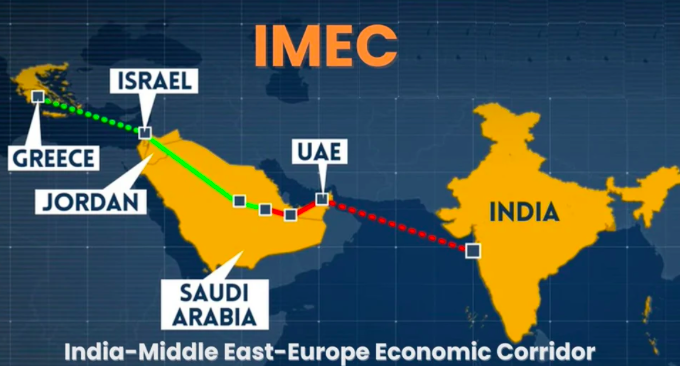
IMEC is designed around two distinct segments: an eastern corridor linking India to the Arabian Gulf by sea, and a northern corridor connecting the Gulf to Europe through rail and port infrastructure. Under the proposed route, cargo would move from Indian ports such as Mundra and Mumbai to Jebel Ali in the UAE, before travelling overland by rail through Saudi Arabia and Jordan to Israel’s Haifa port, from where it would be shipped onward to European destinations including Piraeus in Greece, Trieste in Italy, and Marseille in France. Beyond freight movement, IMEC envisages the laying of electricity interconnectors, a clean hydrogen pipeline, and high-speed digital cables, thereby positioning the corridor as an integrated energy, trade, and data network rather than merely a transport route. The corridor is expected to reduce transportation time by up to 40 percent, and logistics costs by around 30 percent compared to the existing maritime route through the Suez Canal, which currently handles approximately 12 percent of global trade. Since its launch, IMEC has received political endorsement at successive multilateral forums, including the 28th Conference of the Parties (COP28), the World Economic Forum, and Group of Seven (G7) and G20 meetings, as well as during the Modi-Trump bilateral summit held in Washington in February 2025, where US President Donald Trump described IMEC as one of the greatest trade routes in history.
Strategic Rationale for India
For India, IMEC is best understood not as a rivalry with China but as a risk-management strategy aimed at diversifying trade routes and strengthening economic security. The EU remains among India’s top three trading partners, accounting for over 12 percent of India’s merchandise trade, yet this trade flow depends almost entirely on the Red Sea-Suez Canal corridor. The vulnerability of this route was demonstrated in March 2021, when a large container vessel ran aground and blocked the Suez Canal for nearly a week, disrupting a significant share of global trade. The Red Sea crisis of 2023-24, triggered by Houthi attacks on commercial shipping, forced major carriers to reroute vessels around the Cape of Good Hope, adding roughly 3,500 nautical miles and about a week of transit time, while raising fuel costs, insurance premiums, and delivery uncertainty for Indian exporters. Against this backdrop, IMEC offers India a portfolio approach to trade connectivity, combining maritime transport, high-speed rail, and integrated port networks to link India with the Gulf and onward to Europe. A functioning corridor would support India’s ambition to move up the global value chain, with India serving as a manufacturing and services base, the Gulf functioning as a logistics and capital hub, and Europe providing technology, standards, and demand. It would also align with domestic logistics initiatives such as Gati Shakti and Sagarmala, and support India’s west coast ports in achieving higher throughput and global cost benchmarks.
Infrastructure and Financing Status
On the ground, IMEC remains largely in the planning and feasibility stage, with no corridor-specific construction of the missing rail links yet underway, although individual national infrastructure projects such as Gulf port expansions and Saudi rail development continue independently of the corridor framework. Estimates of the total investment required for IMEC vary widely across studies, ranging from a conservative estimate of about US$ 20 billion for the initial rail and connectivity components to a broader estimate exceeding US$ 500 billion when energy, digital, and port modernisation components are included. A related initiative already under way is the Blue Raman submarine cable project, being developed with participation from Omantel, Sparkle, and Google, which is expected to strengthen the corridor’s digital connectivity backbone. On the energy side, an undersea electricity cable linking India and the UAE has been estimated at around US$ 12 billion and is intended to enable real-time renewable energy trading between the two grids. Despite these individual components, a dedicated IMEC financing structure has yet to be materialized. Unlike China’s BRI, which channels centralized financing through state-owned banks, IMEC remains, as of mid-2026, a collection of memoranda of understanding without specific dollar commitments attached. India has not allocated dedicated funds for the corridor, the EU continues to speak of partnerships in general terms, and the US has not committed resources specifically to IMEC outside the broader Partnership for Global Infrastructure and Investment (PGII), which itself is spread across dozens of global projects. Saudi Arabia and the UAE, meanwhile, remain focused on financing their own domestic transformation programmes, such as Saudi Arabia’s Vision 2030, even as they continue to maintain economic ties with China. Proposals for an IMEC Infrastructure Fund, IMEC Green Bonds, and blended finance models involving sovereign wealth funds such as Saudi Arabia’s Public Investment Fund (PIF) and Abu Dhabi’s Abu Dhabi Investment Authority (ADIA), the World Bank, and the Asian Development Bank (ADB) have been discussed but not yet operationalized.
Geopolitical Headwinds
IMEC’s most immediate challenge is geography, since its route passes through some of the most volatile regions in the world. The corridor’s Israeli segment, centred on the port of Haifa, has been directly affected by the conflict in the Gaza Strip, and although a ceasefire is currently in place, the underlying tensions between Israel and Iran-backed groups in the region remain unresolved. These tensions escalated further in 2026 with a US-Israeli military confrontation with Iran that placed the Strait of Hormuz under considerable strain, before a temporary ceasefire was reached in April 2026. This episode underscored both the vulnerability of the Gulf shipping lanes and the potential value of an overland alternative such as IMEC for goods including sulfur and phosphate used in fertilizer production. Iran continues to view IMEC as a strategic encirclement effort, given the corridor’s implicit alignment with the US and Israel and retains the demonstrated capability to disrupt shipping through the Strait of Hormuz and the Gulf of Aden. In addition, Turkey has objected to its exclusion from IMEC, with President Recep Tayyip Erdogan stating that there can be no such corridor without Turkey’s inclusion. Ankara has instead promoted the rival Iraq Development Road, a route running from Iraq’s planned Grand Faw Port through Iraq and Turkey to Europe, though this alternative faces its own difficulties, including Baghdad’s limited bureaucratic capacity and outdated, single-track rail links on the Turkish side. Egypt, too, has an interest in the outcome of IMEC, since the corridor represents a potential long-term threat to the revenues generated by the Suez Canal, which together with Egypt’s Mediterranean and Red Sea ports handles close to 180 million tonnes of cargo annually.
Key Bottlenecks
Beyond geopolitics, IMEC faces concrete, logistical, and infrastructural bottlenecks. While Jebel Ali port in the UAE can handle around 90 million tons of cargo annually, Haifa’s capacity is limited to about 30 million tonnes, creating a significant mismatch along the very route that is supposed to bypass the Suez Canal. Unless Haifa’s capacity is substantially expanded, analysts note that IMEC cannot realistically serve as a large-scale alternative to the existing maritime corridor. Key railway links connecting the UAE, Saudi Arabia, Jordan, and Israel also remain incomplete, meaning that a genuinely seamless ship-to-rail transition does not yet exist. On the European side, the corridor’s three prospective terminal ports, Piraeus in Greece, Trieste in Italy, and Marseille in France, are engaged in a quiet competition to become the primary European gateway for IMEC traffic, a rivalry that has slowed the emergence of a unified European position. This competition carries an added irony, since the port of Piraeus, geographically the most logical Mediterranean entry point, is 67 percent owned by COSCO Shipping, a Chinese state-owned company, raising questions about how a corridor conceived partly as an alternative to Chinese-linked infrastructure can rely on a terminal controlled by Beijing. Taken together, these bottlenecks illustrate why, notwithstanding strong diplomatic backing, IMEC has yet to translate into physical construction of the missing links that would make the corridor operational.
Recent Developments
Despite the financing and security challenges, momentum around IMEC has not disappeared. Union Minister of Commerce and Industry Piyush Goyal has continued to describe India as a trusted bridge of global connectivity through IMEC, projecting that the corridor could reduce logistics costs by up to 30 percent and transportation time by up to 40 percent once operational. Italy has positioned Trieste as its preferred logistics hub and has held conferences examining the corridor’s strategic value for its broader Indo-Pacific outreach, while France continues to promote Marseille as a crucial portal linking India, the Middle East, and Europe across a proposed route of approximately 6,400 kilometers. Separately, the prospect of an EU-India free trade agreement, if concluded, is projected by some estimates to boost bilateral trade by between 41 and 65 percent, a substantial share of which could eventually be routed through IMEC once infrastructure is in place. Working groups involving the signatory nations have reportedly been established to examine technical, regulatory, and financing questions, even though no binding legislation or firm construction timeline had been finalized as of mid-2026. In the US Congress, an adjacent initiative, the Eastern Mediterranean Gateway Act, has been introduced to strengthen American energy and defense ties with Greece, Cyprus, Israel, and Egypt, reflecting continued, if indirect, legislative interest in the broader Eastern Mediterranean connectivity space that overlaps with IMEC’s northern corridor. Several analysts now regard 2026 and 2027 as a decisive window in which the corridor’s strategic logic, reinforced by the disruptions around the Strait of Hormuz, will either translate into concrete financing and construction commitments or see the initiative continue to lag its original ambitions.
Path Ahead
For IMEC to move from a diplomatic aspiration to an operating trade corridor, several steps appear necessary. First, participating nations need to agree on a clear financing framework that specifies contributions from sovereign wealth funds, multilateral development banks, and private investors, since the current reliance on general statements of partnership has not translated into committed capital. Second, the missing railway links between the UAE, Saudi Arabia, Jordan, and Israel need to be constructed, and Haifa’s port capacity expanded, to remove the most immediate physical bottleneck along the eastern segment of the corridor. Third, a coordinating institutional mechanism, potentially in the form of an IMEC Secretariat or Economic Forum involving India, the EU, the Gulf Cooperation Council (GCC), and the US, would help align the competing interests of European terminal ports and ensure that regulatory and customs procedures are harmonized across jurisdictions. Finally, addressing the concerns of countries situated near but outside the corridor, including Turkey and Egypt, through dialogue and possible complementary linkages, could reduce the risk of competing corridors undermining IMEC’s long-term viability. Whether these steps materialize will depend heavily on how the security situation in the Gulf and the Eastern Mediterranean evolves over the coming months.
Conclusion
Nearly three years since its launch, IMEC remains a project defined more by diplomatic intent than by physical infrastructure. Its underlying economic logic, offering India and Europe an alternative to an overstretched Suez Canal route and reducing dependence on volatile Gulf chokepoints, continues to hold strategic appeal, particularly considering recurring disruptions to Red Sea and Strait of Hormuz shipping. At the same time, the absence of a dedicated financing mechanism, the incomplete state of key rail and port links, and the corridor’s exposure to conflict in Israel, Gaza, and the wider Gulf region mean that IMEC’s transformation into a fully functioning trade route is far from assured. The period ahead, widely seen as a decisive window for the initiative, will indicate whether IMEC can move beyond memoranda of understanding and diplomatic statements to deliver the ports, railways, and financing structures required to make it a genuine alternative artery of global trade.



