
By : Simran Sodhi, Guest Author, GSDN
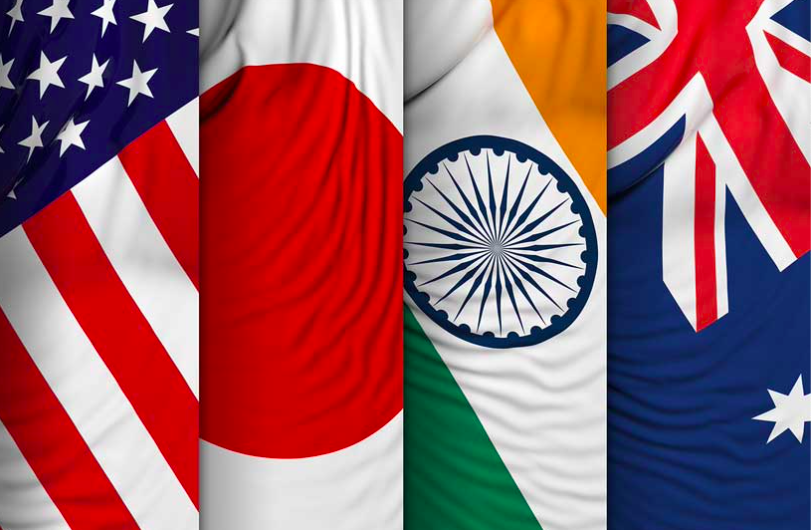
In May of this year, the foreign ministers of the Quad (Quadrilateral Security Dialogue alliance) met in Delhi. The meeting was closely observed as many analysts debate the future of the Quad under Trump 2.0. The Quad Leaders’ Summit, which was due in 2025, has yet to materialize. Further, United States President Donald Trump’s visit to China in May also made it clear that the US is not seeking any confrontation with China. Trump appeared conciliatory in Beijing which brings us to the question as to what is the future of an alliance that was supposed to counterbalance China in the Indo-Pacific. That was never the official status of the grouping but rather the much-understood pact among the four.
In Delhi, the foreign ministers of India, Japan and Australia and the US Secretary of State met and in their press statements later, they announced several areas in which the grouping intends to focus. A decision was taken to launch a new initiative to boost port infrastructure in the Pacific Islands. The first project under this initiative will be to build a port in Fiji. The group members also agreed to expand the Indo-Pacific Partnership for Maritime Domain Awareness (IPMDA) initiative through the Information Fusion Centre for the Indian Ocean Region in Gurugram. India is set to host the second QUAD-at-Sea Ship Observer Mission, which was launched in 2025 at Guam. Further, new initiatives on maritime surveillance, energy security, and critical minerals were announced that showed the grouping’s shift toward strategic cooperation. But there was no clarity when the next Quad Leaders’ Summit would take place.
The origins of the Quad go back to 2004, when the four countries coordinated humanitarian assistance after the Indian Ocean tsunami. In 2007, a more formal dialogue began but then it never really took off. In 2017, the Quad saw a revival and a more focused approach on the four nations coming together to create a counterbalance to China’s ambitions in the Indo-Pacific. There was a buzz that the Quad was going to be an Asian NATO, but again it’s an idea that never really went further.
There was a real fear that the grouping might fall apart when the US changed from a Republican President to a Democrat one. The transition from Trump 1.0 to Joe Biden had many speculate on how that change would affect the Quad. But the Biden administration strengthened the Quad. His administration participated in not only the first in-person summit in 2021 but also in five more summits, including two virtual ones. The Biden administration also pledged to have the Quad play a “defining role in the region” which in effect meant keeping China in check in the Indo-Pacific.
However, what has impacted the Quad the most has been the tenure of Trump 2.0. The US President has unleashed his own vision of global affairs and priority areas. There is also a very distinct sense that the US, under Trump 2.0, does not want to compete with China. During his China visit in May, the focus was on building a “constructive relationship of strategic stability”. Trade was top of the agenda despite the ongoing tensions in the Middle East. China remains a major market for the US, but red tape and regulations act as major obstacles. But during the visit, the Chinese leader Xi Jinping told US business leaders that China’s “doors will open wider” and that American firms would have “broader prospects” in the Chinese market, according to news site Xinhua.
The real question then is that if the US is seeking a closer relationship with China under Trump 2.0, as was displayed by both sides during Trump’s visit, where does it leave the Quad? One can safely say that at this point of time the significance of the Quad has been diminished. The no-commitment by the US to hold a Quad Leaders’ Summit and the movement of the US to co-operate and not compete with China, are clear indications that the Quad will have to operate on low priority now.
For India, this is bad news. The India-US story has been riddled with tensions under Trump 2.0, and the highlights have been tariffs and insults. Quad, for India, was a grouping where India was a major player and the US was betting on it to counter the rise of an ambitious China. However, the script seems to have undergone a change in Washington, DC. And the Quad members have no choice but to play with the new script. While it would be incorrect to write off the Quad, it would be equally incorrect to overstate its importance today.



