
By : Prof (Dr.) M. L Meena and Ravi Dass Bishnoi
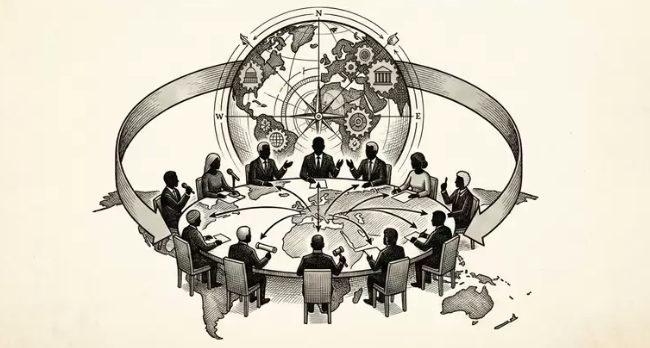
There is a distinction, rarely made in mainstream commentary but essential to understanding the present, especially geopolitical moment, between possessing power and being able to exercise it purposefully. The political sociologist Michael Mann spent much of his career separating what he called despotic power, the state’s capacity to act unilaterally and coercively, from structural power, which is the state’s ability to penetrate civil society and implement its decisions across territory. The most dangerous political condition, Mann argued, is not a weakness. It is the combination of high despotic capacity with declining infrastructural reach, a state that can threaten everything and deliver very little.
The United States currently spends one trillion dollars annually on its military, a record figure, with the Trump administration now proposing to raise that to $1.5 trillion for 2027, a 44 percent increase that the White House itself describes as approaching the historic levels of the build-up before the Second World War. And yet: since early March, Iranian forces have declared the Strait of Hormuz closed and carried out over a dozen attacks on ships attempting transit, while Washington’s ultimatums expired, its deadlines passed, and oil prices rose nearly 50 percent over March alone, one of the steepest monthly rallies on record. The despotic capacity is staggering. The infrastructural reach means the ability to translate that capacity into a durable, stable outcome is visibly deteriorating. This is not a military failure in the conventional sense. It is a structural one, and the distinction matters enormously for how we think about what comes next.
The political scientists Henry Farrell and Abraham Newman identified the conceptual skeleton of this problem several years ago, though the world has taken considerably longer to feel its full weight. Their theory of weaponized interdependence describes how states can leverage asymmetrical positions within global economic networks to coerce other actors and how the very structures that liberals believed would foster peace can be repurposed for coercive ends. The insight was sharp, but it was written primarily from the perspective of great powers the United States using its dominance over global financial clearing systems and semiconductor supply chains to punish rivals. What today has demonstrated, with brutal clarity, is that the logic runs in every direction simultaneously. Iran does not control SWIFT. It does not manufacture semiconductors. It cannot project conventional military force beyond its immediate region. What it does control is 33 kilometres of water through which one-fifth of global oil passes. As one recent analysis put it, conflict in international relations increasingly takes the form of war by any means other than war, in which state and non-state actors use civilian infrastructure, logistics networks, and economic dependencies as levers of coercive power. The Houthis grasped the same geography. A militia with no navy, no air force, and no industrial base understood that the Bab-el-Mandeb strait, the narrow passage between Yemen and Djibouti, was not merely a waterway. It was a structural vulnerability in the global economy, waiting to be exploited by anyone with the will to do so and nothing left to lose.
This is where the popular concept of the polycrisis, associated most prominently with the economic historian Adam Tooze, requires both acknowledgement and serious qualification. Tooze’s formulation that we are living through interconnected crises whose combined impact exceeds the sum of their parts, is descriptively accurate as far as it goes. But a recent critical reading argues that the concept replaces structural explanations with a profusion of empirical data, perceiving events from the implicit standpoint of the managerial state and implying a political programme based on stabilizing existing social relations rather than transforming them. That critique carries weight. Calling everything a polycrisis risks producing a sophisticated vocabulary for helplessness, a way of naming the problem that simultaneously forecloses the question of who built the systems that are now failing, and in whose interest those systems were constructed. The crises of the current geopolitical scenario are not falling from the sky. They have architects. They have beneficiaries. And they have geography.
That geography is the part of this debate that receives the least analytical attention, and it is precisely where the most consequential dynamics are unfolding. The global economy has been constructed, over several decades, around a small number of physical chokepoints whose disruption produces cascading effects entirely disproportionate to the military significance of the actors controlling them. The Strait of Hormuz. The Bab-el-Mandeb. The Taiwan Strait, through which over 60 percent of the world’s semiconductors transit. The South China Sea, over which roughly a third of global maritime trade passes annually. The Lombok and Malacca straits are the underwater cable corridors of the Indo-Pacific. These are not abstract strategic concepts. They are specific coordinates on a map, and the states and non-state actors positioned nearest to them wield leverage that bears no relationship to their GDP or their defence budgets. The liberal international order was not designed with this geography in mind. It was designed in 1944 and 1945 by people whose principal concern was avoiding another European war, and whose conception of global economic governance reflected the industrial and maritime realities of that moment. The world has since reorganized itself around different latitudes and different chokepoints, while institutional architecture has remained largely unchanged.
The United States–China competition illuminates this mismatch with clarity. The conventional framing, a rising power challenging a dominant one, is too tidy to be useful. What is unfolding is a contest over who gets to design the next layer of global infrastructure: not the physical infrastructure of the 20th century, canals and railways and oil pipelines, but the computational infrastructure of the 21st century. Semiconductor fabrication. Artificial intelligence training architecture. Undersea data cables. Cloud computing topology. Rare-earth processing supply chains concentrated in southern China and the lithium triangle of South America. The concentration of nearly 90 percent of advanced semiconductor manufacturing in Taiwan creates a high dependence that shapes not just commercial calculations but sovereign strategic decisions across the entire world. Washington’s chip export restrictions are, at one level, a trade measure. At another level, they are an attempt to freeze the architecture of computational power in a configuration favorable to the United States before China can build around it. Beijing understands this, which is why its response has been a national mobilization that treats cost as essentially secondary, because the alternative is to allow a rival to control the infrastructure through which future military systems, economic productivity, and political influence will all flow. Neither side is miscalculating. Both are responding to the same structural reality with the tools at their disposal. What neither side has adequately reckoned with is that this competition, conducted without institutional guardrails, is actively destroying the interdependence that made both countries rich.
There is a new intellectual debate emerging at the edges of this conversation that deserves to be brought to the centre. It concerns not just who holds power, but who designs the systems through which power moves, and whether, in a world of AI-accelerated decision-making, that distinction between the architects of order and the inhabitants of order is becoming the fundamental political question of the century. The Cold War had a stabilizing logic built into its technology. Verifying a missile signature took time. Assessing intelligence took time. Negotiating a backdown took time. Those hours and days were not inefficiencies; they were the margin of error within which human judgment could intervene before miscalculation became catastrophe. AI-integrated targeting systems, autonomous cyber operations, and algorithmic early-warning networks are progressively eliminating that margin. But the deeper issue is more unsettling still: as AI systems take on more of the work of intelligence assessment and strategic recommendation, the question of whose values, whose threat models, and whose historical assumptions are encoded into those systems becomes a geopolitical question of the first order. An AI trained predominantly on American strategic doctrine will not assess a Chinese naval movement the same way an AI trained on Chinese strategic doctrine will assess an American one. The crisis that results may have no human author, in any meaningful sense. That is a new kind of danger, and the existing vocabulary of deterrence theory is not equipped to address it.
Beneath all of this, the part of the world that has the least representation in the institutions making these decisions bears the greatest cost of their dysfunction. Over 72,000 Palestinians have been killed in Gaza since October 2023, among them more than 21,000 children, with nearly 90 percent of the strip’s water and sanitation infrastructure destroyed or damaged. Meanwhile, against the backdrop of energy and food price surges flowing directly from the Hormuz conflict, the IMF’s Spring Meetings this April produced recommendations that civil society groups across the Global South described as entrenching a cycle of debt distress and austerity rather than addressing the structural crisis. Official Development Assistance was cut by almost 25 percent, the steepest drop in recent history, while Washington proposed a defence budget of $1.5 trillion. The arithmetic of these choices is not accidental. It reflects a global order in which the costs of geopolitical competition are socialised downward and outward, onto the populations with the least institutional voice, while the benefits of the systems being competed over remain concentrated at the top.
The question worth sitting with is not whether the international order is in crisis. It visibly is. The more important question is whether the frameworks we are using to understand that crisis are adequate to its depth. Calling it a polycrisis names the complexity without explaining the causation. Calling it a new Cold War imports a bipolar clarity that does not exist. Calling it multipolarity implies an orderly distribution of influence that the evidence does not support. What we are witnessing is something older and more uncomfortable: a confrontation between the world as it was institutionally designed and the world as it has physically and technologically become. The institutions were built for a particular geography of power. That geography has shifted. The institutions do not have any.
Author



