
By:Khushbu Ahlawat, Consulting Editor, GSDN
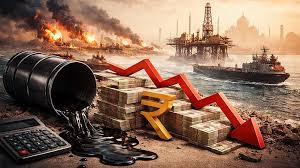
Energy Disruptions and India’s Structural Vulnerability
The ongoing geopolitical instability in West Asia, layered atop the prolonged Russia-Ukraine conflict, has once again exposed the fragility of the global economic system. For India, a major energy importer with deep economic linkages to the region, the crisis presents a complex mix of inflationary pressures, fiscal strain, and external sector vulnerabilities. While temporary ceasefires may offer short-term relief, the structural risks to India’s economy remain significant and far-reaching.
At the heart of the disruption lies energy security. The conflict has severely impacted the production, storage, and transportation of crude oil, natural gas, and fertilizers. A particularly alarming concern is the potential blockade of the Strait of Hormuz, a critical maritime chokepoint through which a significant portion of global oil supplies transit. Any sustained disruption here would sharply constrain supply, pushing global crude prices upward. Although Brent crude prices briefly moderated from $109.3 to around $95 per barrel following a ceasefire, volatility persists. India, which imports crude oil from over 41 countries and depends on imports for nearly 90% of its needs, remains acutely exposed.
Even as India diversifies its energy sources, the pricing mechanism—linked to global benchmarks like Brent and Dubai crude—means domestic costs remain vulnerable to international fluctuations. As of March 2026, India’s crude basket was nearly 19% higher than global averages, reflecting structural inefficiencies and freight costs. Although prices have eased slightly, they remain elevated compared to pre-crisis levels, sustaining pressure on inflation and trade balances.
Transmission Channels: Supply Chains, Industry, and Trade Pressures
The economic impact unfolds through multiple transmission channels. Supply-side disruptions are expected to hit energy-intensive industries first, including fertilizers, chemicals, cement, textiles, and paints. The unavailability of key inputs such as fertilizers could severely impact agricultural output during the Kharif season, which begins in June. This, in turn, risks creating a secondary inflationary spiral through rising food prices.
Beyond immediate macroeconomic pressures, the West Asian crisis also has deeper structural and sector-specific implications for India’s growth engine. The energy-intensive manufacturing sector, which contributes nearly 17% to India’s GDP, is particularly vulnerable to sustained high input costs. Industries such as steel, cement, and chemicals operate on thin margins, and a prolonged rise in energy prices could compress profitability by 200–300 basis points, forcing firms to either pass on costs to consumers or cut production. This, in turn, could slow industrial output growth, which had been projected at around 6–7% annually. The aviation sector is another major casualty, as Aviation Turbine Fuel (ATF) constitutes nearly 40% of operating costs for airlines; even a 10% increase in ATF prices can significantly erode airline margins, leading to higher ticket prices and reduced passenger demand.
The fertilizer sector presents a critical policy concern. India’s fertilizer subsidy bill already exceeded ₹1.75 lakh crore in FY2024–25, and with global prices of key inputs like urea, ammonia, and potash rising sharply due to supply disruptions, the subsidy burden could escalate further. This not only strains fiscal resources but also risks supply shortages during peak agricultural seasons. Given that agriculture employs nearly 42% of India’s workforce and contributes about 15–16% to GDP, any disruption in input availability could have widespread socio-economic consequences, particularly in rural areas.
The banking and financial sector may also experience second-order effects. Rising inflation and interest rates could dampen credit demand, while sectors under stress—such as MSMEs and transport—may face higher default risks. Non-performing assets (NPAs), which had been declining in recent years, could see an uptick if economic conditions worsen. Additionally, higher government borrowing to finance fiscal deficits could crowd out private investment, slowing capital formation at a time when India needs sustained investment to maintain its growth momentum.
From an energy transition perspective, the crisis paradoxically reinforces both risks and opportunities. While high fossil fuel prices increase the urgency of shifting toward renewable energy, they also raise the cost of transition in the short term due to higher input and financing costs. India’s renewable energy targets—500 GW of non-fossil fuel capacity by 2030—require massive investments, and global financial volatility could delay capital inflows into this sector. However, in the medium to long term, persistent geopolitical instability in oil-producing regions may accelerate policy focus on domestic energy security through solar, wind, and green hydrogen initiatives.
Moreover, the geopolitical dimension of the crisis could reshape India’s trade and strategic partnerships. Efforts to diversify crude sourcing toward countries like the United States, Russia, and Latin American producers may intensify, but such shifts often come with higher logistics costs and longer supply chains. Strategic petroleum reserves, currently sufficient for about 9–10 days of consumption, may need expansion to enhance energy security. Simultaneously, India’s diplomatic balancing in West Asia will become more critical, as economic interests increasingly intersect with geopolitical alignments.
Taken together, these sectoral and structural dynamics indicate that the West Asian crisis is not just a cyclical disruption but a catalyst that could reshape India’s economic priorities. The interplay between energy costs, industrial performance, fiscal stability, and strategic policy choices will ultimately determine how resilient India remains in the face of prolonged global uncertainty.
Logistics is another critical pressure point. With storage and transportation costs rising due to fuel price hikes, the cost of final goods is expected to increase across sectors. This cascading effect will reduce consumer purchasing power and dampen overall demand. Simultaneously, Indian exports face a dual challenge—weak demand from West Asia and a broader slowdown in major economies like the United States and Europe. Although the depreciation of the rupee may offer some export competitiveness, it is unlikely to fully offset the contraction in global demand. Another critical dimension is the impact on household consumption and demand patterns. Rising fuel prices directly affect transportation and electricity costs, leaving households with reduced disposable income. According to recent consumption surveys, urban households in India already spend nearly 8–10% of their monthly budget on fuel and energy-related expenses, a figure that could rise significantly under prolonged price stress. Rural households, more dependent on diesel for irrigation and transport, face disproportionate burdens. This demand compression could slow private consumption growth—one of the key drivers contributing nearly 55–60% of India’s GDP—thereby amplifying the broader economic slowdown.
Currency Volatility, Inflation, and External Sector Stress
Currency dynamics add another layer of complexity. The Indian rupee has been under depreciation pressure, exacerbated by rising crude prices and capital outflows driven by global uncertainty. Foreign Portfolio Investment (FPI) outflows reached approximately $13.6 billion in March 2026 alone, reflecting investor nervousness. A weaker rupee increases the cost of imports, particularly energy, further widening the current account deficit. Additionally, remittances from Indian workers in Gulf countries—an important source of foreign exchange—could decline if economic conditions in those countries worsen.
A closer examination of recent macroeconomic indicators reveals the scale and immediacy of the economic risks facing India due to the West Asian crisis. India imports nearly 85–90% of its crude oil requirements, and according to petroleum ministry data, over 60% of these imports are sourced from West Asian countries such as Iraq, Saudi Arabia, and the UAE. In FY2024–25, India’s crude import bill stood at approximately $158 billion, and even a $10 per barrel increase in global crude prices can inflate this bill by nearly $15 billion annually. As of April 2026, the Indian crude basket has hovered above $120 per barrel—significantly higher than the budgeted assumption of around $70–75—implying a substantial deviation that could widen the current account deficit (CAD) beyond the safe threshold of 2% of GDP to nearly 3% or higher. This external imbalance is further compounded by weakening export performance; India’s merchandise exports, which grew modestly in 2024, are now projected to slow due to declining demand from key markets, including West Asia, which accounted for 16.4% of India’s exports in 2024–25.
On the inflation front, empirical estimates by the Reserve Bank of India suggest that a 10% increase in crude oil prices leads to a 30–40 basis point rise in headline inflation. With global crude prices already up by over 50% from baseline assumptions, retail inflation could rise by more than 2 percentage points if the trend persists. Food inflation, in particular, remains vulnerable due to rising fertilizer prices—India imports nearly 50% of its fertilizer needs—and any supply disruption could affect agricultural output during the Kharif season, which contributes significantly to annual food grain production. Additionally, logistics costs in India, already high at around 13–14% of GDP compared to the global average of 8–10%, are expected to increase further due to elevated fuel prices, thereby reducing competitiveness across manufacturing sectors.
Financial markets are also reflecting growing uncertainty. Foreign Portfolio Investors (FPIs) have withdrawn over $13.6 billion in March 2026 alone, exerting downward pressure on the Indian rupee, which has depreciated beyond ₹84–85 per US dollar in recent weeks. A weaker currency not only raises the cost of imports but also increases the burden of external debt servicing. Meanwhile, remittances—India received over $125 billion in 2025, with a large share coming from Gulf countries—could face downside risks if economic conditions in host countries deteriorate due to prolonged instability.
From a fiscal perspective, the government faces a delicate balancing act. Fuel tax revenues, which contribute significantly to the exchequer, may decline if excise duties are cut to contain inflation. Estimates suggest that a ₹1 per litre cut in fuel taxes can result in a revenue loss of approximately ₹13,000–15,000 crore annually. Combined with rising subsidy requirements for fertilizers and LPG, the fiscal deficit—budgeted at 5.1% of GDP—could face upward pressure. Collectively, these data points highlight that the West Asian crisis is not merely a transient external shock but a multi-dimensional economic challenge with deep and measurable implications for India’s macroeconomic stability.
Inflation remains one of the most immediate concerns. Rising fuel and fertilizer costs directly contribute to cost-push inflation. If global oil prices remain elevated, domestic inflation could surge significantly. Estimates suggest that every $7 per barrel increase in crude prices could reduce India’s real GDP growth by around 15 basis points. With current prices exceeding baseline assumptions by nearly $50 per barrel, the cumulative impact on growth and inflation could be substantial.
The current account deficit is also likely to expand. As import bills rise due to higher crude prices and exports weaken, India’s external balance will come under stress. This could further destabilize the rupee and create a feedback loop of inflation and capital outflows. The Reserve Bank of India may face difficult policy trade-offs between controlling inflation and supporting growth.
Fiscal Pressures and Policy Response Challenges
The fiscal implications are equally concerning. To shield consumers from rising fuel costs, the government may be compelled to increase subsidies for petroleum products and fertilizers. While reducing excise duties on fuel can offer temporary relief, it also leads to significant revenue losses. Estimates indicate that the government could face an annual revenue loss of over ₹32,000 crore if the crisis persists. At the same time, states may be pressured to cut VAT on fuel, further straining their finances. This combination of higher expenditure and lower revenue risks widening the fiscal deficit.
Policy responses so far indicate a cautious balancing act. While the government has attempted to manage fuel prices through tax adjustments, the scope for further intervention is limited. Subsidy burdens are expected to exceed budget estimates, particularly if the crisis prolongs. At the same time, policymakers must ensure that inflation expectations remain anchored without excessively tightening liquidity, which could stifle growth.
Looking ahead, the trajectory of India’s economy will depend heavily on the duration and intensity of the West Asian crisis. A quick resolution could stabilize oil markets and ease macroeconomic pressures. However, a prolonged conflict risks embedding high inflation, slowing growth, and weakening fiscal and external balances.
In conclusion, the West Asian crisis is not merely a regional geopolitical issue—it is a systemic economic challenge for India. It underscores the urgent need for long-term strategies, including energy diversification, strengthening of strategic reserves, and enhanced resilience in supply chains. While short-term policy responses can mitigate immediate shocks, structural reforms will ultimately determine India’s ability to navigate such global disruptions and sustain its growth momentum.

About the Author
Khushbu Ahlawat is a research analyst with a strong academic background in International Relations and Political Science. She has undertaken research projects at Jawaharlal Nehru University, contributing to analytical work on international and regional security issues. Alongside her research experience, she has professional exposure to Human Resources, with involvement in talent acquisition and organizational operations. She holds a Master’s degree in International Relations from Christ University, Bangalore, and a Bachelor’s degree in Political Science from the University of Delhi.



