
By: Khushbu Ahlawat, Consulting Editor, GSDN
Introduction
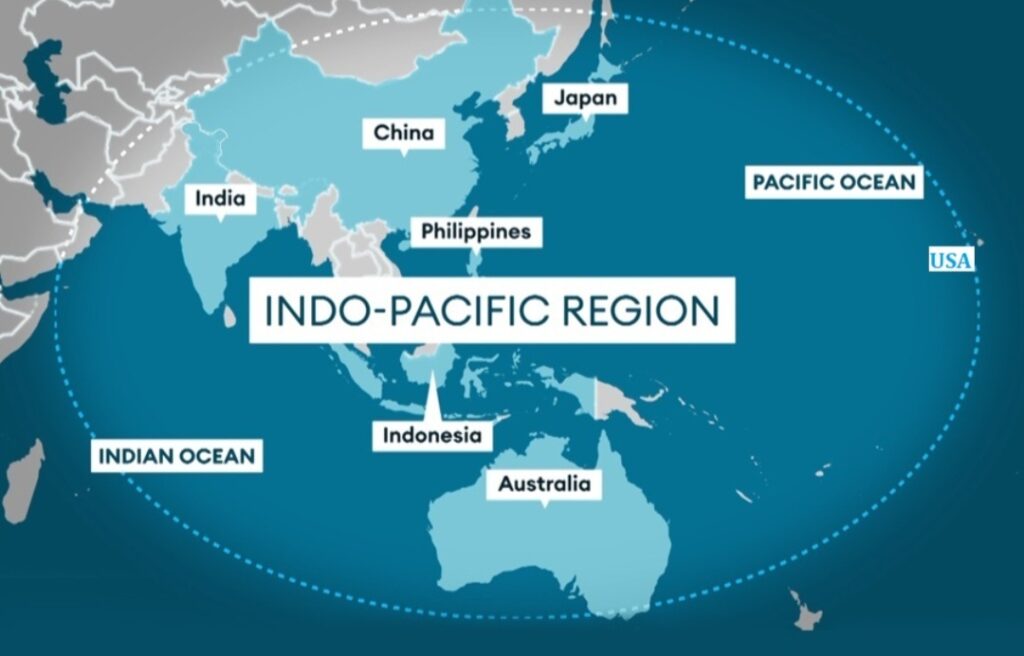
The Indo-Pacific has rapidly emerged as the epicenter of contemporary geopolitics, where economic interdependence intersects with intensifying strategic rivalry. Encompassing some of the world’s most critical maritime trade routes and fastest-growing economies, the region has become central to global stability and prosperity. Yet, this importance has also transformed it into a theatre of heightened tensions, largely driven by the expanding influence of China. China’s increasing military assertiveness, economic outreach, and geopolitical ambitions have reshaped the regional order, raising concerns about the erosion of long-standing norms governing sovereignty, navigation, and peaceful dispute resolution.
Recent developments underscore the urgency of these concerns. China’s intensified military activities around Taiwan, including frequent airspace incursions and naval drills, have heightened fears of potential conflict. Simultaneously, tensions in the South China Sea continue to escalate, with overlapping territorial claims and maritime confrontations becoming more frequent. Scholars such as John Mearsheimer argue through the lens of offensive realism that rising powers inevitably seek regional dominance, often clashing with established powers. This theoretical framework provides a compelling explanation for China’s assertive behavior and the counterbalancing strategies adopted by other Indo-Pacific actors.
China’s Strategic Expansion: Power, Presence, and Pressure
China’s strategic expansion in the Indo-Pacific is rooted in a long-term vision of national rejuvenation and global influence. Under the leadership of Xi Jinping, China has significantly accelerated its military modernization, with a particular emphasis on naval and missile capabilities. The People’s Liberation Army Navy (PLAN) has expanded both in size and technological sophistication, enabling China to project power far beyond its immediate coastal waters. This transformation reflects a shift from a traditionally land-focused military posture to one that prioritizes maritime dominance and expeditionary capabilities.
At the same time, China has pursued an assertive strategy in contested maritime regions, particularly the South China Sea. The construction and militarization of artificial islands have allowed Beijing to establish a quasi-permanent presence in disputed areas, effectively altering the status quo. Despite the 2016 ruling by the Permanent Court of Arbitration, which invalidated China’s expansive maritime claims, Beijing has continued to consolidate its position. Scholars such as Andrew Nathan describe this approach as “coercive gradualism,” where incremental actions cumulatively strengthen strategic control without provoking outright conflict.
Beyond traditional military expansion, China has increasingly relied on grey-zone tactics to advance its interests. These include the use of maritime militias, coast guard vessels, and economic coercion to pressure smaller states. Such tactics blur the line between peace and conflict, complicating the responses of regional actors. As noted by Thomas Schelling, coercion often operates most effectively in ambiguous spaces, where the threat of escalation is implicit rather than explicit. China’s ability to operate within this grey zone has enabled it to achieve strategic gains while minimizing the risk of direct confrontation.
Regional Responses: Balancing, Alliances, and Strategic Convergence
In response to China’s growing assertiveness, Indo-Pacific states have increasingly turned to balancing strategies, both individually and collectively. The United States has played a central role in this effort, reinforcing its military presence and strengthening alliances across the region. Its “Free and Open Indo-Pacific” strategy emphasizes the importance of maintaining open sea lanes, respecting international law, and preventing any single power from dominating the region. This strategy has been operationalized through expanded naval deployments, freedom of navigation operations in contested waters, and deeper defence cooperation with regional partners. At the same time, Washington has sought to integrate economic and technological initiatives into its strategic framework, recognizing that military power alone is insufficient to sustain long-term influence in the Indo-Pacific.
A key manifestation of this balancing effort is the Quadrilateral Security Dialogue, which brings together the United States, India, Japan, and Australia. While not a formal military alliance, the Quad represents a significant step towards strategic convergence among like-minded democracies. Joint naval exercises, enhanced intelligence sharing, and cooperation in emerging technologies have strengthened the group’s ability to respond to regional challenges. Scholars such as Stephen Walt argue that such balancing behavior is a natural response to perceived threats, as states seek to prevent the emergence of a regional hegemon. In recent years, the Quad has also expanded its agenda to include supply chain resilience, critical technologies, climate cooperation, and infrastructure development, thereby broadening its role beyond traditional security concerns and positioning itself as a comprehensive strategic platform.
In addition to the Quad, new security arrangements such as AUKUS have further reinforced deterrence capabilities in the Indo-Pacific. By enabling Australia to acquire nuclear-powered submarines, AUKUS significantly enhances its ability to operate in contested maritime environments. At the same time, regional powers such as Japan and India have adopted more proactive defence postures, increasing military spending and expanding their strategic partnerships. Japan’s shift towards acquiring counterstrike capabilities and revising its defence doctrine reflects a major shift in its post-war security posture, while India has intensified naval modernization and deepened engagements in the Indian Ocean region. These developments reflect a broader shift towards a more multipolar and networked security architecture in the Indo-Pacific, where overlapping partnerships, minilateral groupings, and flexible coalitions are increasingly shaping the regional balance of power.
Economic and Technological Contestation
The strategic competition in the Indo-Pacific extends far beyond military dynamics, encompassing economic and technological domains that are increasingly central to global power. China’s Belt and Road Initiative has played a pivotal role in expanding its influence, linking infrastructure development with strategic objectives. Through investments in ports, railways, and energy projects, China has established a network of economic dependencies that enhance its geopolitical leverage.
However, this expansion has not gone unchallenged. Concerns about debt sustainability, transparency, and sovereignty have prompted several countries to reassess their engagement with Chinese projects. In response, alternative initiatives led by the United States, India, and other partners aim to provide more transparent and sustainable development options. These competing frameworks highlight the growing importance of economic statecraft in shaping regional dynamics.
Technological competition has further intensified the rivalry, with emerging technologies becoming key determinants of strategic advantage. Areas such as artificial intelligence, quantum computing, and semiconductor production are increasingly viewed through a security lens. Scholars like Henry Farrell and Abraham Newman have conceptualized this phenomenon as “weaponized interdependence,” where states exploit global networks to achieve strategic objectives. In the Indo-Pacific context, this has led to efforts to secure supply chains, restrict technology transfers, and invest in domestic innovation capabilities.
Challenges in Containment: Complexity and Constraints
Despite the growing emphasis on balancing China’s influence, the concept of containment faces significant structural and strategic challenges. Unlike the Cold War-era Soviet Union, China is deeply integrated into the global economy, making comprehensive containment both impractical and economically disruptive. Many Indo-Pacific countries rely heavily on trade and investment with China, creating a complex web of interdependence that constrains their strategic choices. This economic entanglement limits the willingness of states to fully align against China, as doing so could jeopardize their domestic growth and stability. Moreover, global supply chains—particularly in manufacturing, rare earth minerals, and electronics—are closely linked to China, making economic decoupling both costly and logistically challenging.
Furthermore, regional diversity complicates the formation of a unified response. Organizations such as the Association of Southeast Asian Nations often prioritize neutrality and consensus, limiting their ability to take decisive action. This fragmentation reduces the effectiveness of collective strategies and allows China to engage with countries on a bilateral basis, leveraging asymmetries in power and influence. Additionally, differing threat perceptions among Indo-Pacific states further weaken cohesion; while some countries view China as an immediate security concern, others prioritize economic cooperation and strategic hedging, resulting in an inconsistent regional approach.
Another critical challenge is the risk of escalation. The increasing frequency of military encounters in contested areas, combined with rising strategic mistrust, raises the possibility of miscalculation. The Taiwan Strait remains a particularly volatile flashpoint, where any escalation could have far-reaching consequences for regional and global stability. As Barry Buzan notes, security dynamics in interconnected regions are inherently complex, with localized conflicts having the potential to trigger broader systemic crises. In addition, the absence of robust crisis management mechanisms and effective communication channels between major powers exacerbates the risk of unintended escalation. The presence of advanced military technologies, including hypersonic weapons and cyber capabilities, further compresses decision-making timelines, increasing the likelihood of rapid and potentially uncontrollable conflict escalation.
Maritime Strategy and Normative Contestation in the Indo-Pacific
A crucial yet often underexplored dimension of the Indo-Pacific contestation lies in the domain of maritime strategy and control over critical sea lines of communication (SLOCs). The Indo-Pacific hosts some of the world’s most vital chokepoints, including the Strait of Malacca, the Lombok Strait, and the South China Sea, through which a substantial portion of global trade and energy supplies transit. China’s growing naval presence and its investments in dual-use port infrastructure across the region reflect a calculated effort to secure these maritime routes while simultaneously expanding its strategic footprint. Scholars such as Alfred Thayer Mahan long ago emphasized that control of sea power is central to global dominance, a notion that continues to resonate in contemporary strategic thinking. China’s development of a “string of pearls”—a network of ports and logistical hubs stretching from the South China Sea to the Indian Ocean—illustrates this maritime ambition. Facilities in Gwadar, Hambantota, and Djibouti, while often framed as commercial ventures, possess clear strategic implications, enabling China to sustain naval operations far from its shores. This expansion has raised concerns among regional powers, particularly India, which views the Indian Ocean as a critical sphere of influence. Consequently, maritime competition has intensified, with increased naval deployments, joint exercises, and investments in maritime domain awareness becoming central features of Indo-Pacific security dynamics.
Simultaneously, the ideological and normative dimensions of China’s rise have added another layer of complexity to the Indo-Pacific strategic environment. Beyond material power, China seeks to shape regional norms and governance structures in ways that reflect its political system and strategic preferences. Initiatives such as the Belt and Road are not merely economic projects but also instruments for projecting influence and shaping development models. Scholars like Yan Xuetong argue that China’s approach represents a form of “moral realism,” where leadership is achieved not only through power but also through the ability to provide public goods and stability. However, critics contend that China’s model often prioritizes state sovereignty over liberal norms such as transparency, accountability, and human rights, thereby challenging the existing liberal international order. This normative contestation is evident in regional institutions, where competing visions of governance and order are increasingly apparent. The Indo-Pacific thus becomes not only a battleground of strategic competition but also a space of ideological contestation, where different models of political and economic organization vie for legitimacy. This dual competition—material and normative—complicates efforts at containment, as it requires not only military and economic responses but also the articulation of a compelling alternative vision for regional order that can attract and sustain the support of diverse states.
Conclusion
The Indo-Pacific stands at a decisive moment, where the interplay of power, ambition, and interdependence will shape the future of global order. China’s strategic expansion has fundamentally altered the region’s security landscape, prompting a range of responses from major and middle powers. While balancing strategies, alliances, and technological investments have emerged as key tools for managing this challenge, they remain constrained by economic realities and the risks of escalation.
Moving forward, a sustainable approach to managing the Indo-Pacific flashpoint requires a shift from simplistic notions of containment to a more nuanced framework of competitive coexistence. This approach emphasizes the importance of combining deterrence with engagement, strengthening regional institutions, and upholding international norms. It also requires recognizing the limits of confrontation and the potential for cooperation in areas such as climate change, trade, and global governance.
Ultimately, the goal should not be to exclude or isolate China, but to ensure that its rise occurs within a framework that respects the principles of sovereignty, transparency, and mutual respect. By fostering a balanced and inclusive regional order, Indo-Pacific states can mitigate the risks of conflict while preserving the conditions necessary for long-term stability and prosperity.

About the Author
Khushbu Ahlawat is a research analyst with a strong academic background in International Relations and Political Science. She has undertaken research projects at Jawaharlal Nehru University, contributing to analytical work on international and regional security issues. Alongside her research experience, she has professional exposure to Human Resources, with involvement in talent acquisition and organizational operations. She holds a Master’s degree in International Relations from Christ University, Bangalore, and a Bachelor’s degree in Political Science from the University of Delhi.



