
By: Anusreeta Dutta
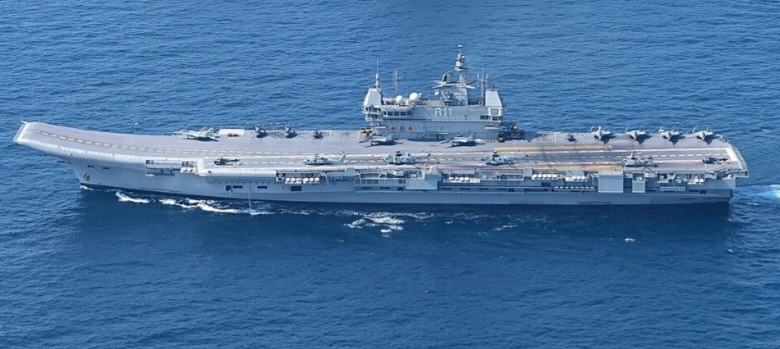
INS Vikrant has had a bigger effect on India’s maritime imagination than most other ships. Vikrant, which the Indian Navy bought from Britain and turned into a Majestic-class carrier in 1961, was more than just a new ship. It became a strategic tool that changed the balance of power in the Indian Ocean, especially during the 1971 war that led to the creation of Bangladesh.
The name lives on in the INS Vikrant, India’s first aircraft carrier built in India. There is a story about changing doctrine, industrial ambition, and strategic independence, as well as naval gear, between these two ships.
The Beginning of a Maritime Vision
Vikrant (R11) went into service while India was still working on its security policy. The trauma of 1962 had shown weaknesses on land, but India’s geography—being a peninsula and sitting on important sea lanes—meant that the focus had to be on the sea. Aircraft carriers gave us reach, a way to scare off enemies, and the ability to change plans.
Most postcolonial governments had trouble keeping their navies up and running, but India’s decision to run a carrier showed that it wanted to do more than just protect its coastline; it wanted to project power throughout the Indian Ocean. Vikrant had a lot of mechanical problems in its early years, like boiler problems that slowed it down for a short time. Still, these limits didn’t make it any less important strategically. It was clear by the end of the 1960s that Vikrant would soon be in trouble.
The Eastern Theatre
In 1971, during the Indo-Pakistani War, Vikrant was sent to the Bay of Bengal to block East Pakistan’s navy. Vikrant was very important in the east, even though speed limits kept it from working in the west. Its Sea Hawk fighter jets attacked ports like Chittagong, Cox’s Bazar, and Khulna, cutting off supply lines and leaving Pakistani troops alone.
The psychological side was just as important as the tactical side. The fact that a carrier was off the east coast showed that the navy was better than the rest. The Pakistani navy knew what Vikrant was up to and sent the submarine PNS Ghazi to stop it. Ghazi’s strange sinking off the coast of Visakhapatnam got rid of the main underwater threat, which made it possible for Vikrant to start its operations.
The blockade made the resistance in the eastern theater fall apart faster. Pakistan’s eastern command gave up in just thirteen days. The birth of Bangladesh was not just a naval victory; if Vikrant hadn’t been in charge of the sea routes, the campaign might have gone more slowly or had a different outcome.
Symbol and School of Belief
Vikrant’s legacy lives on after 1971. It started carrier aviation in India by training many generations of naval aviators and including the idea of sea control in its doctrine. It helped the Navy become known as a blue-water force that could operate far from shore for long periods of time.
Vikrant stood for individuality in a world that was divided during the Cold War. India kept its strategic options open by working with both Soviet and Western suppliers while still being able to make its own decisions. Running a carrier required good planning, technical know-how, and the ability to work well with others. These skills helped the entire defense establishment.
Vikrant’s hull was taken out of service in 1997 and then turned into a museum in Mumbai. It was torn down in 2014. By that time, though, its symbolic capital could not be taken away.
IAC-1: Industrial claim
The commissioning of the new INS Vikrant (IAC-1) in 2022 marked a historic change from being a buyer to being a builder. The warship, which was built at Cochin Shipyard, shows that the area has been able to design and build things for decades.
The new Vikrant is more than just a tribute to the old one in terms of strategy. It shows that India wants to protect the sea routes that run from the Strait of Hormuz to the Malacca Strait, which are important for its trade and energy imports.
People are still talking about carrier capability around the world, even though there are anti-ship missiles and drone warfare. But geography plays a big role in how India thinks. Marine security is not an option because there are more than 7,500 kilometers of coastline and large exclusive economic zones. Carriers can do more than just fight in traditional ways. They can also respond in flexible ways, like with disaster relief, deterrence patrols, and power projection.
A Continental Mindset for Maritime Legacy
People have long thought of India as a continental power that is obsessed with its borders. Vikrant disagreed with this point of view. It made officials realize that the ocean that surrounds the subcontinent is an important part of its future.
This change is shown in the current Indo-Pacific framework by maritime alliances, which are shown by exercises and strategic talks. Vikrant’s legacy includes making it normal for India to be a net security provider in the Indian Ocean region.
Memory, Metal, and Meaning
Warships are made of steel, but they also stand for something. The first Vikrant stood for determination at a key moment in India’s strategic history. The second one builds on that determination in a time of technological change and waters that are up for grabs.
In this sense, legacy does not mean remembering the past. It is a continuation of the goal. INS Vikrant is a good example of a guiding principle in India’s strategic thinking: sovereignty is protected not only at borders but also beyond them. For example, it enforced a blockade in 1971 and built ships in India in 2022.
As fighting at sea heats up in the Indo-Pacific, the name “Vikrant,” which means “brave,” is still appropriate. It reminds us that India’s maritime story is still being written and that the ocean is still very important to its safety, wealth, and strategic independence.



