
By : Dr. Gayathri Pramod Panamoottil
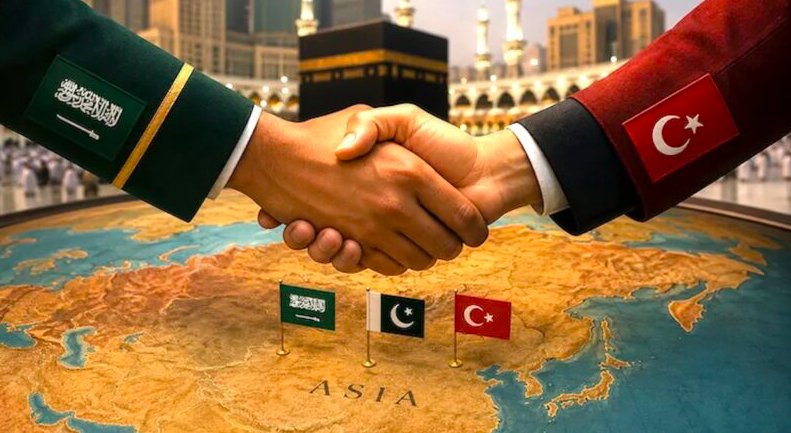
The signing of the Mecca Joint Defence Agreement by Saudi Arabia, Pakistan and Türkiye on 7 August 2026 represents an important development in the evolution of West Asian security architecture. Concluded in Mecca by Saudi Crown Prince and Prime Minister Mohammed bin Salman, Turkish President Recep Tayyip Erdoğan and Pakistani Prime Minister Shehbaz Sharif, the agreement establishes a framework under which an armed attack against one of the three states is to be regarded as an attack against all three. The agreement explicitly invokes the right of individual and collective self-defence under Article 51 of the United Nations Charter. The three governments have simultaneously stressed that the arrangement is defensive, does not identify a particular adversary and remains open to other friendly states.
The significance of the Mecca Pact, however, should not be exaggerated. Describing it as an “Islamic NATO” captures some of its political symbolism but risks overstating its present institutional and military capabilities. NATO has developed over decades into a highly institutionalized organization with integrated military commands, common planning structures, standing forces, and established mechanisms for consultation and collective action. The Mecca framework, by contrast, is at an early stage. Its principal achievement is the creation of a political commitment to collective deterrence and deeper defence cooperation rather than the immediate creation of an integrated military alliance. Reporting the agreement indicates that the precise form of assistance in a crisis would depend on circumstances and on the nature of the assistance requested by the state under attack.
Its importance nevertheless goes beyond symbolism. Saudi Arabia is attempting to reduce the risks associated with excessive dependence on a single external security provider while continuing to maintain its strategic relationship with the United States. Türkiye is seeking a larger autonomous role in regional security while remaining a NATO member and expanding its defence-industrial footprint across the Gulf and wider Muslim world. Pakistan, meanwhile, is transforming a long-standing Saudi security relationship into a broader trilateral strategic platform that connects South Asia, the Gulf and the Eastern Mediterranean.
The agreement therefore reflects a broader movement toward strategic diversification. West Asian states increasingly appear unwilling to assume that security must be guaranteed exclusively by an outside great power. Instead, they are building overlapping networks involving regional military powers, defence industries, intelligence relationships, economic partnerships, and bilateral security arrangements. This does not mean that the United States is being expelled from the region. Indeed, Washington retains enormous military, technological, financial, and diplomatic influence. Rather, regional actors are attempting to ensure that their security does not depend entirely upon Washington’s willingness to intervene in every crisis.
The timing of the pact is critical. The agreement was signed amid heightened tensions surrounding the US-Israel confrontation with Iran and concerns over attacks, missiles, drones, energy infrastructure and maritime routes. The regional environment has demonstrated how quickly a conflict involving Iran can affect Gulf security and international commerce. The Strait of Hormuz, Red Sea, Gulf of Oman and Arabian Sea form a connected strategic system in which developments in one theatre can generate consequences across another.
The pact also creates a complicated strategic equation for Iran. Although Turkish and Pakistani officials have explicitly stated that the agreement is not directed against Iran, Tehran cannot ignore the implications of a closer relationship among Saudi Arabia, Türkiye and Pakistan. Saudi Arabia brings financial strength and geographic proximity to the Gulf; Türkiye contributes a large conventional military and rapidly expanding defence industry; and Pakistan contributes substantial military experience and nuclear capabilities. The combination is therefore significant even if the agreement does not create a unified force. For India, the most important implications are not that a new military bloc has suddenly emerged against New Delhi. The pact does not name India as an adversary, and Saudi Arabia has strong economic and societal ties with India. The more important issue is the expansion of Pakistan’s diplomatic and strategic networks. Islamabad now possesses an additional platform through which it can cultivate relationships with Ankara and Riyadh and potentially internationalize regional and bilateral issues. India must therefore distinguish between an immediate military threat and a longer-term structural challenge. The appropriate Indian response should consequently be one of strategic recalibration rather than alarm. New Delhi should deepen bilateral relations with Saudi Arabia and other Gulf states, expand maritime-security cooperation, strengthen defence-industrial partnerships, maintain productive relations with Israel and the United States without becoming dependent on either, preserve its engagement with Iran and Russia, and accelerate indigenous defence capabilities.
Ultimately, the Mecca Pact is best interpreted as an early manifestation of a more networked and multipolar security order in West Asia. Its future importance will depend on whether the three signatories develop regular exercises, intelligence-sharing mechanisms, defence-industrial projects, institutional structures, and credible procedures for responding to crises. If those elements develop, the pact could become considerably more consequential. If they do not, it may remain primarily a political declaration of strategic solidarity.
The central lesson for India and other outside powers is therefore clear: West Asian security is moving from a predominantly hub-and-spoke model centered on an external guarantor toward a more complex network of regional partnerships. States that adapt early to that transformation will possess greater strategic influence; those that continue to view the region through older alliance structures at risk becoming reactive rather than influential.
Background and Origins
The Mecca Joint Defence Agreement did not emerge in isolation. Its origins lie in a longer process of strategic recalibration in West Asia, intensified by the security crises of the past several years and accelerated by the escalation surrounding Iran in 2026. The agreement signed on 7 August 2026 brought together three states that had already developed substantial bilateral relationships but had never previously converted those relationships into a formal trilateral defence framework. The result is a new strategic mechanism connecting the Gulf, Anatolia, and South Asia.
For decades, the security architecture of the Gulf rested heavily upon American military power. Saudi Arabia and other Gulf monarchies depended upon US intelligence, air defence, naval power, logistics, weapons systems and extended deterrence. The arrangement was mutually beneficial: Washington acquired influence over a strategically vital region and access to energy and maritime routes, while Gulf partners obtained security guarantees and advanced military technology.
Yet the model also generated structural vulnerability. The more regional security depended upon a single external power, the more exposed regional states became to changes in that power’s political priorities. Questions concerning the durability of the American commitment became especially important as Washington periodically signaled a desire to reduce its military footprint or shift attention toward other strategic theatres. Even where US forces remained present, uncertainty over the circumstances in which Washington would use military force encouraged regional governments to develop additional options.
Saudi Arabia therefore increasingly pursued strategic hedging. Hedging does not mean abandoning an alliance; it means avoiding dependence on one partner by maintaining several relationships simultaneously. Riyadh has continued its close relationship with Washington while simultaneously strengthening ties with China, Russia, Türkiye, Pakistan and other regional actors. The Mecca Pact fits naturally within this strategy. It gives Saudi Arabia another layer of deterrence without requiring the Kingdom to sever or downgrade its relationship with the United States.
The regional conflict involving the United States, Israel and Iran in 2026 provided a powerful catalyst. The conflict demonstrated the potential for an attack directed at Iran to generate consequences across the Gulf and surrounding maritime environment. Gulf states faced the possibility that their territory, energy infrastructure or shipping routes could become targets even if they were not themselves direct participants in the war. Such circumstances encourage states to ask whether existing security arrangements are sufficient in a rapidly changing crisis.
The Mecca agreement is therefore partly a response to uncertainty. It does not necessarily indicate that Saudi Arabia has lost confidence in the United States. Rather, it indicates that Riyadh wants more than one strategic option. distinction is important. A state can remain an American security partner while simultaneously developing independent or complementary security relationships with other powers. The bilateral Saudi-Pakistani relationship provided the initial foundation for this development. Pakistan has maintained a long history of military cooperation with Saudi Arabia, including defence training, deployments and institutional links. The relationship has periodically extended beyond conventional diplomacy into questions of strategic security. Pakistan’s large armed forces, extensive military experience and nuclear capability make it an unusually valuable security partner for Saudi Arabia. Türkiye adds another dimension. Unlike Pakistan, Türkiye is a NATO member and possesses a large conventional military-industrial base. Its defence industry has become increasingly important in the Middle East, particularly through unmanned aerial systems, missiles, electronic warfare technologies, and other platforms. Ankara has also pursued an independent foreign-policy posture that seeks greater regional influence while retaining its Western alliances. The three countries therefore offer complementary assets. Saudi Arabia provides financial resources, geographic position and strategic importance. Türkiye offers industrial and technological capabilities and a major conventional military. Pakistan provides military manpower, experience and strategic depth. The agreement attempts to turn these complementary strengths into a political deterrence framework.
The choice of Mecca as the venue is also significant. Mecca possesses enormous religious and symbolic importance across the Muslim world, and holding the summit there inevitably gave the agreement a wider political resonance. Yet the signatories have been careful to avoid presenting the pact as a sectarian alliance. Turkish Foreign Minister Hakan Fidan and other officials have stressed that no common adversary is identified in the agreement. President Erdoğan similarly stated that the arrangement targets no country and is open to other states seeking regional peace and stability.
This distinction reflects the sensitivity of the Iranian question. Saudi Arabia and Iran have historically competed for regional influence, but Riyadh has also pursued periods of diplomatic accommodation with Tehran. A treaty explicitly directed against Iran would therefore constrain Saudi diplomacy and potentially undermine efforts at de-escalation. By defining the agreement in general terms as collective deterrence, Riyadh and Ankara retain greater diplomatic flexibility. The agreement also has a post-October 7 context. The broader Middle Eastern security environment has been transformed by the wars and crises that followed the Hamas attack on Israel in October 2023. Regional governments have had to balance relations with Israel, the United States, Iran and domestic public opinion. The subsequent expansion of missile, drone, proxy and maritime threats has made traditional distinctions between domestic, regional and external security increasingly difficult to maintain. The Mecca Pact thus represents the convergence of several trends: Saudi strategic hedging, Pakistani efforts to expand its diplomatic relevance, Turkish regional activism, the growth of indigenous defence industries and uncertainty over the future shape of the American security role.
Its origins should therefore not be reduced to a single Iranian threat or a single crisis. The agreement is better understood as the institutional expression of a longer-term transformation. Regional powers are increasingly attempting to build security capabilities themselves rather than relying exclusively on external guarantors. The crucial question is what comes next. If the agreement produces regular exercises, intelligence cooperation, defence-industrial integration and permanent coordination mechanisms, it could gradually develop into a significant regional security institution. If implementation remains limited to political declarations, its practical impact will be smaller. The origins of the pact therefore explain both its importance and its uncertainty: it is the product of a changing security environment, but its final institutional character has yet to be determined.
What the Pact Contains — and What It Omits
The significance of the Mecca Joint Defence Agreement lies as much in its wording and institutional design as in the political circumstances surrounding its signing. At its core is a collective-deterrence principle: an armed attack against one of the three signatories is to be regarded as an attack against all. The agreement also reaffirms the right of self-defence under Article 51 of the UN Charter. This provides the pact with an established international-law reference point rather than creating an entirely novel legal formula. The collective-defence clause is undoubtedly the most consequential element. Deterrence depends partly on an adversary’s uncertainty about the consequences of aggression. If an opponent believes that an attack on Saudi Arabia, for example, would remain a bilateral confrontation, the costs of aggression may appear manageable. If the same opponent believes that Türkiye and Pakistan could become involved, the strategic calculation becomes more complicated. However, collective-defence language does not automatically create an automatic military response. This is one of the most important distinctions between the Mecca Pact and NATO. Turkish Foreign Minister Hakan Fidan indicated that a state under attack would request assistance and specify the form of support required. That leaves room for political decision-making regarding whether the appropriate response should involve troops, intelligence, logistics, air defence, weapons, diplomatic support, or other forms of assistance. This flexibility is both an advantage and a weakness. It is advantageous because the three governments retain national control over escalation. Saudi Arabia may not want to enter every conflict involving Pakistan, and Pakistan may not want to become involved automatically in every confrontation involving Saudi Arabia. Türkiye, as a NATO member with its own complex relationships with Russia, Iran, Europe and the United States, also has reasons to preserve freedom of action. The weakness is that ambiguity can reduce deterrence. An adversary may question how far the other members are actually prepared to go. Effective collective defence requires not merely political declarations but credible planning, logistics, interoperability and political will. The agreement also aims to deepen defence cooperation. Official Turkish statements emphasize collective deterrence, defence-industry projects and counterterrorism cooperation. The three countries have substantial opportunities for cooperation in drones, air defence, electronic warfare, intelligence, cyber capabilities, and military training.
Defence-industrial cooperation could eventually prove more important than the treaty of language itself. Türkiye has developed a substantial indigenous defence sector, especially in unmanned systems and aerospace. Pakistan possesses significant experience in co-production and military manufacturing. Saudi Arabia has enormous financial resources and has sought to increase domestic defence production. A triangular industrial relationship could therefore create supply chains that connect Saudi capital, Turkish technology and Pakistani manufacturing and manpower. Nevertheless, it is important not to assume that every possible defence project has already become operational under the pact. Defence-industrial integration is a process rather than an immediate condition. Joint production requires agreements concerning intellectual property, financing, technology transfer, export controls, training, maintenance, and supply chains. The future strategic value of the pact will therefore depend heavily on whether the signatories translate political cooperation into actual industrial capacity.
The same applies to intelligence-sharing. Sharing intelligence can substantially improve deterrence and crisis response, but it requires secure communications, compatible procedures, trusted institutions, and confidence among intelligence services. Regular intelligence cooperation could help the three states identify missile launches, drone activity, maritime threats, terrorist networks and cyber operations. But the sensitivity of intelligence means that cooperation is likely to develop incrementally. One major omission is the absence of a NATO-style integrated command structure. NATO’s operational effectiveness is partly derived from decades of institutional development. Its members have established headquarters, planning mechanisms, command relationships, and interoperability standards. The Mecca Pact currently lacks comparable publicly disclosed structures. A second omission is the absence of a standing joint force. The agreement does not establish a permanently deployed trilateral military formation. This means that military cooperation would have to be assembled when required. Such an arrangement can work, but mobilization and coordination would take time. A third major difference concerns financing. There is not publicly established common defence budget comparable to NATO’s institutional financial mechanisms. Saudi Arabia may finance major projects, Türkiye may contribute industrial capabilities, and Pakistan may contribute personnel or expertise, but this is different from maintaining a shared alliance budget. Another important omission is an explicit nuclear-sharing arrangement. Pakistan is a nuclear-armed state, but the agreement does not publicly establish a mechanism by which Pakistani nuclear capabilities become an alliance nuclear umbrella for Saudi Arabia or Türkiye. Any assumption of automatic nuclear protection would therefore go beyond the publicly available text and official statements.
Geographic scope is also important. The agreement does not publicly establish a detailed map defining every circumstance that would activate collective defence. This creates ambiguity over attacks on bases, ships, cyber infrastructure, diplomatic facilities, proxies, or forces operating abroad. The overall structure is therefore best understood as a flexible deterrence framework. It establishes political solidarity and a commitment to expanded defence cooperation while leaving substantial discretion to the member governments. This may actually be intentional. A highly rigid alliance would impose obligations that could constrain Saudi diplomatic flexibility, Turkish autonomy and Pakistan’s delicate relationship with Iran. The Mecca Pact instead provides a middle ground between complete bilateralism and a fully institutionalized military alliance. Its future trajectory will depend on implementation. Regular military exercises, intelligence mechanisms, defence-industrial projects, and institutional coordination could gradually convert the agreement from a political signal into a more capable security organization. Until then, its principal effect is psychological and strategic: it changes an adversary calculation by demonstrating that aggression against one state could involve two additional regional powers.
Mecca Pact vs. NATO: A Structural Comparison
The description of the Mecca Joint Defence Agreement as an “Islamic NATO” is politically powerful but analytically imprecise. The comparison is useful because NATO is the world’s best-known example of collective defence, and the Mecca Pact contains an attack-on-one-is-an-attack-on-all principle that resembles NATO’s Article 5. Yet the institutional structures, military capabilities, and political commitments of the two arrangements are presently very different.
NATO emerged from the strategic circumstances of the early Cold War and has evolved continuously since its creation in 1949. It possesses decades of accumulated institutional experience, permanent political structures, integrated military commands, defence planning mechanisms, exercises, interoperability standards, and common funding arrangements. It has also expanded its original membership into a large multinational organization. The Mecca Pact, by comparison, was only established in August 2026 and currently consists of three states. The first major difference is institutional depth. NATO is an organization with permanent bureaucracy and political decision-making machinery. The Mecca Pact is presently better described as a treaty-based framework for collective defence and cooperation. Although reports indicate the possibility of a permanent secretariat, its institutional architecture remains at an early stage compared with NATO’s extensive structures. The second difference is command integration. NATO members operate through an integrated command system that enables military forces from different countries to plan and conduct operations together. The Mecca Pact has no publicly established equivalent integrated command. Saudi, Turkish and Pakistani armed forces therefore remain nationally controlled. This distinction matters greatly during war. A political declaration can be made rapidly, but military operations require detailed planning. Air forces need compatible communications and identification systems. Navies need procedures for coordinating patrols and logistics. Ground forces need interoperable command systems. Intelligence agencies need secure information-sharing networks. Without such structures, collective defence can remain largely political. The third difference concerns standing forces. NATO’s members maintain national forces that are assigned or made available to alliance missions through established mechanisms. The Mecca Pact does not create a standing trilateral military force. Any joint military response would therefore need to be assembled from national capabilities.
The fourth difference concerns common funding. NATO possesses institutional financial mechanisms that support shared activities. The Mecca framework has no comparable common defence budget publicly established. This does not prevent Saudi Arabia, Türkiye and Pakistan from financing joint projects, but it makes their cooperation more dependent on bilateral and trilateral decisions. The fifth difference is nuclear deterrence. NATO has a nuclear-sharing arrangement involving the United States and certain European members, although the details differ from a simple promise of automatic nuclear retaliation. The Mecca Pact does not publicly establish nuclear sharing. Pakistan’s nuclear capability is therefore a national strategic capability rather than an officially declared collective nuclear umbrella for the other members. The sixth difference is the nature of the common threat. NATO was built largely around a clearly identifiable strategic adversary during the Cold War. The Mecca Pact deliberately avoids identifying a common enemy. Turkish officials have explicitly said that the agreement is not directed against Iran or any other country. This ambiguity is politically useful but strategically consequential. Alliances are easier to institutionalize when members agree about the principal threat. Saudi Arabia may prioritize missiles, drones and maritime threats from the Gulf; Türkiye may focus on terrorism, regional instability and strategic autonomy; Pakistan may focus on South Asian security and its relationship with India and Iran. Their threat of perceptions overlap but are not identical. Membership also differs. NATO has a defined membership process and institutional rules for expansion. The Mecca Pact has been described by its signatories as open to other friendly states seeking peace and stability. This could eventually transform it into a wider regional framework, potentially involving other Muslim-majority states. But expansion could also make consensus more difficult because new members would bring different threats of perceptions and foreign-policy commitments.
Nevertheless, the comparison to NATO is not entirely misplaced. Both arrangements use collective defence as a deterrence mechanism. Both seek to persuade potential aggressors that military action against one member could generate a wider response. Both can therefore produce strategic effects before a single shot is fired. The key difference is maturity. NATO’s strength is not simply Article 5; it is the enormous institutional ecosystem built around Article 5. The Mecca Pact currently possesses the political principle but not the same institutional machinery. It is therefore more accurate to describe the agreement as an embryonic regional collective-defence framework. If the three states gradually develop joint exercises, command-and-control arrangements, shared intelligence systems, defence planning, and industrial integration, the pact could acquire greater resemblance to a formal military alliance. For India, this distinction is especially important. Treating the Mecca Pact as an already operational NATO equivalent would lead to exaggerated threat assessments. Conversely, dismissing it as mere symbolism would also be a mistake. Institutions often begin with political declarations and acquire practical depth over time. The appropriate analytical position is therefore between these extremes. The Mecca Pact is not an Islamic NATO today. It is a political and strategic framework that could, depending on implementation and future membership, evolve into something substantially more consequential.
The Religion Question
Religion is an unavoidable dimension of the Mecca Pact, but it should not be confused with the entire logic of the agreement. Saudi Arabia, Türkiye and Pakistan are all Muslim-majority states, and the decision to sign the agreement in Mecca gives the arrangement an unmistakable symbolic dimension. Yet the governments involved have deliberately rejected the idea that the pact constitutes a sectarian alliance directed against Iran or another state. This distinction matters because West Asian politics is already shaped by overlapping religious, national, ideological and geopolitical identities. An alliance perceived as a Sunni military bloc against a Shia-majority Iran could deepen existing sectarian tensions even if its architects intend otherwise. The choice of Mecca carries considerable symbolic weight. Mecca is the spiritual center of Islam and therefore provides the agreement with a geographical symbolism extending far beyond conventional diplomatic venues. Pakistani officials have emphasized the shared faith and historic ties of the three states, while Turkish officials have described the agreement in terms of regional peace, stability and collective deterrence. The Organization of Islamic Cooperation also welcomed the agreement as an important step in strengthening regional and international cooperation. That reaction demonstrates how the pact can be presented as part of a broader concept of Muslim solidarity rather than as a narrowly military bloc. Nevertheless, perceptions matter as much as official intentions. Iran is a Shia-majority regional power with significant influence across Iraq, Syria, Lebanon and Yemen. Tehran therefore has reasons to scrutinize any arrangement that brings Saudi Arabia, Türkiye and Pakistan into a closer security relationship.
The danger is the security dilemma. A security dilemma occurs when one state’s defensive measures are interpreted by another as preparation for offensive action. Saudi Arabia may argue that the pact is designed to prevent aggression. Iran may nonetheless perceive a larger network of hostile or potentially hostile military capabilities near its borders. Tehran could then respond by strengthening missiles, drones, proxies, cyber capabilities, or military partnerships. Those responses could reinforce Saudi perceptions of threat, generating further military cooperation.
The same dynamic could work in reverse. If Iran interprets the Mecca Pact as an offensive alliance and adopts more aggressive deterrence measures, the signatories may respond by institutionalising their cooperation. The result would be a cycle in which defensive intentions produce offensive perceptions. This is why the signatories’ repeated insistence that the pact targets no country is strategically significant. Turkish officials have specifically emphasized that there is no written common enemy. Pakistan has similarly described the agreement as purely defensive. The absence of a named enemy gives pact diplomatic flexibility. Saudi Arabia can maintain channels with Iran. Türkiye can continue its complicated relationship with Tehran. Pakistan can avoid being drawn into an unnecessary conflict with its western neighbor. All three can therefore claim that the agreement is about deterrence rather than containment. Yet religion may still influence the political narrative surrounding the pact. Public opinion in Muslim-majority countries can respond strongly to questions involving Palestine, Israel, Iran and regional conflict. Governments therefore face a delicate task: they may use shared Islamic identity to generate political legitimacy while simultaneously avoiding sectarian mobilization.
The sustainability of the pact will depend partly on whether the three governments can maintain that balance. If it becomes framed primarily as a Sunni military alliance, its ability to attract additional members could decline and relations with Iran could deteriorate. If it remains a broad collective-security framework open to peaceful regional cooperation, it could acquire greater legitimacy. The question also has implications for the wider Muslim world. There are significant differences among Muslim-majority states. Some are closely aligned with the United States; others maintain strategic relationships with China or Russia. Some have strong ties with Iran; others view Tehran as a major security challenge. A single religious identity does not eliminate these divergent interests. The Mecca Pact therefore demonstrates the limits of religion as a foundation for military alliance-building. Shared identity can facilitate trust and political symbolism, but it cannot substitute for strategic convergence. Saudi Arabia, Türkiye and Pakistan must still reconcile different threat perceptions, geographic priorities and foreign-policy interests. For India, the religious dimension should be handled carefully. New Delhi has extensive relationships with Saudi Arabia and other Gulf states, and Indian interests in the region are overwhelmingly strategic, economic and societal. Treating the Mecca Pact primarily through a religious lens would risk misunderstanding the more important drivers: security diversification, defence-industrial cooperation, regional autonomy and strategic hedging. The broader lesson is that identity can accelerate alliance formation but cannot guarantee alliance cohesion. The durability of the Mecca framework will ultimately depend on whether its members can build practical mechanisms of cooperation while avoiding a narrative that transforms regional competition into a sectarian confrontation. A successful collective-security system in West Asia would ideally reduce insecurity rather than reproduce it. That requires maintaining diplomatic channels with Iran, supporting regional dialogue and ensuring that collective deterrence does not automatically become collective confrontation.
Strategic Motivations by Signatory
The Mecca Pact is easier to understand when the motivations of Saudi Arabia, Türkiye and Pakistan are examined separately. Although the three countries share important interests, they are not entering the agreement for identical reasons. Their strategic calculations overlap sufficiently to permit cooperation but remain distinct enough to shape how the pact develops.
Saudi Arabia
For Saudi Arabia, the central motivation is strategic hedging. Riyadh does not appear to be abandoning its relationship with Washington. Rather, it is attempting to reduce the risks associated with excessive dependence on any single external guarantor. The Saudi leadership has spent years developing a more autonomous foreign-policy strategy. Economic transformation under Vision 2030 requires regional stability, secure trade routes, and predictable investment conditions. A major war that damages energy infrastructure or shipping would threaten these objectives. Saudi Arabia therefore has strong incentives to develop multiple security partnerships. Pakistan is particularly valuable because of the longstanding military relationship between the two countries. Pakistan provides military expertise and has historically contributed personnel and training to Saudi security. Türkiye offers a different asset: advanced and increasingly indigenous defence technology. The combination gives Saudi Arabia access to both manpower and industrial capabilities. Riyadh also benefits politically from bringing Türkiye into its security network. Ankara is a major regional power with its own strategic autonomy and a substantial military-industrial base. A relationship with Türkiye gives Saudi Arabia additional options beyond American and European defence suppliers.
Türkiye
Türkiye’s motivation is closely connected to its broader ambition for strategic autonomy. Ankara remains a NATO member, but it has increasingly sought to establish itself as an independent regional power capable of influencing developments in the Middle East, Caucasus, Central Asia, Africa and the Mediterranean. The Mecca Pact reinforces that strategy. Türkiye can present itself as a provider of regional security rather than merely a consumer of Western security guarantees. The defence-industrial dimension is particularly important. Turkish companies have achieved major international visibility in drones and other defence technologies. The agreement potentially creates additional markets and industrial partnerships in Saudi Arabia and Pakistan.
For Ankara, the pact also provides a bridge between geographical regions. Türkiye occupies a unique position between Europe, the Middle East, and Asia. Its relationship with Pakistan connects it to South Asia, while its relationship with Saudi Arabia strengthens its position in the Gulf. At the same time, Türkiye must avoid turning the pact into an anti-Iran or anti-Western bloc. Its economic and security interests require relationships with multiple powers. The insistence that the agreement targets no country therefore serves Turkish interests.
Pakistan
Pakistan’s motivations are particularly complex. Islamabad has a long relationship with Saudi Arabia, but the Mecca Pact allows it to transform that bilateral connection into a broader regional role. Pakistan gains diplomatic visibility by participating in an arrangement that includes two major regional powers. Türkiye provides Islamabad with another influential partner, while Saudi Arabia provides economic and political weight. Pakistan may also see an opportunity to strengthen its position as a security provider within the wider Muslim world. Its nuclear status and large conventional military give it a unique profile among Muslim-majority countries. However, this opportunity also creates risks.
The most important risk is Iran. Pakistan shares a border with Iran and cannot afford to become automatically involved in a Saudi-Iran confrontation. Islamabad therefore has a strong incentive to ensure that the Mecca Pact remains defensive and does not develop into a formal anti-Iran coalition. Pakistan also must manage its relationship with India. The agreement could strengthen Islamabad’s diplomatic networks, particularly through Türkiye and Saudi Arabia. However, an excessive emphasis on India-related security could alienate Saudi Arabia, which has significant economic interests in India. The three motivations therefore converge around strategic autonomy but differ in emphasis. Saudi Arabia seeks diversified security guarantees; Türkiye seeks regional influence and defence-industrial expansion; Pakistan seeks strategic relevance and diplomatic depth. This divergence may actually help the pact survive. Because the agreement is not based on a single common enemy, it can accommodate different national priorities. The challenge will prevent those differences from becoming sources of friction. A crisis involving Iran could expose Pakistan’s constraints. A crisis involving Türkiye could raise questions about Saudi and Pakistani willingness to support Ankara. A conflict involving Saudi Arabia could force Türkiye and Pakistan to balance solidarity against their wider interests. The durability of the pact will therefore depend not on whether the three countries have identical interests, but whether their interests overlap sufficiently to sustain cooperation during crises.
Implications for Major Powers
The Mecca Pact affects the strategic calculations of all major powers with interests in West Asia. Its consequences for the United States, Israel, Iran, China and Russia are different, but the common theme is the gradual emergence of a more diversified regional security system.
United States
For Washington, the agreement is both reassuring and challenging. On one level, regional burden-sharing is consistent with an American preference for partners to assume greater responsibility for their own security. If Saudi Arabia, Türkiye and Pakistan invest more in collective defence, the United States may be able to reduce some of the burdens associated with regional security. On another level, however, the agreement could gradually weaken America’s position as the indispensable security provider. If regional states develop alternative defence networks, Washington’s ability to shape regional security decisions could decline. This is particularly important for arms sales, intelligence cooperation, and crisis diplomacy. A Saudi Arabia with multiple capable security partners has greater bargaining power with Washington than a Saudi Arabia dependent almost entirely on American support. The Mecca Pact therefore does not represent immediate American strategic defeat. Instead, it contributes to a long-term diffusion of influence.
Israel
Israel must consider the emergence of a new network involving Türkiye, Pakistan and Saudi Arabia. The pact does not identify Israel as an adversary, and there is no evidence that the three signatories have created the agreement specifically to confront Israel. Nevertheless, Israeli planners must account for the combined capabilities of the three countries. Türkiye is a major conventional military power; Pakistan possesses nuclear weapons; and Saudi Arabia possesses substantial financial resources and strategic geography. The pact could therefore complicate Israeli calculations concerning deterrence and regional military balances. At the same time, Saudi Arabia’s interests are not identical to Türkiye’s or Pakistan’s, limiting the likelihood of automatic strategic alignment against Israel.
Iran
Iran faces the most direct strategic challenge. Even though the agreement is officially non-targeted, Tehran must consider the possibility that aggression against Saudi Arabia could now produce a broader regional response. This may strengthen deterrence. An Iranian decisionmaker who previously considered a limited strike against Saudi infrastructure might now have to consider Turkish and Pakistani involvement. But deterrence can also produce unintended consequences. If Tehran concludes that conventional confrontation has become more dangerous, it could increase reliance on indirect methods such as cyber operations, drones, missiles, or regional partners. The pact therefore creates both stabilizing and destabilizing possibilities.
China
China benefits from the pact’s potential contribution to regional stability. Beijing has major economic interests in Gulf energy supplies and maritime trade. It also maintains a close strategic relationship with Pakistan. China does not need to become a member of the pact to benefit from the deeper connectivity it may create. Greater Saudi-Turkish-Pakistani cooperation could indirectly strengthen Chinese economic and strategic networks, especially where they intersect with the China-Pakistan Economic Corridor. However, Beijing is unlikely to want the agreement transformed into an anti-Iran or anti-American bloc. China maintains relationships with Iran, Saudi Arabia and Türkiye and therefore benefits from multipolarity rather than polarisation.
Russia
Russia faces a more complicated equation. Moscow has important relationships with Iran, Türkiye and Gulf states, but those relationships are not identical. A stronger Türkiye-Saudi-Pakistan framework could reduce Russian influence in some areas while simultaneously creating opportunities for Moscow to engage with additional regional actors. Russia’s principal interest is likely to be avoiding a major regional war that disrupts energy markets and threatens its relationships. Moscow therefore has incentives to encourage a balance among competing regional powers rather than support the emergence of a rigid anti-Iran coalition. Overall, the Mecca Pact contributes to a broader trend in which major powers no longer possess exclusive influence over regional security. Instead, they must operate within a network of overlapping regional partnerships.
Implications for India
The Mecca Pact does not constitute an immediate military threat to India. None of the three signatories has identified India as an adversary, and Saudi Arabia in particular has substantial economic and strategic interests in maintaining strong relations with New Delhi. The principal implications for India are therefore diplomatic, geopolitical and structural rather than an immediate requirement for military countermeasures. The first concern is Pakistan’s expanding strategic platform. Islamabad now has a formal trilateral security relationship involving Saudi Arabia and Türkiye. Both states possess substantial diplomatic influence and extensive international networks. Pakistan can potentially use these relationships to amplify its diplomatic positions on issues such as Kashmir and broader South Asian security. India should not automatically assume that Saudi Arabia or Türkiye will adopt Pakistan’s positions. Saudi Arabia has its own economic interests in India, while Türkiye’s foreign policy is driven by a much wider set of calculations. Nevertheless, Pakistan’s increased access to influential partners gives Islamabad additional diplomatic space.
The second concern involves connectivity. India has invested heavily in projects linking the country with the Gulf, Europe and the wider Mediterranean. The India-Middle East-Europe Economic Corridor concept depends on political stability, maritime security and cooperation among multiple states. A closer Saudi-Turkish-Pakistani relationship could complicate some aspects of India’s regional connectivity strategy, especially if the emerging security architecture develops independently of Indian initiatives. This does not make the Mecca Pact inherently anti-IMEC. Rather, it means India must ensure that its connectivity projects are embedded within a sufficiently broad network of bilateral partnerships. The third issue is maritime security. India depends heavily on the Arabian Sea, Gulf of Oman, Red Sea and Gulf routes for energy and trade. Any deterioration in the security environment directly affects Indian economic interests. The Mecca Pact could contribute positively if it strengthens regional maritime security. It could become problematic if it contributes to militarization or confrontation. India should therefore prioritise practical maritime cooperation with Gulf partners rather than view regional security exclusively through alliance competition. The fourth issue is counterterrorism. Pakistan’s deeper defence relationships may increase its conventional and diplomatic confidence. India should consequently maintain strong intelligence, border-security and counterterrorism capabilities. At the same time, New Delhi should avoid interpreting every development in the Mecca framework through the India-Pakistan lens. Saudi Arabia’s relationship with India provides an important balancing factor. India has a large diaspora in the Gulf, extensive energy ties and growing investment and trade relations with Gulf economies. These connections create incentives for Riyadh to maintain strategic autonomy. India should therefore deepen its relationship with Saudi Arabia independently rather than treating Saudi policy as a function of its relationship with Pakistan.
The same principle applies to Türkiye. Ankara and New Delhi have differences, but Türkiye is too strategically important to ignore. India should seek areas of practical cooperation while managing disagreements through sustained diplomacy. India should also preserve its relationship with Iran. This is especially important because Iran provides geographic access toward Central Asia and Afghanistan and remains a major actor in the Gulf. India’s engagement with the Chabahar corridor gives the relationship a strategic dimension beyond bilateral diplomacy. A balanced Indian strategy should therefore avoid choosing between Saudi Arabia, Iran, Israel, the United States and Russia. India’s interests require simultaneous relationships with all of them.
The Mecca Pact also reinforces the importance of indigenous defence capability. India’s response to changing regional alliances cannot rely solely on diplomatic partnerships. Credible strategic autonomy requires national capabilities in air defence, missiles, drones, electronic warfare, cyber operations, satellites, naval power, and intelligence. The aggregate military figures associated with Saudi Arabia, Türkiye and Pakistan should also be interpreted cautiously. Adding national personnel, tanks, aircraft and naval platforms does not produce a unified military force. Different doctrines, geographic priorities, logistics systems and command structures limit the extent to which raw numbers translate into collective combat power.
India should therefore monitor the evolution of the pact rather than immediately treat it as an existential threat. The key indicators will be joint exercises, permanent institutions, intelligence-sharing arrangements, defence-industrial projects, and the entry of additional members. If these mechanisms deepen, the pact could become more strategically consequential. If they remain limited, its influence will remain primarily political. The correct Indian response is consequently one of strategic diversification. New Delhi should become more deeply embedded in the Gulf’s economic, technological and maritime networks while maintaining autonomy in its relations with Iran, Israel, the United States, Russia and the wider Indo-Pacific. The Mecca Pact should therefore be understood as a reason for India to become more active in West Asia, not less.
Path Forward: A Strategic Response Framework
The emergence of the Mecca Pact requires a forward-looking response based on strategic adaptation rather than alarm. The central lesson is that West Asia is moving toward a networked security environment in which regional powers increasingly combine bilateral, trilateral, and multilateral arrangements. For India, the priority should be deepening bilateral relations with Saudi Arabia. Riyadh should be treated not merely as a Gulf state or energy supplier but as an independent strategic center of power. India should expand cooperation in energy security, investment, technology, infrastructure, digital systems, defence and maritime security.
The objective should not be to compete with Pakistan for Saudi favor. Such a strategy would be unnecessarily narrow. Instead, India should make its relationship with Saudi Arabia so broad and mutually beneficial that it remains valuable regardless of Riyadh’s relationship with Islamabad. Second, India should expand maritime-security cooperation. The Arabian Sea, Gulf of Oman, Gulf of Aden and Red Sea should be viewed as parts of a connected security environment. India’s navy has a central role in protecting commercial shipping and energy flows. Cooperation with Gulf and Indian Ocean partners can strengthen maritime domain awareness, anti-piracy capabilities and crisis-response mechanisms. Third, India should diversify its Gulf partnerships. The United Arab Emirates remains important, but India should simultaneously deepen relations with Saudi Arabia, Oman, Qatar and Kuwait. Each has different strategic priorities, and bilateral relationships allow India to avoid overdependence on any single regional grouping. Fourth, India should maintain its relationships with Israel and the United States while avoiding excessive strategic over-identification. These relationships are valuable for defence technology, intelligence, innovation, and regional diplomacy. But India’s interests are not identical to those of either country. Strategic autonomy requires the ability to cooperate without becoming automatically aligned. Fifth, the Iran channel should remain open. India’s relationship with Tehran is complicated but strategically important. Iran’s geography provides potential access toward Afghanistan and Central Asia, and connectivity projects such as Chabahar remain relevant to India’s continental strategy. India should therefore maintain diplomatic engagement even during periods of intense regional rivalry. Sixth, India should engage Russia proactively. Russia retains influence in West Asia and Central Asia and has important relationships with Iran and Türkiye. Rather than allowing Russian, Chinese, Pakistani and Turkish interests to converge in ways that reduce India’s strategic room, New Delhi should maintain independent engagement with Moscow. Seventh, India should accelerate indigenous defence capabilities. The changing security environment demonstrates the limitations of relying entirely on foreign suppliers. India needs stronger capabilities in drones, counter-drone systems, long-range precision weapons, air and missile defence, electronic warfare, cyber defence, satellites, maritime surveillance and intelligence. Indigenous capability does not mean abandoning international defence partnerships. On the contrary, partnerships can accelerate technological development. The objective should be to ensure that external relationships supplement rather than replace national capability. Eighth, India should invest in strategic intelligence on the evolution of the Mecca Pact. Monitoring statements is insufficient. New Delhi should track exercises, procurement, command arrangements, intelligence cooperation, defence-industrial projects and potential membership expansion.
The possibility of additional members is particularly important. If countries such as Egypt or others eventually join, the geographic and strategic significance of the framework could increase considerably. Turkish officials have already described the agreement as open to other friendly countries. Ninth, India should develop stronger regional crisis-management mechanisms. The more interconnected the Gulf security environment becomes, the more important communication channels will be during crises. India can contribute through diplomatic engagement, maritime coordination and humanitarian assistance. Finally, India should avoid overreacting. Security competition is not inevitable, and the Mecca Pact does not automatically translate into an anti-Indian bloc. Saudi Arabia’s economic relationship with India, Türkiye’s commercial interests and Pakistan’s own need to manage its relationship with Iran all create constraints on the pact’s evolution. The objective should therefore be strategic resilience. India should build enough diplomatic, economic and military capacity that changes in West Asian alliances do not threaten its core interests. The Mecca Pact should be treated as an indicator of a changing system. India’s task is not to prevent that system from changing but to ensure that New Delhi remains one of the actors shaping its evolution.



