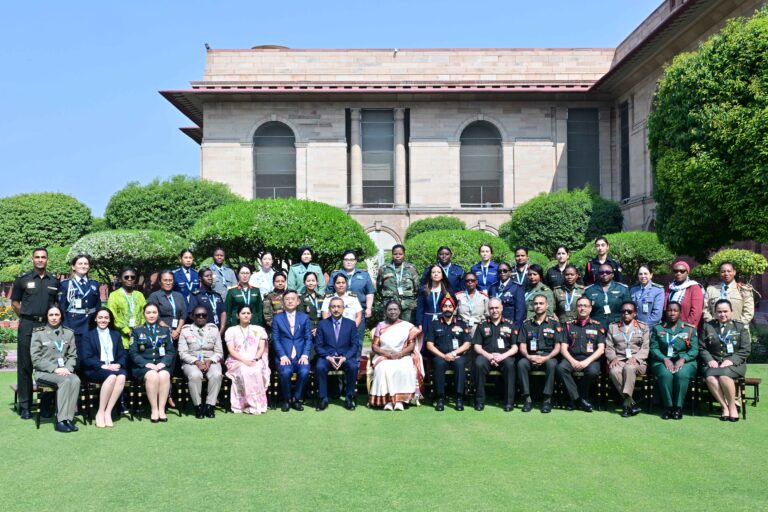
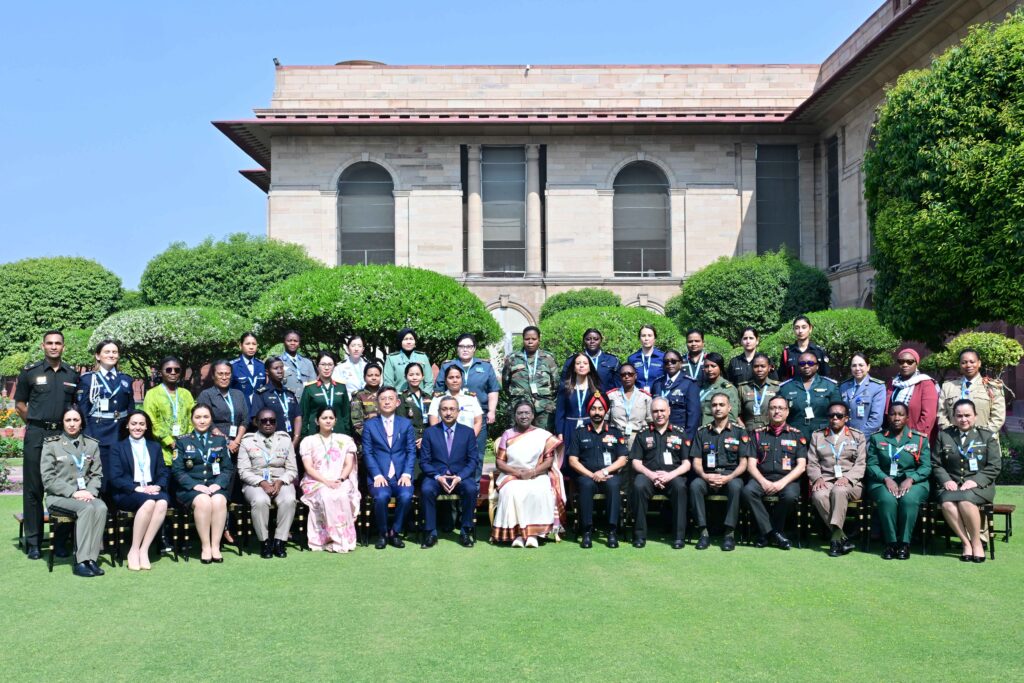
Delegates with the President of India: source Author
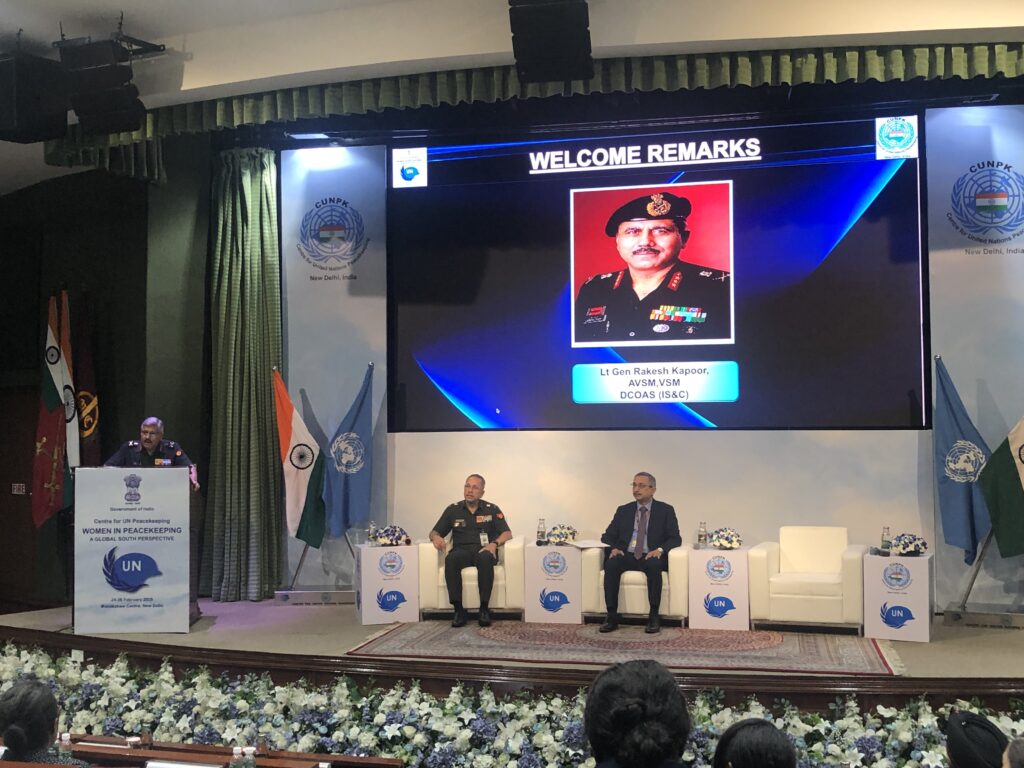
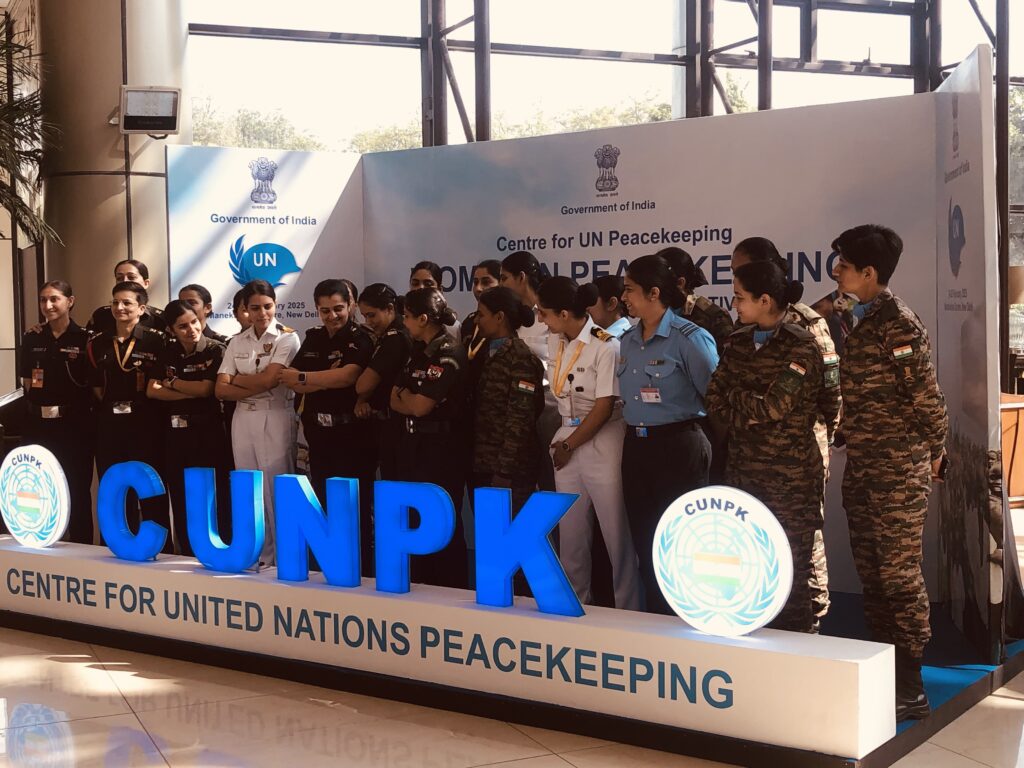
Women armed forces officers from 35 nations of the Global South are in New Delhi to participate in a first ever conference hosted by India, themed “Women in Peacekeeping: A Global South Perspective”, being organised by the Ministry of External Affairs MEA), in partnership with the Ministry of Defence (MoD) and Centre for United Nations Peacekeeping (CUNPK). This year marks 25 years since the adoption of the UN Security Council Resolution 1325, which deals with Women, Peace, and Security.
The conference is aimed at bringing together women officials from the Global South to discuss issues of contemporary relevance to peacekeeping and the various challenges being faced by peacekeeping missions, and reflect the progress made so far but also reaffirm the collective commitment of nations towards enhancing and empowering the role of women in peace and security.
The delegates met President of India, Smt Droupadi Murmu, who said that the presence of women in a peacekeeping mission makes it more diverse and inclusive. “Women peacekeepers often have greater access to local communities and can serve as role models for women and children. They are better equipped to address gender-based violence, build trust, and promote dialogue,” further adding that, “Peacekeeping missions with a higher percentage of female personnel have been more effective in reducing violence and achieving long-lasting peace agreements. It is therefore essential that we induct more women in UN peacekeeping missions,” said the President of India.
Conference in progress: source Author
India has a proud history of contribution to UN peacekeeping, with over 2,90,000 India peacekeepers having served in more than 50 UN peacekeeping missions, since the 1950s. Today, there are over 5000 Indian peacekeepers in nine active missions, deployed in often hostile conditions, for the cause of international peace and security.
Exhibiting the highest traditions of professionalism and conduct, India has been at the forefront of deploying women in peacekeeping roles, both military and police. The first chapter of this journey began in the 1960s, when Indian women, as medical officers, were deployed in Congo. In 2007, India became the first nation to deploy an all-women Formed Police Unit in Liberia—a pioneering initiative that had an indelible impact on both the host community and the broader UN framework. Over the years, this initiative empowered Liberian women, increasing their participation in security sectors. Today, India proudly continues this legacy, with over 150 women peacekeepers deployed across six critical missions, which are the Democratic Republic of Congo, South Sudan, Lebanon, Golan Heights, Western Sahara, and Abyei.
External Affairs Minister Dr S Jaishankar in his address mentioned about India’s singular focus towards the advancement of global peace and security, in the pursuit of which nearly 180 Indian peacekeepers had lost their lives. “One such individual, Captain Gurbachan Singh Salaria, posthumously honored with the Param Vir Chakra for his courage during the UN Mission in Congo, remains a beacon of inspiration. His is the singular case of this highest honor being awarded for operations conducted abroad,” said the EAM.
The Delegates: source Author
India has produced a multitude of exemplary women peacekeepers who have inspired others globally. Dr. Kiran Bedi, who served as the first woman UN Police Advisor, Major Suman Gawani and Major Radhika Sen, recipients of the UN Military Gender Advocate Award in 2019 and 2023 respectively, and Ms. Seema Dhundia, who led the first all-women Formed Police Unit in Liberia, are a few examples who have blazed a trail for others to follow.
The two-day conference in New Delhi is likely to play a crucial role in shaping the outcomes of two significant events due to take place this year, which are the Peacekeeping Ministerial in Berlin and the Peacebuilding Architecture Review in New York.
As explained by some of the visiting peacekeepers during interactions, that women peacekeepers often have unique access to local communities, acting as role models for women in conflict zones. Training courses tailored to include modules sensitising peacekeepers to issues related to women will enhance the effectiveness of peace operations.
Colonel Dilya of Kazakhstan Army has worked in Lebanon under UNIFIL as part of CIMIC (civil military cooperation). She was under the operational command of an Italian contingent. “My job was to interact with civil society, local administration and the military leadership in Lebanon and help in the repair and reconstruction work of roads, schools, hospitals and Churches, which were ravaged in war”, added Col Dilya.
Moroccan Army’s Colonel Hind Jirari has done a one-year tenure in South Sudan as part of Intelligence, before moving back to headquarters in Juba, the capital of South Sudan, where she was assigned an HRD (human resource development) role. Jirari says, “I have never faced any issues during my posting, in fact my knowledge of Arabic helped me in dispensing my duties in South Sudan, as the language used there is a certain dialect of Arabic.”
Tunisia’s Major R Salhi has been trained in Rwanda and is awaiting her posting to a UN mission. She is a specialist in general services.
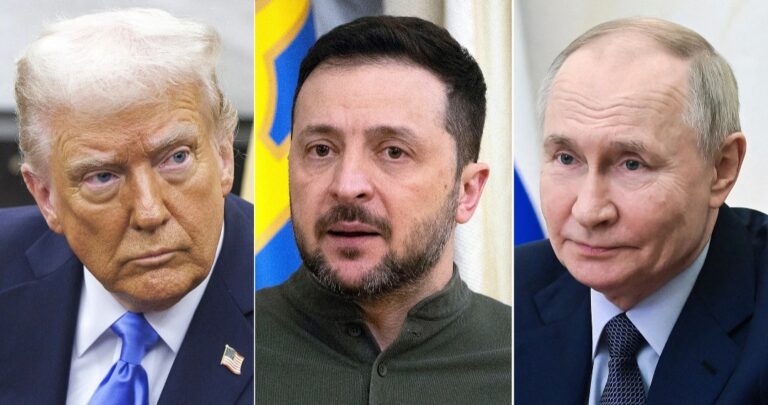
Presidents Donald Trump, Volodymyr Zelenskyy and Vladimir Putin: source Internet
As the Sun set on February 23, 2022 which was a Wednesday, the Ukrainians were looking forward to the last weekend of February a couple of days away, with almost every family planning a fishing, trekking, sight-seeing trip or a dinner in their favourite restaurants.
But all was to change before dawn the next day and this change would not only affect Ukraine but its ripples were to be felt globally.
The next day at 4.30 am on February 24, 2022 well before the sunrise, Russia launched a war on Ukraine. The Russia-Ukraine War as it would be known, was the biggest war that Europe would see after World War II and the “end of the era of peace dividend” which came with the collapse of USSR in 1991 and the formal end of Cold War 1.0 that had lasted from the end of World War II till USSR’s disintegration.
Russia’s invasion of Ukraine was certainly not a sudden decision. It was a result of the buildup taking place since USSR disintegrated on December 26, 1991.
Reasons for the Russia-Ukraine War
While the spotlight for the reason of the Russia-Ukraine War has been the expansion of NATO which includes the Ukrainian President Volodymyr Zelenskyy’s insistence on joining NATO, another reason of the outbreak of this war which needs mention is the internal disturbance in Ukraine, which has been purposely ignored by many, as it puts Ukraine in an uncomfortable position.
Expansion of NATO: Consequent to the meeting of the US President George W. Bush with the USSR President Mikhail Gorbachev in December 1989 in which the Soviet President was assured that the Soviet interests will not be harmed in the backdrop of the revolutions happening in Eastern Europe, the US Secretary of State James Baker met the Soviet President on February 09, 1990 in Moscow and promised that NATO, which was created on April 04, 1949 with 12 nations as its members, will not move one inch eastward.
The very next day, the West German Chancellor Helmut Kohl met the Soviet President and took his assent to unify both the Germanys. West Germany and East Germany unified on October 03, 1990.
After the British Prime Minister John Major assured Mikhail Gorbachev in March 1991 that NATO would not be strengthened further, the Soviet President believed the assurances of the US and UK leadership and dissolved the Warsaw Pact on July 01, 1991. At that point of time NATO had 16 members.
With the security cover withdrawn over the Eastern Bloc countries, and US reneging its promise of keeping USSR interests secure, the inevitable happened. USSR, one of the two superpowers, disintegrated into 15 nations in end-December 1991.
Thereafter, US went on a NATO expansion spree after the US President Bill Clinton on January 12, 1994 in Prague expressed his intent to expand NATO. And, by 2021, NATO had 30 members.
Since 1994, Russia had numerous talks with USA to stop NATO’s expansion but all talks failed.
In the 2008 NATO Summit held in Bucharest, Romania from 02-04 April, Ukraine and Georgia expressed interest to join NATO and Russia, the biggest country that was formed after collapse of USSR realised the danger that was closing in to its borders.
In August 2008, Russia invaded Georgia and in the 16-day war that lasted from August 01-16, 2008, Russia emerged victorious and a pro-Kremlin government was installed in Georgia and the issue of Georgia wanting to join NATO went on a back-burner.
Witnessing the Russian invasion of Georgia, the Ukrainian President Viktor Yushchenko who was in power from 2005-2010, too put on hold its decision to join NATO.
Internal Unrest in Ukraine: Viktor Yanukovych, who became Ukraine’s fourth President in 2010 and had pro-Kremlin leanings was not inclined for the NATO membership. Since he hailed from the Donetsk region of Ukraine having been its Governor and majority of the Donbas region in which Donetsk falls speaking Russian language, in 2012 he enacted the Kivalov-Kolesnichenko Law which made Russian as an official language of Ukraine.
Further, under Russian pressure Viktor Yanukovych withdrew from signing an association agreement with the European Union which was in an advanced stage of negotiations and instead accepted a Russian trade deal and loan bailout in November 2013.
This decision resulted in mass protests across Ukraine and with the civil unrest peaking in February 2014 in which more than 100 people died, the Ukraine Parliament impeached Viktor Yanukovych on February 22, 2014.
The very next day, the Kivalov-Kolesnichenko Law was repealed on February 23, 2014. The same day massive unrest started in Donbas, Odessa and Mariupol and mass defections started happening in the Ukrainian Armed Forces over the language issue.
Grabbing the perfect opportunity that the internal unrest created in Ukraine, Russia invaded Crimea on February 27, 2014which it had been eyeing for long as it overlooked the important sea-route from the Sea of Azov to the Black Sea passing though the Bosporus Strait, Dardanelles Strait in the Sea of Marmara to the Mediterranean Sea and finally linking to the warm waters of the Atlantic Ocean.
As the war in Crimea raged on between the Russian & Ukrainian Armed Forces, the Russian Navy destroyed three-fourth of the Ukrainian Navy and more than half of the Ukrainian Navy officers defected to Russia.
With the Ukrainian Navy crippled in the Crimean Peninsula, the war in Crimea did not last long and on March 16, 2016, Russia declared its victory in Crimea. On March 18, 2014, Crimea was incorporated as a part of Russia, consequent to a referendum held a couple of days earlier.
Meanwhile, the unrest in Donbas recommenced on April 12, 2014 and the Ukrainian Armed Forces launched a counter-offensive codenamed “Joint Forces Operation” for the territorial integrity of Ukraine.
Heavy fighting ensued between Ukrainian Armed Forces and the Donbas separatists completely supported by Russia.
Buildup to the 2022 Russia-Ukraine War
The first invasion in Europe after the World War II was the invasion of Georgia by Russia from August 01-16, 2008 which resulted in victory of Russia and the installation of a pro-Kremlin government in its capital, Tbilisi. Six years later, in 2014, Russia annexed Crimea from Ukraine.
The Russians were now confident of their military might and the weakening of the US-led NATO and the division, hesitancy and poor leadership in the European Union. On November 07, 2019, the French President Emmanuel Macron had described NATO as “brain-dead”. Clearly, all stars now aligned to Russia’s geopolitical and military advantage in Europe.
As Donbas started witnessing heavy fighting after Crimea was annexed, President Putin assessed that eventually Donbas will fall on its own to the Russians and thus for the next about seven years till February 2021, there were no plans of Russia to launch a full-fledged war on Ukraine.
However, in February 2021, the National Security Council of Ukraine banned three television channels which were owned by Viktor Medvedchuk, a Ukrainian oligarch with strong pro-Kremlin leanings. Now, television is the strongest medium to indoctrinate views and shift leanings. This act of Ukraine enraged Putin who saw it as a strong rebuttal to his long-term plans of Donbas ceding on its own from Ukraine to Russia.
Two months later, Putin and Russia’s Defence Minister Sergei Shoigu went on a vacation to a secluded resort in Serbia. It was here that the plan for Russia’s invasion of Ukraine was hatched. As a signal of divine blessings, Putin and Shoigu at the end of their vacation in Serbia went to meet a famed Serbian priest who lived in near vicinity and the duo were blessed by him and the priest gave the date of the invasion as February 22, 2022!
On return from the vacation in Serbia, Putin wrote a 5000-word article titled “On the Historical Unity of Russians & Ukrainians” which was uploaded on the Presidential website of Kremlin on June 12, 2021. This article has become a mandatory reading in all Russian military academies since then.
The preparation for Russia war on Ukraine began in right earnest.
While the US intelligence was sure of a large-scale invasion next year by Russia in early-2022, President Zelenskyy dismissed the idea of Russia attacking Ukraine. Thus, the subtle message to the Ukrainian military and the Ukrainian citizens was that Russia would never attack Ukraine.
Hence, life in Ukraine went on normal though the war clouds were darkening and the American intelligence repeatedly warning Zelenskyy of the impending war.
Russia, meanwhile was planning a three-pronged attack on Ukraine.
And on February 24, 2022 at 4.30 am early in morning, well before the sun could rise in Ukraine, Russia had invaded Ukraine from the northern, southern and the south-eastern fronts from Belarus, Crimea and the Donbas respectively.
It was not that the Russian offensive went on smoothly. There were serious flaws in the Russian military operations which have been discussed by the Author in an article published earlier.
However, as on date Russia controls 18.2% of the Ukrainian territory which includes a successful land-corridor from the Donbas region to Crimea, while Ukraine controls about 1200 square kilometres of the Russian territory, primarily in the Kursk region.
On the day Russia waged the war on Ukraine on February 24, 2022, the Russians controlled one-third of the Donbas region apart from the whole of Crimea, annexed eight years earlier.
Though today marks three years of the ongoing Russia-Ukraine War, the Ukrainians had already lost a large chunk of their land to the Russians before the war had begun on February 24, 2022.
Way ahead for the War
Whatever little hopes Zelenskyy had pinned on the US President Donald Trump for continued aid and assistance to Ukraine in its war against Russia were dashed on January 29, 2025 when the US President suspended all aid globally, except to Israel and Egypt.
And the final American nail on the coffin of Ukraine’s war efforts, came on February 12, 2025, when Pete Hegseth, the US Secretary of Defence in Brussels, rejected Ukraine’s bid for NATO membership and called the return to the pre-2014 borders in Ukraine as unrealistic.
Had the Ukrainian President studied international relations and geopolitics, he would have understood that in the past one decade the USA has never sent its military soldiers to any of its ally, whenever war has besieged them.
President Zelenskyy created conditions for Russia to wage a war on his country, which in simplistic terms can be described as fool-hardy. With over 100,000 Ukrainians killed and much of Ukraine reduced to dust and large swathes of land lost to the Russians, Ukraine stands at the same crossroads which it did a decade earlier, with no NATO membership on the horizon.
And to add wounds to Ukraine’s injury, on February 18, 2025, the global media reported of a “privileged and confidential” document of February 07, 2025 that the USA had offered US$ 500 billion to the war-torn Ukraine to take full control of Ukraine’s natural resources including rare earth minerals, oil and gas, ports and infrastructure with a warning that if Ukraine rejects this deal, then it would be handed over to Russia “on a plate”. This deal amounted to a higher share of the Ukrainian GDP than Germany’s First World War reparations and much harsher than the conditions imposed on both Germany and Japan after their defeat in World War II in 1945.
And on the same day the US offer to Ukraine leaked, senior US and Russian officials met for the first time since the outbreak of the war to discuss the end to this war. The American delegation was led by Marco Rubio, Secretary of State and the Russian team was led by Sergei Lavrov, Foreign Minister. The meeting in Riyadh ended on a positive note of ending the war, both for the USA and Russia. But with Ukraine left out of the meeting, for sure dark and gloomy days will continue for Ukraine even after the war ends.
The words of the former National Security Advisor of USA, Henry Kissinger “It may be dangerous to be America’s enemy, but to be America’s friend is fatal” would be ringing loudly in President Zelenskyy’s ears as he finds himself standing lonely on a steep precipice looking at the death and destruction in Ukraine including territorial loss due to his own grave blunder of having blind-faith in the American assistance resulting in the imminent Russian victory in near distance, and the mortgaging of Ukraine to USA lurking in the far distance.
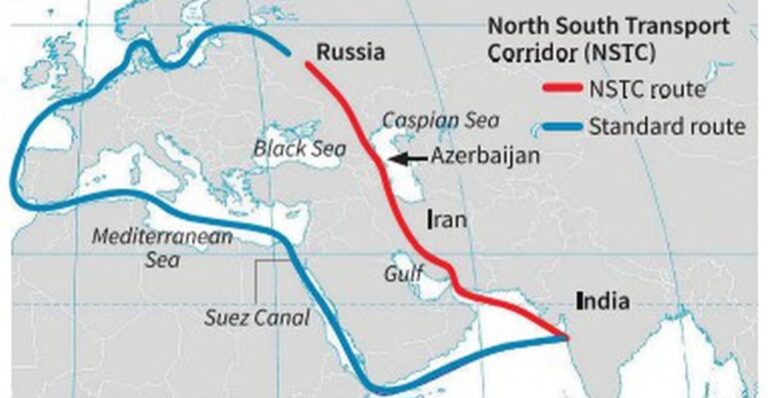
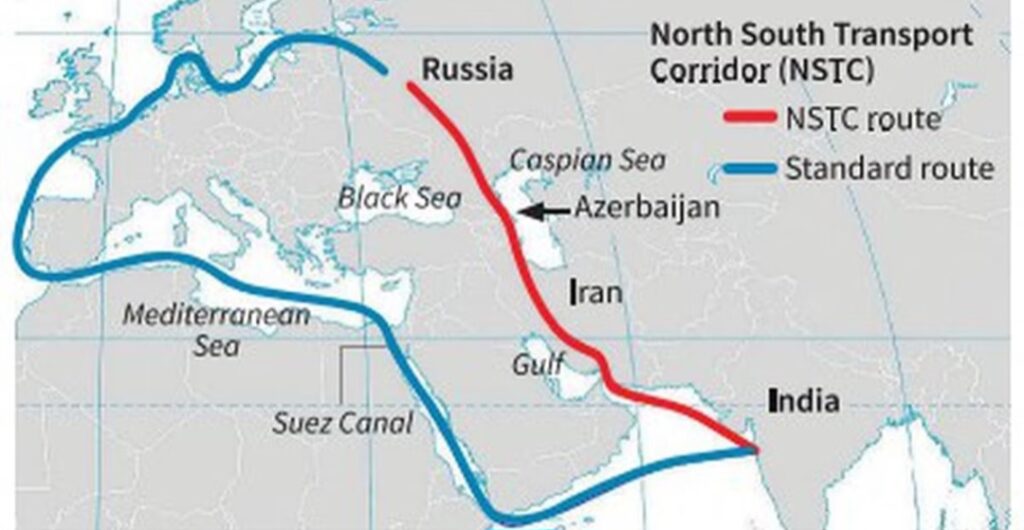
International North South Transport Corridor: source Internet
It’s an international corridor for transport from north to south, the corridor that stretches 7200 kilometers multimodal trade routes between India and Russia, connecting to Europe through Iran to Azerbaijan and Central Asia. This corridor was initiated by an agreement in between India, Russia, and Iran in 2000, and has already opened to the full participation of several other members, thus, it has proven out to be increasing in its significance on regional and global trade. Unlike the maritime route, which traversed through the Suez Canal, this offered a shortening and effective alternative route for freight transportation by rail, road, and water transport-the INSTC route.
Geopolitically and economically, the present Eurasia is the outcome of hundreds of years of trade, connection, and strategic competitions. As for geopolitical attributes, Central Asia has been the major historical scene, crossing places between Europe and Asia with rivalries among great powers because of where exchanges occur. In the modern context, owing to the natural resources embedded in Central Asia and the opportunity for connecting this region with the rest of the world, the vast majority of existing world powers such as China, Russia, and the United States have been queuing for possible positions or footholds to gain influence. India too has historical economic and geopolitical relations with Central Asia, which date back to the Silk Route era, when trade routes linked what is now Northern India with Persia, Central Asia, and possibly points further afield.
Today, the engagement for India in Central Asia is bound to be affected by geographical and political barriers as the region is landlocked and lies outside direct access from India to Central Asia through territory of Pakistan. It understands well the strategic necessity for alternative connectivity routes and thus has put its efforts in his direction in aims such as the International North-South Transport Corridor (INSTC) for broadening India’s economic footprint and strategic interests in the region. As a comprehensive, multimodal transport corridor between India and Russia and Europe through Iran and Central Asia, the INSTC has integrated itself fast into Indian regional strategy.
Connectivity, in its essence, is an inevitable pillar of regional cooperation and integration. The International North-South Transport Corridor (INSTC), to be based on a multi-modal transport system, is extremely important in linking India, Central Asia, Russia, and beyond. Enabled initially by an agreement in 2001 among India, Russia and Iran, the corridor has slowly developed to become an increasingly strategic reason for several other countries to join in.
In fact, it brings India close to a very promising alternative route to Central Asia, besides avoiding travel by Pakistan. The corridor joins India’s Mumbai and Kandla, with Bandar Abbas and Chabahar in Iran, connecting for almost all types of trade flows-surface, rail, and seas. Later-on, the goods from Iran are transported by sea, to the Caspian Sea to Russia and to Europe. This explains cost and time spent on it, which has decreased by around 50% or more than the previous route through the Suez Canal.
The INSTC may be the biggest enabling factor for expanding trade and economic linkages for India with Central Asia. Indian traders had traditionally used these land routes to trade in commodities; however, with newer geopolitical realities, they need to think of alternatives. Corridor means for carrying Indian goods from pharma, textiles, and machinery to the Central Asian market. On the other hand, for India, it still needs hydrocarbons that are present in large quantities in Central Asia, primarily oil and natural gas. The corridor thus promises to make for more regional efficiency and attractiveness with the addition of new partners like Azerbaijan, Kazakhstan, and Turkey.
Apart from the economic benefits, the INSTC is also strategically relevant to India’s foreign policy toward Central Asia. By increasing economic dependence on this part of the region, India may counteract a significant thrust of the Eurasian influence wielded by China because of the BRI. Also, the promotion of INSTC’s own part, namely Chabahar port, will ensure a connect for India’s connectivity into Afghanistan, thus ensuring less reliance on transit routes through Pakistan.
India’s Export Potential in INSTC Member Countries
According to 30 to 40% of average reduction in transit time and cost savings of about 30%, the INSTC now brings a national opportunity for India to expand its exports with eligible countries like Russia, Central Asia, Iran, and other member countries. The Indo-Russian trade is already exceeding US$ 50 billion and is expected to increase more with the needed acceleration provided by INSTC in the commercial exchanges in sectors where India has a competitive advantage in 2023.
Pharmaceutical products and healthcare commodities form among the most important exports. In 2022/23, pharmaceutical exports from India to Russia included only slightly less than that of $591 million. The increasing demand for affordable generics and medical devices found in Central Asia and Iran thus makes it very possible for the INSTC to act as a significant channel for India’s medical industry.
The engineering and machinery sector, which exported US$ 2.4 billion worth of goods to Russia in 2023, would benefit equally. Faster and more reliable logistics would enable the smooth functioning of the supply chain for automobile components, electrical equipment, and heavy machinery. Another sector with vast potential for export opportunities is IT and digital services, with the demand from Russia and Central Asian countries for Indian software solutions, fintech, and cybersecurity continued to grow.
India is already exporting US$ 567 million worth of tea, coffee, and spices to Russia and US$ 330 million of basmati rice to Iran for agricultural and food processing. The INSTC can increase agricultural exports by reducing spoilage and transit time hence strengthening India’s position as a key food supplier. In the textiles and apparel sector, another major sector, exports were pegged at USD 548 million to Russia and USD 204 million to Iran in 2022, while the corridor can serve to strengthen India’s competitiveness in these markets.
Challenges in the Operationalization of INSTC
The International North-South Transport Corridor (INSTC), which holds much strategic promise, has a number of barriers toward its uninterrupted realization. Infrastructure is one significant constraint, especially when it comes to the railway and road infrastructure in Central Asia as well as in the Caucasus. Somewhat well developed, although inefficient because of the delay of connectivity into the rail networks and between these with the transshipment facilities, are the transport networks across Iran, Russia, and India. Moreover, the Bandar Abbas and Chabahar ports in Iran need further expansion to catalyze heavier trade volumes.
Customs and regulatory issues are additional problems posed to trade flow. The varying tariff structures, complex customs procedures, and different documentation are lengthy bureaucratic delays in trade facilitation. In this, the absence of a Free Trade Agreement (FTA) between India and the Eurasian Economic Union (EAEU) works against competitiveness for India in these markets.
Financial issues with sanctions mainly on Iran and Russia create challenges to trade. Limited direct banking channels; alternative payment systems; and currency fluctuations, all contribute to the perceived risk to businesses.
A further impediment presents itself in the exotic realm of risks-the challenge posed by geopolitical factors. US-Iran tensions and sporadic conflicts between Azerbaijan and Armenia have created uncertainties along major transit routes. At the same time, the Russia-Ukraine war threatens other INSTC routes. In this context, China, with its Belt and Road Initiative (BRI), is constructing competing trade routes such as the Middle Corridor, thus siphoning off traffic from INSTC.
To tackle the situation the countries on the INSTC will have to work towards improving infrastructural development, regulatory harmonization, and advanced financial management. The active participation of India in enhancing logistics and trade facilitation will be helpful for realizing the entire potential of the corridor.
Conclusion
The multi-spherical International North South Transport Corridor (INSTC) is indeed a commendable advancement in global trade, providing India with an important link connecting Russia with Central Asia and Europe. Development of the corridor is a way of bypassing Pakistan and minimizing the utility of the Suez Canal. Consequently, not only can this reinforce India’s economic outreach, but also add to its geopolitical clout in Eurasia. Depending on how the INSTC program attempts to overcome obstacles arising from infrastructural constraints, financial bottlenecks, and regulatory complications, the project could totally reshape regional trade structures with the kind of fastness and cost-effectiveness which is otherwise not available via existing routes.
Export sectors such as pharmaceuticals, engineering goods, agriculture, and textiles will vary with potential benefits, courtesy of improved access to member states of INSTC. However, the total benefit realization via the corridor will need an integrated approach to put in place appropriate infrastructure, rule-based trade regulations, and financial arrangements. Agreement on such solutions would be necessary through regional cooperation, investments, and coordinated policy effort.
Global economic and geopolitical changes reshaping Eurasian connectivity today would render INSTC an important strategic asset for India, furthering India’s outreach as a major player in the region. By tackling operational impediments and improving trade facilitation, India can guarantee that INSTC develops into a fully functional, resilient, and competitive corridor propelling deeper economic integration and long-term regional stability.
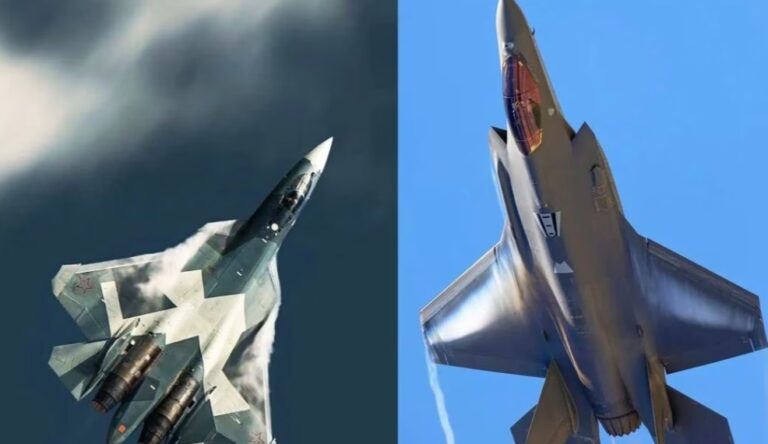
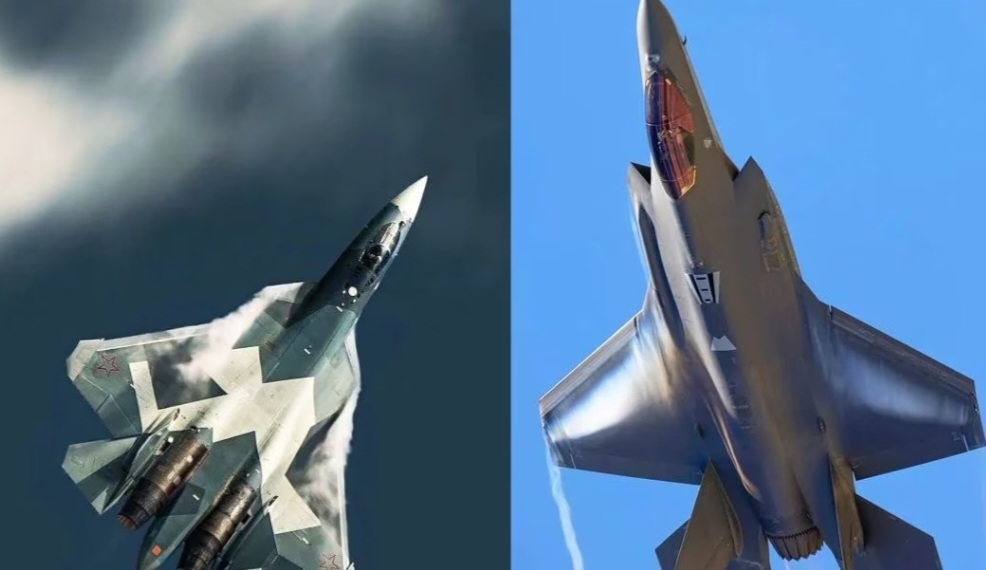
Recently, the United States President Donald Trump wants to ramp up weapon sales to India especially the F-35 Jets. Trump wants to sell these fighter jets to India they’re made by US defense major lockhead Martin’s F35, is a fifth-generation jet something which India needs. Now, New Delhi is spoiled for choice here because the Russians have also thrown their hat in the ring. Russia makes the Sukhoi Su-57 jet it has offered to make it in India for the Indian Air Force.
From February 10-15th, 2025, week both Jets were showcased at Air India Show 2025 and this has never happened before anywhere in the world, the F35 and the s57 at the same event. so New Delhi has a choice to make the offensive F35 or the defensive s57 which one is better? Who will give us a sweeter deal and which jet is more suited to India’s needs?
The Russian Su-57 felon and Lockheed Martin’s F35 lightning both are advanced fifth generation fighter aircraft made by rival countries participated in the same space which India’s defense Ministry has described as historic and this moment comes at a crucial time when India is seeking to bridge its fifth-generation fighter gap. It may not be long before that happens during his high-profile meeting with prime minister Narendra Modi US president Donald Trump has extended an offer to India to purchase the F35.
Trump plans to ramp up weapon sales to India this year and this includes the US made F-35 Jets if the deal comes through India would join a small club of nations including Israel Japan and NATO states which are allowed to buy these aircraft from the US but Washington is not alone in wanting India to buy its fifth gen fighter jets so is Russia while India is a long-standing customer of the US defense industry its top supplier has historically been Russia.
New Delhi depends on Moscow for nearly 60% of its defense equipment the war in Ukraine has added doubts about future supplies but Moscow is looking to boost its defense ties with New Delhi a few days ago Russia offered to make its Su-57 in India for the Indian Air Force.
Which fifth generation Fighters is better suited for India?
The F-35 is a single engine stealth multi-roll fighter aircraft while, the Su-57 is a twin engine stealth multi-roll fighter aircraft. the F35 has a top speed of Mach 1.6 the Su 57 has a top speed of Mach 2. Both the Jets are designed to perform a variety of missions including air-to-air combat and air to ground strikes.
The F35 has a combat range of about 1,500 km while the Su 57 has a combat range of about 1,900 km but when it comes to stealth the F35 has more advanced capabilities it’s equipped with sophisticated avionics and sensor systems simply put the F35 has offensive strengths while the s57 is defensive now.
India would need to look beyond just the capabilities or the cost, all the S-57s have been produced in smaller numbers they haven’t actively participated in combat operations meanwhile, the F-35 is part of many Air Forces more than a thousand aircraft are in active service. the jet is combat proven plus India is also focusing on developing its own fifth generation Fighter (the AMCA) aircraft a single seat twin engine fifth generation stealth multi-roll combat aircraft which has become a focus.
Is India ready for air supremacy?
On Februrary 6, 2025 (Thursday), an Indian Air Force mirage-2000 fighter plane jet crashed in Madhya Pradesh, while the pilots ejected safely in time and escaped with minor injuries but what led to this crash?
The Air Force says a systems malfunction they have ordered an investigation into the crash. We know that mirages are part of an aging Indian Fleet they were manufactured by French company Dassault aviation. India bought 24 retired mirages from France not to fly them but to use them for spare parts and we are considering similar deals with Greece and Qatar. the hope is to somehow extend the lifespan of the mirages the goal was to retire them by 2030 but now they’re expected to fly into the 2040s and why is that?
The major reason is replacements which are not ready as IAF are already phasing out old Soviet Jets so they cannot retire the mirage yet the numbers won’t allow it. IAF has a sanctioned Squadron strength of 42 but only 29.5 up and running and each Squadron has around 18 fighter jets. that’s one big challenge for India’s Air Force to expand our Fleet of jets even the IAF Chief flagged it recently he lamented the delay in India’s homegrown fighter jet program. So, quantity is one problem but so is quality.
On the other side, China already has a fifth-generation fighter jet recently they debuted a sixth-generation jet as well, a futuristic stealth plane. India’s other rival, Pakistan is expanding its fleet. Reports say they will buy fifth gen planes from China.
From Stealth to Nuts & Bolts: F-35 Lighting vs Su-57 Felon
Both of these two aircrafts were designed with very different goals in mind shaped by different economic and military priorities. In reality the Su 57 works best for Russia while the F35 is more aligned with US defense needs.
The US has a defense strategy based on offensive operations, basically striking first and doing it at long range Russia on the other hand focuses more on defensive strategies mainly because of its vast borders and the need to protect its own territory from numerous adversaries.
The Su-57 is built for short range air defense and intercepting intruders in contested airspace especially near Russia’s borders it’s designed to stop enemy fighters and air strikes from breaching Russian defenses on the flip side the F35 is all about penetrating heavily defended airspace targeting enemy air defense systems and striking from long distances think of the F-35 as the US’s offensive tool while the s57 serves as Russia’s defense Shield
Who’s got the better height?
In terms of stealth both planes are stealthy but they handle it differently, the F35 as ultra-low radar cross-section of just 0.15sm making it nearly invisible to the radar it’s got all aspect stealth meaning no matter where a radar is positioned be it front-back or side it’s tough to spot. The su-57 do stealthy has a larger RCS between 0.1 and 0.5 squ/Mtr. it shines when flying head from the front it can sneak up an enemy including the F35 but if it flies into contested airspace from any other angle it’s easier to detect so the F35 has the edge in staying hidden in a wider range of situations
The Su-57s radar Suite is pretty impressive it’s got five Radars including three x-band ASR Radars and two l-band Radars.
The L-band Radars are particularly effective against stealth Fighters like F35 which are optimized to dodge x-band Radars but combining all of its radar systems the s57 can track an F35 from such farther away than one radar alone could that said the F35 isn’t entirely defenseless. it’s designed to disrupt and neutralize enemy air defenses so it could likely penetrate Russia’s multi-defense systems but if the Su-57 is in the mix, it might have better chance of intercepting an F35 in Russia’s airspace
The F35 is made for offense it can get deep into contested airspace undetected locate and identify enemy targets and pass that information to other Fighters it also has limited ground attack capabilities though it’s not as focused on that as it is on striking targets from distance
the s57 on the other hand was designed more for defensive roles it can intercept incoming threats like the F-35 and engage ground Targets in Friendly airspace but lately Russia has been upgrade trading the s57 with long range stealthy missiles giving it a bit of offensive capability as well however the F35 still holds the advantage.
So, who will win the race?
At the end it all boils down to what the IAF values more if they need more cost-effective solution, that can defend the skies and take on offensive operations from inside their own airspace the Su 57 might be the better-fit. but if India leans towards offensive capabilities the ability to strike first and the political alignment with the United States, the F35 could be worth the investment, either way it’s a tough choice each fighter brings something important to the table.
Special thanks to Jai Verma for guiding me throughout the research. His domain knowledge and technical expertise in defence technologies played crucial part in enriching the write-up.
Sri Lanka’s politico-economic trajectory has been unique and also a basket case of governance failure and (near) state collapse. In its history, it has been forced to seek IMF assistance 16 times since 1965- marking a chequered history of civil war, political assassinations, terrorism, economic challenges and constitutional crisis. The latest downturn came with COVID-19 headwinds. Factitious social relations between ethnically dominant Sinhalas and Tamil Hindus, Muslims and Christians, along with regional divide, are all well-known constituents of this postcolonial littoral Asian state. The deadly mix of social disunity, economic mishandling and political cronyism produced the latest upheaval. However, within this tale of multiple governance mistakes, there is also a jubilant reassertion of people’s aspirations and tenacity of Sri Lankan identity after the watershed 2024 elections.
The recent presidential and parliamentary elections delivered a clear break from the past by ushering in the National People’s Power (NPP) government in parliament. For the first time in Sri Lankan history, second-round ballots were counted in Presidential elections – installing the underdog Anura Kumara Dissanayake (AKD). The 2022 sovereign default of over US$ 50 billion was a landmark moment in Sri Lankan political and economic history, culminating in widespread structural economic woes like hyperinflation, non-availability of essentials, rapidly diminishing foreign reserves and mounting government deficits. There had been ample warning signs. Sri Lankan debt to GDP ratio rose to 115.5% in 2022 on the eve of economic collapse. Curiously, the steadily increasing Foreign Direct Investment from 2020-22, matched by a healthy inflation rate of 4.6% in 2020, rapidly metamorphosed into an economic calamity, charting a rise to 69% in 2022.
Significant trends in the elections
While the ‘Aragalaya’ movement and Gota Go Gama street protests forced President Gotabaya and Mahinda Rajapaksa out of power, India took steps to mitigate the humanitarian suffering by offering US$ 4 billion in aid, currency swaps, loan deferrals, and supply of essentials. China initially hesitated to take interest cuts on Sri Lankan loans only agreed to restructure debts after the Official Creditors Committee (of which India is a part) restructured Sri Lankan debts. While the US$ 2.9 billion loan from the IMF stabilised the economic shock, its political spillover was all but certain. Career politicians and elite parties were voted out, with the anti-systemic, pro-poor coalition NPP sweeping both presidential and parliamentary votes. India was quick to gauge the turning wheels (unlike Bangladesh) and had invited AKD months before the elections for a tete-e-tete.
As Rajapaksas fled after the economic meltdown, Ranil Wickremesinghe and his team of senior economists negotiated with the IMF and steered the path in a highly volatile situation. He had the tough task of reining in inflation and pacifying the rising public anger at the generations of political and economic incompetence. The belle of the ball – the Janatha Vimukthi Peramuna (JVP) party of AKD has its roots in the militant leftist movement of the 1970s with a history of opposing regional autonomy for Tamils. It and 21 other political parties inaugurated the NPP coalition in 2019. AKD won only 3.16% of the votes in the presidential elections that year, while JVP bagged only three parliamentary seats. With catapulting socio-economic conditions, its fortunes, too, have somersaulted. As it cut back on Marxist-Leninist rhetoric and rebranded itself as a pro-people progressive force in Sri Lankan politics, NPP has taken the road to political power by fielding professionals, artists, and activists against entrenched dynasts (Prime Minister Harini Amarasuriya has been a university professor).
The Tamil common candidate failed to garner a majority vote in the region. Despite JVP’s opposition to devolution under the 13th amendment, AKD managed to secure second highest votes in some districts in the East, with Sajith Premdasa (opposition leader) bagging higher overall support. Further, election campaigning this season was devoid of ethnic and religious polarisation, a pleasant evolution from the low of the 2019 Easter attacks. NPP has consolidated a broad support base of governance-centrism while eschewing sectarian and communal angles. Plummeted vote shares of Namal Rajapaksa, SLPP candidate and Ranil Wickremesinghe (seen complicit in corruption and misgovernance) reflect people’s frustrations with traditional political scions.
The consultative practices followed by NPP in discussions with the electorate, IMF, and foreign countries and proposing a pragmatic 128-page manifesto area marks a fresh start from the oligopolistic and closed-door dealings of Rajapaksas. With several failing regimes in South Asia (Afghanistan, Pakistan, Myanmar) – Sri Lanka could have been added to this list. Still, it is to the credibility of a responsive domestic political system that acknowledged people’s anger and effectuated a change of guard. Post-election, AKD has already measured down on some of his demands to temper down harsh austerity measures of the IMF. But now he has to navigate promised tax cuts, increased welfare spending, and economic recovery. However, a stable and inclusive political environment is currently a ray of light for the island nation.
Messages for stakeholders
23.7% of Sri Lankan import comes from China (the largest partner), with India a close second with a 22.1% share. Significant foreign aid is tied to structural reforms for opening up and liberalising key sectors and may face resistance from traditional constituents. For example, Sri Lankan fishermen face stiff competition from mechanised Indian trawlers. Investors would do well to involve local communities in sustainable endeavours. NPP has promised to review controversial foreign projects but must also evaluate their revenue-generating potential. In view of the controversy, Adani Group quit its proposed Mannar and Pooneryn wind energy projects where the tariff, according to AKD, had been excessively priced at 8.26 cents or US$ 0.0826. A resilient economy with diversification beyond tourism and export of primary commodities (which, along with remittances, had dwindled in the COVID-19 pandemic, leading to the economy’s free fall) is the need of the hour. High tax rates and labour market issues led to the collapse of the MSME sector – its revival is critical to Lankan recovery. According to the World Bank, labour force participation continues to fall from 49.9% in the first quarter of 2023 to 47.1 % in the first quarter of 2024.
Foreign intervention was a major electoral issue, with AKD promising a balancing act between India and China. While India is funding capex like energy, connectivity, and housing projects, China is pursuing a ‘slow swallowing strategy’ with predatory foreign aid (Hambantota project and cucumber farms in Jaffna). High-interest commercial loans continue to expose Sri Lanka to external vulnerabilities and pose significant long-term credit risk. IMF’s $3 billion bailout hinges on the pruning of unsustainable debt-to-GDP ratio and policy predictability (avoiding ad hoc arbitrary straightjacket measures like introducing organic farming in one fell swoop). NPP has a golden chance to correct the social strife and disenfranchisement bred by majoritarianism and economic mismanagement and reclaim Sri Lankan autonomy in foreign dealings.
Lingering aftershocks remain, with 23.7% of households being food insecure and 26% consuming an insufficiently nutritious diet in 2023. The main pain point of net zero foreign currency reserves has been tentatively resolved with a 7.3 % appreciation of Sri Lankan Rupee between January and August 2024 and an official reserve of US$ 6.1 billion by the 2024 end. The reform measures for macroeconomic stability entailing prudential pruning methods such as tweaks in monetary policy, internal debt restructuring, market-sensitive utility pricing, and rational revenue measures have ushered in some semblance of stability and hope. Still, the sustainability and deep-rootedness of revival are questionable as much of these buds of recovery are due to inflows from partner states, increased tourism receipts and remittances. Tell-tale signs like as contraction of real wages by 16.9 and 22% between 2021 and 2024,
FDI has increased post-elections, with Japan, China, and India announcing new projects and resumption of suspended ones. After stabilisation, foreign tourist arrivals have increased by 38% from 2023, along with a rebound in remittances. However, many of its skilled professionals have been leaving the homeland – with 3,00,000 individuals migrating in 2024 alone. This brain drain can be converted from a short-term challenge to a long-term ‘brain circulation’ of rebranding the island economy as a service exporter and smoothing out the long-term economic prospects for prospective returnees. Sri Lanka has tasted ice and fire from rapacious foreign investment proposals (leasing Hambantota Port to China for 99 years) and heavy dependence on commodity exports. The contradiction in ‘comfortable’ per capita incomes (US$ 3342 in 2022 – at the height of slowdown compared to roughly US$ 2352 in India) despite being a low-income country was brought forth in this recent economic crisis. Repeated bouts of political and social turbidity further compound the structural weaknesses of the Sri Lankan economy. Coupled with the disastrous 2019-22 “homegrown solutions” or domestic economic experiments. Learning its lessons, a Financial Stability Fund was operationalised, with a Public Debt Management Office (PDMO) to be unveiled by 2025 end.
Cue for a resurgent Sri Lanka
Green shoots have been recorded, such as a low unemployment rate of 4.7% (2023) coupled with a current account surplus, increasing growth, rising remittances from abroad, and disinflation after 6 successive quarters of negative growth in 2023. The new Sri Lankan government is prioritising inclusive growth by putting women at the centre stage for economic growth (they constitute 56% of the Sri Lankan electorate). Still, it has far to go with only two women cabinet ministers in a 21-member strong cabinet. According to the Sri Lankan Central Bank’s ‘Policy Agenda for 2025’ and beyond, the tentative recovery is premised on an accommodative stance and low inflation stimulating economic activity. By bypassing crowding out of investment, the private sector could secure a much larger share of funds in 2024. To strengthen the banking sector’s resilience, Bank Recapitalisation Strategy for nine public sector banks was prepared. The dominance of state-owned enterprises (SOEs) or public sector units (PSUs) is a distinctive feature of the Sri Lankan economy (much like its dominant position in India a few years ago). The government is reportedly considering restructuring, not disinvestment, to turn around the fortunes of these SOEs.
Presiding over a turnaround, the prospects of a democratic deepening and long-term economic reforms seem vivid. This has come as a relief coming after the colossal blunders in Rajapaksa’s reign. The continual decline of tax revenue from 1991 (compounded by a 30% cut in tax demand in the 2022 budget), substantial debt liability from Chinese and private investors’ loans and the final blow of COVID-19 sealed Sri Lanka’s fate. The government then not only failed in handling the pandemic and allaying the foreign investors’ concerns in its debt repayment capacity. The rate of interests of these loans then began to rise – much beyond the government’s capacity to refinance. Even then, the Rajapaksa government decided not to approach the debtors for restructuring constructively and took an overnight ad hoc decision of banning chemical fertiliser imports ostensibly to promote organic cultivation and reduce import bill.
It can reduce dependence on foreign aid by better capitalising on its strengths – marketing itself as a multicultural tourist experience and supporting micro businesses by wellness and hospitality agents. Further, the robust migration networks and garment-tea export can be tweaked to align with global supply chains. Inclusivity and participatory growth can do wonders for this island economy. A recent Sri Lankan parliamentary debate focused on women’s unpaid role in the care economy – a positive development to re-envision the economic contributions of vulnerable sections. A similar focus on other marginalised groups like Tamils and their concerns about labour (tea industry), fishing, and land rights would also be a welcome step. The government has already promised to return Tamilian lands occupied by the government during the deadly civil war. Keeping in pace with changing times, the AKD government ushered in the digital revolution by launching the ‘GovPay’ government digital payment platform and the ‘eBMD’ system for birth, marriage, and death certificates through embassies.
The 2025 budget presented by President Dissanayake has expressed hope for a 5% growth and rising exports of goods and services worth US$ 19 billion (2025). He reported the comfortable forex reserves of December 2024 to be US$ 6.1 billion. The Sri Lankan Rupee is also trailing with a decent exchange rate – LKR 300 worth US$ 1 or INR 88.17. However, he also recognised the high cost of living and the fall in real wages. The sharp increase in poverty has been noted since the 2022 crisis, reaching 25.9% in 2023. AKD has prepared a social welfare (Aswesuma) focused spending plan focused especially on health and education without compromising IMF confidentiality of capping welfarist spending at 0.6% of GDP. This made some point that half of government expenditure has been allocated only for debt payments.
It is clear from the recent toppling of ‘democratic’ South Asian regimes that people’s trust and sound financial management go hand in hand. Sheikh Hasina’s Bangladesh was touted as a poster boy of low-income economic growth while Sri Lanka was seen as a ‘basic needs’ success story – but this strength turned out to be paper tigers. By embodying significant diversity, regional differences and cycles of economic boom and bust, Sri Lanka has narrowly escaped falling into innumerable dreadful possibilities after the Rajapaksa’s mishandling, like a military coup and civil unrest culminating in state failure. Reforms like abolishing the executive presidency, abating institutional corruption, devolution of power through implementation of the 13th amendment, able monetary and fiscal policies, and ditching the focus on ‘bigger and better’ infrastructure projects (often financed with debilitating debt-creating foreign investments) can be the goals for Si Lankan resurgence.
As India’s aerospace public sector unit – Hindustan Aeronautics Limited (HAL) faced flak over the indigenous Light Combat Aircraft (LCA) Tejas Mk-1A’s delay owing to delayed engine supplies by the US engine manufacturer GE Aerospace, global engine giants could be seen displaying their cutting-edge propulsion systems at the Bangalore-based biennial airshow-Aero India.
When GE Aerospace was asked about their two-year delay in the 99 F404 IN20 engines which would power the Indian homegrown fighter LCA Tejas Mk-1A, they attributed the delay to the pandemic-related supply chain disruptions, component shortages, and logistical challenges.
For GE Aerospace, meeting the revised March 2025 deadline is crucial—not only to regain the confidence of Indian defence authorities but also to strengthen its strategic foothold in India’s defence market, as their other contract for the F414 engines to power the LCA Tejas Mk-2 and the indigenous fifth generation advanced medium combat aircraft (AMCA), also has its fate hanging in the balance. The F414 MoU (memorandum of understanding) was signed in June 2023. According to HAL CMD (Chairman and Managing Director) Dr DK Sunil, the F414 contract would have its first meeting at the end of this month in two phases, one of which is about transfer of technology (ToT), as HAL has demanded a 80 percent ToT and the second phase would be about price negotiations.
GE Aerospace Signs Contract with Indian Air Force for T700
GE Aerospace signed a five-year Performance Based Logistics (PBL) contract with the Indian Air Force (IAF) to provide a comprehensive sustainment solution for the T700-GE-701D engines powering the IAF’s fleet of AH-64E-I Apache helicopters, at Aero India 2025.
Under this contract, GE Aerospace will be responsible for the Maintenance, Repair, and Overhaul (MRO) of the T700 engines as well as flight parts to ensure engine availability to the IAF. The PBL solution is designed to streamline engine sustainment operations, improve turnaround times, and enhance the availability and operational readiness of the Apache fleet.
“We are honored to continue our partnership with the IAF through this PBL contract, which underscores our commitment to deliver reliable and innovative sustainment solutions for critical defence platforms,” said Youngje Kim, Vice President and General Manager, Asia Pacific, Defence Systems for GE Aerospace. “This agreement demonstrates GE Aerospace’s focus on supporting the IAF’s operational needs and mission readiness by ensuring the T700 engines are maintained at the highest level of performance.”
The T700/CT7 family of turboshaft and turboprop engines powers 15 types of military and civilian helicopters and fixed-wing aircraft with more than 130 customers in over 50 countries.
More than 25,000 T700/CT7 engines have been delivered and approximately 130 million total flight hours accumulated. The T700/CT7 design has proven itself in the harshest environments, logging millions of flight hours in hot-harsh combat zones like Iraq and Afghanistan.
United Engine Corporation showcases state-of-the-art Russian aircraft and helicopter engines at Aero India
The Russian United Engine Corporation (UEC), a subsidiary of the Rostec State Corporation showcased its latest advancements in aero engine technology at the Aero India airshow. The company highlighted the fifth generation 177S engine, designed for use in fighter aircraft, and the newly developed VK-650V engine, intended for light helicopters. For the first time at Aero India, UEC displayed the VK-650V turboshaft engine, which has received the Type Certificate in Russia and is ready for series production. The engine is designed to power Russian helicopters such as the Ansat and Ka-226T. Its design also allows it to be used on other helicopters and potential future airborne platforms.
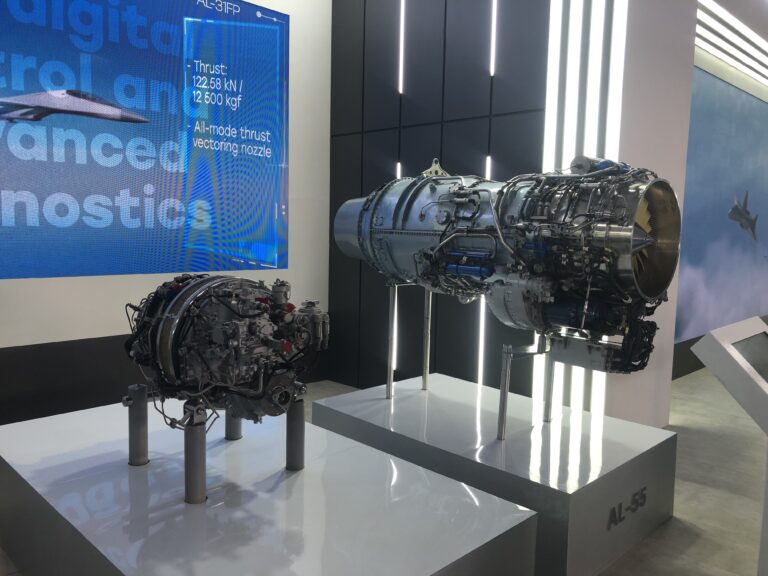
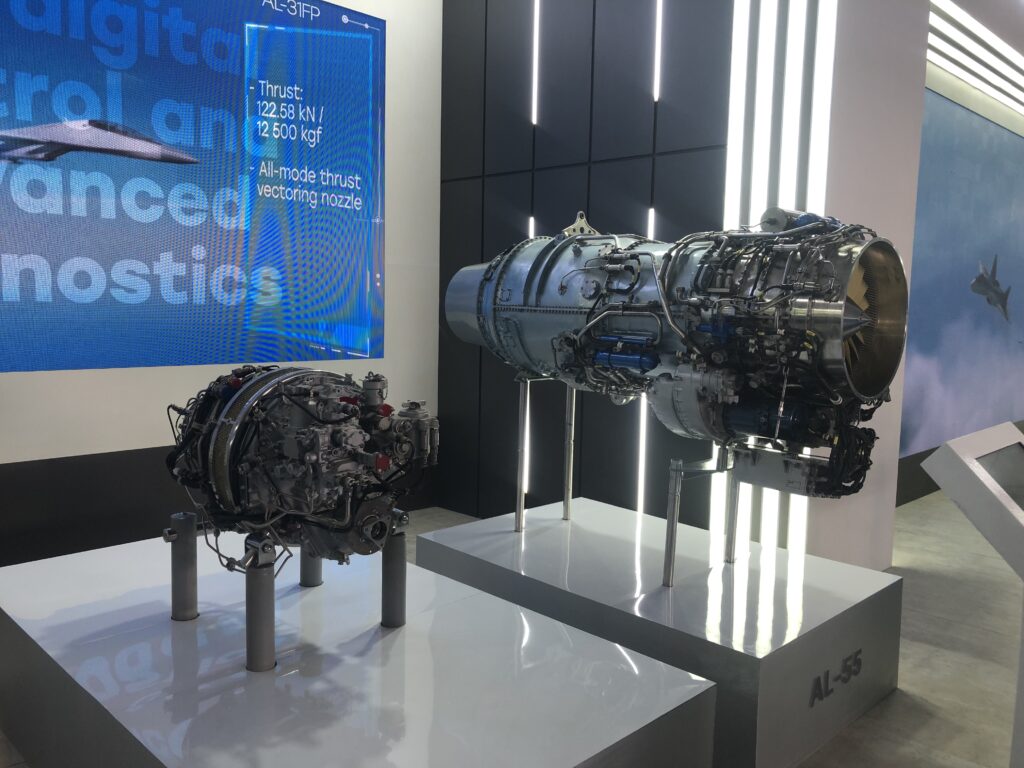
A full-scale mock-up of the latest 177S fighter engine was on display at the UEC stand. The innovative design solutions implemented in this new engine ensure a significant increase in thrust while maintaining the same dimensions as the base AL-31FP engine currently in service in India on the Su-30MKI aircraft, which is manufactured locally at HAL Corporation. The 177S engine has a service life of 6,000 hours, with the potential to increase thrust if service life requirements are reduced. The 177S engine features reduced fuel consumption in all operating modes, resulting in lower operating costs.
“UEC, as part of the Rostec State Corporation, is expanding its range of aviation engines for modern aircraft and helicopters, creating new powerplants to meet customer requirements. The 177S engine is classified as a fifth-generation engine and can be installed on both previous and new-generation aircraft without any design modifications. The new VK-650V turboshaft engine can be used on both Russian and foreign light helicopters. We have already received the type certificate confirming that the engine is ready for serial production,” said Mikhail Remizov, UEC Deputy General Director for Strategy, Program-Project Management and Organisational Development.
UEC also presented the AL-55E engine for trainer aircraft. It has been specially developed by UEC for the Indian HJT-36 trainer. This engine has several advantages, in particular its modular design, which simplifies maintenance and repair and reduces operational costs.
The Joint Stock Company UEC (part of the Rostec State Corporation) is the only company in Russia specialising in the development, serial production, and service of engines for aviation, space programs, the oil and gas industry, and energy sectors. Rostec State Corporation is the largest machine-building company in Russia, bringing together over 800 scientific and production organisations across 60 regions of the country. It plays a key role in supplying armaments and military equipment as part of the state defence order.
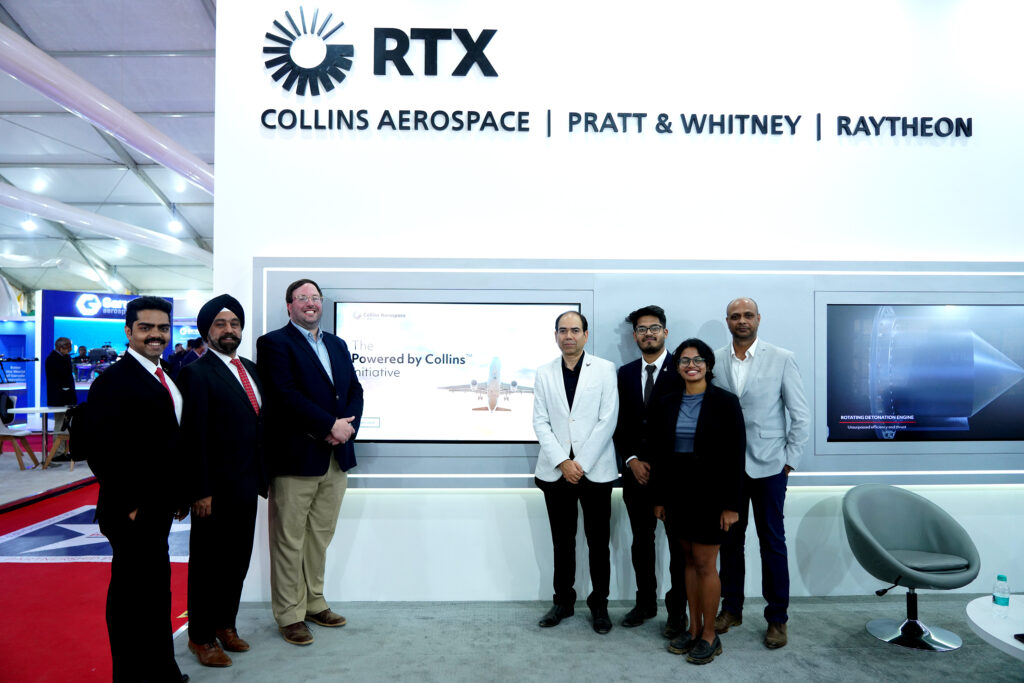
Collins Initiative 2025: source Author
Safran selects TEAL for the production of LEAP engine turbine parts in India
At Aero India 2025, Safran Aircraft Engines, a world-leading French engine manufacturer specialising in the design, development and production of aircraft engines, and the Bangalore-based Titan Engineering and Automation Limited (TEAL), signed a contract for the production of parts for the LEAP engine’s low-pressure turbine.
This first partnership between the two companies leverages TEAL’s technological expertise and will enhance production capabilities for the LEAP in India. Production of the first parts will start in 2026.
This contract is part of the “Make in India” policy promoted by the Indian government to support the country’s aerospace growth. In this context, Safran Aircraft Engines is developing a complete industrial ecosystem in India, backed by major Indian partners to support the ramp-up of LEAP production, as well as the M88 engine powering the Rafale.
“We are proud to collaborate with Safran Aircraft Engines on this strategic project. This partnership reflects our expertise in the production of complex parts, and strengthens our position as a key player in the aerospace supply chain,” says Sridhar Neelakantan, CEO of TEAL, adding, “We look forward to applying our know-how to the production of the LEAP engine, and to contributing to its expansion in India.”
“We are delighted by this new partnership with TEAL, which marks an important step in our development in India and the setting up of local supply chains,” adds Dominique Dupuy, Purchasing VP at Safran Aircraft Engines, adding, “We look forward to working closely with TEAL, a major partner of our supply-chain in India.”
Safran Aircraft Engines is thus strengthening its footprint in India, a key market where the company already has five production sites in Hyderabad, Bangalore and Goa. A sixth site, dedicated to LEAP engine maintenance, repair and overhaul (MRO) activities, will open in Hyderabad in 2025. India is CFM’s third largest market in terms of the number of engines in service, with 75 percent of the Indian commercial fleet equipped with CFM engines. Today, of the 500 aircraft operated by seven Indian airlines with CFM engines, over 370 are LEAP-powered, and over 2,000 engines are on order are for Indian airlines.
In addition to the announcement of its partnership with TEAL, Safran Electronics & Defence also announced the expansion of its activities in India with the opening of a new production site for electronic cards and aeronautics and defence calculators in Bengaluru, as well as a new research and development (R&D) center in electronics.
These sites will contribute to the international expansion and exports from India of Safran Electronics & Defence in the fields of defence, space, and avionics. They will reinforce the strong ties between Safran Electronics & Defence and its Indian customers and partners by simplifying industrial schemes, especially to accelerate the availability of critical equipment.
“This double investment, a significant step in the development of Safran Electronics & Defence’s industrial and R&D activities in India, aims to enhance the competitiveness and local integration of industrial and technological activities. This project, which aligns with the government’s Make in India program, demonstrates Safran’s commitment to leveraging the skills and talents of the Indian industry while actively contributing to the industrial growth of the country,” reiterated Franck Saudo, CEO of Safran Electronics & Defence.
In Historic Partnership BEL IAI Aerosystems begin operations to support India’s Defence Forces
Heralding a new chapter in Indo-Israeli defence and security cooperation, a landmark joint venture between Navratna Defence PSU Bharat Electronics Limited (BEL) and Israel Aerospace Industries (IAI) announced the commencement of its operations at Aero India 2025.
The JV is a significant step towards strengthening international collaboration, paving the way for a robust strategic partnership envisaged to provide a single point of contact for extending long-term product support services for India’s defence Forces.
Incorporated on September 25, 2024, BIA is uniquely positioned as the exclusive support entity for post-warranty maintenance of India’s defence systems. This initiative leverages manufacturing capabilities and technological innovations, fostering India’s self-reliance in sync with the ‘Make in India’ vision even while delivering world-class solutions.
Beyond post-warranty maintenance, this collaboration will also lead to the transfer of advanced technological capabilities to India, enabling the development of local expertise in critical defence systems. By establishing a dedicated support infrastructure, the JV will empower India to operate, maintain, and enhance its defence systems independently. The venture’s long-term impact extends to creating job opportunities, upskilling the local workforce, and contributing to the growth of India’s defence manufacturing ecosystem, reinforcing the nation’s position as a global defence player.
Boaz Levy, President and CEO of Israel Aerospace Industries, said: “This collaboration is a historic milestone as it marks the first-ever joint company established by leading defence firms of Israel and India. It reflects the robust and flourishing relationship between the two nations, and we are excited about the significant contributions this venture will bring to India’s defence capabilities. We extend our gratitude to the tri-services for their unwavering partnership.”
“The launch of BEL IAI Aerosystems ushers in a paradigm shift in providing seamless product and life cycle support for MRSAM/LRSAM systems supplied to the tri-services. The JVC reflects the strategic partnership between India and Israel and the commitment of BEL and IAI to jointly provide state-of-the-art weapon systems and life cycle support for the Indian Defence forces”, said Manoj Jain, CMD, BEL.
Collins Aerospace, an RTX (NYSE: RTX) business, announced the launch of its Powered by Collins Initiative™ 2025 edition at Aero India. The initiative invites deep tech small- to medium-sized enterprises to work with a leader in aerospace and defence through targeted collaboration opportunities which represent technologies critical to the industry’s future. This year’s opportunities bring focus to material informatics and quantum-enabled navigation.
Collaboration opportunities represent known needs for active aerospace and defence projects and programs, where collaboration through funded, rapid development demonstration programs can accelerate deployment of solutions for customers. Since its launch in 2023, the Powered by Collins Initiative has worked with companies focused on aerospace and defence as well as companies in adjacent industries.
In addition to this year’s collaboration opportunities, Collins has expanded the program with the launch of the Powered by Collins ecosystem on Switchpitch – an online startup relationship management platform that helps to connect startups with enterprises, investors and technology accelerators.
“Innovation and Collins’ technology development needs are constantly evolving, and the Powered by Collins Ecosystem serves as a complement to our existing collaboration network, enabling Collins business teams to engage potential solution providers throughout the year. We believe this will unlock even more dynamic collaboration and rapidly provide solutions to meet our customers’ needs,” said Mary Lombardo, Vice President, Advanced Technology for Collins.
Thales and Bharat Dynamics Ltd Agree on Initial Supply of Man Portable Air Defence systems to India
European defence giant Thales and India’s Bharat Dynamics Limited (BDL) will provide a first supply of Laser BeamRiding MANPAD (LBRM) Very Short Range Air Defence (VSHORAD) Missiles andlaunchers to the Indian Ministry of Defence. This is a major success, following on fromthe signing of the Partnership Agreement in 2021 between Thales and BDL to work onthe LBRM, with the support of the Indian and UK Governments.
This agreement will improve India’s air defence capabilities to enable them to enhance their national security with a highly accurate and countermeasure-resistant up-to-date technology.
LBRM, manufactured up to 60 percent in India, are short-range, man-portable, air-defence systems and optimised to provide defence against air threats, including fixed-wing fighter ground attack aircraft and unmasking attack helicopters, as well as drones.
This initial supply of High Velocity Missiles (STARStreak) and launchers will be delivered this year and represents the first time that India has received this latest VSHORAD capability. This step confirms the foundation of a long-term collaboration and manufacturing partnership between Thales and BDL. In the spirit of the ‘Make in India’ initiative, this partnership will serve the current and future requirements of the Indian armed forces.
Thales, together with BDL, is committed to the transfer of technology (ToT) of battle proven capabilities to India to equip the Indian armed forces.
This contract represents the first major agreement since the establishment of the India-UK Defence Partnership, a bespoke programme breaking down barriers to trade and offering government-to-government contracting where appropriate, further solidifying the defence and security relationship between the two nations. This contract also reflects Thales’ long-term partnership of 70 plus years with India, serving as a testimony to its continued growth.
BEL delivers 7,000th transmit/receive module to Thales for Rafale RBE2 Radar
In line with the Make in India policy, Navratna Defence PSU Bharat Electronics Ltd (BEL) has manufactured the 7,000th T/R (transmit/receive) module for the RBE2 radar on-board the Dassault Aviation Rafale, and delivered it to Thales.
Thales is demonstrating its commitment to the Make in India policy through transfers of technology and production. This transfer has been growing since it was initiated in 2017 and has expanded both in scope and quantities.
Thales is an active stakeholder in the Make in India policy of the Indian Government. In November 2020, the first RBE2 AESA (active electronic scanning array) radar with a front end manufactured by BEL in India was delivered by Thales to Dassault Aviation. Four years later, BEL announced that the 7,000th transmit/receive module has been produced and delivered to Thales.
This Thales-BEL cooperation has been expanded with the start-of-the production of advanced technological microwave modules dedicated to the Rafale SPECTRA EW (Electronic Warfare) suite. AESA RBE2
Specifically developed for Rafale, the RBE2 is the first in-service European AESA radar and has been combat proven on Rafale aircraft operated by the French Air Force and the French Navy. It was developed in close partnership with Dassault Aviation and the French Defence Procurement Agency (DGA) to meet the requirements of air forces, and uses innovative technologies to combine advanced fire control radar functions and target tracking capabilities. The T/R (transmit/receive) modules are key to the RBE2 radar’s active electronic scanning performance, enabling it to steer the radar beam with the speed of an electronic chip.
Building on Thales’s 50 plus years of expertise with earlier generations of radars for combat aircraft, the RBE2 gives the Rafale a number of key advantages. Compared to radars with conventional antennas, the RBE2 delivers an unprecedented level of tactical situational awareness, faster detection and tracking of multiple targets, and can also implement several radar modes instantaneously. Thales and Bharat Electronics Limited are long-standing partners with several technological collaborations to their credit. The manufacturing of T/R modules by BEL for Thales’s RBE2 radar is a key reference, and the recent delivery of the 7,000th T/R module, a remarkable milestone.
“This achievement not only reflects our collective commitment to; Make in India but also highlights the successful transfer of technology and production, with BEL meeting the highest international standards of industrial excellence. We will continue to develop cutting-edge technologies and strengthen local capabilities in India to further contribute to the Aatmanirbhar Bharat vision”, said Pascale Sourisse, President and CEO, Thales International.
“We are proud to have successfully delivered the 7000th T/R module for the RBE2 radar to Thales. This marks a significant step in our partnership with Thales and underscores our dedication to enhancing India’s defence capabilities. Through our close collaboration with Thales, we continue to implement world-class industrial practices and develop advanced technological expertise in line with the ‘Make in India’ initiative,” said Manoj Jain, Chairman & Managing Director, BEL.
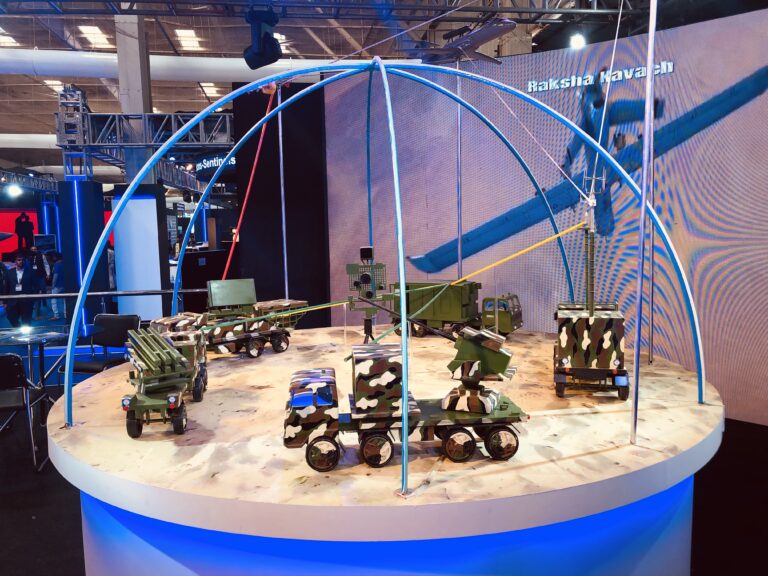
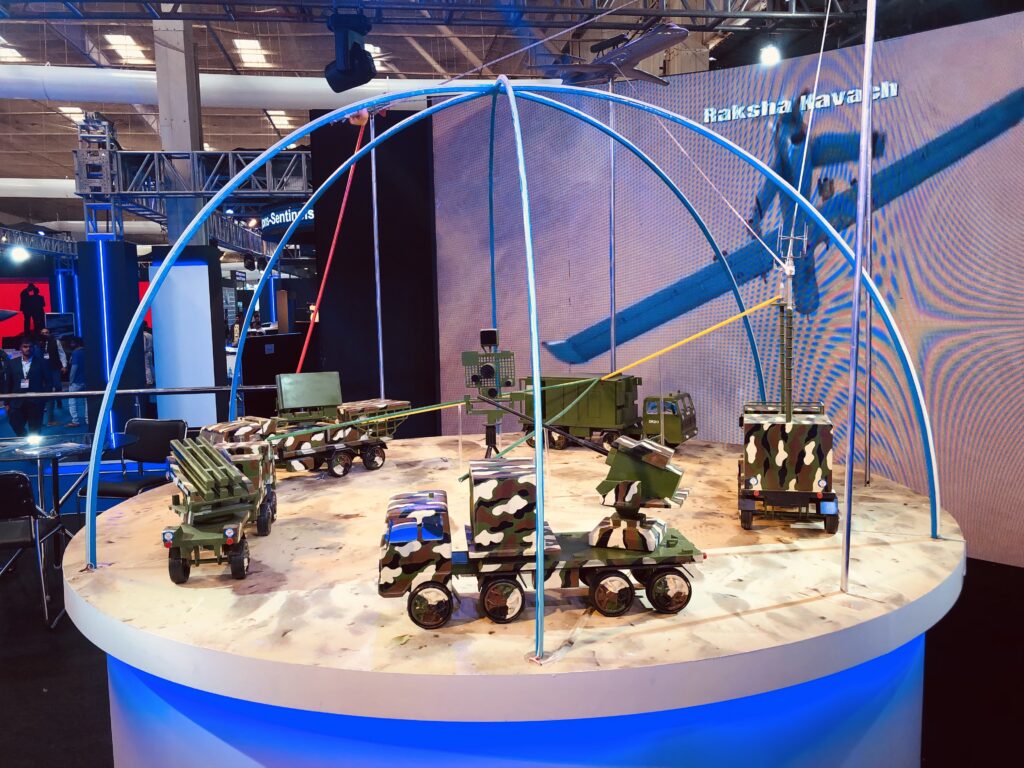
At the 15th edition of the Bengaluru-based biennial airshow- Aero India, India’s govt-run defence agency Defence Research and Development Organisation (DRDO) launched its homegrown ‘Íron Dome’, called the ‘Rakshak-Suraksha Kavach’, which was showcased for the first time at this year’s Republic Day parade.
The complete system which is still in design stage is awaiting Government sanction, but Project Director of the system Dr PS Pandian said that it could be put together in no time as all systems in the Kavach were indigenous.
The Kavach is intended to secure high-end installations and assets covering a range of 250 kilometers. The Raksha Kavach is a comprehensive, multi-layered defence system developed by the DRDO and it integrates advanced military technologies designed to safeguard India against threats across land, air, and underwater domains. For multi-layered protection against multi-domain threats the Kavach comprises the Quick Reaction Surface-to-Air Missile, Airborne Early Warning & Control System, 155mm/52 Cal Advanced Towed Artillery Gun System, Drone Detection, Deterrence & Destruction System, a Satellite-Based Surveillance System, Medium Power Radar – Arudhra, Advanced Lightweight Torpedo, Electronic Warfare System – Dharashakti, Laser-Based Directed Energy Weapon Very Short-Range Air Defence System, Indigenous Unmanned Aerial System, V/UHF Manpack Software Defined Radio for Land Forces, Indigenous Secure Satellite Phone and the UGRAM Assault Rifle.
ADA signs MoU for the development of Flight Control Actuators for AMCA programme
In a significant milestone along the sidelines of Aero India 2025, in Bangalore, an MoU (memorandum of understanding) for Development of Flight Control Actuators for the AMCA (advanced medium combat aircraft) programme was signed between the Govt-owned Aeronautical Development Agency (ADA), and Godrej & Boyce Manufacturing Company Limited, Mumba, a part of Godrej Enterprises Group, which includes precision manufacturing along with procurement of aero grade raw materials. This would enable ADA to force multiply the human resource and advantages built in Indian industries and ensure that the timelines of the programmes are met.
The Godrej& Boyce Manufacturing Company Limited., had been associated with ADA for over two decades in developing the components for flight critical DDV based servo actuators and associated functional elements. ADA had nurtured Godrej in developing these state-of-the-art actuators while Godrej established the precision manufacturing technologies, processes and skillset along with the assembly and testing required to build such high precision parts for the actuator assemblies. Godrej have completely developed build to print capabilities for these actuator assemblies and have established the core competence to take this technology further.
Godrej & Boyce is an Aerospace business house, actively engaged in manufacturing of critical systems used for space applications, defence and aircraft sectors for national programmes and global customers. Starting with precision machined components for ISRO in 1985, today Godrej manufactures Liquid Propulsion Engines for ISRO launch vehicles, missile sub systems for defence, engine modules, flight control actuators and hydraulic pumps, tubing, complex fabrication and composite structural parts for aircraft platforms.
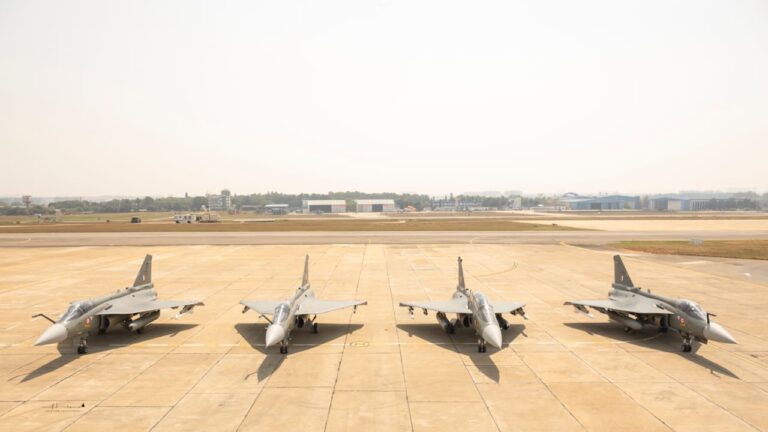
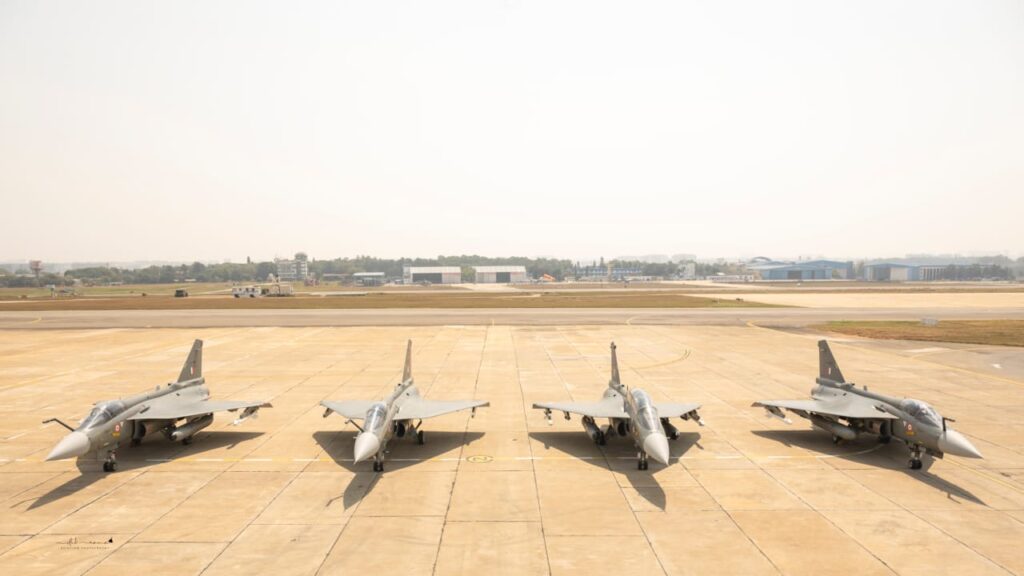
India’s indigenous Light Combat Aircraft (LCA) Mk-1A, manufactured by the Hindustan Aeronautics Limited (HAL) made its spectacular debut atop the Bengaluru skies at the 15th edition of the biennial airshow Aero India 2025, enthralling the vast audience comprising representatives from 80 nations at the Yelahanka Airbase.
Four Mk-IA aircraft flew in ‘finger four’ formation called ‘Yodha’ formation. The Mk IA second prototype did an amazing aerial display in front of the spectators. The Mk-IA, also called the ‘Alpha,’ is a more capable and significantly upgraded aircraft slated to be a part of the Indian Air Force (IAF) in the coming months.
The upgrade includes a new sensor suite, new more capable Mission and Digital Flight Control System, new weapons, net centric capability and Astra BVRs apart from Precision guided weapons. IAF has placed an order for 83 aircraft on HAL. The lead aircraft are poised to get Military Type Certificate and enter service.
The Mk-1A is an enhanced version of the Mk-1, which is already in service with the IAF. The LCA program is poised to be a key pillar of India’s air combat capabilities, with the IAF projected to operate around 350 LCAs—including Mk-1, Mk-1A, and Mk-2 variants—over the next decade and beyond.
The LCA Mk-1A induction into service is facing delays over engines from the US-based manufacturer GE Aerospace, on which HAL Chief Dr. DK Sunil said, “We have assured the IAF at multiple meetings that all Mk-1A structures will be ready. Once the engines arrive, production will commence.”
HAL is actively working to resolve the engine supply issue. Two major contracts—one for 97 additional Mk-1As and another for 156 light combat helicopters for the IAF and the Army, valued at $15BN are expected to be finalised within the next three to six months. HAL is committed to deliver all 83 Mk-1As from the first order within three-and-a-half years and aims to complete the upcoming 97-aircraft follow-on order by 2031.
HAL CMD Dr. Sunil announced that the company’s current order book stands at $15 billion, with key contracts including 156 ‘Prachand’ multi-role light combat helicopters and 98 Light Combat Aircraft (LCA) Tejas Mk-1A fighter jets. Looking ahead, HAL aims to expand orders to $23 billion by outsourcing sub-assemblies to private players, ramping up production lines, and achieving its target of manufacturing 24 aircraft per year by 2026.
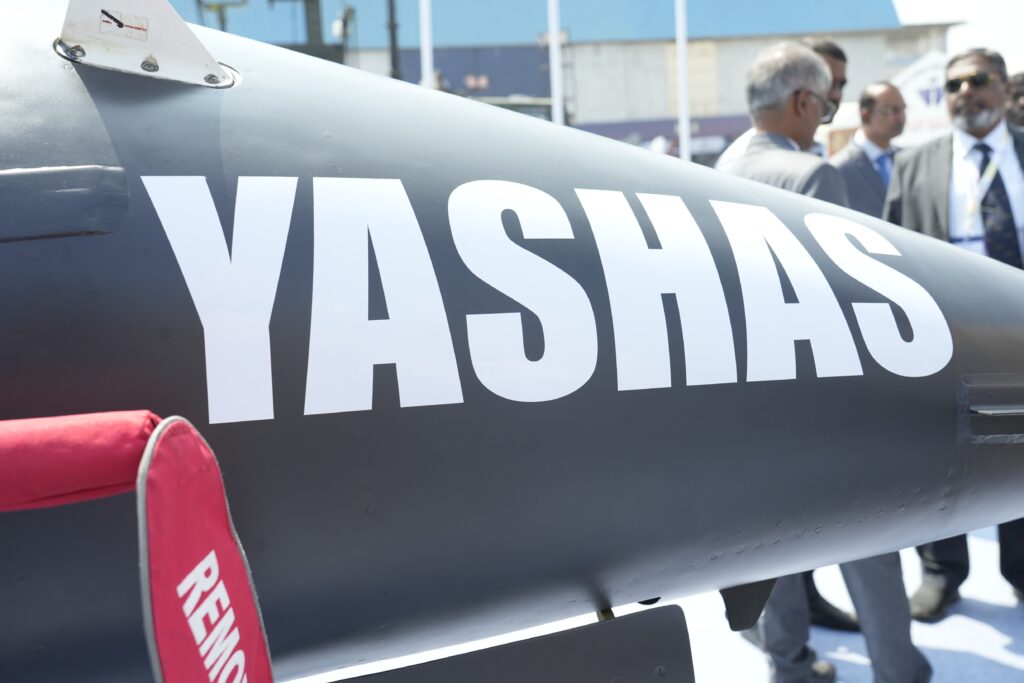
Yashas unveiling: source Author
HAL’s Upgraded Hindustan Jet Trainer (HJT) 36 Unveiled as ‘Yashas’
The flagship jet training aircraft of HAL, Hindustan Jet Trainer- HJT-36, is now renamed as ‘Yashas’ after extensive modifications to resolve departure characteristics and spin resistance throughout the aircraft envelope. Secretary Defence Production, Sanjeev Kumar, unveiled the new name in the presence of Dr D K Sunil, CMD, HAL and senior officers at Aero India 2025 in Bengaluru.
“The large-scale changes to the baseline intermediate training platform has led to significant upheaval in its capabilities and hence provided an opportunity for a new name to be given in accordance with the aircraft’s continued relevance as a training system for modern military aviation. In light of this, HJT-36 is named Yashas”, said Dr Sunil.
For induction into service, the aircraft was recently upgraded with state-of-the-art avionics and an ultra-modern cockpit. These will enhance training effectiveness and operational efficiency, whilst providing weight reduction and overcoming obsolescence of imported equipment with Indian LRUs.
Yashas is capable of stage II pilot training, counter insurgency and counter surface force operations, armament training and aerobatics. It is powered by a FADEC controlled AL55I jet engine, providing best in class thrust to weight ratio, optimised thrust management and reliability. Stepped up rear cockpit with drooped nose provides excellent all-around vision and enhanced situational awareness with state-of-the-art glass cockpit with MFDs (multi-functional display and HUD (head up display). The capabilities of HJT-36 are stall and spin, aerobatics, armament carriage up to 1000kg, single point ground refueling and defueling.
The HAL Management Academy (HMA), the nodal training agency of HAL and the Indian Institute of Information Technology Dharwad (IIIT Dharwad) signed a Memorandum of Understanding (MoU) to strengthen industry-academia collaboration in advanced technologies, at Aero India.
The partnership will focus on joint research, internships, and technical education in areas such as Artificial Intelligence, Data Science, Robotics, AR/VR, and Digital Manufacturing, particularly in applications relevant to the aerospace and defence sectors. Under this MoU, HAL officers will have opportunities to pursue higher education programs at IIIT Dharwad, while students will gain hands-on experience through internships at HAL’s various divisions. The collaboration also includes joint workshops, technical paper publications, and faculty exchange programs.
The global trade landscape has taken a hit over, the US president Donald Trump announced sweeping new tariffs hitting imports from Mexico China and Canada. He’s also suspending the D-Minimis exemption for Chinese Imports, this exemption previously allowed small value shipments under $800 to enter the US duty-free.
Why the suspension?
Trump’s Administration cited National Security concerns with China, Mexico and Canada all under scrutiny the US is battling a deadly opioid crisis with fentanyl linked to 75,000 overdose deaths in 2023. Trump believes China and Mexico are supplying the chemicals used to make these synthetic opioids, by tightening trade rules he aims to enhance screening and crack down on illegal drug inflows. Platforms like Sheen and Temu have been shipping products directly to the US consumers without tariffs, therefore removing D-Minimis exemption forces Chinese importers to pay up levelling the playing field for US businesses.
Trump argues that the US has been losing billions of dollars due to unfair trade practices, his message make it in the United States or pay the price. Canada and Mexico retaliated with their own counter tariffs including 25% tax on US$ 30 billion worth of US goods while Beijing is preparing to challenge Trump’s move at the World Trade Organization signalling that more economic retaliation could be on the way.
Stock markets have dropped sharply across the globe amid fears of a full-blown trade War, the US dollar is strengthening while the Mexican peso, Canadian dollar and Chinese yen are falling even cryptocurrencies are affected with Bitcoin down over 4% now. Trump has hinted at tariffs on the European Union claiming unfair trade imbalances but for now the UK is spared.
Long-Term Impact on US-Canada Relations
The Bank of Canada just made its first-interest rate decision since a trade war with the US became a real possibility, they cut their overnight interest rate (a quarter % point) which is great news for borrowing money but they also acknowledged that a storm may be coming.
“We will tariff and tax foreign countries to enrich our citizens” was Trump’s promised tariffs have the potential to throw Canada’s economy into a tail spin tariff in the case of retracted significant trade conflict it would badly hurt economic activity in Canada. There is still a ton of uncertainty about how this will play out but the Bank of Canada did lay out a worst-case scenario. The Bank of Canada predicts that this would cause a significant decline in the volume of exports from Canada to the US which makes sense because tariffs are just taxes paid for by the businesses doing the buying. So if American companies suddenly have to pay more for the same Canadian goods because there’s a 25% tax on everything. In first case, Canadian might decide to buy less stuff to avoid the tariffs all together.
What tariffs do?
The more expensive product make come up with ways of finding something cheaper, efficient and closer to home (decrease anybody’s willingness to buy). If demand starts decreasing for Canadian exports the net value exports could drop too, when less demand for product the price of that product falls as well and Bank of Canada is mentioning that would happen here whether anyone exporting to the US or not.
The Bank of Canada’s next prediction according to these factors could cause Canada’s GDP to fall pretty significantly they acknowledge that the government could mitigate this by taking some of that tariff money that they start charging and pumping it back into the economy either to businesses or consumers themselves but still this would have a very material effect would have a very severe effect on economic activity. The Bank of Canada has cryptic opting not to give any real indication as a lot of uncertainty and it just didn’t seem very useful to provide guidance and when exactly how that’s going to play out through the economy, the Bank of Canada cutting interest rates when the economy weakens because if lower rates make it cheaper for Canadians to borrow money which makes it more likely that they’ll spend money and that can help stimulate a struggling economy, but it’s not so simple because it’s about higher prices at the same time growth will be weak inflation will be higher because that’s the direct impact of tariffs when commodities like fruits and vegetables get more expensive (inflation).
How will the markets be impacted?
The immediate impacts for his tariffs target Canada, Mexico and China. These are the top three exporters to the United States. Canada sends them oil, gas, aluminium. Mexico sends computers wiring and medical instruments as both Nations send cars and auto parts.
As per 2017 Canadian govt report talks about the interconnected auto manufacturing situation car parts across the US-Canada border six times before a vehicle is finished but what happens when blanket tariffs are in place then each of these transfers attracts an additional fee raising the price of the car multiple times over, and basically destroying the industry in its current form. It’s a similar situation with Mexico raw materials go to the US they are turned into parts then sent to Mexico for assembly and the final cars are then sold back in the US. This system will break too and this is just the automobile sector. The agricultural sector in both Mexico and Canada are intrinsically linked with the US as well
The Canadian agricultural ministry describes a typical American breakfast wheat grown in Canada processed in the US cranberries grown in Canada processed in the US same with oats strawberries and pork this breakfast plate does not work without free trade not in the current prices at the current prices anyway with Trump’s incoming tariffs and then Trudeau’s retaliatory ones the price of this all American breakfast will go through the roof in the short run anyway the us could try and substitute its dependence on Canadian agricultural goods. Maybe Americans can do without the famous Canadian maple syrup but the concern of tropical food from Mexico bananas and tomatoes and the controversial avocados which can’t grow in the American climate not at the same scale 63% of US vegetable imports come from Mexico about 50% of all fruits and nuts as well they come from Mexico. So with the new tariffs Americans should get ready for a less healthy diet or be prepared to shell out far more prices will almost certainly rise and it’s not the exporting countries that will bear them tariffs are paid by importers in the United States the people importing the cars, fruits, wood, oil these are US-based entities they will pay a fee to the US government to sell these products in the US market.
What usually happens is that they pass on the costs to the end consumers the customers the average American people basically it’s a new domestic tax American money will make its way to the government offers just because they want to keep eating (Mexican tomatoes) there are a lot of counterarguments to this one is that people will opt for domestic Goods instead they will buy.
American another argument is that the importing companies will take a hit on their profits they will absorb the Tariff costs not pass them on to customers both these arguments rely on a fair retail corporate benevolence think about it why wouldn’t a domestic car company hike their own prices foreign cars just got more expensive an American company can also raise their prices by just a little less than their foreign counterparts
The domestic company will start raking in extra profits while still being marginally more competitive than the foreign brand either customer who loses and the second argument about importers absorbing the Tariff costs which company do bet on to do that which company is so kind as to take a profit hit to Shield American customers
The last argument in support of tariffs is the US dollar price the US dollar value will surge it’s already happening tariff supporters say this automatically makes foreign Goods cheaper countering the inflationary effects of tariffs this also helps improve trade deficits. Now, this argument also relies on an assumption that the dollar value will rise in proportion to the costs neatly cancelling out any price Rises but really when does anything happen.
So, the dollar value increase will help soften the blow but it probably won’t erase the effects completely meanwhile the dollar rise affects the rest of the world take India for example, the rupee has hit a record low it fell below 87 Rupees to a dollar, this means India’s imports got more expensive and exports became less valuable. Almost every country will experience this without deals to trade bilaterally in local currencies. Many countries are at the mercy of dollar fluctuations but local currency deals come with their own risks.
Trump has threatened tariffs on countries who ditch the dollar BRICS nations could face 100% tariffs he said and this includes India. so all software and service sales to the US could suddenly become uncompetitive so far Donald Trump has just targeted Canada Mexico and China his next Target could be Europe and then possibly the BRICS Nations basically everyone that the US runs trade deficits with everyone exporting things to the United States. So, until unless the world finds a way to bypass the US, many are in for a rough.