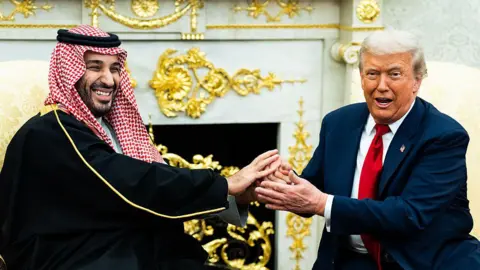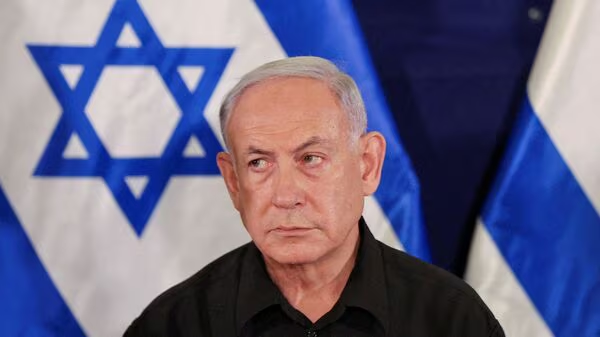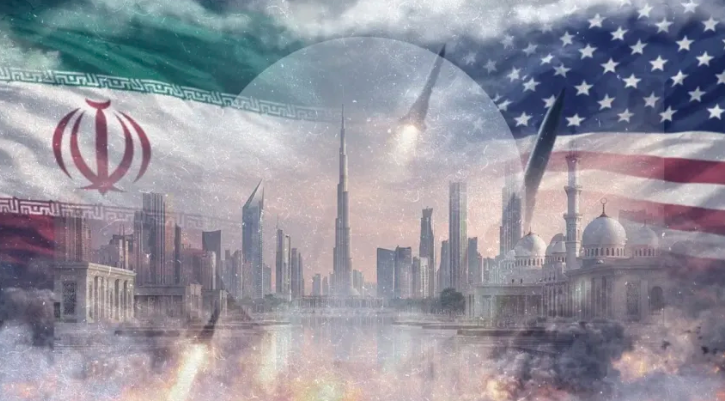
Pictorial representation of the title: source Internet
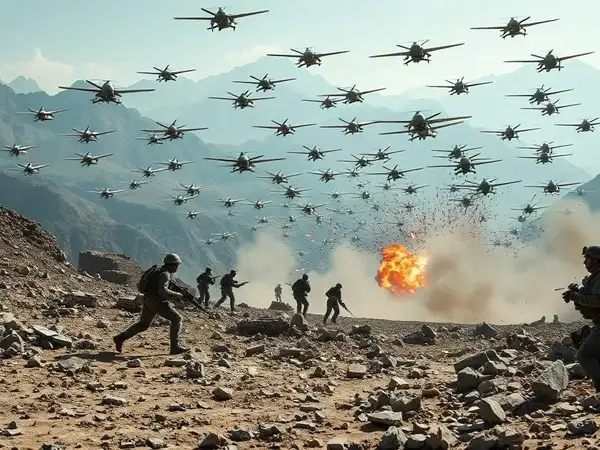
Neither are all territories annexed by kinetic action nor do countries loose war by physical combat alone. Since times immemorial has the half-front or the enemy within, has caused many a kingdom or nations to collapse. In simplistic terms, the half-front are the unnamed and unidentified internal forces in a nation working against the nation. In the 21st Century too, modern warfare which now encompasses six official domains-land, sea, air, cyber, electromagnetic spectrum and space and numerous unofficial domains which includes the half-front too.
On January 17, 1999, two People’s Liberation Army (PLA) officers, Colonel Qiao Liang and Colonel Wang Xiangsui released their book “Unrestricted Warfare: China’s master plan to destroy America”. The 196-page well-written book had just a simple message to convey that anything that can be weaponised, will be weaponised. The book did not garner much interest in the USA for many years after its release, till it was too late and China had overtaken the USA in economic, military and diplomatic power. The book now is a compulsory-read in most of the US military training institutions and combat formations. A typical example of “Too little, too late”.
But long before this book was published, Adolf Hitler perfected the art of using information warfare and the half-front strategy in warfare. Ever since the Modern Era or the Modern Period started in 1500, Hitler’s use of unconventional methods in annexing territories or using them as strategic pivots for military purposes needs to be understood, for they have a bearing on the half-front dynamics that confront nations that are to go to war soon. And amongst such nations staring at a war on the horizon are India and Taiwan.
Three incidents merit attention which show Hitler’s success of the half-front in foreign nations.
One, on December 08, 1940 as World War II raged on with Germany on a rampage, Sir Winston Churchill, the British Prime Minister wrote to the US President, Franklin D. Roosevelt pleading subtly for America to enter the war. Instead, the USA passed the Lend-Lease Act on March 11, 1941 allowing the lending or leasing war supplies to the Allied nations, thereby staying clear of physically entering the World War II. The main reason was the intense anti-war sentiments in the US that time.
Hans Thompson, the German Charge d’Affairs to the USA in 1940 spent huge amount of money to sway public opinion against the USA entering World War I. Infact, full page advertisements were regularly taken out in leading American newspapers under several US citizens names (with their explicit concurrence) which had bold lines stating “Keep America Out of War”. In one such advertisement in the New York Times on June 25, 1940, US$ 30,000 was paid for the full-page advertisement on the front-page.
However, after Japan attacked Pearl Harbour on December 07, 1941, the USA formally announced the entry in the World War II on December 11, 1941. Had the US entered the World War a year earlier when Churchill wrote to Roosevelt, the huge catastrophe would have been nipped in the early stages rather than the World War prolonging till 1945. But, Adolf Hitler through Hans Thompson had been successful in stalling the entry of America for over a year in the initial months of the World War II which were crucial for Germany.
Two, in early 1940, Dr Franz Six based in London had secretly raised six Einsatzkommando units in London, Bristol, Brimingham, Liverpool, Manchester and Edinburgh which were to create mayhem once the German forces had landed in Great Britain. These six units were given a list of 2300 prominent personalities in Great Britain who had to be assassinated after the Germans would enter Great Britain.
Adolf Hitler issued Directive No. 16 on July 16, 1940 to invade Great Britain in mid-August 1940 under Operation Sea Lion. The invasion for Great Britain started on August 15, 1940 but ended in a disaster and on October 12, 1940, Hitler called off Operation Sea Lion as the German forces could never land on the British soil. Thus, Dr Franz Six’s six Einsatzkommando units were never operationalised.
Three, when Germany annexed Rhineland on March 07, 1936, Austria on March 13, 1938 and Sudetenland on October 01, 1938 without firing a single shot and loss of any German life. The modus operandi to capture these three foreign territories by Adolf Hitler, who had assumed power as the Chancellor of Germany on January 30, 1933 was propping up activists staying in these foreign territories who were on his pay-roll to ferment violence and create intense internal mayhem. And as unrest would spread in these foreign territories, Germany would stake claim over these territories and subsequently annex them, proclaiming the German writ over these foreign territories. For the sake of world peace, the international community would remain a hapless bystander.
Using the similar tactics of the half-front, Hitler annexed Bohemia and Moravia on March 15, 1939 and the Memel region from Lithuania on March 23, 1939. Thus, in just a short span of three years from 1936-39, Adolf Hitler had annexed five foreign territories with over 100 million people without firing a single shot and loss of any German life.
It is another story that Hitler’s attack on Poland on September 01, 1939 proved to be his nemesis which finally led to the outbreak of the World War II leading to Germany’s defeat, splitting into two nations and Hitler’s suicide in 1945, at a cost of 50 million dead in World War II, including 6 million Jews killed in the Holocaust in Germany.
But, till Hitler did the cardinal mistake of attacking Poland, the half-front had paid him rich dividends.
Taiwan’s Half-Front
After China’s three military attempts to annex Taiwan, called as the Taiwan Strait Crisis failed, China realised that both kinetic and non-kinetic efforts were necessary in case the foremost Chinese military aim of annexing Taiwan had to fructify.
Hence all-out efforts were launched in both the non-kinetic and kinetic domains too in accordance with the book “Unrestricted Warfare: China’s master plan to destroy America” published in 1999 and the Full Spectrum Operations Doctrine promulgated by the USA in 2001 respectively.
On May 16, 2022 Chen Ming-tong, the Director General of the National Security Bureau of Taiwan in a stunning announcement stated that the Chinese Communist Party (CCP) was funding Taiwanese internet celebrities to spread Chinese propaganda in Taiwan using cognitive warfare campaigns.
And on September 08, 2023 Taiwan’s Mainland Affairs Council reported that CCP’s efforts in Taiwan through cognitive warfare were increasing which could pose grave risk to Taiwan.
In 2024, Radio Free Asia’s probe revealed that a journalist of Xinhua, China’s state news agency, edited scripts and directed guests behind the scenes in one of Taiwan’s television news channels.
2025 saw Taiwan’s Mainland Affairs Council candidly admitting that Douyin and Xiaohongshu, two famous Chinese-origin applications used widely by the Taiwanese, are vectors for pro-unification propaganda.
China is using religious sentiments too in its non-kinetic preparations to annex Taiwan. It has started targeting the Taiwanese worshippers of the sea-goddess Matsu who is greatly revered in Taiwan using propaganda that Matsu wishes to see the reunification of China and Taiwan.
China has since-long funded the Taiwanese to undergo tours to China, taking care of their travelling and accommodation arrangements, including in the itinerary of the travellers pro-China programmes, apart from meeting Chinese government officials.
In an opinion poll released on February 14, 2025 by the Taiwan Public Opinion Foundation, 13.3% openly favoured unification with China. Not a small number by any standards and a number that has great potential to cause upheaval in Taiwan when the cross-strait war happens. Taiwan has a population of 23.9 million and going by the opinion poll, 3.17 million falls in the pro-unification category.
China’s half-front in Taiwan is on firm ground. Though Taiwan doesn’t have the issue of terrorism like India has, but its half-front has potential to cause immense damage in the wake of the Chinese aggression.
Half-front in India
On July 09, 2025, General Anil Chauhan, the Chief of Defence Staff of the Indian Armed Forces, stated that the convergence of interests between China, Pakistan & Bangladesh will have serious implications for India’s stability and security dynamics.
Eight years earlier, on June 08, 2017 General Bipin Rawat, the then Indian Army Chief had remarked that the Indian Army has to be prepared for the 2.5-front war with the external threats being China and Pakistan and the internal threat being the half-front. That time Bangladesh was pro-India with Prime Minister Sheikh Hasina in harness.
All changed on August 05, 2024 when Sheikh Hasina had to flee Bangladesh as student protestors swarmed over every possible Bangladeshi government building. Since then, Bangladesh has turned anti-India with vicious statements on India and violent attacks on Hindus settled in Bangladesh, apart from regular desecration of Hindu temples in Bangladesh.
The Indian Parliamentary Standing Committee on External Affairs in its report tabled on December 18, 2025 has unequivocally stated that India faces its greatest strategic challenge in Bangladesh since 1971.
Arunachal Pradesh is one of the three China’s immediate military aims which has been clearly stated in the US’ Annual Report to Congress on Military & Security Developments involving China, released on 23 Dec 2025.
India is staring at a 3.5-front war on its horizon any time after 2030.
Whether Bangladesh opens up militarily against India or not, that only time will tell. But India has to be prepared militarily for Bangladesh along with China, Pakistan and the half-front within.
USA was forced to enter the World War I on 06 Apr 1917 after the Zimmermann telegram was intercepted by the British intelligence a day after it was sent on 17 Jan 1917 from Germany to Mexico, which proposed a defence pact between Germany & Mexico with Germany assuring Mexico that it will help it take Texas, Arizona & New Mexico from USA. The contents of this telegram were made public on 01 March 1917 leading to massive American outcry eventually forcing USA to enter the World War I.
The repeated statements emanating from Bangladesh regarding Siliguri Corridor & India’s seven North-East states definitely have external backing & assured support.
The regular influx of illegal immigrants in India and their seamless integration in the Indian society is a sure recipe for a disastrous broth that is on slow fire. Estimates put an annual influx of 40,000 illegal immigrants to India. In the year 2024, only 2331 illegal immigrants were deported from India. Data for the years 2020, 2021, 2022, 2023 wasn’t available in the public domain at the time of writing this article. During the two-year period of 2018-2019, total of 3311 were deported from India. One issue clearly emerges; the deportation of illegal immigrants is far lesser than their influx in India.
After India had an 88-hour military confrontation with Pakistan in May 2025 called Operation Sindoor by India, 11 Indians from different religions and communities, were arrested in India on charges of spying for Pakistan. Regular reports trickle in of educated persons including scientists spying for Pakistan.
The arrest of six doctors in November 2025 as part of a terrorist module linked with the Red Fort Terror Attack, formally declared the entry of white-collar terrorists in India. Till the Red Fort Terror Attack on November 09, 2025 which killed 13 persons in New Delhi, it was generally believed that uneducated and unemployed persons were part of terror modules. However, the arrest of doctors changed the paradigm of terrorism in India.
The half-front operatives be it indoctrinated by radicalism or induced by monetary considerations; both pose grave threat to India.
How many such sleeper cells exist in India is extremely difficult to comment upon. But the fact that the doctors of the Red Fort Terror Attack could evade the Indian intelligence & security agencies for over two years before their eventual arrest, points to the efficacy with which educated terrorists can evade law.
All timelines in public domain point to China & Pakistan waging the two-front war on India any time after 2030. In this war, Bangladesh and the half-front in India would play a role of consequence, thus making the 3.5-front war a critical challenge for India.
The next few years are immensely crucial for both Taiwan and India.
History has proven that the entry of one Superpower has always tilted the course of war where the aggressor had enjoyed military superiority ab-initio.
The World War I which broke out on July 28, 1914 had the Central Powers comprising Germany, Austria-Hungary, Ottoman Empire and Bulgaria in a commanding position till the entry of the USA on April 06, 1917 which tilted the war in favour of the Allied Powers, resulting in the defeat of the Central Powers and the end of the World War I on November 11, 1918.
World War II which broke out on September 01, 1939 gave the Axis Powers comprising Germany, Italy and Japan enormous success till the USA entered the war on December 11, 1941, eventually resulting in the defeat of the Axis Powers and the end of the World War II on September 02, 1945.
China’s earlier three military attempts to annex Taiwan called as the Taiwan Strait Crisis failed as the USA stood rock-solid behind Taiwan.
The world today has three Superpowers – the USA, Russia and China. These three superpowers will not interfere in each other’s military aspirations as has been made clear in the US’ National Security Strategy released on December 04, 2025.
Why China didn’t activate the half-front in its earlier military confrontations with Taiwan is because China did not have the economic heft back then. All changed after China became the world’s third largest economy in 2007 and the second largest economy in 2010.
And after 1962, China hasn’t gone to war with India. The Doklam Crisis in 2017 and the Galwan Valley Clash in 2020 didn’t erupt into full-fledged wars with India as China was clear that before its war for Taiwan, it will not enter into any military confrontation with any country whatsoever. Why the Galwan Valley Clash happened, has been discussed by the author in his earlier article.
China is militarily superior than both Taiwan and India. And if the military power of Pakistan and Bangladesh is added to China, the balance heavily tilts in favour of China-Pakistan-Bangladesh combine in comparison with India. The half-front in both Taiwan and India have enormous damage potential.
All political parties of both Taiwan and India should concentrate on preparations for the war clouds that are on the horizon for Taiwan and India, and not indulge in trivial issues which consume both time and energy. After all, a person has only 24 hours to work and finite energy at disposal. The half-front needs to be found and tackled in double-time as every minute now matters for both Taiwan and India, apart from of course preparing both economically and militarily.
The next two years for Taiwan and the next five years for India are critical and crucial for both these nations that are at the forefront of facing the Chinese military overtures. It should be remembered that that there no runners up in a war. Any war has only two clear results – the victor and the vanquished.
About the Author
Lt Col JS Sodhi (Retd) is the Founder-Editor, Global Strategic & Defence News and has authored the book “China’s War Clouds: The Great Chinese Checkmate”. He tweets at @JassiSodhi24.
The Trump Corridor has rapidly become a defining geopolitical pivot in the South Caucasus because it alters the balance of power in a region which has largely shaped by the vast clash of regional and global interests. The creation of Trump Corridor 2025 has rapidly become a defining geopolitical pivot in the South Caucasus, capable of transforming the region into a new transit hub envisaged for fostering peace between Armenia and Azerbaijan through the strategic infrastructure diplomacy. As it alters the balance of power in a region which has largely shaped by the vast clash of regional and global interests. Although the agreement was presented as a pragmatic step toward economic integration and peace building mechanism its true meaning lies in the strategic transformations it sets in motion through Infrastructure Development. . The corridor reconfigures the region’s geopolitical architecture by creating new avenues of influence for some states while constraining or displacing the traditional power of others. The corridor is not a transfer of sovereignty; rather, it functions as a legally regulated commercial and transit route, guaranteed under Armenian law and administered by a multinational consortium. Its purpose is expansive: the route is designed to carry road and rail transport, energy pipelines, fiber-optic communications, and related infrastructure, laying the foundation for what Washington framed as a new “Economic Peace Corridor” across a historically conflict-ridden region.
Although the agreement was presented as a pragmatic step toward economic integration and peace building, its true meaning lies in the strategic transformations it sets in motion. The corridor reconfigures the region’s geopolitical architecture by creating new avenues of influence for some states while constraining or displacing the traditional power of others. Its impact is amplified not only by the infrastructure it enables but by the geopolitical symbolism embedded in a 99-year US-brokered transit agreement—a commitment long enough to redefine expectations about the future of Eurasian connectivity. The first and most immediate geopolitical shock generated by the corridor concerns Russia. For the last three decades, Russia asserted itself as the principal arbiter of security in the South Caucasus, leveraging its military bases in Armenia, its peacekeeping missions, and its role as mediator in the Nagorno-Karabakh conflict. Armenia, isolated by closed borders with Turkey and Azerbaijan, relied on Russia not only for defense but also for energy, trade routes, and political support. Azerbaijan, despite pursuing an independent foreign policy, still balanced its relationships with Russia to avoid provoking Moscow’s hostility. The Trump Corridor undermines this system by establishing a major transit route that circumvents Russian territory and, more importantly, excludes Russian oversight. The United States has, for the first time in decades, directly shaped the territorial configuration of the region without Russian approval. This represents not only a tangible loss of influence but a symbolic break with Moscow’s long-standing assumption that the South Caucasus falls within its uncontested sphere of influence.
Russia’s weakened position has been sharpened by structural vulnerabilities. Its prolonged war in Ukraine, combined with the economic pressure of international sanctions, has reduced Moscow’s ability to project power or sustain diplomatic leverage across neighboring regions. The corridor deal thus arrived at a moment when Russia lacked both the capacity and political bandwidth to challenge US involvement. As a consequence, regional actors read the Trump Corridor as evidence of Russia’s declining primacy. This perception is itself a strategic fact: it influences the calculus of smaller states, encourages diversification away from Russian dependency, and erodes Moscow’s credibility as a guarantor of security.
The United States, conversely, has used the corridor to re-establish itself as a central strategic actor in the South Caucasus after years of diminished visibility. Washington’s involvement signals a renewed interest in shaping the Eurasian connectivity agenda and counterbalancing the influence of Russia, Iran, and even China. Unlike previous Western initiatives that were largely diplomatic or value-driven, this agreement binds US influence to tangible infrastructure, regulatory frameworks, and commercial governance mechanisms that will persist for nearly a century. The United States achieves a durable geopolitical presence without deploying soldiers or establishing military bases. Instead, it embeds itself through what might be described as “strategic infrastructure diplomacy,” where long-term economic corridors double as instruments of political alignment and geopolitical stabilization.
The corridor also supports broader US energy and economic goals. It creates new opportunities for transporting Caspian oil and gas to Europe in ways that reduce dependence on Russian energy supplies. Simultaneously, it fits within global strategies aimed at diversifying supply chains and establishing alternative trade routes that bypass chokepoints dominated by rival powers. The United States thus positions itself as an architect of Eurasian transit systems at a time when global infrastructure competition—particularly with China’s Belt and Road Initiative—has become a defining element of international strategy.
Turkey emerges as another major beneficiary of the corridor. For years, Ankara has sought to consolidate its influence across the Turkic world, stretching from Turkey through Azerbaijan to Central Asia and the Caspian Sea. The Trump Corridor creates a new link that fulfills many of Ankara’s long-term strategic aspirations. It enhances Turkey’s direct physical connection with Azerbaijan and strengthens east–west trade paths that run through Turkish territory. Beyond logistics, the corridor enhances Ankara’s symbolic leadership among Turkic-speaking nations, reinforcing Turkey’s role in organizations such as the Organization of Turkic States. It also opens new economic opportunities for Turkish construction firms, energy companies, and telecommunications enterprises. Turkey therefore becomes not just a regional power but a central connector between Europe and Asia, extending its influence deeper into Eurasia.
In contrast, Iran views the corridor with considerable anxiety. For decades, Iran played a crucial role as a transit route for both Armenia and Azerbaijan, leveraging its geographic position to influence regional politics, collect transit revenues, and balance against Turkish and Russian influence. The Trump Corridor directly threatens these functions by offering Armenia and Azerbaijan a route that bypasses Iranian territory. More troubling for Tehran is the fact that the corridor introduces long-term US strategic involvement along Iran’s northern border—a scenario Iranian policymakers have long feared. In Tehran’s view, the corridor is not a neutral economic project but part of a broader Western strategy to marginalize Iranian influence, reshape regional connectivity in ways that exclude Iran, and potentially encircle Iran with US-aligned infrastructure. This perception creates new tensions and introduces the possibility of Iranian pushback, whether diplomatic, economic, or through indirect regional tactics.
Perhaps the most transformative geopolitical shift is unfolding in Armenia. After decades of dependence on Russia—politically, militarily, and economically—Armenia finds itself re-evaluating its entire strategic orientation. The failures of Russian peacekeeping after 2020, coupled with Moscow’s diminished attention and capability due to its war in Ukraine, left Armenia increasingly vulnerable. The Trump Corridor provides Armenia with an opportunity to diversify its alliances, attract Western investment, and embed itself in new international partnerships. While the agreement remains controversial within Armenia, it also symbolizes a potential escape from isolation. Participation in the corridor aligns Armenia more closely with Western economic systems, reduces its reliance on Russian-controlled transit routes, and opens the possibility for improved relations with its neighbors, including Azerbaijan and Turkey. Whether this marks a permanent realignment or a pragmatic adjustment remains to be seen, but the shift is undeniable.
Azerbaijan, meanwhile, consolidates its strategic position through the corridor. The long-standing desire to obtain secure access between mainland Azerbaijan and Nakhchivan is achieved not through military escalation but through a multinational, legally guaranteed corridor. This strengthens Azerbaijan’s regional influence, deepens its strategic relationship with Turkey, and enhances its ability to position itself as a critical transit hub between Europe and Asia. The corridor provides Azerbaijan with new economic advantages, increased geopolitical leverage, and greater autonomy in its foreign policy decision-making.
In this way, the Trump Corridor functions as a geopolitical prism through which each regional actor reconfigures its strategic priorities. It weakens old alliances, forges new ones, and transforms the South Caucasus into a contested arena of 21st-century connectivity politics. While the infrastructure itself is important, its geopolitical implications are far more consequential. The corridor initiates a profound regional realignment with implications extending from the Black Sea to Central Asia and from the Persian Gulf to Europe. Whether this new configuration evolves into a stable system of cooperation or a new geography of competition will depend on how regional powers manage the tensions and opportunities created by this strategic pivot.
Regional Security Dynamics After the Trump Corridor Agreement
The announcement of the Trump Corridor in August 2025 generated immediate and powerful reactions across the region, revealing both the magnitude of the agreement and the fragility of the geopolitical environment into which it was introduced. Unlike conventional infrastructure projects, which tend to provoke technical and logistical questions, the Trump Corridor triggered a deep recalibration of political expectations and security anxieties. For some, it represented a historic opportunity to stabilize one of the world’s most volatile borderlands and integrate it into the global economy. For others, it signified an alarming redistribution of influence, a potential challenge to territorial sovereignty, or even a threat to national survival. The intensity of these reactions underscores the complex regional security dynamics that have shaped the South Caucasus since the collapse of the Soviet Union.
Understanding these reactions requires situating the Trump Corridor within a suitable theoretical framework. Three frameworks in particular illuminate the motivations and behaviours of regional actors: classical and neorealist theories, liberal institutionalism perspectives, and Regional Security Complex Theory (RSCT). Realist frameworks help explain the competitive pursuit of power, influence, and territorial control that shape the decisions of states like Russia, Iran, and Azerbaijan. Liberal institutionalism offers insight into the economic and cooperative motivations underlying Armenia’s and the United States’ support for the corridor. Meanwhile, RSCT, developed by Barry Buzan and Ole Wæver, provides a valuable lens through which to analyse the South Caucasus as a region where intense security interdependence binds the fates of Armenia, Azerbaijan, Georgia, Russia, Turkey, and Iran (Buzan & Wæver 2003). Together, these frameworks reveal the multi-layered security dynamics that emerged in response to the corridor.
Role of Big Power Nations
From the perspective of Russia, the Trump Corridor represents a structural threat to its strategic depth in the Caucasus. Over time, Moscow may develop countermeasures that aim to undermine the corridor’s potential or at least dilute American influence in its administration, whether through the promotion of alternative transit projects, diplomatic pressure on Yerevan, or closer military-technical cooperation with Iran. Russia’s ability to mobilize these levers will depend heavily on its own domestic stability and its foreign policy bandwidth, especially in the aftermath of prolonged conflict involvement elsewhere. If Russia’s power projection capacity continues to be limited, the Trump Corridor could accelerate the erosion of its regional sphere of influence, leading not only to geopolitical retreat but also to the emergence of new power vacuums that might invite competition among NATO states, Iran, and Türkiye. Over several decades, such vacuums often produce new security dilemmas, including arms build-ups, proxy dynamics, or covert operations targeting infrastructure networks.
Iran’s long-term posture toward the corridor reflects a deeper concern that transcends immediate bilateral relations. The Trump Corridor cuts across the broader north-south and east-west connectivity matrix that Iran has attempted to shape through projects such as the International North–South Transport Corridor (INSTC). As the new corridor solidifies, Iran fears that it will be strategically bypassed in trans-Eurasian trade routes, marginalizing its role as a connector node and amplifying Western influence in a geographic space Tehran considers vital to its border security and ethnic politics. Over the long term, Iran is likely to adopt a dual strategy of containment and accommodation. The containment dimension may involve closer alignment with Russia, deepening military ties, and supporting Armenian defense capabilities in indirect ways. The accommodation dimension may entail pragmatic adjustments, such as negotiating partial integration with the corridor’s energy, customs, or rail systems, should geopolitical conditions shift. Iran’s reaction over the next several decades will also be shaped by domestic political evolution, economic resilience under sanctions, and the stability of its northern provinces populated by ethnic Azerbaijanis, who have historically played a significant role in the country’s internal political balance. If Tehran interprets the corridor as a threat to its territorial integrity or ethnic cohesion, its long-term opposition may harden into a more assertive regional security posture.
Türkiye, by contrast, stands to gain considerably in the long run. The corridor strengthens Ankara’s longstanding objective of creating a direct land link to the Turkic world, from the Caucasus to Central Asia. This vision, couched in the language of cultural affinity and strategic depth, aligns with broader Turkish aspirations to become a pivotal Eurasian power capable of influencing trade, energy, and military dynamics across multiple regions. As decades pass, Türkiye could capitalize on the corridor by integrating it into larger projects such as the Trans-Caspian Gas Pipeline, expanded fiber-optic grids, and transcontinental railway systems. Over time, the corridor may also support Turkiye’s emerging military-industrial footprint in the region, especially as Azerbaijani procurement of Turkish drones, missiles, and air-defense systems continues to grow. The corridor thus forms part of a long-term strategic condominium between Ankara and Baku, which may reshape the regional balance of power and challenge Iran’s security perception. Turkiye’s NATO membership further complicates this trajectory, because the corridor indirectly increases Western access to the Caspian Basin, a trend that Russia and Iran will likely perceive as destabilizing.
The United States’ long-term strategic calculus is fundamentally tied to the corridor’s ability to rewire Eurasian connectivity away from Russian and Iranian spheres of influence. Over several decades, the corridor could become a component of a wider American approach to diversify energy routes, secure Western access to Caspian resources, and counterbalance China’s Belt and Road Initiative (BRI). The corridor can serve as a stepping stone for U.S. engagement with Central Asian republics seeking alternatives to Russian and Chinese economic dominance. From a long-term perspective, the Trump Corridor is not only a logistical asset but also a symbolic assertion that American diplomacy can still shape critical infrastructure outcomes in geopolitically sensitive regions. The endurance of this influence, however, depends on Washington’s ability to maintain consistent foreign policy engagement, which historically has oscillated with changes in administration. Should U.S. strategic focus drift toward the Indo-Pacific or domestic priorities, a geopolitical vacuum may arise that other regional powers would eagerly fill.
China’s long-term position is more ambivalent. On one hand, Beijing benefits from any diversification of trans-Eurasian routes, because redundancy in infrastructure strengthens the resilience of trade networks under the Belt and Road Initiative. On the other hand, the Trump Corridor could undermine Chinese influence if it becomes part of a Western-led connectivity architecture designed to counterbalance the BRI. Over decades, China may attempt to integrate the corridor into its broader Eurasian strategy through investment, construction contracts, or digital-connectivity projects. Alternatively, it may view the corridor as a Western intrusion and opt to reinforce its ties with Iran and Russia. The long-term direction will depend on how the corridor intersects with China’s economic interests and its competition with the United States.
Within the South Caucasus itself, the domestic political durability of the corridor is perhaps the most decisive variable. Armenia’s long-term compliance with the land-lease agreement will depend on its internal political stability and its evolving perception of national security. If the corridor becomes a symbol of national humiliation or foreign imposition, domestic actors may mobilize opposition that could undermine the agreement. Conversely, if the corridor generates tangible economic growth, employment, and infrastructural development, Armenian public opinion could shift toward cautious acceptance. In Azerbaijan, long-term support is more likely to remain stable, because the corridor serves a central national objective: strengthening territorial connectivity and consolidating the post-2020 regional order. Nevertheless, Azerbaijan’s domestic stability, elite cohesion, and succession politics will shape its approach over several decades. Any internal instability could affect the reliability or militarization of the corridor.
Another long-term implication concerns the militarization potential of critical infrastructure. Historically, strategic corridors often become flashpoints for coercion, sabotage, or hybrid warfare, particularly in regions characterized by deep-seated rivalries. The Trump Corridor is no exception. Over decades, it may become a contested space where states or non-state actors attempt to disrupt transport flows, undermine the legitimacy of host governments, or leverage the corridor as a bargaining chip in diplomatic disputes. The long-term security of the route will depend on robust monitoring mechanisms, cross-border communication channels, intelligence-sharing frameworks, and international oversight. If these mechanisms remain weak, the corridor could evolve into a site of recurrent crises that destabilize the broader South Caucasus. Over several decades, the corridor may strengthen the diversification of oil and gas routes to Europe, reducing dependency on Russia and contributing to the continent’s broader energy-security strategy. As renewable energy transitions deepen globally, the corridor may additionally become central to the transport of critical minerals, green-technology components, or new-generation fiber-optic infrastructure. These long-term developments could elevate the South Caucasus from a peripheral region to a key node in the global digital and energy economy. However, they also carry risks: increased strategic value often invites geopolitical contestation, making the region more vulnerable to interference, sanctions pressure, or coercive diplomacy by rival powers.
Hybrid Security Threats and the Vulnerability of Infrastructure
The Trump Corridor also introduces new forms of hybrid security vulnerabilities. As a major transport and communications artery, the corridor becomes a potential target for cyber-attacks, sabotage, misinformation campaigns, and political pressure. The involvement of American companies in the telecommunications dimension—particularly fiber-optic infrastructure—heightens the strategic value of the corridor while increasing the likelihood of cyber conflict, espionage, or technological interference (Drake 2024). Infrastructure corridors often become focal points for criminal networks, smuggling routes, and illicit trade. The South Caucasus, with its complex borders and history of trafficking across black markets, faces heightened risks of criminal exploitation. These hybrid threats blur the line between national security, economic security, and law enforcement, requiring sophisticated coordination between states that do not fully trust one another.
Yet beneath the optimistic language of economic integration lies a landscape of profound risks, contested narratives, and structural uncertainties that could shape the fate of the corridor—and the stability of the region—for decades to come. Far from offering a straightforward path toward cooperation, the corridor exposes unresolved historical grievances, introduces new geopolitical competitions, and creates potential flashpoints that could ignite under the wrong conditions. Understanding these risks requires an expansive analytical lens that examines political, economic, security, legal, normative, and infrastructural dimensions of the agreement. The corridor is not merely a physical pathway connecting Azerbaijan to Nakhchivan; it is a geopolitical infrastructure which aimed to strengthen the estranged relation through the strategic allocation of ambitious infrastructural programmes. The trump logically tries to underpin the strategic ambitions of six major actors: Armenia, Azerbaijan, the United States, Turkey, Russia, and Iran. Its implementation intersects with power transition dynamics, securitization logics, state-fragility concerns, and competing visions of regional order. While the corridor holds the promise of prosperity, the structural conditions in which it emerges suggest that peace building will not be automatic and may instead depend on resolving systemic vulnerabilities that—if ignored—could derail the project or turn it into a source of new instability. These geopolitical tensions introduce long-term uncertainties that may overshadow the corridor’s potential benefits if not carefully managed. Potential escalation pathways include:
Russian pressure on Armenia via political proxies
Iranian military signaling escalating into localized incidents
Turkey–Iran tensions over influence in Nakhchivan
Sabotage or hybrid operations against corridor infrastructure
Armenian domestic instability spilling into regional politics
The corridor thus becomes both a symbol of peace and a potential flashpoint for conflict. The Trump Corridor marks a profound transformation of the South Caucasus security environment. It creates opportunities for cooperation and economic revival but simultaneously amplifies longstanding suspicions, rivalries, and power struggles. By applying theoretical frameworks—RSCT, balance-of-threat, and power transition theory—we see that the corridor operates as both a regional integrator and a geopolitical disruptor. It is not simply infrastructure. It is a reconfiguration of power, identity, and strategic vision across Eurasia.
Implications of Trump Corridor
While the corridor celebrated in certain geopolitical circles as a transformative infrastructure project capable of unlocking new economic potential in the South Caucasus, simultaneously carries profound risks that cast shadows across the region’s security landscape. These risks are neither abstract nor peripheral. Rather, they are deeply embedded in the historical animosities, power asymmetries, and geopolitical rivalries that have defined the South Caucasus for centuries. As with any major restructuring of regional connectivity, the corridor exposes all participating states to a complex interplay of uncertainty, suspicion, and strategic vulnerability. The dramatic reconfiguration of transit routes, alliances, and regional influence opens opportunities for cooperation, but it also imposes destabilizing pressures that may be exploited by actors seeking to enhance their own strategic positions at the expense of others.
The corridor’s critics in Armenia also point to the political fragility of the region, arguing that a long-term agreement of ninety-nine years requires a stable geopolitical environment that is unlikely to materialize in a region historically marked by conflict fluctuation and sudden shifts in alliances. Furthermore, they argue that no legal guarantee can fully compensate for the shifting balance of power. Changes in leadership, security doctrines, or external alliances could render the corridor a point of leverage in unexpected ways. From the standpoint of political realism, this criticism resonates strongly. The structural environment of the South Caucasus is fundamentally anarchic in the classical realist sense described by Kenneth Waltz, meaning that states cannot fully rely on external guarantees or international law when their survival is at stake. Armenia’s vulnerability lies not in the corridor itself but in the broader structural imbalance that shapes its foreign policy options.
On the Azerbaijani side, the corridor is widely celebrated as a historical achievement, yet it also introduces uncertainties that complicate Baku’s strategic calculus. While the infrastructure strengthens Azerbaijan’s role as a regional transit hub, it simultaneously increases its exposure to geopolitical friction. Iran’s hostile reaction to the corridor, for example, creates a set of risks that Azerbaijani policymakers cannot ignore. Tehran’s perception that the corridor enhances Western and Turkish influence near its borders could lead to a long-term deterioration of Iranian-Azerbaijani relations. Although these tensions may manifest primarily in diplomatic rhetoric or shows of force, the possibility of more acute confrontation cannot be ruled out. Iran’s strategic culture, shaped by perceived encirclement and external threats, is particularly sensitive to American-supported projects. This sensitivity is heightened by the presence of a large Azerbaijani minority in Iran, who’s cultural and linguistic affinities with the Republic of Azerbaijan occasionally provoke anxiety within Tehran’s political establishment. Iran’s security institutions may fear that an enhanced Azerbaijan, empowered by new transit routes and closer ties to Turkey and the United States, may inadvertently inspire ethnic assertiveness or separatist sentiments within its own population. Even if Azerbaijan’s leadership has no interest in pursuing such outcomes, the mere perception of risk can influence Iranian policy in ways that create unpredictable security consequences.
Iran’s criticism of the corridor also reflects a broader geopolitical concern: the gradual erosion of its regional influence as major international actors redesign connectivity routes that bypass Iran entirely. For centuries, Iran benefited from its strategic location as a land bridge between the Caucasus, Central Asia, and the Middle East. The Trump Corridor threatens to diminish this role by redirecting trade, energy, and logistics flows through Armenia, Azerbaijan, and Turkey, thereby weakening Iran’s leverage over regional transport. The competition between transit routes is not merely commercial; it carries significant political implications. States that control key corridors accrue geopolitical relevance, diplomatic leverage, and economic resilience. Iran’s exclusion from the emerging network places it at a strategic disadvantage, leading Tehran to portray the corridor as a zero-sum project aligned with hostile Western objectives. This interpretation aligns with Barry Buzan and Ole Wæver’s Regional Security Complex Theory, which suggests that regional security patterns tend to be shaped by clusters of interconnected threats and rivalries. In the South Caucasus, the corridor recalibrates these clusters, isolating Iran while strengthening Turkey, Azerbaijan, and the United States.
Russia’s criticism of the corridor is rooted in geopolitical decline and strategic anxiety. For decades, Moscow maintained an unchallenged position in the South Caucasus, supported by military bases in Armenia, peacekeeping missions in contested areas, a pervasive intelligence network, and strong economic ties. However, the war in Ukraine, international sanctions, and the deterioration of Russia-Armenia relations have weakened Moscow’s ability to influence regional affairs. The Trump Corridor underscores this erosion by enabling Western-backed infrastructure in a region Russia has long considered its near-abroad. Russian analysts argue that the corridor undermines the territorial continuity of the “Russian sphere of influence,” a strategic doctrine central to Russian foreign policy since the 1990s. Moscow’s muted public reaction reflects not acceptance but incapacity: Russia’s diminished power prevents it from exerting meaningful leverage over Armenia or Azerbaijan. This power vacuum presents risks because regional actors, sensing Russia’s diminished authority, may pursue bolder or more independent strategies, which could lead to destabilizing competition.
Another major source of uncertainty stems from the complex political landscape within Armenia itself. The corridor has deepened fissures between pro-government reformists and opposition forces that accuse the government of betraying national interests. The opposition frames the corridor as part of a perceived pattern of capitulation following Armenia’s military defeats and diplomatic concessions. This narrative may be politically expedient, but it also inflames nationalist sentiment in ways that risk destabilizing Armenia’s internal politics. Protests, street mobilizations, and attempts to force early elections could create domestic instability at precisely the moment when the corridor requires political consensus to be implemented smoothly. A weakened or divided Armenian government may lack the capacity to oversee the corridor’s operation effectively, increasing the likelihood of accidents, sabotage, or politically motivated obstruction. Domestic instability also risks inviting external interference. Historically, regional powers have exploited Armenia’s internal divisions to influence its foreign policy orientation, and the corridor may once again become a tool in such geopolitical maneuvering.
The Trump Corridor as a geopolitical pivot reflects deeper transformations in global power distribution. The United States, after years of relative disengagement from the South Caucasus, has reasserted its influence through a strategic approach that combines diplomatic brokerage with economic incentives and security assurances. The corridor becomes a tangible expression of American strategic resurgence in a region long contested by rival powers. At the same time, Türkiye has emerged as a central player, advancing its ambitions for Turkic connectivity and leveraging its close partnership with Azerbaijan to reshape the regional order. The corridor strengthens the Ankara–Baku axis and creates new avenues for Turkish influence, not only in trade and energy but also in military affairs, technological cooperation, and cultural diplomacy. Iran, by contrast, faces a strategic predicament, watching the corridor undermine its long-standing role as a transit state and potentially altering the ethnic, political, and economic dynamics along its northern frontier. For Tehran, the corridor represents more than an infrastructural threat; it symbolizes the encroachment of Western-aligned connectivity into what Iran considers a vital sphere of national security.
Conclusion
The Emergence of the Trump Corridor in 2025 represents one of the most consequential geopolitical developments in the South Caucasus since the dissolution of the Soviet Union. As this research has demonstrated across multiple analytical layers, the corridor is not merely an infrastructural project but a strategic reconfiguration of the region’s political, economic, and security landscape. At its core, it symbolizes the reopening of physical connectivity in a region long fractured by war, mistrust, and competing spheres of influence. But more significantly, it reveals the extent to which external powers, domestic political shifts, and long-standing territorial grievances intersect to shape the future of Trans-Regional order. The Trump Corridor, therefore, should be seen as both an artifacts of diplomatic negotiation and a structural force with the capacity to reshape alliances, redefine borders of influence, and alter the trajectory of interstate relations in the South Caucasus for decades to come. Ultimately, the Trump Corridor’s greatest risk lies in its dependence on a volatile regional order. The South Caucasus sits at the intersection of three civilizational, strategic, and ideological blocs: the Russian sphere, the Turkic sphere, and the Iranian-Persian sphere. The corridor introduces a fourth element—the United States—without resolving tensions among the existing three. Thus, the corridor sits atop a foundation of uncertain stability, vulnerable to geopolitical tremors that could reshape the region. The Trump Corridor is a bold attempt to reimagine the South Caucasus through connectivity, cooperation, and economic integration. Yet it also introduces an unprecedented array of risks: domestic political instability, unresolved historical grievances, hegemonic resentment, regional power struggles, infrastructural vulnerabilities, and profound legal uncertainties. Whether the corridor ultimately stabilizes or destabilizes the region will depend on how these risks are managed, mitigated, or ignored. In this sense, the corridor embodies both the promise and peril of 21st-century geopolitics.
About the Author
Gayathri Pramod works on the genealogy of governance over life and death in times of war, with a particular focus on the West Asian front. Her research interests centre on the thematic study of war crimes and other geopolitical flashpoints. She is presently Assistant Professor of Political Science, Faculty of Law, Marwadi University.
Pictorial representation of Aatmanirbhar Bharat: source Internet
“The principles of foreign policy- that nations act in their political, economic, and military self-interest, is a timeless truth for Kautilya’s Arthshastra.” – Roger Boesche
“Any future act of terror shall be considered as an act of war”, declared the present Prime Minister of India. Across the whole spectrum of sacred spiritual texts of the ancient Indian civilisation- the Srimad Bhagavad Gita, Srimad Bhagavatam, the Upanishads, the Puranas, and especially the Arthshastra; the idea of national policy making, defence policy and strategy formulation, as well as the interconnection between the civilian and the military wing of national development was considered paramount, acted upon each and every second of one’s living breath. From time immemorial, the protection of border security (both, external and internal sovereignty), national policy making, and paradigm of defense infrastructure were considered quintessential as well as highly inevitable for future national development, fastened economic progress, social and cultural cohesion, along with diligently crafted statecraft involving both civil and military dimensions- being considered the backbone of national progression.
On the world stage, each and every country needs to makes it mark by showing a very strong front in the face of dynamically ever changing geopolitical scenarios, constantly ever shifting international interests (in international relations, there are no permanent friends or enemies, there are only permanent interests), and intricately linked numerous events happening at the same time. This not only showcases active engagement of a particular government in national interest, but also proves to be successful in light of unpredictable challenges that come a nation’s way- such as terrorism, economic trade warfare, information warfare, drone warfare, well-thought-out diplomatic strikes, and emerging new faces of intricately linked mesh of organised crime syndicates. In the light of all these parameters to be always kept in mind while planning and laying down the track for national security- the above-mentioned declaration of the present Prime Minister of India, turns out be an astutely considerate one. Lord Sri Krishna thundered like a bolt when he supremely guided Arjuna to fight for the righteous cause, in the right way, at the right time, for the welfare of the citizens, and with the rightful use of weapons. That same tactical stance was taken by Lord Sri Rama when He waged the righteous war on Ravana’s Lanka by crossing myriad obstacles, through the righteous means. Both, diplomatic peace talks and strategic precision-based military strikes are a part of maintaining cordial relations with one’s neighbour and the bigger world-state beyond that, with both being used at their appropriate times. This dual application of intrigue-based actions was also highlighted by Air Marshal A.K. Bharti in a recent press briefing, whereby he stated- विनय नमानतजलधि जड़, गए तीनि दिन बीति। बोले राम सकोप तब, भय बिनु होइ न प्रीति!
National security thereby is a very important tool in the archetypal design of national development. It not only reflects the traditional-cultural principles of ancient civilisational thought-process being imbibed in the collective national consciousness, but also- the tenets of natural justice, global constitutionalism, constitution constitutionalism, historical learnings and myriad experiences, propositions of just, ethical, and equitable philosophies, along with the essence of the dynamic societal perspectives. The collective compass of hereditary, social, economic, psychological and political fundamentals form the basis and foundation of all that encompasses-national security. Kautilya, the great Indian political and economic theorist-highlighted the harmonious balance between foreign policy as well as internal development of a State as the two most valuable pillars of national security. Even though, India does not possess a national security doctrine, still national security can be defined in certain terminologies.
‘Doctrine’, on its part is labelled as a dogma- an explication or officially acceptable version of a religious teaching. However, doctrine is universally applied to all stated fundamental statements that are officially acceptable versions of narratives built. National security is however, a broader term encompassing the protection of nation’s stability, safety, and protection from various existential and premonition-based threats, either external or internal; and widely encompasses military security, economic security, energy security, food security, cyber-security, environmental security, social security and various parameters of human development in a particular nation-state. National security, thereby defines in unambiguous terms the framework that outlines security objectives and national interests of a country. The need for India’s comprehensive national security doctrine has been felt at a number of times, the latest being in the backdrop of Operation Sindoor.
The interoperability and desirability of a national security doctrine as well as defence self-reliance was also felt in the words of Field Marshal, former COAS SHFJ Manekshaw, MC, when he said, “one thing remains the same, your task and your duty. You are required to ensure the security of this country against any offence. What is that means for you? That means that you should have to fight, and fight for a win. There is no room for losers. If you lose, don’t come back. You will have disgraced the country, and the country won’t accept you.” Indian State leaders have added their own unique touch to national security perspectives, and a panoptic doctrine shall aid significantly in countering traditional and non-traditional national threats. These include the nuclear doctrine (‘No-First Use Policy’; ‘Credible Minimum deterrence’; and ‘promising massive retaliation attack’), the joint-ness of the Indian Armed Forces (integration and theatrisation of Indian Army, Indian Navy and Indian Air Force; and synergy and strategic coordination), counter-insurgency and counter-terrorism doctrine, cyber-security and coastal security doctrine, et al.
It is in this light that defence policy formulation- typically dealing with the procurement, design, manufacturing, export-import, et al of defence products- and the inter-linkage of the same with the national security doctrine, while inculcating the canon of civil-military fusion into the aforementioned matrix is inevitable for a militarily superior and developed nation. This Aatamnirbharta (self-reliance) of defence functioning, national security perspective and civil-military symphony is the surest way ahead for a Vishwaguru– walking steadily on the path of Vasudhaiva Kutumbhakam and diplomatic equidistant ambivalent postulations.
Defence Self-Reliance and Civil Military Fusion for National Security: A Comprehensive and Comparative Analysis
“₹1.27 Lakh Crore in Production, ₹21,083 Crore in Exports, Defence on the Fast Track.”-Press Information Bureau (2025)
Defence security simply means that the ‘defence-state’ of a nation is par excellence, and will provide a timely aid in protection of national security, national sovereignty, vital interests and protection from external threats, as it is. Defence security encompasses defence infrastructure, defence production, combined armed forces command systemic apparatus, and cyber-security mechanisms. Additionally, it also includes preparedness for research and development, international cooperation in defence sector, sustainability defence options, energy-food-financial security matrix and disaster management response preparedness. Even though defence security is a complex and intricately dynamic and complex field, constantly evolving into holistic approach, integrating infrastructural, military and intelligence fields, into one combined sphere. However, focusing majorly on the defence infrastructure paradigm at hand, it is pertinent to first analyse the current state of the same, before delving further into what more can be done.
According to a report recently released by the Press Information Bureau, “India’s defence sector has undergone a remarkable transformation since 2014, evolving from a largely import-dependent military force to one increasingly focused on self-reliance and indigenous production. As one of the strongest military powers globally, India holds a pivotal role in ensuring regional security and fulfilling strategic goals. The country’s defence budget, which stood at ₹2,53,346 crore in 2013-14, has seen a significant rise, reaching ₹6,21,940.85 crore in 2024-25, reflecting a clear commitment to strengthening the nation’s defence capabilities. Central to this transformation is the growth of India’s defence manufacturing industry, which has become an integral part of the economy. Through the “Make in India” initiative and policy reforms, the government has actively promoted domestic production and reduced reliance on foreign procurement. This shift has been a key component of India’s broader vision of achievingAatamnirbharta (self-reliance) in defence, positioning the nation as an emerging hub for the production of advanced military technologies and equipment.”
The report thereby highlights the growth of record defence production, achievement of new milestones (India is on track to achieve a target of ₹1.75 lakh crore in defence production in the current fiscal year), visionary viewpoint for future defence production (whereby, India aims to cross Rs. 3 Lakh crore in defence production by 2029), a heightened surge in defence exports, and a noticeable decadal growth rate in defence infrastructure. This highlights India’s expanding global reach, newer key export destinations, fosteration of key defence relationships, and diversified export portfolio.
The report carefully concludes that, “India’s defence sector has made unprecedented strides over the past decade, driven by a strong policy push towards self-reliance and domestic manufacturing. The significant rise in defence production and exports underscores the country’s growing capability as a global defence manufacturing hub. With a record ₹1.27 lakh crore in defence production and exports reaching ₹21,083 crore in FY 2023-24, India has demonstrated its commitment to reducing dependency on imports while strengthening its presence in the global market. As the nation aims for ₹3 lakh crore in defence production and ₹50,000 crore in exports by 2029, these achievements highlight India’s emergence as a reliable defence partner worldwide. By leveraging innovation, strategic partnerships, and indigenous capabilities, India is well-positioned to play a pivotal role in the future of global defence manufacturing and security.” The report thereby gives certain parameters, whereby it is clearly noticeable that India has made definite strides in her defence sector. Employing tactically thought-out strategies, Indian defence regime has gained ground in- (i) self-reliant defence manufacturing in the home-ground; (ii) achieved targeted defence manufacturing-again employing good domestic policies; (iii) diversified the defence manufacturing and export bucket; (iv) stressed upon making reliable defence partners across the globe-France, Israel, etc; and (v) set up ambitious targets for the future. This sums up the movement of India’s defence infrastructure from total dependence on imports to rising exports and Aatamnirbharta.
Entities like public sector undertakings (PSUs), private organisations and companies, as well as research think-tanks have aided in the development of indigenous defence infrastructure in India. These include but are not limited to Bharat Earth Movers Limited (BEML), Bharat Electronic Ltd. (BEL), Hindustan Aeronautics Limited (HAL), and connected Ordnance Factories as well as Defence Public Sector Undertakings (DPSUs). Private companies like Tata Advanced Systems, Bharat Forge, Larsen and Toubro (L&T), Bharat Dynamics, Paras Defence, and Adani defence along with Defence Research and Development Organisation (DRDO) – are active players in the defence sectors. It is only because of the shared partnerships in the public-private sectors, along with collaborative efforts being waged by startups under the various governmental schemes, that India is progressing on the path of defence reliance and progressive defence infrastructural build-up. The strength of the Indian defence sector was appropriately showcased in the now-paused Operation Sindoor, which the world saw with gaping eyes and an out-of-grasp breath.
Indian defence scenario is characterised appropriately by growing self-reliance as is clear from the aforementioned facts, along with investments in ‘Make in India’ initiatives, allowing increased Foreign Direct Investments (FDIs), making of Defence corridors, holding of regular Defence Expos and exhibitions, along with think-tank symposiums and conclaves, allowing space to dissent-discord-innovative ideas, modernisation including active trials, cutting edge technological platforms, and development of missiles having longer range of impact for futuristic wars. Additionally, research organisations and the government are also actively preparing for futuristic cyber warfare using drones, information warfare systems, and robotic warfare scenarios, whereby human casualties can be nullified, and human interventions are limited to tactical deployment as well as operation of machines. This is in addition to increased budget allocation, capital expenditure, and maintenance of the combined Indian defence forces in the best way possible. This has added on to the strength of the Indian armed forces and also aided in providing an opportunity-filled way forward.
However, steps like increasing the present budget for defence manufacturing and research-development, progressive and enhanced partnerships between the public-private sectors for defence manufacturing, expanding the base for defence exports and manufacturing from the present minuscule scale, implementation of timely delivery of defence products promised to the Indian defence agencies, and efficient procurement processes, along with fixing liabilities and accountability wherever occurring, fostering focused technological growth and expertise, while providing production-linked incentives in defence exports as well as domestic manufacturing can greatly aid in speeding up the defence self-reliant process in India, in addition to assessing the cyber security measures that need to be taken up for readying the defence forces for futuristic warfare challenges.
This must be done in timely and phased manner, synchronising the same with- development of India into global supply chain hub, establishing a credible image for Indian defence products, and building government’s trust on the private sector capabilities as well as open-market opportunities in the defence space. This partnership with civilian development capabilities is the first step towards fueling civil-military partnership in the defence Aatamnirbharta sector of India. Cues can be taken from foreign jurisdictions as well who have heralded defence self-reliance through pain-staking yet rewarding steps taken.
Defence infrastructural building and national security paradigm are the basis of channeling up the civil-military fusion in India. This can be practically achieved by- operational partnerships between uniformed services and the bureaucracy led by the civilians as well as the civilian defence volunteers to fulfil the goal of Viksit Bharat by 2047, as anticipated and envisioned by the Indian governance system; integration of the three services (aforementioned); joint-ness of purpose and seamless coordination between the three services as well as the policing-paramilitary-central armed police forces; effective collaborative partnership between the armed forces and the research and development organisations of India; and the industry-academia spheres for better idea-deployment in a particular scenario. These steps if taken will not only aid in joint-ness in operation but also in strategic planning before planning any move, that will aid in taking into consideration all the factors which are necessary to be considered.
Apart from active integration of civilian and military activities, promotion of civil-military fusion through policies, government strategies, eliminating barriers in the same, while making and taking up “whole-of-nation” approach, instead of accordance of national security duty solely on the military sphere of personnel, state-led funding and institutional support for future development of tactical and limited human force, investment in collaborations between industry and academia, and fueling of strategic and economic motivations, et al; should be taken up to integrate the two seemingly far-off extremes of the Indian nation. Cues can also be taken from foreign jurisdictions which have successfully succeeded in this particular effort.
Parting Note: The Road Ahead for a Secure Nation
After analysing the aforementioned facts and figures, along with arguments produced, it is quite clear that the strengthening of defence manufacturing industry and related infrastructure, along with the synchronised effort that must be taken up to link the same with the civil-military fusionary functionality of the Indian jurisdiction, is a must for building up a unique blend of national security components, quite indigenous to the Indian circumstances. National Security formulation is now indeed need of the hour for the Indian jurisdiction and the same must be formulated as soon as possible, while taking into the account the historical military past of India, her experiences in war since independence and even before that, learnings from Indian spiritual texts as discussed since they include answers to each and every situation that can come up in the national security sphere and military sphere; various doctrines developed by past and present leaders; and the civil-military fusion forming an unambiguous part of the same. All this must be done while harmonising India’s traditionally-rich past and modernising efforts for the defence infrastructure.
Development of self-reliant India in terms of border security and larger defence security parameters should be one of the quintessential aims of the national security doctrine. This when read with the aforementioned pointers will definitely prove to be a whole-some and a comprehensive strategy that will enable India to guide her way towards a more nationally secure and defence-wise confident nation, amidst the ever-changing geopolitical international situations, which are ultimately out of one’s control and influenced by a number of factors. All this must be done while strengthening the soft power of India’s diplomatic actions. A national security doctrine encompassing civil-military fusion and defence Aatamnirbharta will definitely lead India to greater heights, as envisaged by her great sages and philosophers, the many freedom fighters, and the armed forces deployed at the border’s day and night, for national security. India was meant to be and is meant to be the Vishwaguru. Bow down, oh world, India’s time is here, India’s time is today, and India’s time is now. Jai Hind.Jai Hind ki Sena.
Approval ratings are one of the simplest ways to understand how people feel about a President. They do not tell the full story of governance, but they show whether the public believes the President is doing a good job. When approval is high, it usually means people feel confident about leadership and the country’s direction. When approval is low, it often signals worry, anger, or disappointment.
Donald Trump has always been a unique figure in American politics. His leadership style, communication methods, and political ideas have divided the country more sharply than most presidents in modern history. Because of this, his approval ratings have been closely watched, debated, and argued over since his first term.
Now, as Trump serves another term as President of the United States, his approval ratings once again raise an important question: Is the President of the United States (POTUS) on the right track? To answer this, we must look carefully at the numbers, understand what drives them, and explore what they say about the country’s mood and direction.
What Are Approval Ratings and Why Do They Matter?
Approval ratings measure how many people approve or disapprove of the job a president is doing. Polling organizations regularly ask a simple question: Do you approve or disapprove of the way the president is handling his job? The answers are then presented as percentages.
These ratings matter for several reasons. First, they show public trust. A president with high approval usually has more political strength to pass laws and push policies. Members of Congress are more willing to support a president who is popular with voters. Second, approval ratings influence elections. Low presidential approval often hurts the president’s party in midterm elections. Third, approval ratings shape how history remembers a president.
However, approval ratings are not perfect. They are influenced by emotions, party loyalty, media coverage, and current events. They do not always reflect careful judgment of policy details. Still, they remain one of the best tools to understand public opinion.
A Brief Look at Trump’s Approval History
Donald Trump’s approval ratings have been unusual compared to other presidents. During his first term, his approval rarely crossed 50 percent. From the beginning, the country was deeply divided about him. Supporters strongly approved of his leadership, while critics strongly disapproved. There were fewer undecided people than usual.
This pattern has continued into his current term. His approval ratings tend to stay in the high 30s or low 40s. Disapproval is usually higher than approval. What is striking is not just that the numbers are low, but that they do not change much. Big events, major speeches, or policy announcements often cause only small shifts.
This stability suggests that many Americans have already made up their minds about Trump. For many people, opinions about him are fixed and unlikely to change.
The Role of Political Division
One of the biggest reasons for Trump’s approval pattern is political division. The United States is more polarized than it has been in decades. People increasingly identify strongly with political parties, and this shapes how they view leaders.
Republican voters mostly approve of Trump. Their approval often stays very high, sometimes above 80 percent. Democratic voters almost always disapprove of him at similar levels. Independent voters, who do not belong to either party, usually lean toward disapproval, though less strongly.
Because of this, Trump’s approval ratings say more about party loyalty than performance alone. Supporters see him as fighting for their values. Critics see him as harmful to democracy and social unity. This divide makes it very hard for Trump to gain broad national approval, even if some policies succeed.
The Economy and Public Opinion
The economy is usually the most important factor in approval ratings. When people feel financially secure, they tend to approve of the president. When prices rise or jobs feel uncertain, approval falls.
During Trump’s current term, many Americans have expressed concern about the economy. Issues such as inflation, cost of living, housing prices, and healthcare expenses affect daily life. Even if economic indicators show mixed or moderate performance, what matters most is how people feel in their own lives.
Polls show that Trump’s approval on economic handling is lower than on some other issues. Many voters feel that prices are still too high and that their wages are not keeping up. These feeling hurts approval, especially among middle-class and working-class families.
Economic dissatisfaction also affects independent voters more than party loyalists. While Trump’s supporters may defend his economic policies, many independents judge based on personal experience, and this has pushed approval down.
Immigration and Border Policy
Immigration is one area where Trump performs relatively better in approval ratings. His strong stance on border security has long been central to his political identity. Many supporters believe he is addressing a serious national issue that previous administrations ignored.
Polls often show higher approval for Trump’s handling of immigration compared to his overall job rating. Some independents also support stricter border controls, which gives Trump some broader backing on this issue.
However, this support is limited. Critics argue that his immigration policies are too harsh and create humanitarian problems. As a result, while immigration boosts his standing among supporters, it does not significantly raise his overall approval nationwide.
Foreign Policy and America’s Image
Foreign policy also influences approval ratings, though less directly than the economy. Americans usually pay less attention to foreign affairs unless there is a crisis. Still, leadership on the global stage affects how people view a president.
Trump’s foreign policy style is direct and often confrontational. He emphasizes national interest, strong borders, and fair trade. Supporters see this as strength. Critics see it as damaging to alliances and global trust.
International surveys show that confidence in U.S. leadership has declined in many countries during Trump’s leadership. While this does not directly affect domestic approval for all voters, it shapes the overall picture of American leadership and influences how history may judge his presidency.
Leadership Style and Personal Image
A president’s personality matters. Trump’s communication style is very different from most presidents. He speaks directly, often emotionally, and frequently uses social media. This approach excites supporters but frustrates critics.
Many people who disapprove of Trump point not only to policies but also to tone and behaviour. They express concerns about respect for institutions, political norms, and democratic traditions. These concerns affect approval ratings, especially among educated voters and moderates.
At the same time, supporters admire his willingness to challenge political elites and speak plainly. For them, his style feels honest and refreshing. This contrast shows why approval ratings remain divided and stable.
The Media’s Influence
Media coverage plays a major role in shaping public opinion. The modern media environment is highly fragmented. Different news outlets present very different views of the same events.
Supportive media highlight Trump’s achievements and defend his decisions. Critical media focus on controversies, legal issues, and political conflicts. Because many Americans consume news that matches their beliefs, opinions are reinforced rather than challenged.
This media division helps explain why approval ratings do not move much. People see different versions of reality, and approval reflects those separate narratives.
Comparing Trump to Other Presidents
When comparing Trump’s approval ratings to past presidents, a clear difference appears. Most presidents since World War II have enjoyed periods of majority approval, especially early in their terms. Trump has rarely reached that level.
This does not mean he is the least effective president, but it does mean he governs without broad national support. Historically, presidents with low approval often face more resistance in Congress and weaker influence over national debate.
Trump’s situation is unusual because his base support remains strong even when overall approval is low. This allows him to continue leading his party effectively, even if national approval is limited.
Does Low Approval Mean Failure?
Low approval does not automatically mean a president is failing. Some presidents have passed major reforms despite low popularity. Others were popular but ineffective.
For Trump, low approval reflects division more than complete rejection. He has achieved policy goals that matter deeply to his supporters. At the same time, he has not convinced a majority of Americans that his leadership benefits the whole country.
This creates a presidency that is strong in one direction and weak in another. Strong among loyal supporters, weak in building national unity.
Is the Country on the Right Track?
When people are asked whether the country is on the right track, responses often mirror approval ratings. Many Americans say the country is headed in the wrong direction. Reasons include economic stress, political conflict, and social tension.
Supporters of Trump often say the country is improving, especially in areas like border control and national pride. Critics believe division and uncertainty have increased.
These mixed views show that there is no shared national agreement on progress. Approval ratings reflect this lack of consensus.
What Approval Ratings Mean for the Future
Approval ratings shape the political future. Low presidential approval can hurt the president’s party in elections. It can also affect long-term legacy.
If approval remains low, Trump may struggle to gain support for large new initiatives. However, strong base loyalty ensures he remains influential within his party.
Future historians will likely view Trump’s presidency as one defined by division rather than consensus.
Final Assessment
So, is POTUS on the right track? The answer depends on perspective.
From the viewpoint of Trump’s supporters, he is doing what he promised. They see approval ratings as biased or irrelevant. From the viewpoint of the broader population, approval ratings suggest dissatisfaction, concern, and division.
Factually, Trump’s approval ratings remain low compared to historical norms. They show limited national support but strong partisan backing. They reflect a country deeply divided in values, priorities, and trust.
In the end, Trump’s approval ratings tell us less about short-term success and more about the long-term state of American democracy: polarized, emotional, and struggling to find common ground.
Memorial post the Bondi Beach terror attack: source Internet
Bondi Beach has been considered one of the most iconic and symbolically Australian public areas. Lying on Sydney’s eastern coastline, the beach signifies much more than natural beauty; it is also a manifestation of social openness, multicultural coexistence, and easy public life that characterizes modern Australia. Decades on, Bondi has turned into a shared civic space in which locals, migrants, and tourists interact amongst themselves without anything getting in the way, hence signifying a national identity tied to trust, availability, and democratic principles. It was this very symbolism that made the impact of the terrorist attack near Bondi Beach last December 14, 2025, all the more profound.
In recent years, Australia has not been immune to any of the pressures common throughout most liberal democracies around the world: growing political polarization, rapid digital transformation, social isolation further exacerbated by online environments, and the spread of violent ideologies through global networks. Against this backdrop of tensions, Australia nonetheless enjoyed a pervasive sense of safety underpinned by strong institutions, effective policing, and an extensive counter-terrorism framework. The Bondi Beach attack brought this feeling of security to an abrupt end.
The attack was as much a psychological rupture as one of violence. It showed that radicalization can be homegrown, without large terrorist networks or foreign structures of command, and it can use the most mundane forms of public space to generate maximum fear and disruption. The incident made Australians confront some tough questions regarding radicalisation, the failure of prevention, and whether existing approaches were adequate to deal with current security challenges. Understanding the full context of the attack is what will enable them to prevent such tragedies in the times to come.
The Bondi Beach Attack: A Detailed Account
On December 14, 2025, Bondi Beach and its environs were teeming with people enjoying the peak of the Australian summer. The promenade along the beachfront was packed with families, joggers, surfers, and tourists, as were the nearby cafés, public walkways, and access roads. This typical setting was a holiday season afternoon filled with leisure and motion rather than tension or alertness.
Calls started rolling in about violent incidents near pedestrian zones adjacent to the beach around 4:30 p.m. Witnesses, out of breath, described two attackers making their way through crowded public spaces, targeting civilians with bladed weapons. In addition to blade-carrying individuals, there were improvised incendiary devices used to generally create widespread panic and disorientation. The attackers seemed to act together and with purpose, targeting areas where many people usually converge on foot.
Chaos spread quickly in seconds, with civilians running in all directions, some toward the open beach, others into nearby buildings or side streets. Scores of people were injured in the first few minutes while onlookers attempted to help in a scenario of confusion and terror. Fire only raised panic levels, complicating the evacuation process and making access for the emergency services difficult.
In minutes, police units from New South Wales arrived, joined by ambulance services and counter-terrorism officers of the police. Authorities went into exclusion zones, evacuated areas within proximity, and initiated mass-casualty response protocols. The attackers were neutralized shortly after a short pursuit and confrontation in a violent standoff.
There was little time to dwell upon the speed and professionalism of the response since the human cost was terrible: several civilians had been killed, and scores were suffering from serious injuries. All the hospitals in Sydney were put on emergency footing; trauma counselling services were activated for victims, eyewitnesses, and first responders. Evening fell with Bondi Beach being completely sealed off, the venue having turned from a symbol of fun and frolic to a scene of national tragedy.
Who were the perpetrators?
Further investigations showed that the attackers were a father-son duo from New South Wales. The fact that the perpetrators were related made it all the more disturbing for the public and debunked many conceptions regarding terrorism. Whereas other terrorist cells involve members unrelated to each other, this attack was the result of a personal, home-based network where ideological views had been propagated and strengthened by close personal ties.
Background checks revealed nothing significant as a criminal element tied to violent crimes. On the other hand, intelligence agencies verified that both of them previously drawn attention due to online activities related to extremist material. Digital forensic examination showed continued access to propaganda videos, ideological texts, and extremist forums. The use of encrypted messaging platforms was consistent with exchanging radical content and reinforcing ideological commitment.
The formal charge sheet listed terrorism-related offenses, murder, attempted murder, and conspiracy to intimidate the public. Authorities emphasized that the Bondi case underlined the evolving phenomenon of micro-radicalisation in which the conventional structures of organization give way to small family units or intimate networks. It allows the development of radical ideas behind closed doors, well hidden from early detection.
The perpetrators showed how extremism can breed in quiet privacy before exploding into public violence. Their actions challenged the existing intelligence models, which mainly focus on large networks rather than small self-enclosed extremist units.
Motives and Radicalisation
Preliminary investigations have established that the attackers were ideologically driven under the influence of the Islamic State, commonly referred to as the Islamic State of Iraq and Syria. Although there was no direct operational or financial linkage, it was a case of ideological allegiance through materials recovered, symbolism, and even online activities. This is in line with global trends where the influence of extremist organizations is mainly through ideologies other than by command structure.
In this case, the process of radicalization was gradual and cumulative: long-term exposure to radicalizing digital ecosystems normalized violence, and continually reinforced grievance-based narratives that framed Western societies as corrupt and hostile, and violent action was morally justified and necessary. Over time, a narrative of this kind lowers psychological barriers to committing acts of terror.
The authorities also looked into the attackers’ travel patterns. In the absence of any confirmed attendance at training camps overseas, short international trips in turn point to the potential for exposure to transnational extremist ideas. The Bondi case underlines the trend of growing radicalization devoid of any direct physical contact with terrorist organizations and often based merely on ideological indoctrination amplified by online platforms.
Security and Counterterrorism Response
Australia boasts one of the best-developed systems of counterterrorism in the Indo-Pacific: federal and state coordination, mechanisms for intelligence sharing, preventive detention laws, financial monitoring mechanisms, and community-based prevention programs. Following the attack at Bondi Beach, national threat assessments were reviewed, with security stepped up for a period at major public venues.
The security and anti-terror response to the Bondi Beach assault was rapid, coordinated, and reflective of Australia’s established crisis-handling system. Immediately after the eruption of violence on December 14, 2025, officers from the New South Wales Police Force arrived at the location within minutes. Their swift intervention subdued one assailant and captured the other, effectively shortening the attack and averting additional casualties. Emergency medical teams simultaneously initiated mass-injury protocols, ensuring quick treatment and evacuation of the wounded.
Within hours, Australian officials officially classified the event as a terrorist strike, activating the national counter-terrorism apparatus. This enabled federal bodies, notably the Australian Federal Police and the Australian Security Intelligence Organisation, to collaborate with state police in a joint inquiry. Specialized task forces carried out synchronized raids, confiscated electronic devices, and launched comprehensive forensic and intelligence reviews to uncover ideological drivers, planning details, and potential external connections.
A major emphasis of the investigation was online radicalisation. Security services scrutinized digital activity, encrypted messaging, and extremist media consumption, highlighting the shifting character of lone-offender terrorism. Intelligence sharing was strengthened between federal and state levels, while global information-exchange channels were engaged to evaluate any cross-border extremist influence.
In the immediate period following the incident, security alerts were elevated nationwide. Police presence expanded across public venues, religious sites, and large events, while risk evaluations for upcoming gatherings were updated. Politically, the reaction prioritized prevention over mere response, reigniting debate on early-intervention policies, monitoring of online extremism, and community-driven counter-radicalization programs.
In total, although the operational response succeeded in containing the assault, the episode highlighted the necessity for more robust preventive measures to tackle radicalization before it escalates into violent acts.
Societal Impact
At the society level, the attack provoked a profound sense of shared shock and fragility. Bondi Beach, long seen as an emblem of openness, recreation, and multicultural harmony, was abruptly turned into a place of dread and grief. The targeting of a public, faith-based gathering magnified the psychological effect, as it shattered the belief that social and cultural occasions were naturally secure environments.
One of the most immediate social repercussions was the intensified feeling of insecurity in everyday life. Mass assemblies, religious observances, and cultural festivities came under greater examination, with groups voicing unease about their protection. This climate of apprehension threatened to reshape daily conduct, fostering self-restraint, diminished involvement in communal activities, and increased mistrust in interpersonal relations.
The incident also deepened worries about escalating antisemitism and religious bigotry. By striking a Hanukkah event, the attackers reinforced anxieties among Jewish communities about their safety and sense of belonging. This produced a ripple across other minority groups, who interpreted the episode as a cautionary sign of how extremist beliefs could evolve into targeted aggression. Although there was a surge of solidarity and interfaith backing, there was simultaneously the danger of stigmatization and societal division.
Political Impact
Politically, the Bondi Beach attack triggered swift and resolute actions from the Australian authorities. National figures denounced the brutality without hesitation, presenting it as an assault on Australian ideals rather than a single group. This rhetorical positioning was crucial, as it aimed to avert social division while reaffirming the government’s duty to safeguard all citizens equally.
The episode rekindled discussions on homeland security and anti-terror strategies. Legislators encountered renewed demands to assess whether current intelligence systems, monitoring powers, and preventive mechanisms were sufficient to identify and counter radicalization at earlier stages. Special focus was placed on solitary actors and online-driven extremism, which strain conventional security approaches centred on organized networks.
Safety at public gatherings emerged as a major political concern. Doubts were raised about risk evaluation procedures, collaboration between national and regional agencies, and the adequacy of safeguards for religious and cultural assemblies. This spurred appeals for greater investment in community policing, intelligence sharing, and rapid-response infrastructure.
The incident also shaped political dialogue on individual rights. Although there was wide agreement on the necessity of stronger protection, worries surfaced about the possible expansion of surveillance authority and its consequences for privacy and democratic liberties. Political conversations increasingly revolved around how to balance citizen security with the preservation of Australia’s liberal democratic identity.
Why Australia Should Act Against Radicalism
Radicalism serves as the ideological foundation for terrorism. Although not every person influenced by radical ideas resorts to violence, nearly all terrorist acts are preceded by ideological indoctrination. Australia has long confronted dangers from both organized extremist groups and solitary attackers, the latter being especially challenging to identify and stop.
Contemporary radicalism often evolves gradually, largely through digital platforms, encrypted messaging systems, and global propaganda networks. Individuals may adopt radical beliefs without traveling overseas or formally joining militant organizations, thereby reducing conventional intelligence warning signs. If ignored, such radicalization heightens the risk of sporadic, high-impact assaults aimed at civilians, religious minorities, or public venues, as demonstrated in the Bondi Beach episode.
Neglecting to address extremism at an early stage compels the state into reactive counter-terrorism actions, which are more expensive, less efficient, and frequently occur only after irreversible damage has been done.
Australia should confront extremism not from fear and anxiety, but with strategic and deliberate foresight. Extremist ideologies weaken national defence, erode social unity, threaten democratic principles, and create enduring economic and institutional burdens. The Bondi Beach incident revealed that even strong societies remain susceptible when radical movements are left unchallenged.
The attack showed that radicalism is both a concrete, real-life threat and one that resides in domestic environments, online spaces, and everyday communities. The strategies to address it need to be long-term and comprehensive, going beyond reactive policing.
Education is the key to prevention: schools and universities have to develop critical thinking, digital literacy, and civic engagement to counter radical narratives. Community-based programs can help in early intervention and assist the vulnerable to radicalization. Through an integrated strategy that unites protection, learning, civic participation, and online regulation, Australia can address radicalism at its foundation rather than only its aggressive expressions. Taking firm action now is vital to safeguarding Australia’s future as a safe, welcoming, and democratic nation.
Programs of deradicalization also have to be expanded. These programs need to focus on disengagement, rehabilitation, and reintegration, not punishment. Online platforms should also be made accountable for the extremist content they host, more so, with the major revenues they amass in Australia, usually running into hundreds of millions of US dollars annually.
Conclusion
The terrorist attack at Bondi Beach on 14 December 2025 marked a real turning point in the Australian understanding of domestic security threats. It exposed something about the evolving nature of radicalism, testing assumptions about safety in public space. Beyond the immediate tragedy, it underlined the urgent need for proactive prevention and social resilience that would be sustained.
Any Australian response will have to be vigilant and inclusive, firm but principled. Reinforcing efforts to address the causes of radicalisation, strengthen community cohesion, and adapt counter-terrorism frameworks, Australia can pay homage to the victims of Bondi, taking further action toward ensuring that such an incident will never happen again.
Prime Minister Modi meeting President Putin: source Internet
The Reciprocal Exchange of Logistics Agreement (RELOS) is a significant bilateral administrative arrangement that will enhance military cooperation between India and Russia. The RELOS agreement sets out procedures governing the movement of military formations, warships and military aircrafts between Russia and India, as well as the arrangements for providing logistical support to each other’s forces. It is a military pact which allows both the nations to draw on each other’ ports, airfields and facilities for refuelling, resupply, maintenance and berthing. The pact is administrative rather than a mutual-defence treaty. It will be applicable during both wartime and peacetime missions. The agreement was signed earlier in 2025 and moved through Russian parliamentary ratification late in the year. President Vladimir Putin signed the law formally enacting the pact on Russia’s side. RELOS was ratified by the State Duma, the lower house of parliament, on December 2, followed by approval from the Federation Council, the upper house, on December 8.
Its Effects
RELOS agreement enables armed forces to operate far from home bases for longer durations. Access to partner-country ports, airbases, and logistics hubs reduces dependence on long supply chains, thereby improving mission endurance during joint exercises, patrols, or humanitarian operations. It will enable smoother utilisation of the host nation’s existing logistics networks and enhance the ability to respond swiftly to crises. It will also provide a strategic edge to the military operations of both countries. Exposure to advanced logistics practices of partner militaries helps improve domestic logistics planning, inventory management, and maintenance standards, contributing to long-term military modernization. It enhances India’s maritime outreach and influence in strategically important regions. It will boost Maritime Domain Awareness (MDA) and shared logistics facilities would enable better information exchange about maritime activities. Access to refuelling and replenishment facilities enhances naval and air force presence in critical regions such as sea lanes of communication, choke points, and contested areas, contributing to deterrence and regional stability. The practical effect of RELOS depends on which facilities the two sides make available and how often they are used. Russia’s territory spans the Arctic, the Pacific, Baltic and Black Sea littoral zones. Indian access to certain Russian ports or airfields could extend India’s operational options from the Indian Ocean into higher latitudes and Eurasian approaches. The arrangement could open access to scores of Russian naval and air facilities stretching from Vladivostok to Murmansk, a capability that, if operationalised, would materially expand Indian options in areas like the Northern Sea Route and Russia’s Far East. That prospect is strategically significant because it deepens India’s ability to operate in theatres that were previously remote or logistically difficult to sustain. For Russia, reciprocal access to Indian ports in the Indian Ocean would make long-distance deployments, logistics for joint operations and Humanitarian Assistance and Disaster Relief (HADR) missions more sustainable in the Indo-Pacific region. RELOS balances India’s logistics agreements with Quad countries and Russia’s non-Quad stance. It strengthens Russian presence in Indo-Pacific without Quad involvement. It Counterbalances US influence and China’s regional role for both India and Russia. The pact gives India an additional logistics partner and reduces single-point dependencies. That diversification can be seen as strengthening autonomy rather than constraining it. India already has logistics arrangements and defence cooperation with other partners such as the United States, France and Australia. Adding a formal logistics arrangement with Russia expands the menu of partners and complicates attempts by any one external power to limit India’s operational freedom. By sharing existing logistics infrastructure instead of creating new facilities abroad, countries can significantly reduce operational costs. This reimbursement model avoids heavy upfront investments while still ensuring logistical availability. RELOS would strengthen the strategic partnership between India and Russia, deepen trust and institutionalize defence cooperation between the two countries. It acts as a confidence-building measure and signal long-term strategic intent, reinforcing broader diplomatic and security relationships. In UN peacekeeping, anti-piracy patrols, and multinational task forces, RELOS simplifies logistics coordination. Shared support structures reduce duplication of effort and improve mission efficiency. RELOS agreement demonstrates India’s ability to operate with major powers or regional partners like Russia, signalling strategic depth and readiness. This can have a deterrent effect by showcasing extended operational capabilities.
Its Challenges
Logistics cooperation is as much about common procedures and standards as it is about geography. India will need to invest in interoperability protocols, legal frameworks, and supply-chain agreements so that visiting Russian and Indian units can be serviced smoothly without ambiguity. Many Russian bases are optimized for Russian systems and logistics chains and currently unsuitable for Indian machines. India will need to evaluate which ports and airfields can practically and safely service Indian platforms and vice versa, and what upgrades or mutual-standard provisions are necessary for both the nations. Differences in equipment, fuel standards, accounting procedures, and documentation complicate execution. India will have to be careful of the legal and administrative details as such agreements work only if customs, diplomatic clearances, status of forces, health and medical protocols and liability rules are clearly spelled out. Issues such as jurisdiction, liability, taxation, and dispute resolution can be contentious. While India and Russia can agree bilaterally, the use of certain technologies, spare parts, dual-use equipment, banking or payment channels could be complicated by third-country sanctions or export controls. It may affect relations with Western institutions or investors sensitive to geopolitical alignments. Both, India and Russia will need compliant mechanisms to avoid exposure to secondary sanctions or legal entanglements. Neighbouring countries or adversaries may view such agreements as threatening resulting in escalation of regional insecurity. Maintaining good relations with them and gaining their trust is crucial. Such agreements complicate a country’s stance during international conflicts involving the partner state. Access to ports, airbases, and logistics hubs carry a risk of leakage of strategic or operational information resulting in exposure of sensitive facilities. Sharing logistics systems can also expose vulnerabilities in supply chains and infrastructure. RELOS does not guarantee support during wartime and access may be restricted due to domestic laws or political decisions. The agreement may be ineffective in fast-moving or high-intensity conflicts. While RELOS agreements enhance logistical efficiency and military reach, they are not cost-free. Strategic autonomy concerns, security risks, geopolitical repercussions, and operational complexities limit their effectiveness.
Indo-Russian Engagement
Politically, both countries engage through annual meetings of two Inter-Governmental Commissions. One focuses on Trade, Economic, Scientific, Technological, and Cultural Cooperation (IRIGC-TEC) and another on Military-Technical Cooperation (IRIGC-MTC). India and Russia regularly conduct the Tri-Services exercise ‘INDRA’. The joint military programs between both the nations include BrahMos cruise missile program, 5th generation fighter jet program and Sukhoi Su-30MKI program. India has purchased S-400 Triumf, T-90S Bhishma and AK-203 Rifles from Russia. Kamov Ka-226 200 are going to be manufactured in India under the Make in India initiative. Russia remains India’s largest and most important arms seller.
India needs to treat RELOS as a tool to increase operational flexibility and resilience, not as a geopolitical pivot. If implemented with carefully, with multiple logistics lines, legal safeguards, and transparent diplomacy, RELOS will add to India’s strategic autonomy.
In the twenty-first century, global power is no longer defined by military strength or territorial control. Instead, it is increasingly shaped by technological dominance and control over digital infrastructure. Semiconductors, artificial intelligence, cloud computing, and data governance now form the backbone of economic productivity, military capability, and political influence. This transformation has given rise to what analysts describe as Pax Silica a technology centric global order led primarily by the United States and its allies, grounded in dominance over chips and digital standards. Much like Pax Americana once relied on military and financial supremacy, Pax Silica rests on technological superiority as the primary instrument of global influence. At the heart of this emerging order lies a strategic question with profound geopolitical implications: can Pax Silica meaningfully counter China’s rise as a technological and systemic rival? Rather than confronting China through direct military conflict, US and its partners have increasingly turned to technological containment restricting access to advanced chips, limiting knowledge transfers, and shaping global technology governance. These measures have undeniably introduced friction into China’s technological ascent. Yet they also expose the limits of containment in an era defined by scale, adaptation, and long-term strategic patience. Pax Silica may constrain, but whether it can decisively counter China remains deeply contested.
Technology as Power: How Pax Silica Seeks to Counter China
Pax Silica operates on simple logic: advanced technologies, particularly semiconductors and artificial intelligence, form the foundation of modern economic growth, military power, and geopolitical influence. Control over these technologies translates into leverage across global supply chains, defense systems, and future innovation pathways. In this framework, technological leadership becomes a substitute for territorial control, and access denial replaces traditional coercion. The most visible portrayal of this strategy has been the tightening of export controls on advanced semiconductor technologies. Restrictions on cutting-edge chips, chip-design software, and manufacturing equipment aim to slow China’s progress in high-performance computing and AI systems. Advanced lithography machines, produced by firms such as ASML, and fabrication capabilities concentrated in companies like TSMC, remain embedded within an ecosystem of allied states. Pax Silica seeks to use these chokepoints by ensuring that China remains downstream in the technological value chain. This approach reflects a deliberate attempt to weaponize interdependence. Rather than decoupling entirely, the United States accelerates its position at the global tech networks to impose selective constraints. Export controls, and supply-chain reshoring initiatives under policies such as the CHIPS and Science Act aim to preserve technological asymmetry without triggering open conflict. In theory, Pax Silica offers an efficient, low-cost method of strategic competition one that avoids military tension while imposing real constraints. In the short term, this strategy has produced tangible effects. Chinese firms face rising costs, limited access to AI training hardware, and engineering inefficiencies caused by reliance on older-generation chips. These constraints do not halt innovation, but they slow down its pace. Delays in AI model training, reduced computing power, and higher capital expenditure translate into strategic friction, particularly in sensitive domains such as military simulation, autonomous systems, and advanced surveillance technologies. Pax Silica thus succeeds as a form of temporal containment: it buys time for the United States and its allies to consolidate their technological lead while complicating China’s trajectory. Moreover, Pax Silica reinforces alliance cohesion. By coordinating export controls and setting shared standards among like-minded states, the United States constructs a rules-based technological environment that China must either adapt to or bypass. This collective approach enhances the credibility of technological containment in the near future. In this sense, Pax Silica does not merely constrain China it reshapes the structure of global technological competition itself.
Limits of Technological Containment: China’s Adaptation and the Boundaries of Pax Silica
Yet, technological containment faces fundamental limitations when applied to a state like China. Unlike smaller or economically dependent countries, China possesses the scale, resources, and political capacity to counter external pressure and respond strategically. Rather than collapsing under technological denial, Beijing has increasingly turned inward accelerating domestic innovation, expanding research and development, and framing technological self-reliance as a core national objective. One of the most significant factors undermining Pax Silica’s long-term effectiveness is China’s scale advantage. With a vast population, immense data-generation capacity, and centralized state coordination, China can compensate for technological constraints in ways that most countries cannot. In artificial intelligence development, access to massive datasets can partially mitigate limitations in hardware. Over time, this allows China to pursue alternative technological pathways rather than replicating Western models exactly. Technological pressure has also strengthened China’s political narrative of self-reliance. External restrictions are framed domestically not as evidence of vulnerability, but as justification for intensified national investment. This framing reduces political costs and mobilizes long-term state support for indigenous innovation. Paradoxically, Pax Silica risks accelerating the very decoupling it seeks to avoid pushing China toward a more autonomous and resilient technological ecosystem.
The deeper limitation of Pax Silica lies in its assumption that technological superiority alone can counter a systemic rival. Technology does not operate in isolation. Political systems, economic resilience, and demographic scale shape outcomes in long-term rivalries. China’s model of technological development differs fundamentally from that of liberal market economies. Whereas Pax Silica relies on private innovation governed by legal and ethical constraints, China integrates technology directly into state strategy. This enables rapid resource mobilization, tolerance for short-term inefficiencies, and prioritization of strategic outcomes over market logic. Additionally, Pax Silica depends on sustained alliance coordination with an inherently fragile foundation. Export controls and technology governance require long-term consensus among democracies with divergent economic interests. Any fragmentation within this coalition weakens the effectiveness of containment. China, by contrast, benefits from centralized decision-making. These asymmetries suggest that while Pax Silica can shape the pace and cost of China’s rise, it cannot decisively determine its outcome.
Strategic Insights: Global South and the China Question
Beyond bilateral competition, the effectiveness of Pax Silica also depends on how it shapes the broader global technological environment, particularly in the Global South. China’s technological rise is not confined to domestic innovation alone; it is deeply intertwined with its ability to export digital infrastructure, platforms, and standards across Asia, Africa, and Latin America. Through initiatives such as digital connectivity projects, smart city technologies, and affordable telecommunications infrastructure, China embeds itself within the technological ecosystems of developing states. This presents a structural challenge for Pax Silica. While advanced semiconductor controls target the upper end of the technology spectrum, much of China’s global influence operates at the middle and lower tiers, 5G networks, surveillance systems, digital payment platforms, and cloud services. For many Global South states, Chinese technology is not only cheaper but also bundled with financing, infrastructure, and political non-interference. Pax Silica, by contrast, offers technological superiority without always offering accessibility at scale. Standard-setting further complicates containment. Global governance bodies that define technical norms for telecommunications, data flows, and artificial intelligence are increasingly contested arenas. China’s active participation in international standards-setting institutions allows it to shape the technical rules that govern future digital systems. Even if Pax Silica maintains dominance over cutting-edge innovation, losing influence over standards risks eroding long-term leverage. Technological leadership without normative leadership produces an incomplete form of power.
Moreover, the perception of Pax Silica matters as much as its material strength. If technological containment is viewed by non-aligned states as exclusionary or protectionist, it may generate resistance rather than alignment. Many emerging economies seek access to technology, not participation in great-power rivalry. Without offering alternatives, Pax Silica risks reinforcing a fragmented digital order rather than consolidating global influence. These dynamic highlights a central paradox: the more Pax Silica focuses narrowly on denying China access to advanced technologies, the more space it may leave for China to consolidate influence elsewhere. Containment at the top of the value chain does not automatically translate into dominance across the broader digital arena. As a result, Pax Silica’s success in countering China depends not only on restriction, but on its capacity to provide attractive, scalable, and politically legitimate technological alternatives.
Conclusion: Constraint Without Containment
Pax Silica represents a significant evolution in how global power is exercised. By shifting strategic competition from military confrontation to technological dominance, it offers a means of managing rivalry without immediate escalation. In doing so, it has redefined the terrain of great-power competition for the digital age. Yet the evidence suggests that Pax Silica can delay and constrain, but not fully counter, China’s rise. Technological containment imposes costs and friction, but it does not neutralize the structural advantages of scale, and long-term strategic commitment that underpin China’s trajectory. Rather than preventing China’s ascent, Pax Silica reshapes it forcing adaptation rather than submission. The future global order will therefore not be decided by technological dominance alone. It will depend on how technology interacts with political legitimacy, economic resilience, and strategic vision. Pax Silica may define the rules of competition, but it cannot, by itself, determine the winner. The central question moving forward is not whether Pax Silica can counter China, but whether technological power without broader political consensus and global legitimacy can sustain a stable order in an increasingly fragmented world.
Pictorial representation of disarmament: source Internet
Even in the 21st century, the world is still battling many challenges such as climate change, poverty, and pandemics, but one of the biggest threats to human survival has been nuclear weapons. Saving countless lives of innocent human beings and building a world free from the threats of nuclear and other weapons of mass destruction (WMD) is the real idea of nuclear disarmament in the 21st century. Humanity’s best gift to the next generation is a nuclear-weapons-free world.
This blog explores the current happenings in the issue of nuclear disarmament and the major challenges that make progress lag in the world today. Indeed, as this blog topic presumes, we will venture beyond the simple questions relating to nuclear disarmament in the 21st century, the barriers to disarmament today, and how we can move toward a more peaceful and secure world.
Global Landscape of Nuclear Disarmament
During the initial phase of the nuclear era, nuclear weapons were adapted for a broad variety of delivery systems: artillery systems, land, air, and sea-based missiles of various ranges, as well as carrier-based and land-based aircraft. The Soviet Union had even developed nuclear landmines. Till the 1970s, important force categories of the US and Soviet Union had become less dependent on conventional warfare due to the widespread substitution of nuclear weapons for conventional weapons.
The current nuclear power list adds up to nine countries: ‘The United States, Russia, China, France, the United Kingdom, India, Pakistan, Israel, and North Korea.’ The global nuclear stockpile in total comes close to 13,000 weapons which even though is much lower than what it used to be during Cold War but is still well enough to pose a very huge threat to humanity.
The current world scenario is dominated by the United States and Russia, accounting for more than 9/10th of the world’s nuclear arsenal. They are currently modernizing their arsenals while also participating in arms reduction treaties, like New START, that further decreased and limited the long-range nuclear weapons of both USA and Russia. Other countries such as China, India, and Pakistan are either expanding their arms inventories or acquiring fresh weapon systems considering the regional security conditions. Since, India has its border disputes with Pakistan and China it has no choice but to carry on the work of developing its defence projects. As a matter of fact, though the UK and France have arsenals that are relatively stable, they have pressures to improve their deterrent capabilities subsequent to the changes in threats. Since 2006, the North Korean regime has steadily tried to increased its nuclear capability with frequently occurring tests causing. There are some concerns about the military dimension of Iran’s nuclear program too.
Several key international agreements deal with nuclear disarmament, including the Treaty on the ‘Non-Proliferation of nuclear weapons (NPT)’, which intends to prevent the spread of nuclear weapons, and the ‘Treaty on the Prohibition of nuclear weapons (TPNW)’, which seeks to completely ban these weapons. The ‘Comprehensive Nuclear-Test-Ban Treaty (CTBT)’ prohibits nuclear test explosions, but it has yet to enter into force because some key states have not ratified it.
Modern Disarmament Efforts
Arms control initiatives have transformed dramatically in recent years, especially in the context of US-Russian relations. A new START treaty came into force in 2011 and was extended for a further five years in February 2021, it thus provides a necessary framework to limit the deployed strategic nuclear warheads to 1,550 each for the two nations. Although both United States and Russia, even in the wake of mounting tensions fuelled by geopolitics, had refused to pull out of the treaty in its entirety till its expiration in February 2026, there’s increasingly less hope about arms control after Russia suspended it altogether in 2023 amidst its invasion of Ukraine.
Critical bilateral and multilateral treaties that prevent nuclear proliferation and serve as the roadmap for the destruction of nuclear arsenals include the ‘Treaty on the Non-Proliferation of Nuclear weapons (NPT)’ and the ‘Treaty on the Prohibition of Nuclear Weapons (TPNW)’. Agreement on compliance with these treaties is almost impossible, considering the reality that nuclear-armed states have been and are still trying to increase their stockpiles. Direct diplomacy between nuclear-armed states remains an important part of trust building, cooperation enhancement, and stockpile reduction.
Challenges to Nuclear Disarmament
Various nuclear states have waged high-intensity rivalries during the twenty-first century that presented many major problems for nuclear disarmament efforts. Most notably, the United States-Russia relationship has continued to deteriorate since Russia’s invasion of Ukraine and has led to the suspension of key arms control treaties, most notably the New START treaty.
Meanwhile, tensions between the United States and China are increasingly rising since China is rapidly modernizing its nuclear arsenal to catch up with that of the United States, giving it an arms race mentality. In South Asia, the long-standing hostility between India and Pakistan has remained unresolved, caused by territorial disputes and military buildups, this rivalry can increase the chances of nuclear escalation in future conflicts. North Korea’s continued development of nuclear arms, however, does pose a global security threat complicating the disarmament dialogue because their government continues to test missiles even after being subjected to international sanctions.
Advances in technology, for their part, have also posed a major hurdle to the process of nuclear disarmament. The emergence of hypersonic missiles has become a nightmare for traditional deterrence strategies since the high speed at which it travels presents the challenge to be detected even by an early warning system, thus being a cause of uncertainty and a likelihood to be miscalculated or to have a false launch.
In the same way, while artificial intelligence is being integrated with armed forces systems, it boosts the capabilities of such forces in operations and leads to less human loss due to wars, but decision-making in nuclear operations is a big concern as of now. AI’s potential for errors may result in unintended nuclear escalation during crises. The AI system would misidentify a common civilian carrying arms for self-defence as an army personnel. The increase in the threats of cybersecurity increases vulnerability to the nuclear command and control systems. This is a cause of worry relating to unauthorized entry and a chance of devastating effects if cyber criminals were successful.
Steps taken towards Disarmament and way forward
The United Nations has time and again claimed that nuclear disarmament has to play the key role in the promotion of global peace and security. The UN Secretariat plays an important role in regulating nuclear proliferation while at the same time leading towards the complete elimination of nuclear weapons. “Securing Our Common Future: An Agenda for Disarmament” underlines the UN agenda, which advocates for dialogue and negotiation between nuclear states by encouraging risk-reduction measures and transparency in nuclear weapon programs. The first UN resolution in 1946 created a Commission to manage atomic energy control. It also showed a commitment to using nuclear energy for peaceful purposes and to disarmament. The UN also played an important part in establishing several multilateral treaties aimed at achieving nuclear disarmament, such as the NPT, CTBT, and TPNW.
The ‘International Atomic Energy Agency (IAEA)’ also plays a key role in nuclear disarmament and non-proliferation efforts. It does this mainly through its safeguards system, which makes sure that civilian nuclear programs are not used for military purposes. The Agency checks international agreements, promoting transparency and building trust between countries. Some regional organizations and initiatives, such as ASEAN and the African Nuclear-Weapon-Free Zone Treaty, are also working to establish nuclear-free zones to help reach global disarmament goals.
Balancing security and disarmament are a significant challenge for nations. They want to reduce their arsenals without jeopardizing their national security. New diplomatic methods, like phased disarmament with mutual verification and transparency, can help build trust among nations. These methods can include confidence-building actions, such as joint military exercises and sharing information. The goal is to lower tensions and create genuine opportunities for negotiation.
Conclusion
Nuclear disarmament is in every sense of the term mandatory, especially for the new century, for the fact that the mere presence of nuclear weapons becomes a serious threat to their existence but a greater threat to human race in general. With the rise of geopolitical tensions and new technological capabilities emerge, the risks of nuclear proliferation are also increasing. To stop this, world leaders and citizens must recognize that working together through diplomacy, cooperation, and significant peacebuilding projects is crucial for nuclear disarmament.
The need for nuclear disarmament is more pressing today than in the past. The existence of nuclear weapons poses a serious threat to humanity. Growing geopolitical tensions and emerging technologies increase the risks of nuclear spread. It is crucial for world leaders and citizens to understand the importance of working together through diplomacy, cooperation, and strong peacebuilding efforts.
This means that nuclear disarmament in the twenty-first century should be even more urgent. The threat these weapons pose to human existence is significant. The escalating tensions create a serious potential for risks that could lead to global nuclear spread, which in turn threatens peace and global security. World leaders should recognize the need for coordinated efforts to address this issue through actions like international diplomacy, cooperation, and effective peace building.
It would require global cooperation to build trust among nations, to make disarmament talks meaningful, and to ensure a nuclear weapon-free world for future generations. The path to complete disarmament needs constant dedication and collaboration in dismantling the systems that support nuclear deterrence. This approach puts humanity first and safeguards our world.
The 2025 United States National Security Strategy (NSS), released under President Donald Trump’s administration, marks a pivotal shift toward a sovereignty centered approach, prioritizing American interests while demanding greater self-reliance from European allies. It marks a sharp departure from the language and priorities of recent administrations. President Trump believed the past US strategies to be too vague or unrealistic so he introduced the NSS to focus only on core national interests. After the cold war, United States’ leaders tried to dominate the whole world, which drained resources and exploited the middle class. The NSS acts as President Trump’s ‘correction approach’. It focuses on economic growth, industrial policy, defence, and supply-chain security as national security imperatives, not just as trade or domestic policy topics but as core instruments of statecraft. The NSS emphasizes on safety and sovereignty of the state by building the world’s strongest military which can protect the borders and take actions as per US interests. US believes in peace through strength. It also stressed upon the prevention of espionage, drugs, propaganda and uncontrolled immigration. The United States is home to the majority of immigrants and President Trump is set to take control on who enters and exits the American borders. It prioritizes on safeguarding free speech, religion and democracy. The NSS links domestic industrial revival and protection of critical technologies to geopolitical advantage, signaling that the United States will use tariffs, export controls, and targeted investment policies as instruments of national strategy.
Its Implications
The 2025 NSS amends US grand strategy in ways that matter for Europe on multiple levels. The document in its ‘America First’ frame, says, that America will prioritize direct national interests first and expect partners to shoulder more of their own defense and regional stability as it advances a narrower conception of US global responsibility. It pushes Europe for self-reliance. The doctrine’s insistence that allies must take on greater responsibility for their security logically pushes European governments to boost defense spending and capability development. For many states that is politically acceptable or necessary. For example, the German government has already adopted measures to increase military expenditure following Russia’s 2022 invasion of Ukraine. The US wants Europe to take primary responsibility for its own defense rather than relying heavily on American support. This reprioritization does not mean US withdrawal but a rebalanced partnership. NATO allies are expected to spend more on defence. President Trump’s ‘Hague Commitment’ has set a target of 5% of the GDP for all NATO states.
The document contains unusually sharp critiques of European governments and institutions, questioning European migration, governance, and what it describes as erosion in civic culture. It also signals limits to US backing for NATO (North Atlantic Treaty Organization) enlargement. The strategy suggests NATO should not keep expanding indefinitely. This could mean fewer new members in the future and a focus on strengthening existing alliances instead of enlarging them. European capitals responded with surprise and to some extent, anger. European political leaders reacted publicly and quickly. Several EU (European Union) leaders and officials condemned the tone of the NSS and its apparent willingness to criticize European democracies. Germany’s chancellor called for Europe to become less dependent on the US for security.
One of the sharpest concrete implication concerns Ukraine. The US is interested to negotiate a quick end to the Ukraine war to stabilize Europe and prevent escalation of the conflict. It emphasizes on restoring ‘strategic stability’ with Russia, which could mean encouraging Europe to accept compromises for peace. This posture of America increases the pressure on Europe to become the primary security broker for Ukraine’s future, role European nations are not uniformly prepared to accept. This is a shift from open-ended support for Ukraine toward a settlement that prioritizes stability. International relations (IR) experts and analysts worry that the NSS’s messaging about NATO expansion and its emphasis on regional responsibility could be read in Russia as a window for aggressive diplomacy or coercion. European publics and policymakers in countries bordering Russia and in those with high stakes in Ukraine’s future fear that US’s signaling might embolden Russia’s bargaining position or reduce the appetite in the US for strong deterrence measures in Europe. Media and think-tank commentary suggests that the NSS’s combination of praise for nationalist movements in some allied states and its critique of European governance risks inflaming division within Europe itself. The document criticizes Europe’s low birthrates, migration policies, censorship, and loss of national identity. It implies the US will support European movements that promote national sovereignty, cultural revival, and resistance to EU-style transnational governance. This could help in emboldening the nationalist or populist parties across Europe. The NSS will affect domestic politics in European democracies. The document’s critique of certain European policy choices and its apparent sympathy in tone towards nationalist movements may embolden far-right parties that already favor closer ties with the US administration responsible for the NSS. Pro-Atlantic parties will face pressure to demonstrate both independence and competence in national security. This dynamic could increase polarization, complicate coalition-building, and make sustained transatlantic coordination more difficult.
The NSS emphasizes on economic security. Reshoring, secure supply chains, and protection of critical technologies will prove to be both, advantageous and disadvantageous for Europe. European leaders share an interest in protecting semiconductor production, critical minerals, biotech and other strategic industries and coordinated industrial policy between the US and EU could yield mutual resilience but a competitive mercantilist streak in US policy could increase trade friction, pressure European firms to choose between markets and accelerate de-globalization trends. The NSS makes it likelier that United States will adopt unilateral measures such as tariffs, investment screens, export controls, etc. to protect domestic industry and forcing Europe to respond with its own defences or accept regulatory divergence. America wants Europe to combat Chinese overcapacity, tech theft, and cyber espionage. Europe is urged to open markets to US goods and treat American businesses fairly. This means that Europe will be pushed to align more closely with US trade and technology policies.
The NSS essentially accelerates Europe’s trend of moving towards strategic autonomy. This has positive sides for Europe. A Europe capable of credible defense, stronger industrial bases, and independent diplomacy would be less vulnerable to external coercion and better able to act as a global security actor in its own right. A more capable Europe would also be a stronger partner to the United States on shared challenges like China’s assertiveness, climate security, and technological governance but strategic autonomy is not a binary switch. Building military capabilities, industrial capacity and political strength will take time and resources. European states remain interdependent with the US for nuclear deterrence, power projection, certain intelligence capabilities and advanced defense technologies. The optimal path is therefore not autarky but ‘strategic sovereignty’. This means strengthening European capacities while preserving the institutionalized transatlantic cooperation that delivers unique value. The NSS’s challenge is to push Europeans toward this middle ground.
Despite criticism, the United States sees Europe as vital for global stability and prosperity. Transatlantic trade, science, and culture remain central pillars. The US wants a ‘strong Europe’ that can partner in preventing adversaries like Russia or China from dominating the continent. Europe must redefine its role with discipline, ensuring priorities like Russian deterrence are defended amid US recalibration. Unity requires accepting US-led diplomacy, internal cohesion, and economic hardening to remain indispensable. Failure risks strategic irrelevance, but renewal could strengthen the West against shared threats. The 2025 US National Security Strategy is a political and strategic provocation as much as it is doctrine. The NSS shapes years of US policy, pushing Europe towards sovereignty. Transatlantic ties endure but evolve, with Europe’s agency pivotal in a competitive era.