
By : Bhaskar Jha, Research Analyst, GSDN
Introduction
India has always looked at The Himalayas as an asset. A terrain which was arduous to navigate, providing the subcontinent with a natural barrier against colonial threats from Central Asia. The following geographical advantage seems to be under siege as China develops dual-use infrastructure to transform the Tibetan plateau and the Himalayas. The seclusion of the region, which was considered a demerit, has been converted into an operational advantage. These developments have been formidable as China aims at expanding its strategic dominance.
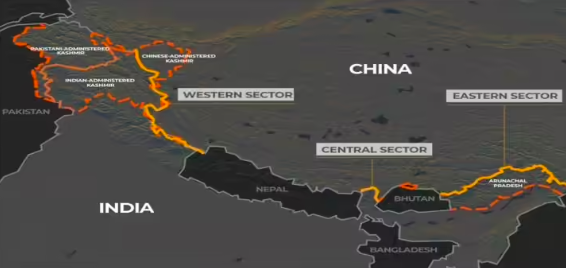
While the Border Roads Organization publishes yearly updates, with infrastructural advancements gradually progress in the region of Arunachal Pradesh, the question that lingers is the comparative advantage provided by these developments. China has developed roads covering more than 600km in Tibet in the last decade. The runways with the capacity of managing heavy-lift aircraft at Shigatze and Hotan, and a network of villages complement the objective of projecting a strategic dominance even further.
Moreover, the confrontations as Doklam and Galwan have showcased Chinese intentions at pursuing its objective, even it takes making intimidating advances. India’s approach of investing into pluralistic alliances and pragmatically assessing its strategy to satisfy its national interests can be threatened if China gains geographic leverage. The following article delves into the bells that have rung, trying to assess the extent of the threat and carving India’s path of tackling these jeopardizing advances.
Background
It has been six years since the vehement Galwan clash happened, and India has lacked in its response to ensure a safety net in case of a recurrence. The policy recommendations look reactionary and symbolic in nature as India aims at investing in ISR, build infrastructure alongside the LAC, while banning Chinese applications and strict FDI approval screenings. A critical question that arises is whether we are even tackling the right problem?
China’s buildup along the lines of LAC, have been considered as a measure of projecting its force and dominance in the region, and aid in any kind of aggressive advancements in the future. However, it also serves as a political purpose, where it is altering the baseline of the amount of presence considered normal in a disputed region, from both psychological and legal domains. If India approaches this issue from a strictly militaristic lens, it might tackle the threat of an aggressive Chinese advancement soon but still lose the border dispute.
Urgency
The urgency of this matter has intensified in the last three years, established from the two cases as follows:
- The troop disengagement at Depsang Plains and Demchok in 2024, have been followed by continued construction activities moderated by the Chinese leadership in other non-disengaged sectors like the Pangong – Tso sector. Beijing disengagements instead of reflecting its compatibility, showcases its tactical approach with the strategic build-up sustaining in the background.
- China’s multi-billion railway expansion into Tibet, which incorporates the successful completion of the first phase of the buildup the Sichuan – Tibet Railway and the Xinjiang -Tibet Railway, that run close to the LAC. These developments completely alter the current scenario as it facilitates PLA mobilization in delicate border regions.
However, these developments are not immediate, but a process that has continued for a couple of decades now. It is critical to understand the Chinese strategy of Salami Slicing and then observe the gradual build-up in these regions.
Sustenance before Strike – The Risk of Salami Slicing
The most significant change in the military scenario alongside the Himalayas, Tibet, and the LAC is the PLA’s capacity and capability to endure, apart from its overwhelming arsenal. The Chinese expansion via the Salami Slicing way, has been following a consistent series of events, where the build infrastructure in the disputed territory, enhance Intelligence, Surveillance, and Reconnaissance (ISR) capabilities in the region, gradually gulping it into the new status quo.
The Case of the Depsang Bulge and Galwan valley
The Depsang Bulge is a region which is controversial as it finds itself very close to the LAC. In late-2010s and 2020, China started crucial infrastructure buildup in the region. This was followed by a blockade of Indian access to five patrolling points in these Depsang plains. During the clash at the Galwan valley, Beijing had already gained leverage in these regions before the physical clash even began. Each of these steps were too minor for India to take a significant action, but detrimental in establishing influence in the region.
Recent Developments
China has created a network of all-weather roads, tunnels and forward supply posts encompassing the region of Tibet, which facilitates the expansion of PLA at LAC flashpoints within 3 days.
Beijing has also expanded its accommodation capacity alongside the PLA, employing a strategy of Civil-Military Fusion using dual-use villages, with these settlements expanding to more than 600 in the last decade through the Xiaokang Border Village Programme.
The villages of Mayjam and Pangda in Arunachal Pradesh documented by satellites, have shown reinforcements, communication towers, and infrastructure irregular with agricultural requirements.
The Moldo-Garrison complex, which incorporates ammunition stores, helicopter landing paddocks, and pre-positioned fuel, portrays the region being prepared for sustaining combat operations, rather than patrolling.
India, on the contrary, works along the lines of Ladakh, enhancing road connectivity, which was sanctioned more than a decade ago. It also portrays its disagreements regarding these build-ups, protesting these actions in the international arena.
The gap in infrastructure and promptness is alarming for India, as it can turn out to be a significant factor in the honest assessment.
The Two Front War
These developments aren’t limited to LAC but are based on a pattern that has led to the creation of a nexus, afflicting the border dynamics for India. One major example for the following developments can be the China Pakistan Economic Corridor and the Karakoram Highway Expansion, which is gradually strengthening China and Pakistan’s military-economic relations. Moreover, PLA’s operations alongside the LAC, with Pakistan engaging the LOC has create a two-front scenario.
The structure of India’s Military forces wasn’t built in a way to sustain a way alongside 4000+ kms of active frontier deployment. Moreover, China’s continuous investment and advancement along the LAC and assistanceprovided to Pakistan for deployment, has proved this possibility to gradually become a potential military strategy.
Compounding both these threats creates a surveillance of asymmetry which increases the risk exponentially. China’s deployed infrastructure, include its SIGINT stations, and electronic warfare systems with the capability of high-altitude UAV operations near the Pangong Tso, provides Beijing access to view India’s deployments. China also has a leverage in electronic warfare, which gives it an advantage in the first few hours of an active conflict.
Therefore, we come back to the question of whether we are preparing on the right front. An adversary that can see you better than how you see them, doesn’t require deception to surprise.
Policy Recommendations and Suggestions
Asking Appropriate Questions
India uses the kilometers of road complete as a standard unit of benchmark used by the Border Roads Organization to highlight the border infrastructure progress. Change this metric to one that facilitates border connectivity. The question relevant to discourse is – How quickly can a brigade reach a contested space?
The Ministry of Defence can publish an Index -LAC Connectivity Index, which compares China’s capability against India’s growing infrastructure sector by sector, and demonstrates India’s operational readiness.
Create a Border Infrastructure Intelligence Cell.
There is no dedicated Border Infrastructure Intelligence Cell to track Chinese construction along the Borders. While the Border Roads Organization, Defence Intelligence Agency, and National Technical Research Organization work in this domain, they function separately. There is no platform where the resources can be pooled, and a more coordinated approach can be taken.
Build a Minilateral Narrative
China has created more than just blocs and understandings. China has also created a narrative revolving around connectivity, shared prosperity and development. While India has worked along the same lines, it is reactionary in nature. India has created a security architecture with QUAD, CSC and IONS, while blocs like IMEC for economic strategy.
India can use these groupings for information sharing through satellite imagery in times of conflict, a diplomatic support against civil military fusion strategy employed by China and boost its strategies of SAGAR and MAHASAGAR with the help of other partners to create a narrative of India’s intent at being the first responder and net provider of security in the Indian Ocean Region to gain credibility countering China’s influence built through the BRI.
The Mountain Strike Corps
New Delhi should rewrite the mandate of the Mountain Strike Corps. An offensive response formation can be used as a tool of deterrence with a framework that incorporates a forward deterrence posture, with pre-positioned and pre-delegated authority.
Prepare for the Emerging Domains of Warfare
China has been preparing for a multi-domain warfare possibility, and India needs to respond in a similar fashion.
- A theatre level command structure should be created for electronic and cyberwarfare.
- Include these areas of warfare in the Joint Military Doctrine and devise a well-structured plan for each of these domains.
- Joint exercises and training programmes should be held with QUAD countries to improve awareness and enhance preparation.
Conclusion
The alarm bells have been rung and the threat on India increases every day. What is crucial right now is to dive into the fundamentals and find the right questions to address. The Chinese Salami Slicing tactic has been in progress since the last two decades now. As the Chinese advancement gets more aggressive India needs to prepare to dissuade, deter and defend its territory. The concept and manifestation of warfare is diversifying, and India needs to take prompt action in each of those directions.



