
By : Suman Sharma
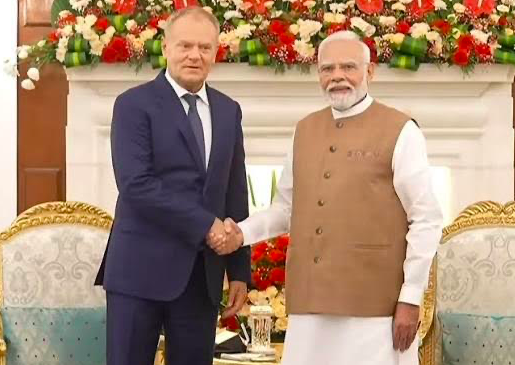
Polish Prime Minister Donald Tusk’s October 2026 visit to India signalled a renewed push to translate defence ties into industrial collaboration and joint capability-building. Both sides agreed to establish a Defence Industry Dialogue, opening new avenues for co-development, co-production and technology collaboration between Indian and Polish defence companies, designed to expand engagement between Indo-Polish defence manufacturers and identify commercially viable opportunities, beyond conventional procurement, thereby paving the way for business-to-business partnerships, technology collaboration, joint development and co-production for defence industrial cooperation. Secretary (West), Ministry of External Affairs (MEA) Sibi George, during his press interaction, said the two countries were exploring practical collaboration building on their complementary capabilities. He noted that defence-sector businesses were increasingly active in exploring opportunities, with Polish defence companies also represented in the Prime Minister’s delegation.
The eighth meeting of the India–Poland Joint Working Group on Defence, held in Warsaw in September, reinforced the institutional framework for sustained engagement.
A proposed agreement on the mutual protection and exchange of classified information could build the trust needed for sensitive technology partnerships, technology transfer and joint production. The two countries also agreed to launch a Counter-Terrorism Dialogue, with both leaders calling for concerted international action against terrorist networks, safe havens and financing. The India–EU Security and Defence Partnership, signed in January 2026, provides a broader framework reflecting a growing convergence in cybersecurity, critical and emerging technologies, and defence innovation. Both leaders welcomed the India–EU Security and Defence Partnership signed in January 2026, signalling an opportunity to connect bilateral cooperation with Europe’s wider security architecture. Collaboration in these areas could strengthen technological resilience and open new avenues for Indian and Polish companies.
Space and emerging technologies are emerging as promising new frontiers. Secretary Sibi George highlighted the joint spaceflight of Indian astronaut Group Captain Shubhanshu Shukla and Polish astronaut Sławosz Uznański-Wiśniewski aboard the Axiom-4 mission in 2025, saying both sides had agreed to encourage greater engagement between their space industries, including startups. The two countries also plan to promote collaborative research in artificial intelligence, semiconductors and quantum technologies, alongside stronger partnerships between businesses and research institutions. These initiatives could broaden the strategic partnership beyond traditional defence engagement into advanced technology and innovation.
This was Prime Minister Donald Tusk’s second visit to India as PM from 21-23 October 2026, at the invitation of Prime Minister Narendra Modi. His programme included bilateral talks in New Delhi and engagements with business stakeholders in Bengaluru. He visited New Delhi in 2017 as President of the European Council for the India–EU Summit.
In the key outcomes, besides the Defence Industry Dialogue and an agreed Counter-Terrorism Dialogue, the agreement on mutual protection and exchange of classified information was expected to be signed later; an MoU on geology, mining and critical minerals remained under negotiation. An agreement on cooperation between the two countries’ national archives had been concluded but was still to be signed.


