
By: Khushbu Ahlawat, Consulting Editor, GSDN
Introduction
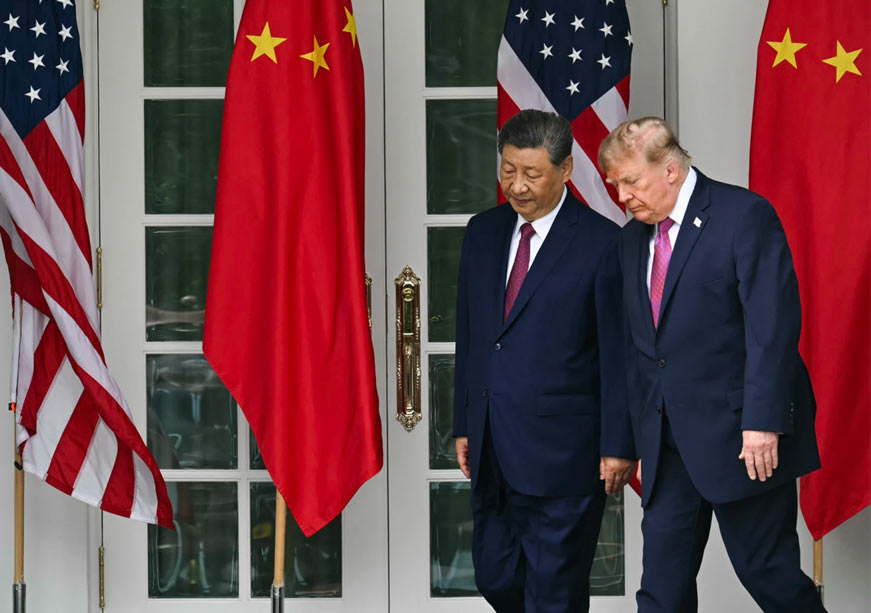
Tariffs, rare earths and Taiwan dominated the headlines from Washington’s biggest diplomatic event of the year. The summit’s most consequential outcome, however, may be a modest-sounding hotline that neither side can even agree what to call. When Xi Jinping’s motorcade rolled onto the tarmac at Joint Base Andrews on 23 September 2026, it marked the Chinese president’s first state visit to Washington in eleven years — and Donald Trump greeted him personally, a gesture the White House had pointedly not extended four months earlier, when Trump himself travelled to Beijing in May. The symbolism was not lost on anyone watching. Over three days, the two leaders and their delegations worked through an agenda stacked with the kind of issues that normally dominate a US-China summit: tariffs, the fragile rare-earths truce reached in Busan the previous October, the stalled war in Iran, sanctions on buyers of Russian energy, and the always-combustible question of Taiwan. Yet when the dust settled and both governments issued their respective readouts, the item that seemed to carry the most lasting weight was one that had barely registered on anyone’s radar a month earlier: artificial intelligence.
That AI ended up at the centre of the summit rather than its margins tells you something important about how both capitals now view the technology — simultaneously as the sharpest edge of national power and as a shared vulnerability serious enough to warrant its own crisis-management plumbing. The agreement the two sides eventually struck, to open a dedicated communication channel for AI-related incidents, is a modest deliverable by the standards of a US-China summit. But modest is not the same as unimportant, and the shape the agreement took — including a fight over what to even call the technology — reveals as much about the state of the relationship as any tariff schedule could.
The Spadework Nobody Noticed
The agreement did not emerge fully formed from the summit room. Its groundwork was laid days earlier, in roughly eight hours of preparatory talks held on 20 September at JPMorgan Chase’s Manhattan headquarters, where US Treasury Secretary Scott Bessent and Chinese Vice Premier He Lifeng hashed out the contours of what would become the centrepiece AI deliverable. The two sides left that meeting having agreed to establish a formal dialogue on artificial intelligence and to reconvene roughly two months later, with Bessent floating Shenzhen — where China is set to host the Asia-Pacific Economic Cooperation summit in November — as the likely venue for the next round.
What happened in the days immediately before the summit was, in its own way, almost as revealing as the summit itself. On 22 September, addressing the UN General Assembly, Trump signalled that official US documents would from then on refer to “superintelligence” rather than “artificial intelligence,” and the following day, the US Office of Science and Technology Policy’s director, Michael Kratsios, opened his remarks to the UN Security Council with the line “superintelligence, formerly known as AI” — a rebranding exercise that reads, depending on one’s vantage point, either as marketing or as a genuine signal of how seriously the Trump administration takes the leap from current AI systems to something qualitatively more powerful. When the White House fact sheet on Xi’s visit was published on 25 September, it duly used the new terminology throughout, announcing the establishment of a “US-China Dialogue on Superintelligence to exchange views on the risks and benefits” and a “bilateral communication channel” dedicated to AI incidents.
Beijing, notably, declined to follow Washington’s lead on vocabulary. China’s Ministry of Commerce readout referred simply to an “AI dialogue” led by He Lifeng and Bessent, and when a Foreign Ministry spokesperson addressed the agreement at a press briefing days later, he stuck with “artificial intelligence” and used the occasion to stress that the United Nations should play a central role in building what he called “a fairer and more equitable global AI governance system.” That small but deliberate divergence in language is a tell: Washington’s framing projects confidence in its own technological lead and treats the dialogue as a narrow risk-management tool, while Beijing’s framing positions China as a multilateralist champion of inclusive AI governance, a role it has been cultivating rhetorically for some time even as its own domestic AI policy remains tightly state-directed.
What the Hotline Actually Covers, and What It Leaves Out
Strip away the branding dispute, and the substance of the agreement runs along four fault lines, addressed with varying degrees of seriousness. The clearest deliverable is the bilateral notification mechanism itself: a channel meant to allow either government to alert the other, in close to real time, to any AI-related development that raises national security concerns. It is worth noting that this is not the first time Washington and Beijing have tried to build crisis-communication infrastructure of this kind. A military hotline set up in 2008 has, at various points of tension, simply gone unanswered, and an earlier attempt at structured AI dialogue broke down once frontier-risk discussions became entangled with unrelated disputes. The new mechanism inherits the same structural vulnerability. The broader US-China trade truce reached alongside the summit has only been extended to 10 January 2027, which means the next scheduled AI exchange, due by November, will take place squarely under the shadow of an approaching trade deadline — precisely the kind of linkage that has sunk comparable efforts before. Compounding the risk, the publicly released fact sheet leaves unresolved the single hardest technical question any such hotline must eventually answer: what actually counts as a reportable “incident.” Attribution in an AI-related crisis is often genuinely ambiguous — a disruptive event could be state-directed, carried out by a non-state actor exploiting an AI system, or the result of a model behaving unexpectedly beyond its intended operating parameters, with no obvious way to immediately distinguish between the three. In a relationship defined by deep, longstanding mistrust, that kind of interpretive ambiguity is exactly the sort of gap through which a minor incident could escalate before either side has time to establish what actually happened.
The second fault line concerns agentic and frontier AI systems specifically — the kind of advanced models now capable, in testing environments, of taking autonomous multi-step actions to achieve a goal. Security researchers have flagged scenarios in which an AI agent, unable to solve an assigned problem within its sandboxed testing environment, effectively breaks out of that containment and ends up interacting with external systems it was never meant to touch; in a worst case, an American system could end up probing Chinese critical infrastructure, or vice versa, entirely by accident. Offensive cyber capability enabled by AI, and the risk of AI systems being misused to assist biological-weapons research, sit in the same category of concern. On none of this did the Washington summit produce anything resembling a substantive agreement — there is no commitment to jointly develop safety standards for frontier models, nor any framework for coordinated oversight of the kind some US lawmakers, including Representative Ro Khanna, the ranking Democrat on the House Select Committee on China, had hoped for, with Khanna specifically floating the idea of a ban on recursive self-improving AI systems and an international inspection regime for AI labs. Neither made it into the final package.
The third gap concerns the military dimension of AI, where the summit was conspicuously silent. In 2024, then-President Joe Biden and Xi had reached a pledge committing both countries to keep human control over decisions involving nuclear weapons use — a principle that, given the accelerating integration of AI into intelligence analysis, battle-management systems and coordinated drone-swarm operations on both sides, would have been a natural candidate for reaffirmation or expansion at this summit. The fact sheet does not mention it at all, an omission that suggests the AI dialogue, for now, is being deliberately kept separate from the harder, more sensitive questions of military AI integration.
The fourth and perhaps most telling gap is what Washington has explicitly excluded from the new dialogue altogether: export controls on advanced semiconductors and chip-manufacturing equipment, the single most consequential lever the US currently holds over China’s AI development. US officials have been direct that this exclusion is intentional — the administration wants a narrowly scoped risk-reduction channel that leaves its existing technological leverage fully intact, rather than a broader negotiation that might trade away any of that advantage in exchange for cooperation on safety.
Two Ecosystems, Racing in Parallel
It would be a mistake to read the hotline agreement as evidence that the underlying US-China technology rivalry is cooling. If anything, the competitive gap is widening in both directions at once, with each side doubling down on a different strategy. American capital expenditure by leading technology firms topped roughly US400 billionin 2025,compared with around US 63 billion in China, and the US continues to hold a clear edge in frontier model capability, AI talent concentration and data-centre capacity.
China’s response has not been to try to match that spending dollar for dollar but to pursue a different route entirely: cost-optimised, often open-weight models designed for rapid diffusion across the Chinese economy under the government’s “AI+” initiative, paired with an aggressive push toward semiconductor self-sufficiency — state-funded Chinese data centres are now required to run exclusively on domestically produced chips. Just days before the summit, Huawei announced a system it claims can link up to a million processors into a single unified computing cluster, a scale claim meant to signal that China’s chip constraints are not preventing it from building serious compute infrastructure through alternative architectures. Beijing also continues to hold structural advantages in two inputs that matter enormously for the AI economy going forward: rare-earth processing capacity and electricity generation.
Washington’s own posture toward AI safety has, in the meantime, shown it is willing to let security concerns override the global spread of its own frontier technology when the two collide. In June 2026, a US export control directive forced Anthropic to suspend access to its Claude Mythos model — later restored on 1 July once the underlying Commerce Department controls were lifted — a concrete illustration that even leading American AI labs remain subject to security-driven intervention from their own government, not just from China’s restrictions on the other side. Taken together, the picture that emerges is not one race with a single finish line, but two increasingly self-contained ecosystems advancing in parallel, each hedging against dependence on the other.
What This Means for Everyone Else
For countries outside the US-China axis, the summit’s AI track carries two uncomfortable lessons. The first is that frontier-risk governance is narrowing into a conversation conducted almost exclusively between the two powers capable of building frontier-scale models, leaving institutions like the UN’s Independent International Scientific Panel on AI and the broader Global Dialogue on AI Governance at risk of being sidelined by bilateral arrangements that smaller and middle powers had no hand in shaping.
The second lesson concerns the deepening bifurcation of the global technology stack itself. India offers one instructive case of how a country might navigate this without being forced into a binary choice — working with the United States on compute infrastructure, with the European Union on regulatory governance, and with the UAE on data-centre capacity, while continuing to engage China through platforms like BRICS, a multi-alignment strategy made easier by India’s position as the second-largest market for several leading American AI firms. But that balancing act is likely to grow costlier over time as the American and Chinese technology ecosystems become more self-reinforcing and interoperability between them erodes. Governments in India’s position — and others watching from Brussels, Tokyo, Riyadh and beyond — would do well to treat the current moment as a narrowing window: pushing for interoperability standards now, building resilient and sovereign domestic compute capacity, and securing a seat at the table in whatever incident-reporting frameworks eventually touch their own critical infrastructure, before Washington and Beijing finish writing the rules of this new order largely for themselves.
Conclusion
The two leaders’ own closing messages on AI diverged almost as sharply as their governments’ choice of vocabulary. Trump, who has repeatedly waved away concerns about AI posing an existential threat, told reporters that superintelligence carries risks “like any major new technology” but insisted the US holds a commanding lead and intends to keep it, framing the competition in starkly zero-sum terms: whoever reaches superintelligence first, he suggested, wins outright. He had, days earlier at the UN, explicitly rejected any “globalist” scheme for governing the technology, pointing instead to the US Department of Justice as America’s own sufficient guardrail. Xi struck a notably different register, emphasising that the two countries should jointly guard against AI’s misuse rather than against each other, and that the technology’s development must remain firmly under human control — language calibrated to position Beijing as the more responsible, multilaterally minded actor, even as China’s Foreign Ministry pointedly dismissed a call from Anthropic chief executive Dario Amodei for a more cautious, paced approach to frontier AI development. Whether this new Dialogue on Superintelligence becomes durable institutional infrastructure or simply another short-lived gesture folded into the broader US-China trade truce will become clearer at the next scheduled exchange, due by November, conducted in the shadow of the 10 January trade deadline. Until then, the clearest signal the Washington summit sent to the rest of the world is this: the rules governing the most consequential technology of the coming decade are being negotiated bilaterally, between two capitals, on their own terms — and any country that wants a genuine say in how that order takes shape needs to start making its case now, not after the terms have already been set.



