
By : Kumar Aryan, Research Analyst, GSDN
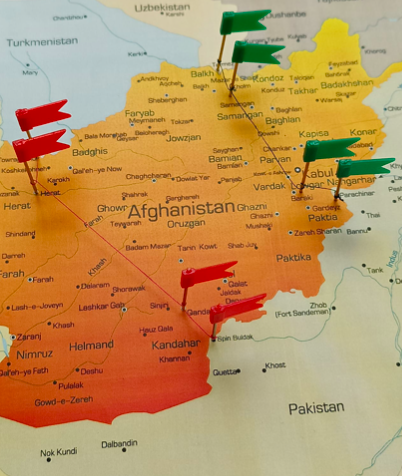
Afghanistan occupies a geopolitical position that is disproportionate to the size of its economy. Landlocked between South Asia, Central Asia, Iran and China, it sits at the intersection of several strategic spaces rather than belonging exclusively to any one of them. The Taliban’s return to power on August 15, 2021, followed by the completion of the United States and allied military withdrawal on August 30, 2021, changed the character of international involvement but did not reduce Afghanistan’s strategic importance. Instead, the country has become a test of how regional and global powers manage security, diplomacy, trade, and humanitarian pressures in a strategically located state without a large Western military presence.
A Strategic Geographical Pivot
Afghanistan’s geography is the foundation of its geopolitical relevance. It shares borders with Pakistan, Iran, Turkmenistan, Uzbekistan, Tajikistan and China, creating direct interfaces with South Asia, Central Asia, the Iranian and Caspian regions, and western China. The narrow Wakhan Corridor gives Afghanistan its direct border with China, while the country’s southern and western routes provide potential access to Pakistan’s ports and Iran’s Chabahar corridor.
This position has historically drawn external powers into Afghan affairs. The British-Russian rivalry of the nineteenth century, the Soviet intervention beginning in December 1979 and the international military campaign after September 11, 2001, each demonstrated that political change in Afghanistan can acquire consequences far beyond its borders. The contemporary difference is that strategic competition increasingly revolves around influence, connectivity, and risk management rather than permanent foreign occupation.
Connectivity illustrates why geography remains decisive. Afghanistan can serve as a physical link between Central Asian economies and South Asian markets, but it can also become a bottleneck when security deteriorates or border crossings close. The Central Asia-South Asia Electricity Transmission and Trade Project, known as CASA-1000, is a US$1.2 billion regional electricity project designed to transmit up to 1,300 megawatts of surplus power from Kyrgyzstan and Tajikistan through Afghanistan to Pakistan. The World Bank notes that the Afghan segment is indispensable to the system and that implementation resumed after the 2021 pause. Completion of the Afghan section is expected by the end of 2027. Afghanistan therefore matters because neighboring regions cannot fully exploit several major connectivity opportunities without stable transit through Afghan territory.
Security and Cross-Border Militancy
Security is the most immediate source of Afghanistan’s global geopolitical significance. The country remains connected to several militant networks, including Islamic State in Iraq and the Levant-Khorasan (ISIL-K), Al-Qaida and the Tehrik-e-Taliban Pakistan (TTP). The key concern for outside powers is not only violence inside Afghanistan but the possibility that networks linked to Afghan territory could threaten neighboring states or support attacks farther afield.
The latest United Nations reporting shows that apparent nationwide stability does not eliminate security risks. Between May 1 and July 31, 2026, the United Nations recorded 2,947 safety and security incidents, 11 percent more than during the same period in 2025. A separate United Nations assessment published on July 31, 2026, found that ISIL-K retained the intent to conduct external operations and was rebuilding capacity for occasional high-profile attacks despite pressure from the de facto authorities and Pakistan.
The Afghanistan-Pakistan relationship demonstrates how domestic security issues can become regional crises. Islamabad has repeatedly argued that the TTP and associated networks operate from Afghanistan, while Taliban authorities reject the allegation and oppose Pakistani military action on Afghan territory. The dispute has increasingly acquired a military dimension. On September 21, 2026, the United Nations confirmed at least three civilian fatalities and four injuries in an apparent Pakistani airstrike in Kunar Province and reported that Paktika Province was also affected. The United Nations had already documented more than 1,100 civilian casualties arising from cross-border armed violence in Afghanistan during 2026. Such escalation can affect border trade, migration, counterterrorism cooperation and the security calculations of China, Iran and Central Asia.
Afghanistan therefore remains significant to global security because risks originating in or around the country can cross several borders at once. Its strategic importance does not require a return to the level of international conflict seen during the early twenty-first century; the persistence of transnational militant networks and fragile regional relations is sufficient to keep Afghanistan on the security agendas of major powers.
Diplomatic Re-engagement and Great-Power Competition
Since 2021, Afghanistan has moved from a predominantly Western military-centred framework toward a more fragmented system of regional engagement. The United States continues to maintain sanctions and security concerns relating to the Taliban and the Haqqani Network while permitting humanitarian activity under specified exemptions. Afghanistan is not subject to comprehensive United States sanctions, but selected Taliban and Haqqani-linked individuals remain designated.
Russia has pursued a more overt normalization strategy. On July 3, 2025, Russia formally recognized the Taliban government, becoming the first country to do so since the Taliban returned to power. Moscow linked the decision to prospects for cooperation in security, counterterrorism, narcotics control, trade, energy, transport and infrastructure. Russia’s position also reflects concern about instability reaching the Central Asian states to its south.
China has pursued sustained engagement focused on security, trade and long-term economic access. On August 20, 2025, Chinese Foreign Minister Wang Yi met Afghanistan’s acting foreign minister in Kabul. China expressed interest in Afghanistan’s formal participation in the Belt and Road Initiative (BRI) and in expanding cooperation on mining. China has also used regional diplomacy to manage Afghan issues. From April 1 to 7, 2026, China, Afghanistan and Pakistan held an informal meeting in Urumqi, while Chinese Special Envoy for Afghan Affairs Yue Xiaoyong conducted further consultations in Pakistan and Saudi Arabia from August 30 to September 5, 2026.
These developments show that Afghanistan is increasingly being handled through overlapping regional mechanisms rather than a single dominant external power. China, Russia, Iran, Pakistan, India and the Central Asian states have different interests, but all have reasons to prevent Afghanistan from becoming a source of wider instability. The result is a form of competitive engagement in which diplomatic access itself has become a strategic instrument.
China, Minerals and the Economic Geopolitics of Afghanistan
Afghanistan’s resource base adds an economic dimension to this competition. A United States Geological Survey assessment published in 2007 identified substantial deposits and prospective resources of copper, iron, lithium, rare-earth elements and other minerals. These estimates indicate geological potential, not immediately recoverable from commercial reserves. Infrastructure, finance, security and export capacity remain major constraints.
Current production data show why caution is necessary. The United States Geological Survey’s 2024 reporting states that major mineral exploration projects have been conducted by Chinese companies, while production remains concentrated in commodities such as talc, chromite, coal, cement and construction materials. Afghanistan ranked as the world’s 11th-largest talc producer in 2024, accounting for 2.6 percent of global output. The contrast between substantial geological potential and modest industrial output is important: minerals can create long-term strategic value, but they do not automatically create immediate geopolitical leverage.
China’s interest therefore extends beyond extracting commodities. Mining projects can support investment in roads, logistics, and energy, while improved connectivity can make resource projects more commercially viable. The relationship is reciprocal. Yet delays, contractual disputes and difficult terrain demonstrate that diplomatic engagement does not guarantee successful investment. Afghanistan’s economic significance is consequently better understood as a long-term potential tied to infrastructure and regional access rather than as an immediate resource windfall.
Pakistan, India and Iran
Afghanistan is central to the strategic calculations of Pakistan, India and Iran, but for different reasons. Pakistan shares the longest border with Afghanistan and is directly exposed to militant attacks, border clashes, refugee movements and trade disruption. The TTP dispute has become particularly important because Pakistan sees the issue as a national security problem, while Kabul rejects accusations of providing haven and objects to cross-border strikes.
India’s relationship is shaped by the absence of a direct land border. New Delhi therefore relies on air and maritime routes, particularly through Iran, for sustained economic access. On January 8, 2025, Indian Foreign Secretary Vikram Misri met Afghanistan’s acting foreign minister in Dubai and discussed bilateral relations, regional developments, humanitarian assistance and trade through the Chabahar Port. India has maintained engagement partly because developments in Afghanistan affect wider South Asian security and access to Central Asian markets.
Iran’s position is shaped by border security, trade, migration and water-related interests. Iran also serves as an alternative commercial route when Afghanistan-Pakistan crossings are disrupted. The interaction among Pakistan, India and Iran means that Afghanistan is embedded in a wider strategic triangle extending from the Arabian Sea to Central Asia. None of the three states can determine Afghanistan’s trajectory alone, and their priorities sometimes diverge sharply over political legitimacy, trade routes and regional influence. Their common exposure to instability, however, keeps Afghanistan at the center of South Asian diplomacy.
Central Asia and Regional Connectivity
Afghanistan is increasingly important to the Central Asian states because geography offers both risks and opportunities. Uzbekistan, Tajikistan and Turkmenistan have strong incentives to prevent instability from moving northward, but they also seek access to South Asian markets and ports. Uzbekistan has been especially active in promoting the Trans-Afghan Railway concept.
On July 1, 2026, the President of Uzbekistan highlighted acceleration of the Trans-Afghan railway project as part of efforts to strengthen regional and international transport links. Earlier, on July 3, 2025, Uzbekistan discussed trade, transport, energy and mining cooperation with Afghanistan and stressed the strategic importance of the railway. These initiatives reflect a wider effort to connect landlocked Central Asia with Pakistan and other southern markets.
CASA-1000 demonstrates the same structural logic in the energy sector. Afghanistan is the central link connecting the participating northern and southern countries, meaning that its infrastructure is essential even when political relations remain complicated. Central Asian governments therefore have a strong incentive to favor practical engagement on border security, trade, electricity and transport. Afghanistan’s geopolitical relevance is partly the result of this structural dependency: it can either connect regions that are otherwise separated by difficult geography or obstruct their integration when instability interrupts transit.
Humanitarian, Economic and Migration Pressures
Afghanistan’s geopolitical importance cannot be separated from its economic and humanitarian conditions because internal shocks often become regional problems. The World Bank estimated real gross domestic product growth of 4.8 percent in 2025 and projected growth of about 4 percent in 2026, while also estimating a 5.6 percent decline in GDP per capita and a current account deficit equivalent to 36.1 percent of GDP in 2025. The data illustrate the gap between aggregate economic growth and household welfare.
The humanitarian picture remains severe. The World Food Programme projects that 13.8 million Afghans face acute food insecurity in 2026, while 4.9 million women and children are expected to require treatment for malnutrition. The agency has appealed for US$540 million to sustain operations through January 2027. The scale of need matters geopolitically because food insecurity, unemployment and weak services can increase migration and place additional pressure on neighboring states.
Migration is already a major regional issue. The Office of the United Nations High Commissioner for Refugees reported 1,228,920 returns to Afghanistan during 2026 as of September 22. The term of returns includes deportations, assisted voluntary repatriation and other movements, so the figure should not be treated as a single category of refugee return. It nevertheless demonstrates the magnitude of movement affecting Afghanistan, Pakistan and Iran. Large-scale returns can strain housing, employment, water, healthcare and local infrastructure in Afghanistan while also altering bilateral relations with neighboring states.
Counternarcotics creates another cross-border dimension. The United Nations Office on Drugs and Crime estimated that opium poppy cultivation fell to 10,200 hectares in 2025, 20 percent below 2024, while potential opium production declined by 32 percent to 296 tons. Farmers’ income from opium sales fell from US$260 million in 2024 to US$134 million in 2025. The decline may reduce the scale of illicit production, but it also creates livelihood pressures that can affect rural stability. Afghanistan’s humanitarian, economic, migration and narcotics issues therefore remain interconnected with regional security.
Afghanistan’s Strategic Relevance Beyond 2026
Afghanistan’s geopolitical importance is likely to remain structural because the drivers are rooted in geography rather than a single conflict. Its position between Central Asia and South Asia, its direct border with China, its proximity to Iran and its access routes toward the Arabian Sea ensure continuing external interest. At the same time, militant networks create a persistent security dimension that neighboring states cannot manage independently.
What has changed is the way influence is pursued. The post-2021 environment is characterized less by large-scale foreign military deployment and more by selective diplomacy, economic engagement, sanctions, regional mediation and infrastructure initiatives. The United Nations remains the principal multilateral platform, while China, Russia, Iran, Pakistan, India and the Central Asian states pursue overlapping but distinct approaches.
The future economic trajectory is equally consequential. Afghanistan possesses mineral and transit potential, but converting that potential into sustained growth depends on infrastructure, financial access, investment conditions, trade routes and domestic policy. Projects such as CASA-1000 and the Trans-Afghan Railway demonstrate that regional economic integration can depend on Afghan territory even when questions surrounding international recognition remain unresolved.
Afghanistan should therefore not be understood only as a security problem or only as an economic opportunity. The same geography that enables trade also creates exposure to militant networks. The same regional engagement that can support investment also raises questions over diplomatic legitimacy. The same reduction in narcotics cultivation that may benefit regional security can intensify economic pressure on vulnerable farming communities. Afghanistan matters because these tensions converge in one country while producing consequences across several regions.
Conclusion
Afghanistan matters in global geopolitics because it sits at the intersection of several strategic systems at a time when the balance around it is changing. Its territory connects Central Asia to South Asia; its borders expose neighboring states to security and migration pressures, and its mineral and infrastructure potential attracts sustained economic interest. Severe humanitarian need, economic fragility and restrictions affecting women and girls further complicate the country’s relationship with the wider international system.
Its importance is therefore best understood through concrete networks rather than historical slogans. Security threats cross borders. Trade routes cross borders. Electricity lines cross borders. Population movements cross borders. Diplomatic influence also crosses borders. Afghanistan’s strategic weight comes from this interdependence.
For the international community and regional powers, the central geopolitical challenge is how to manage that interdependence while limiting the risks that can radiate from Afghanistan. That makes Afghanistan an enduring geopolitical pivot whose significance extends well beyond its immediate neighborhood and beyond the events that first placed it at the center of international security debates.



