
By: Sonalika Singh, Consulting Editor, GSDN
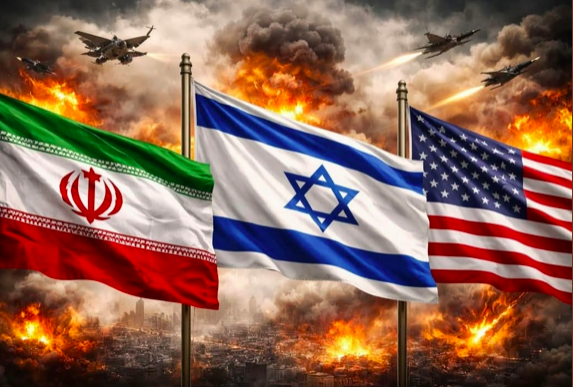
The confrontation between the United States, Israel, and Iran in early 2026 marks a significant turning point in the evolution of modern warfare. While missiles, drones, and airpower remain the most visible instruments of military conflict, the deeper transformation lies in the integration of artificial intelligence into nearly every stage of military operations. From intelligence collection and data analysis to target identification, logisticscoordination, and post-strike assessment, AI has begun to reshape the pace, scale, and nature of warfare. The American and Israeli campaign against Iran illustrates how algorithmic systems are increasingly embedded in military decision-making processes, compressing the time required to plan and execute complex operations while generating both strategic advantages and serious ethical concerns.
The escalation of the conflict began on 28 February 2026, when the United States and Israel launched a coordinated campaign of air and cyber strikes against Iranian military infrastructure. Fighter aircraft, cruise missiles, drones, and naval platforms targeted missile launch sites, command centres, radar installations, and air defence networks across Iran. Within the first twenty-four hours of the campaign, reports indicated that approximately 1,000 targets had been struck. Such a scale of coordinated attacks would traditionally require weeks of intelligence preparation and operational planning. However, the speed with which these operations unfolded reflected the growing influence of artificial intelligence systems that enabled military planners to process vast volumes of intelligence data and prioritise targets at unprecedented speed.
One of the central technological tools supporting the campaign was the Pentagon’s Maven Smart System, an intelligence analysis platform designed to process large datasets derived from surveillance and reconnaissance sources. Originally developed to analyse drone imagery, the Maven system integrates satellite images, signals intelligence, intercepted communications, and battlefield reports into a unified analytical framework. Artificial intelligence algorithms within the system help identify patterns and anomalies across these datasets, allowing analysts to detect potential military targets far more rapidly than traditional intelligence workflows would permit. In practical terms, the system assists military planners in narrowing vast streams of raw data into prioritised lists of targets that commanders can evaluate before authorising strikes.
The impact of such technologies on military operations is often described as “decision-cycle compression.” Modern battlefields generate enormous volumes of information from satellites, drones, radar networks, cyber surveillance systems, and communications intercepts. In earlier conflicts, intelligence teams required large numbers of analysts to manually process this information, a time-consuming process that slowed operational planning. Artificial intelligence now allows this information to be analysed almost instantly. For example, during the opening phase of the 2026 campaign against Iran, AI-assisted systems reportedly helped military planners identify and prioritise hundreds of potential targets within hours, enabling the rapid coordination of simultaneous strike operations across multiple regions of the country.
Artificial intelligence also played a critical role in intelligence collection and interpretation prior to the outbreak of hostilities. Israeli intelligence agencies had spent years monitoring Iranian communications networks, intercepting signals intelligence, and analysing digital data streams associated with Iran’s military and political leadership. Increasingly, AI tools were used to sift through these vast volumes of intercepted data. Algorithms capable of speech recognition and pattern analysis helped identify key individuals, detect unusual communication patterns, and track movements across digital networks. These systems enabled intelligence agencies to monitor Iranian officials more efficiently and identify potential targets within Iran’s command structure.
In addition to communications analysis, AI systems also assisted in processing surveillance imagery from satellites and drones. Modern military reconnaissance platforms capture massive quantities of high-resolution images covering wide geographic areas. Artificial intelligence algorithms can rapidly scan these images and identify objects that match predefined characteristics, such as missile launchers, military vehicles, radar installations, or weapons storage facilities. By automatically flagging potential targets within these images, AI dramatically reduces the time required analysts to identify military infrastructure and assess its operational significance.
The integration of large language models into military intelligence systems further accelerated analytical processes. Systems such as Anthropic’s Claude were reportedly integrated with the Maven platform to assistanalysts in organising information and summarising intelligence reports. Large language models are particularly effective at synthesising large volumes of textual information, translating intercepted communications, and generating concise analytical summaries. By automating aspects of information processing, these systems enable intelligence teams to focus more directly on strategic interpretation and operational planning.
Despite the sophistication of these technologies, AI systems do not operate autonomously in combat operations. Military officials emphasise that artificial intelligence functions primarily as a decision-support tool rather than an independent weapons system. Commanders remain responsible for evaluating target recommendations and authorising strikes. However, the role of AI in generating and prioritising target lists has significantly accelerated the pace at which military decisions are made. In earlier conflicts, identifying a target might require days of intelligence verification. In the current environment, algorithmic systems can generate target suggestions within seconds.
The growing reliance on artificial intelligence has also transformed the logistical aspects of warfare. AI-enabled planning systems help military commanders allocate resources such as aircraft, missiles, drones, and surveillance assets. By analysing factors such as geographic proximity, weapon effectiveness, and operational risk, these systems recommend which units and weapons are best suited for specific missions. In some respects, the process resembles algorithmic matching systems used in commercial applications, where software rapidly pairs resources with tasks based on multiple variables. For military planners managing large-scale operations, such capabilities significantly improve operational efficiency.
Artificial intelligence also supports post-strike assessments, another critical component of modern warfare. After a strike operation, reconnaissance of drones and satellites collects imagery to evaluate the damage inflicted on targeted facilities. AI algorithms can compare before-and-after images to identify structural damage, detect destroyed equipment, and estimate whether targets have been successfully neutralised. These automated assessments allow commanders to quickly determine whether additional strikes are necessary or whether operations can move on to other objectives.
However, the increasing role of AI in warfare has also generated significant controversy and ethical debate. One of the primary concerns relates to the accuracy and reliability of algorithmic systems used in target identification. While AI systems can process enormous amounts of data, they are not infallible. In testing conducted by the United States military, object recognition algorithms used in intelligence analysis reportedly achieved accuracy rates significantly lower than those of experienced human analysts. Mistakes such as misidentifying civilian vehicles as military equipment can have devastating consequences when translated into targeting decisions.
Another concern involves the phenomenon known as “automation bias,” where human operators place excessive trust in machine-generated recommendations. When algorithmic systems produce target lists or intelligence assessments, there is a risk that analysts may accept these outputs without sufficiently questioning their validity. Over time, reliance on AI systems may also lead to what researchers describe as “cognitive offloading,” where human analysts become less capable of independently evaluating information because they rely heavily on automated tools.
These risks are particularly significant in high-pressure wartime environments where decisions must be made quickly. When artificial intelligence reduces complex analytical processes to rapid algorithmic outputs, commanders may face pressure to act on machine-generated recommendations without extensive deliberation. Critics argue that the accelerating pace of algorithmic warfare may increase the likelihood of errors and unintended civilian casualties.
Civilian casualties have indeed become a central issue in the conflict. Reports indicate that the American and Israeli bombing campaign has caused extensive damage to infrastructure across Iran, including schools, markets, energy facilities, and healthcare centres. Investigations into several strikes have raised questions about whether AI-generated targeting data contributed to errors in identifying military objectives. Although military officials maintain that human oversight remains in place for all strike decisions, the role of AI in shaping the targeting process has drawn intense scrutiny from human rights organisations and legal experts.
The strategic implications of AI-enabled warfare extend beyond individual strikes. Artificial intelligence allows militaries to operate at a tempo that would be impossible using traditional intelligence processes. By compressing decision cycles, AI systems enable rapid escalation of military operations. In the case of the American and Israeli campaign against Iran, the ability to identify and strike hundreds of targets within a single day demonstrated how algorithmic systems can dramatically intensify the pace of warfare.
Iran’s response to the campaign also reflects the growing influence of artificial intelligence in military strategy. Iranian forces launched missile and drone attacks against Israeli territory and American military installations across the Middle East. Some analysts believe that Iranian targeting decisions were also supported by algorithmic systems designed to identify strategic vulnerabilities in the regional infrastructure supporting American and Israeli operations. Notably, Iranian strikes targeted radar installations and data centres associated with surveillance networks and AI-driven command systems, suggesting an awareness of the technological infrastructure underpinning modern warfare.
The conflict has also expanded into the cyber domain, where artificial intelligence plays an increasingly important role. Cyber operations accompanying the military campaign targeted communications networks, logisticssystems, and surveillance infrastructure. AI-assisted cyber defence systems help detect anomalies in network activity, identify potential intrusions, and respond to digital threats more rapidly than traditional methods. As cyber warfare becomes more integrated with conventional military operations, artificial intelligence is likely to play a central role in defending digital infrastructure and coordinating cyber responses.
Another emerging dimension of AI-enabled warfare involves attacks on digital infrastructure. Data centres that support cloud computing services and AI workloads have become strategically significant targets because they store and process the data necessary for intelligence analysis and military planning. During the conflict, strikes on data centres in the Gulf region disrupted digital services and highlighted the vulnerability of the technological infrastructure supporting modern military operations. These attacks demonstrate that future conflicts may increasingly focus on digital systems that underpin information processing rather than physical military installations.
The integration of artificial intelligence into warfare also reflects broader technological competition among major powers. AI systems developed by companies such as Anthropic, OpenAI, and other technology firms are increasingly embedded in national security infrastructure. Governments are evaluating which models perform best in intelligence analysis, translation, cybersecurity monitoring, and data processing. The involvement of private technology companies in military operations raises complex questions about the relationship between the technology sector and national security institutions.
At the same time, artificial intelligence remains dependent on human expertise and organisational capacity. Military AI systems require extensive infrastructure, including surveillance networks, data storage facilities, and highly trained personnel capable of managing and interpreting algorithmic outputs. Without these supporting structures, even the most advanced algorithms cannot function effectively. The American and Israeli campaign against Iran demonstrates how decades of investment in intelligence systems, data infrastructure, and military technology have enabled the integration of AI into operational planning.
Ultimately, the use of artificial intelligence in the conflict between the United States, Israel, and Iran illustrates the beginning of a new phase in the evolution of warfare. AI does not replace human decision-makers, but it fundamentally changes the speed and scale at which military operations can be conducted. Intelligence analysis that once required thousands of analysts can now be performed by small teams supported by algorithmic tools. Target identification that once took days can now occur within minutes. These changes have the potential to reshape strategic planning, operational coordination, and the nature of military conflict itself.
The broader significance of the conflict lies in the demonstration that control over data, algorithms, and digital infrastructure is becoming as important as control over territory or conventional military forces. In an era where artificial intelligence shapes intelligence gathering, targeting decisions, and operational planning, technological superiority may increasingly determine the outcome of conflicts. The American and Israeli attack on Iran therefore represents not only a geopolitical confrontation but also a preview of how artificial intelligence will influence the conduct of war in the twenty-first century.

About the Author
Sonalika Singh began her journey as an UPSC aspirant and has since transitioned into a full-time professional working with various organizations, including NCERT, in the governance and policy sector. She holds a master’s degree in political science and, over the years, has developed a strong interest in international relations, security studies, and geopolitics. Alongside this, she has cultivated a deep passion for research, analysis, and writing. Her work reflects a sustained commitment to rigorous inquiry and making meaningful contributions to the field of public affairs.




Very good i like it
wish you all the best
wish you best and best