
By: Dr. Shweta Tiwari
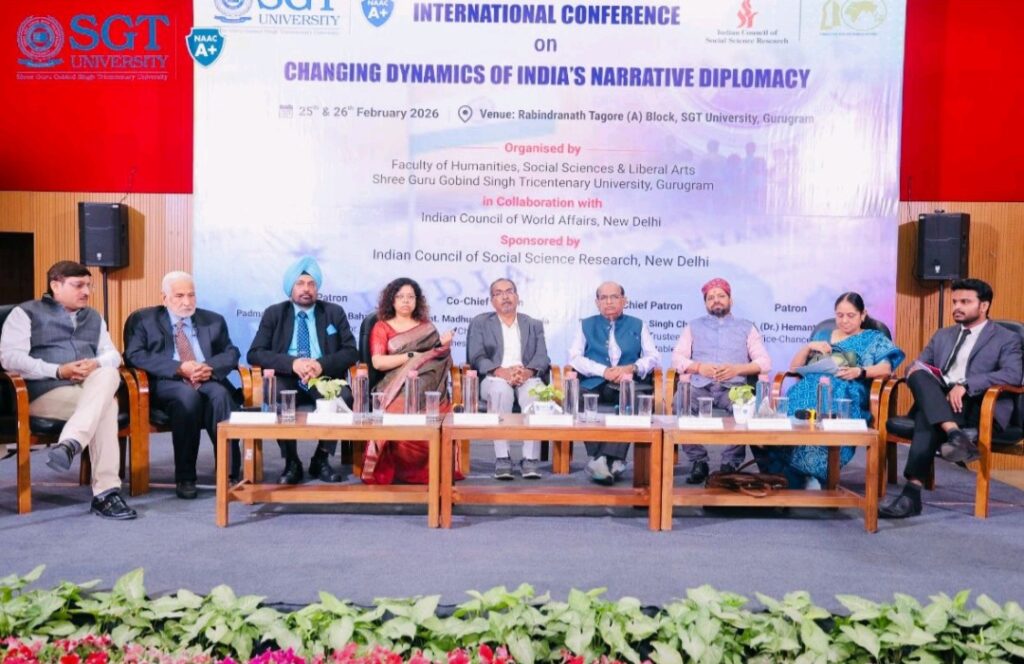
The Two-Day International Conference on Changing Dynamics of India’s Narrative Diplomacy, was organized by the Faculty of Humanities, Social Sciences and Liberal Arts, Shree Guru Gobind Singh Tricentenary University in collaboration with the Indian Council of World Affairs and sponsored by the Indian Council of Social Science Research unfolded as a multidimensional academic engagement, on February 25-26, 2026. Bringing together scholars, practitioners and policymakers, the conference examined the ways in which India’s global image is increasingly shaped by narratives, perception-building and strategic communication. Through keynote lectures, panel discussions and thematic technical sessions, it highlighted that in an interconnected yet fragmented global order, countries compete not only for territory, trade, or military leverage but also for legitimacy, credibility and moral authority within discursive and digital spaces.
The conference began with a panel discussion titled “Narrative Diplomacy: Theory and Praxis”. The panellists, Dr. Artyom Garin, Dr. Aurora Martin, Dr. Titipol Phakdeewanich, Ms. Anamika Bhattacharjee and Ms. Cynthia Francis established the conceptual foundation of the conference by examining the evolving nature of diplomacy in the twenty-first century. They also emphasized that contemporary diplomacy extends beyond traditional statecraft into spheres such as storytelling, cultural memory, digital communication, diaspora engagement and human rights discourse. In this context, India’s civilizational heritage and pluralistic traditions were identified as important narrative assets. At the same time, they stressed that the effective articulation of such narratives requires credibility, adaptability and ethical grounding.
The Inaugural Session began with the rendition of Vande Mataram and the ceremonial lighting of the lamp. In her opening remarks, Dr. Nandini Basistha reflected on the transformation of diplomacy from conventional state-centric practices to what she described as a world of “many truths,” where global perceptions are shaped by cultural practices, food traditions, diaspora networks and digital media.
The Hon’ble Vice-Chancellor of SGT University, Prof. (Dr.) Hemant Verma delivered the inaugural address situating India’s narrative diplomacy within the changing geopolitical environment and emphasizing its growing relevance in global politics.
The Guest of Honour, Dr. Anwesha Ghosh, highlighted India’s cultural diplomacy through initiatives such as yoga, cinema, humanitarian outreach and vaccine diplomacy. The Keynote Address by Prof. Dr. Arvind Kumar provided a geopolitical overview of India’s emergence as a significant global actor, particularly through its role in institutions such as the G20. The Chief Guest, Dr. Vijay Chauthaiwale reflected on India’s diplomatic resurgence and emphasized trust-building and humanitarian engagement as key pillars of its global narrative. In the Presidential Address, Padma Bhushan Ram Bahadur Rai traced the historical evolution of India’s foreign policy, emphasizing the renewed sense of national confidence and civilizational pride in contemporary diplomatic discourse. The session also witnessed the release of the conference souvenir and the book Stories, Soft Power, and Strategy: India’s Narrative Diplomacy in the 21st Century. The inaugural proceedings concluded with a vote of thanks.
A special session titled “The Power of Perception: Narrative Diplomacy and Operation Sindoor” added a praxis-oriented dimension to the conference. It featured Dr. Hemang Joshi in conversation with Prof. (Dr.) Hemant Verma as they discussed how contemporary strategic operations unfold simultaneously across military, political and digital arenas. The “Operation Sindoor” was discussed not only as a security initiative but also as a symbolically resonant event demonstrating the importance of naming, framing, and communication in shaping public perception. The speakers highlighted the concept of narrative sovereignty, stressing that nations must proactively articulate their own perspectives rather than allowing external narratives to dominate. They also emphasized the responsibility of democratic institutions, political leadership, and the media in balancing transparency with strategic communication.
The technical sessions of the conference expanded these themes across a wide range of interdisciplinary perspectives. India’s Narrative Diplomacy: Theory and Praxis explored the philosophical and ethical foundations of India’s diplomatic narratives. Scholars discussed the role of concepts such as dharma, sustainability and constitutional ethics in shaping India’s international image. The papers highlighted that cultural practices including cuisine, environmental stewardship and democratic values contribute to a more nuanced global narrative. Another session titled The Narrative Diplomacy of Different Countries brought together eight papers examining narrative strategies across diverse geopolitical contexts. Presenters analyzed how different nations employ storytelling and symbolic communication to balance ideals with strategic interests, particularly in regions marked by political tensions and fragile neighbourhood relations. Several papers also emphasized the importance of indigenous epistemologies and sustainable development frameworks in shaping contemporary diplomatic practices. Bollywood and the Impact of Indian Cinema, examined the role of cinema as a powerful instrument of India’s soft power. Eight research papers stressed on Bollywood’s contribution to shaping global perceptions of India while also reflecting complex social debates within the country. Scholars discussed themes such as Indian Knowledge Systems, philosophical thought, gender representation, anti-caste discourse and national identity in cinematic narratives. Collectively, the session demonstrated that Bollywood transcends entertainment and functions as an influential cultural and diplomatic medium negotiating questions of identity, ideology and international representation.
Buddhist Heritage, Indology and the Indian Knowledge System comprised nine presentations exploring India’s civilizational heritage as a resource for contemporary diplomacy. Papers examined Buddhist diplomacy, ecological soft power, intellectual property strategies, educational traditions rooted in parampara and strategic thought. The discussions highlighted how ancient philosophical traditions can inform modern diplomatic practices by connecting cultural authenticity with strategic autonomy in a multipolar world.
The second day of the conference began with a panel discussion titled “Changing Dimensions of India’s Narrative Diplomacy.” The panel included Prof. S. D. Muni, Lt. Col. J. S. Sodhi, Dr. Sampa Kundu, Prof. Ramdas Rupavath, Prof. Dr. Alka Parikh, Prof. Saroj Kumar Verma, Dr. Ravi Rameshchandra Shukla, and Dr. Girisanker S. B. Nair. The panellists offered a multilayered understanding of India’s narrative diplomacy by integrating strategic, cultural and technological perspectives. Discussions emphasized the importance of adapting traditional diplomatic practices to a rapidly transforming global environment shaped by digital communication, geopolitical competition and emerging technologies.
The second day’s technical sessions further expanded the scope of the conference. The session Digital Storytelling and Social Media Diplomacy contained twelve papers examining the growing role of digital platforms in shaping diplomatic narratives. Scholars discussed language politics, Digital Public Infrastructure, misinformation and the ethical challenges associated with AI-driven communication. The session highlighted how digital technologies have transformed diplomatic engagement by enabling faster communication while simultaneously creating new vulnerabilities related to misinformation and data manipulation. Narratives of Food, Democracy, and Diaspora examined cultural practices and diaspora networks contribute to the formation of “Brand India.” Eight papers examined the interconnections between sustainable development, democratic values, diaspora engagement, and culinary diplomacy. Presentations also addressed developmental challenges such as poverty, health and education while reflecting on the opportunities and constraints involved in diaspora diplomacy within a multipolar global order. Challenges and Prospects of Narrative Diplomacy, featured eleven research papers analysing the evolving strategic landscape of India’s global engagement. Scholars discussed cultural partnerships such as India-Vietnam relations, maritime diplomacy, humanitarian assistance and disaster relief operations as examples of India’s responsible international leadership. Papers also addressed issues such as coalition governance, national identity, inclusive education and ethical traditions in shaping both domestic and international narratives. The session concluded with reflections on emerging challenges, particularly the role of artificial intelligence and digital technologies in transforming the production and circulation of knowledge. The last session was conducted in an online format, included more than fifty research papers and significantly expanded the thematic scope of the conference. Scholars explored topics such as democracy, Buddhism, Gandhian thought, diaspora diplomacy, digital transformation, internal security, and strategic autonomy within the broader framework of narrative diplomacy. Papers examined instruments of soft power including geographical indication tags, gastrodiplomacy, grassroots leadership initiatives, and the internationalization of India’s digital payment systems such as UPI. Several presenters critically analysed China’s narrative strategies, Indo-Pacific geopolitics, neighbourhood diplomacy, and India’s engagement with the Global South in multilateral institutions such as the United Nations Security Council. Discussions also addressed contemporary concerns including AI-driven disinformation, identity politics, coalition governance, and security challenges in border regions such as Ladakh and the Northeast.
The conference concluded with a Valedictory session that brought together strategic, diplomatic, and academic reflections. The Chief Guest, Lt. Gen. Shokin Chauhan, provided a security-oriented perspective on narrative diplomacy. Drawing on his extensive experience in defence and international cooperation, he emphasized that contemporary conflicts increasingly unfold not only on physical battlefields but also within informational and cognitive domains. He argued that perception management, strategic communication and narrative framing have become essential components of national security. Highlighting India’s expanding global role, he noted that humanitarian assistance and disaster relief operations, peacekeeping missions, maritime security initiatives and evacuation operations contribute significantly to shaping India’s international narrative as a responsible and responsive power.
Lt. Gen. Chauhan further stressed that strategic narratives must be grounded in clarity of national interest while remaining aligned with democratic values and ethical responsibility. He cautioned that hybrid warfare, misinformation, and AI-driven disinformation campaigns present serious challenges to national narratives. Consequently, he advocated greater institutional preparedness, stronger inter-agency coordination, and increased intellectual investment in strategic studies to safeguard India’s global image in an increasingly contested information environment. The Guest of Honour, Ambassador Ashok Sajjanhar offered a diplomatic perspective based on decades of experience in international relations. He observed that India’s foreign policy has evolved from a largely state-centric approach to a more multidimensional model that integrates culture, diaspora engagement, digital diplomacy and economic partnerships. According to him, India’s civilizational depth, democratic framework, and pluralistic identity constitute enduring narrative strengths. However, he emphasized that these strengths must be communicated consistently and credibly across international platforms. Referring to India’s engagement with the Global South, multilateral institutions and Indo-Pacific partnerships he argued that narrative diplomacy must combine moral positioning with strategic pragmatism. He also highlighted the growing role of embassies and diplomatic missions as narrative hubs that engage with academia, think tanks, media organizations and civil society.
The valedictory deliberations reinforced the central insight of the conference: in the twenty-first century, nations compete not only through material capabilities but also through the credibility, coherence, and persuasive power of their narratives. The conference also included an award ceremony recognizing outstanding scholarly contributions presented during the event. Awards were presented in three categories. The Best Paper Award was conferred upon Dr. Mohd Shahzad, Ms. Devarati Mandal, Dr. Bijetri Pathak, Mr. Partha Debnath, and Dr. Amita Arora. The Best Graduate Paper Award was presented to Ms. Neha Kumari, Mr. Ashutosh Prasad, Mr. Prathamesh Kamble, Ms. Anamika Singh, Ms. Dona Martin, Mr. Mohd Zaid Irfan, and Mr. Santosh Kumar Sahoo. The Best Paper in the Intern Category was awarded to Mr. Daksh Singh and Ms. Surati Chaturvedi. The ceremony also recognized the contributions of the best interns across various organizing committees.
A key takeaway from the conference was that narrative diplomacy is not merely an academic concept but a comprehensive soft power architecture. It integrates Indian Knowledge Systems, cultural exports, digital infrastructure, humanitarian outreach and diaspora networks into a cohesive diplomatic vision. At the same time, participants acknowledged emerging challenges such as misinformation, data misrepresentation, geopolitical contestations and the disruptive potential of artificial intelligence. Several recommendations emerged from the deliberations. These included the establishment of a National Narrative Diplomacy Centre to facilitate cross-sectoral coordination between academia, policy institutions and diplomatic bodies expanding Digital Public Infrastructure and Indian Knowledge Systems through partnerships with the Global South; investing in counter-narrative strategies to address misinformation and AI-driven propaganda and leveraging diaspora networks to strengthen India’s engagement with regions such as Southeast Asia and the Indo-Pacific.
In conclusion, the International Conference successfully highlighted the transformative role of narratives in shaping India’s global presence. The discussions demonstrated that India’s diplomatic future lies in harmonizing civilizational heritage, democratic values, technological innovation and strategic communication. Over the course of two days, the conference not only enriched academic discourse but also generated meaningful insights for policy engagement and future research.




Excellent narrative