
By: Khushbu Ahlawat, Consulting Editor, GSDN
Introduction
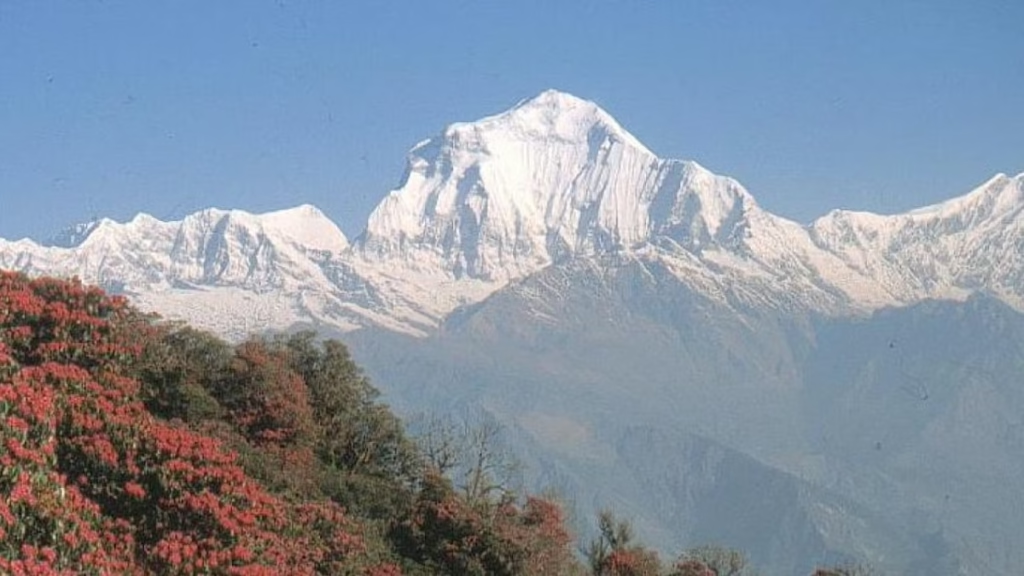
The Himalayan region, often described as the “Water Tower of Asia,” is one of the most critical freshwater reserves in the world. Its glaciers, snowfields, rivers, and natural springs sustain nearly 1.5 billion people across South and Southeast Asia. At the same time, the region has become one of the fastest-growing tourism destinations due to its scenic landscapes, cultural heritage, religious sites, and cooler climate compared to the plains. However, this rapid expansion of tourism has created significant pressure on fragile mountain ecosystems, particularly on water resources. Many Himalayan towns such as Shimla, Leh, Gangtok, and Nainital now experience recurring water shortages during peak tourist seasons, revealing the growing tension between economic development and environmental sustainability.
Water scarcity in the Himalayas is not simply the result of natural hydrological limitations. Instead, it reflects a complex intersection of tourism-led urbanisation, climate change, fragile infrastructure, and governance challenges. Seasonal surges in tourist populations often coincide with dry months when water availability is already limited. As a result, the demand for water in hotels, restaurants, and tourism-related services increases dramatically, intensifying competition with local residents for limited supplies. This situation highlights a paradox: tourism is promoted as a key driver of economic prosperity in the Himalayas, yet the same industry is increasingly contributing to environmental stress that threatens the long-term sustainability of these destinations.
Historical Evolution of Tourism in the Himalayas
Tourism in the Himalayan region has deep historical roots that date back to the colonial period. During the nineteenth century, the British established hill stations such as Shimla, Mussoorie, and Darjeeling as summer retreats to escape the intense heat of the Indian plains. These settlements were designed primarily for colonial administrators and elites and were supported by carefully planned infrastructure, including water supply systems sourced from nearby streams and springs. Shimla in particular emerged as the summer capital of British India in 1864, hosting government offices and seasonal administrative functions. As a result, significant investments were made in roads, railways, sanitation systems, and water infrastructure to support temporary population surges during the summer months. After independence in 1947, many of these hill stations gradually transformed into popular domestic tourist destinations, attracting visitors from across India. Religious tourism also expanded significantly, with pilgrimage routes to places such as Kedarnath, Badrinath, and Amarnath becoming major drivers of regional travel.
The expansion of tourism accelerated significantly after India’s economic liberalisation in the 1990s. Rising incomes, improved transportation networks, and the rapid growth of digital travel platforms encouraged a surge in domestic tourism. Himalayan states began actively promoting tourism as a key economic strategy, investing heavily in road construction, hospitality infrastructure, and destination branding. The development of airports, improved highway connectivity, and the spread of online booking platforms made remote mountain destinations more accessible than ever before. Government campaigns such as “Incredible India” and state-level tourism initiatives further amplified visitor inflows to the region. Over the past two decades, tourist arrivals in states such as Himachal Pradesh, Uttarakhand, and Sikkim have increased dramatically. However, much of this growth has occurred without adequate planning for environmental sustainability, leaving local infrastructure and natural resources struggling to cope with the growing seasonal demand. The absence of comprehensive carrying-capacity assessments and integrated urban planning has intensified pressure on fragile mountain ecosystems, particularly on water resources, waste management systems, and local livelihoods.
Climate Change and Environmental Stress in the Himalayas
Climate change is increasingly reshaping the hydrological dynamics of the Himalayan region. The Himalayas contain approximately 15,000 glaciers that feed some of Asia’s most important river systems, including the Indus, Ganges, and Brahmaputra. These glaciers play a critical role in regulating water flows, particularly during the dry season, ensuring a steady supply of freshwater to both mountain communities and millions of people living downstream. However, rising global temperatures have accelerated glacial retreat across the region, altering river flow patterns and increasing the risk of glacial lake outburst floods (GLOFs). Scientific assessments indicate that Himalayan glaciers are melting faster than the global average, raising concerns about long-term water security in South Asia. While short-term increases in glacial meltwater may temporarily boost river flows, the long-term depletion of glaciers could significantly reduce water availability for both mountain communities and downstream populations.
Recent scientific studies highlight the scale and urgency of this transformation. The Intergovernmental Panel on Climate Change (IPCC) has warned that the Himalayan region could lose up to one-third of its glacier volume by the end of the century even if global warming is limited to 1.5°C, and potentially up to two-thirds under higher emission scenarios. Similarly, research from the International Centre for Integrated Mountain Development (ICIMOD) suggests that glaciers in the Hindu Kush–Himalayan region are disappearing at an accelerating rate, with 2023 and 2024 witnessing record levels of glacial mass loss. This rapid melting has already led to the formation and expansion of unstable glacial lakes across Nepal, Bhutan, and northern India, increasing the likelihood of catastrophic GLOF events. Such incidents can destroy downstream settlements, disrupt water infrastructure, and damage tourism-dependent economies in mountain regions.
In addition to glacial retreat, changing precipitation patterns are contributing to growing water stress in the Himalayas. The region is experiencing more frequent extreme weather events such as cloudbursts, flash floods, and landslides, while also facing longer dry spells during certain seasons. According to data from the Centre for Science and Environment, the Indian Himalayan region recorded more than 800 extreme weather events between 2022 and 2025, causing thousands of fatalities and extensive damage to infrastructure. These climatic disruptions are closely linked to rising surface temperatures and altered monsoon dynamics, which are making rainfall patterns increasingly erratic. Such events not only threaten lives and property but also destabilise fragile mountain ecosystems that support local water systems.
These changes disrupt traditional water sources such as springs and streams that many Himalayan communities depend upon. Studies indicate that a large proportion of springs across the region have either dried up or experienced reduced discharge due to deforestation, land-use changes, and climate variability. Research conducted by the NITI Aayog has suggested that nearly half of the springs in the Indian Himalayan region are showing signs of decline or seasonal drying. As springs historically served as the primary source of drinking water for mountain communities, their degradation directly affects rural livelihoods and urban water supply systems alike. When these environmental pressures intersect with rising tourist demand for water, the result is an increasingly fragile and unpredictable urban water system, making sustainable water governance an urgent policy priority for the Himalayan region.
Tourism Pressure and Water Crises in Himalayan Cities
Rapid tourism growth has significantly transformed many Himalayan towns into densely populated urban centres, particularly during peak travel seasons. In destinations such as Shimla, the influx of tourists during the summer months can multiply the city’s population several times over, placing enormous strain on already fragile water supply systems that were originally designed for far smaller resident populations. According to data from India’s Ministry of Tourism and state government reports, Shimla receives over 3–4 million tourists annually, while the resident population is only around 170,000. During peak months, daily water demand in the city rises to over 45–50 million litres per day (MLD), while the municipal supply often struggles to exceed 35 MLD. This imbalance was dramatically exposed during the 2018 water crisis, when the city came close to “Day Zero.” Several neighbourhoods went without piped water for nearly a week, forcing residents to rely on water tankers. The continued arrival of tourists during the crisis triggered public outrage and intensified debates about the sustainability of tourism-led urban development in fragile mountain ecosystems.
Similar patterns are emerging across other Himalayan destinations. In Leh, tourism arrivals have increased sharply over the past decade—from roughly 77,000 visitors in 2010 to more than 500,000 annually in recent years—leading to a surge in water demand for hotels, guesthouses, and restaurants. Because surface water sources remain limited, authorities increasingly rely on groundwater extraction, which studies suggest has led to a measurable decline in groundwater levels in several parts of the town. The shift from traditional systems such as glacier-fed irrigation channels to centralised infrastructure has also contributed to groundwater contamination and inefficient distribution. Similar pressures are visible in cities like Gangtok and Nainital, where water demand regularly exceeds supply during peak tourist seasons. Research indicates that tourist facilities can consume up to three to four times more water per person than local households, particularly due to amenities such as hot showers, laundry services, and landscaped properties. This unequal consumption pattern has created growing tensions between residents and tourism businesses, highlighting the urgent need for sustainable water management strategies in Himalayan urban centres.
Governance Challenges and the Need for Sustainable Water Management
One of the central challenges behind water scarcity in Himalayan tourist cities is not only environmental stress but also weak governance and fragmented water management systems. Many mountain towns were historically designed to support small populations, yet urban expansion and tourism growth have dramatically increased water demand without a corresponding upgrade in infrastructure or regulatory frameworks. Municipal authorities often struggle with outdated pipelines, high levels of leakage, and limited storage capacity. For instance, in Shimla nearly 35–40% of treated water is estimated to be lost through pipeline leakage and distribution inefficiencies, further worsening shortages during peak tourist seasons. Similarly, in Nainital, water demand during the summer tourism period frequently exceeds supply by 20–30%, forcing local authorities to impose water rationing or rely on tanker deliveries. These governance gaps reveal that the issue is not simply one of natural scarcity but of inadequate planning, insufficient investment in resilient infrastructure, and limited coordination between tourism departments and urban water authorities.
Recent events across the Himalayas further highlight the consequences of unsustainable tourism governance. In Leh, rapid hotel construction and the rise of homestays have sharply increased groundwater extraction, leading to declining aquifer levels in several neighbourhoods. Meanwhile, in Joshimath, uncontrolled construction combined with fragile geological conditions triggered severe land subsidence in 2023, forcing authorities to evacuate hundreds of residents and temporarily halt tourism activities. Such incidents demonstrate how unregulated development can destabilise both the natural environment and urban infrastructure. Addressing these challenges requires a more integrated approach to tourism and environmental governance. Policies such as carrying-capacity assessments, strict building regulations, water-efficient tourism infrastructure, and revival of traditional water harvesting systems could significantly reduce pressure on fragile Himalayan ecosystems. Without such reforms, the continued expansion of tourism risks deepening water crises and undermining the long-term sustainability of Himalayan cities that depend on both natural resources and visitor economies.
Conclusion
The growing water stress in the Himalayan region illustrates the complex relationship between environmental sustainability and tourism-driven economic development. While tourism has emerged as a vital source of income and employment for many mountain communities, its rapid and largely unregulated expansion has intensified pressure on already fragile water systems. Cities such as Shimla, Leh, Gangtok, and Nainital increasingly face seasonal water shortages, particularly during peak tourist months when demand for water in hotels, restaurants, and tourism services rises dramatically. These challenges are further compounded by climate change, declining spring discharge, and aging infrastructure that is unable to cope with sudden population surges. As a result, water scarcity in the Himalayas cannot be viewed solely as a natural resource issue; rather, it reflects a broader governance challenge involving urban planning, tourism management, and environmental protection.
Addressing this growing crisis requires a fundamental shift in how tourism development is planned and managed in mountain regions. Demand-side water management strategies—such as installing water-efficient fixtures in hotels, promoting rainwater harvesting, and regulating groundwater extraction—can significantly reduce pressure on local water systems. Equally important is the need for stronger institutional coordination between tourism authorities, urban planners, and environmental agencies to ensure that infrastructure development aligns with ecological carrying capacities. Without such integrated planning, the continued expansion of tourism risks further destabilising fragile Himalayan ecosystems and deepening inequalities in water access between residents and tourism enterprises.
In addition, policymakers must adopt innovative governance models that prioritise sustainability and long-term resilience. Measures such as visitor caps during peak seasons, diversification of tourism destinations, and integrated tourism–water–waste management frameworks can help distribute tourist flows more evenly and reduce environmental stress. International examples such as Bhutan’s “high-value, low-impact tourism” strategy demonstrate how tourism revenue can be used to support conservation and community welfare while limiting ecological damage. Ultimately, the future of tourism in the Himalayas will depend on climate-resilient policies that balance economic opportunity with environmental responsibility. Protecting the region’s water resources is not only essential for sustaining tourism but also for safeguarding the livelihoods and water security of millions of people who depend on the Himalayan ecosystem.

About the Author
Khushbu Ahlawat is a research analyst with a strong academic background in International Relations and Political Science. She has undertaken research projects at Jawaharlal Nehru University, contributing to analytical work on international and regional security issues. Alongside her research experience, she has professional exposure to Human Resources, with involvement in talent acquisition and organizational operations. She holds a Master’s degree in International Relations from Christ University, Bangalore, and a Bachelor’s degree in Political Science from the University of Delhi.



