
By: Brigadier KGK Nair, SM (Retd)
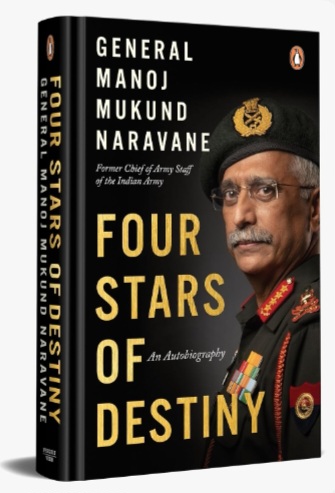
Working within the realms of ambiguity is the hallmark of a true leader. It is the crucible where the weight of the four stars is tested against the friction of political reality. Yet, the ongoing storm in Parliament over General M.M. Naravane’s stalled memoir, “Four Stars of Destiny”, raises a fundamental question about the nature of our higher echelons. Are we witnessing the rise of “leaders of convenience,” who prioritize personal legacy and post-retirement prospects over the decisive, often uncomfortable, actions required while in the chair?
In his memoir — excerpts of which have recently triggered acrimonious exchanges in the Lok Sabha—General Naravane recounts the night of August 31, 2020, as a “hot potato” moment. As Chinese tanks rumbled toward Rechin La, he describes a frantic search for clear orders from the very top. The message that finally reached him from the Prime Minister, conveyed via the Defence Minister (RM), was: “Jo uchit samjho, who karo” (Do whatever you deem appropriate).
The Protocol Fallacy
Apologists for the General argue that his hands were tied by the 1996 and 2005 bilateral agreements that forbade firing within 2km of the LAC, or that he was paralyzed by the need for concurrence from the bureaucratic China Study Group (CSG).
But this defence fails the moment one remembers the 20 brave Indian soldiers who made the supreme sacrifice at Galwan just weeks prior. Their blood was the ultimate testimony that the “peace deals” were dead; the enemy had already torn up the rulebook. To cite “no-firing” protocols while tanks are advancing in 2020 is not professional restraint; it is a failure of character. A leader of character recognizes when the strategic landscape has shifted and acts to protect the nation’s sovereignty. If the General felt the political leadership was “hollow,” his duty was to force a resolution—or resign in protest—while he still held the baton. Having chosen to be silent then, even if we assume to maintain a united front at the strategic levels with the “enemy at the gates”, he should have maintained his “omerta” in respect to the institution of COAS rather than write a post mortem now!
Delegation as a Test of Character
A true military leader also does not view a “carte blanche” from the political establishment as a burden. In the higher echelons of command, being told to “do what you deem fit” is the ultimate restoration of military authority. It is the moment the state trusts the General to be a commander, not a clerk.
Yet, Naravane’s narrative suggests he felt “onus” and “abandonment” rather than empowerment. This is the hallmark of a leader of convenience—one who is comfortable when the responsibility is shared by a committee, but who comes a cropper when the ambiguity of war requires a solitary, bold decision.
The Shadow of Ambition
The optics are further muddied by the race for the Chief of Defence Staff (CDS) post. During the long vacancy following General Bipin Rawat’s passing, the perception of “auditioning” for the role became unavoidable. When a sitting Chief seems to be navigating ideological currents or leveraging his home advantage to secure his next move, his objective military advice is compromised, as is the weight of any post retirement indictment he chooses to offer! Did the desire for the next “big post” temper the professional pushback required during the Ladakh crisis? A leader of character keeps both eyes on the battle; a leader of convenience keeps one eye on his next office. While Naravane has since claimed he “never questioned the wisdom of the government” regarding the CDS appointment, his memoir ironically seeks to do that and maybe also something to embarrass the govt, just to get even!
COAS on Probation
The govt also has an equal share in this fiasco by taking too long and playing musical chairs with the military hierarchy in their selection to the CDS. The tragedy of the nine-month CDS vacancy was that it forced a sitting Chief into an unintended “probation.” For a commander leading a standoff at the LAC, even the whisper of a post-retirement ‘reward’ is enough to devalue his strategic voice. The powers that be should surely realize the damage that this could do to the institution of COAS and CDS in particular and the Services at large!
The Verdict
The moral authority of the baton is not a pensionable asset to be spent later in a tell-all book. A General who waits for a book deal to find his voice hasn’t led; he has merely observed.
If we allow the “Retirement Revelation” to become the standard for our top brass, we degrade the institution of the Army Chief. We need leaders of character who are willing to risk their careers for the mission, not leaders of convenience who save their “truths” for the publisher. True leadership is exercised when the risk is personal and the consequences are immediate—not in a four-star post-mortem written from the comfort of a study.




Excellent analysis and unbiased article.
Great insight. Precise and incisive
Excellent write up and I agree wholeheartedly . Senior leadership gas let down the junior leaders ( up to the level of colonels / COs ) in the army since 1947 . Whether it is rank structure , pay and allowances , opening up the Cantonment roads and pushing thru the ideology of any particular govt in the armed forces , just to mention a few , our generals have let us down in the eyes if their subordinates . If our top heirachy had stood with us in 2016/17 after 7 th pay commission , there would not have been any agitation by veterans
Could not have put it better.
Most apt ! Decision making dilemmas at that stage of professional career and at the helm of the Army’s highest leadership, is indeed shocking ?!! Sad commentary on how our senior leadership is selected and respinsibilities are abdicated !
Important and pointed questions on decisiveness, transparency, and civil–military balance. It is a sharp and well-argued analysis.well done.
My take: Given the scale of invasion and the fact that the Indian defence chiefs come under a civilan rule, I think Gen. Narvane did the right thing to reach out to the Defence Minister and appraise him of the situation, expecting a firm reply. Rajnath Singh is ultimately responsible, when it comes decision making, no ifs, no buts. With that irresponsible response, he clearly abdicated his duty and accountability!
On the other hand, as you have correctly said, Gen Naravane should have pushed him for a decision. He was in the situation of “Damned if you Do, Damned if you Don’t”. I bet Rajnath would have pulled him up for not alerting him on time and taking his permission and made it a big issue.
A clear unambiguous analysis. I am really not sure if, unlike USA and other few democracies where the political leadership issues clear verbal & written politico military guidance with well spelt out end state, the ‘Jaisa Uchit’ guidance was good enough for initiating military action against China. The consequences could have been unimaginable or may be uncontrollable. Could have expanded even beyond military domain resulting in blame game. The last paragraph is hard hitting and seems to be part of the assessed authentic dot trail.
The whole episode though reminds us of the old adage – Success has many fathers but failure is an orphan.
Brutal 😄
An objective analysis. The author rightly argues that the Army is duty bound to respond to any aggression with an appropriate response without looking over the shoulder. In such cases the action is better left to the commander on ground and in my experience his response is always the best as his and his men’s life are at stake. One cannot condone the fact that we lost a brave CO and 16 men during this period probably due to such dithering and ambiguity due to ambition at higher levels. Reminds one of the Kargil intrusion where young officers paid the price for strategic myopia.
insightful and straight from the heart of a soldier.
You remind service ethics—honour, hierarchy, and responsibility—while underlining perception at the apex defines institutional credibility.
Great analysis of the issue! Shorn of all the noise that vested interests have been making and going into the crux of the matter with clinical clarity of thought. The General indeed failed as a military leader and paradoxically admitted it too though framing it as “lack of clear directions”!
Well analysed. Perhaps, some of the “Scholar Warriors” are too scholarly.
Very well written, but Article is too focused on leadership. The situation demanded Jt ops but no info available. It has taken period 1989-2025 to define terror red line and response matrix. Maturing of Higher defence management and decision making is very long complex process and will not be easy to evolve where society believes in goodness of humanity and has neglected its mil since independence. Promotion policy has always been representative than competitive. Four Star Destiny is reminded and opportunity for course correction
Brilliant discourse indeed -selection of CHIEFS must not be left to the Govt of the day
We have to devise better ways with a nation of 1.4 billion and an army of 1.4 million.
Can we have some thing like the board room approval akin to Corporate World-
let the military organisation decide with some percentage votes to the political establishment
Good Generals are not always good leaders. A good leader is one who stands by the decision he takes and for which freedom from restraint, independence and prioritises the larger good of the organisation, the men he commands and nation at all times.
Gen Naravane should have conveyed to Modi & Rajnath the action he is going to take rather than looking over his shoulder for orders.
Memoirs from operations during one’s soldiering days only will tell you one side of the story- better if they ar co authored