
By: Khushbu Ahlawat, Consulting Editor, GSDN
Introduction
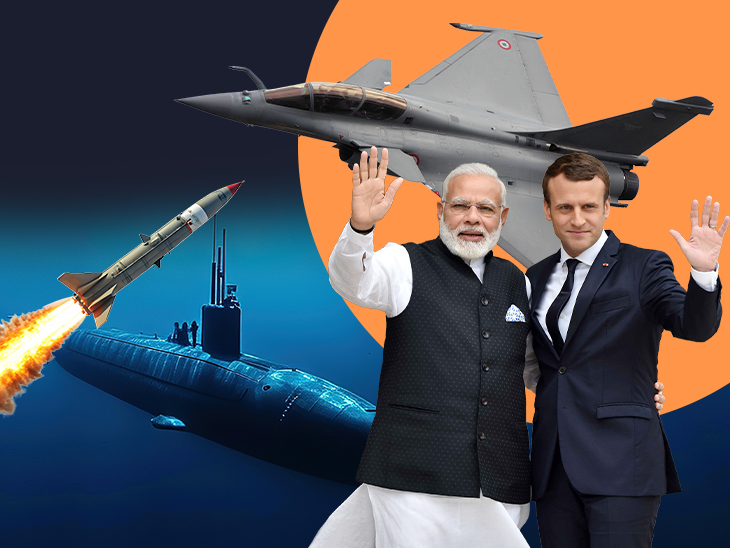
In February 2026, as French President Emmanuel Macron stood beside Prime Minister Narendra Modi during his official visit to India, the symbolism was unmistakable. The declaration that India–France ties stretch “from the deep oceans to the tallest mountains” was not diplomatic hyperbole; it captured the strategic breadth of a partnership that has matured into one of India’s most stable and trusted global relationships. What began as a buyer–seller defence equation in the 1950s has evolved into a comprehensive strategic alignment grounded in shared commitments to sovereignty, multipolarity, and strategic autonomy.
The 2026 visit, coinciding with the “India–France Year of Innovation,” underscored that the bilateral relationship is no longer confined to defence procurement. It now spans advanced technology, maritime security, space cooperation, climate transition, nuclear energy, and critical supply chains. Yet, at its core remains defence cooperation—the anchor of trust and continuity in a volatile international system. The transition underway—from procurement to co-development, from licensed assembly to intellectual property co-ownership—signals a decisive structural shift. The Rafale MRFA project and the unprecedented DRDO–Safran AMCA engine collaboration represent not merely defence contracts, but a redefinition of industrial sovereignty.
This article argues that 2026 marks an inflection point in India–France defence ties: a movement toward genuine technological partnership that could reshape India’s aerospace ecosystem and recalibrate power equations in the Indo-Pacific. Beyond conventional defence trade, the emerging framework emphasises co-design, joint research, industrial integration, and intellectual property sharing. Such a shift strengthens India’s strategic autonomy while positioning France as a pivotal long-term collaborator in advanced defence innovation and regional security architecture.
Historical Foundations: Trust Forged in Combat and Autonomy
India–France defence cooperation began formally in 1953, when India signed a contract with Dassault Aviation for the acquisition of the Dassault Ouragan fighter aircraft. Known in India as the “Toofani,” this platform marked one of independent India’s earliest major defence procurements from a Western supplier. At a time when India was still shaping its post-colonial strategic identity, the decision to diversify beyond British equipment signalled New Delhi’s desire for operational flexibility and diplomatic balance. The Toofani aircraft were not merely symbolic acquisitions; they were actively deployed during the 1961 liberation of Goa and undertook reconnaissance missions during the 1962 India–China War. These early operational deployments laid the foundation for institutional familiarity between the Indian Air Force (IAF) and French aerospace systems.
The partnership deepened with the induction of the Mystère IV, another Dassault platform that saw combat during both the 1965 and 1971 India–Pakistan wars. By this stage, French aircraft were no longer experimental additions but had become integrated into India’s frontline strike and air superiority capabilities. Importantly, this period established a pattern: French platforms proved reliable in high-intensity conflict conditions, reinforcing professional confidence within the IAF.
The late 1970s marked a structural shift from procurement to industrial collaboration with the induction of the SEPECAT Jaguar, a Franco-British aircraft. Nearly 180 Jaguars were delivered over two decades, with the majority manufactured under licence in India by Hindustan Aeronautics Limited. This arrangement went beyond simple purchase agreements; it embedded technology absorption, domestic assembly lines, and maintenance ecosystems within India’s defence industrial base. The Jaguar’s long service life—participating in operations ranging from the Indian Peace Keeping Force (IPKF) deployment in Sri Lanka to the 1999 Kargil War—demonstrated the durability of this industrial partnership.
In the 1980s, India inducted more than 50 Mirage-2000 fighters from Dassault Aviation. The Mirage-2000 became one of the most trusted platforms in the IAF’s inventory. During the 1999 Kargil War, its ability to deliver precision-guided munitions at high altitude proved decisive in neutralising fortified Pakistani positions. Two decades later, in the 2019 Balakot airstrike, Mirage-2000 aircraft again played a central operational role. These missions elevated the platform’s status from a tactical asset to a strategic instrument of deterrence. Both the Jaguar and Mirage fleets are widely assessed to contribute to the air-based leg of India’s nuclear triad, underscoring the level of trust reposed in French-origin systems.
Perhaps most significantly, the partnership endured geopolitical turbulence. Following India’s 1998 nuclear tests, several Western countries imposed sanctions and restricted defence cooperation. France, however, maintained engagement and avoided a punitive rupture. This decision left a lasting impression in New Delhi’s strategic community. It reinforced the perception that Paris pursues an independent foreign policy and values long-term strategic partnerships over short-term political signalling. Thus, over seven decades, India–France defence ties have evolved through combat-tested platforms, licensed production, industrial learning, and diplomatic steadiness. The continuity of engagement—across wars, sanctions, and shifting global alignments—has forged a rare foundation of trust. It is this accumulated operational confidence and shared commitment to strategic autonomy that continues to anchor the bilateral defence partnership today.
Rafale MRFA: Industrial Depth Meets Strategic Urgency
India’s fighter squadron strength has declined to nearly 30 squadrons against a sanctioned strength of 42, creating a widening operational gap at a time of growing regional security challenges. The Defence Acquisition Council’s Acceptance of Necessity for 114 Multi-Role Fighter Aircraft (MRFA) — widely expected to favour additional Dassault Rafale jets — reflects the urgent need to restore combat capability. Unlike the earlier 2007 MMRCA tender, which collapsed over cost and liability disputes and led to the 2016 Intergovernmental Agreement for 36 Rafales, the new MRFA proposal is designed to go beyond procurement. Under current plans, 18 aircraft would be delivered in fly-away condition, while more than 90 would be manufactured in India with substantial transfer of technology (ToT), targeting over 50 percent indigenous content under the Defence Acquisition Procedure 2026. This approach aligns with India’s broader goal of reducing import dependency while simultaneously strengthening deterrence capabilities across both western and northern borders.
At the heart of this shift is an expanding industrial ecosystem led by Dassault Aviation in partnership with Tata Advanced Systems Limited and other Indian firms. The upcoming Rafale fuselage plant in Hyderabad and Maintenance, Repair, and Overhaul (MRO) facilities in Noida signal India’s integration into Dassault’s global supply chain. Collaboration with Safran (engines), Thales (avionics), and MBDA (missile systems) further strengthens this ecosystem. Beyond manufacturing, the project is expected to generate skilled employment, boost MSME participation in aerospace supply chains, and encourage technology absorption in advanced materials and avionics. Valued at around US$35 billion, the MRFA deal could become the largest in IAF history and would consolidate the Rafale as a unified platform across both air force and naval variants, streamlining logistics, training, and operational readiness well into the 2030s while bridging the gap until the indigenous AMCA becomes operational.
The AMCA Engine Breakthrough: A Strategic Game-Changer
If the Rafale MRFA deal strengthens India’s fighter fleet, the AMCA engine partnership strengthens India’s technological independence. The agreement between the Defence Research and Development Organisation (DRDO) and Safran to jointly develop a powerful 120–140 kN engine for India’s Advanced Medium Combat Aircraft (AMCA) is a major milestone. For the first time, India will receive 100 percent transfer of technology for highly sensitive engine components, including single-crystal turbine blades and advanced heat-resistant materials. These parts are critical because they allow engines to function at extremely high temperatures without losing performance.
Jet engines are among the most complex machines in the world. Very few countries have the capability to design and produce advanced fighter jet engines on their own. At present, only the five permanent members of the UN Security Council—the United States, Russia, China, the United Kingdom, and France—have full expertise in this field. Through this partnership, India moves closer to joining this small group of technologically advanced nations. The new engine will power the AMCA Mk2, expected to enter service in the mid-2030s, with testing likely to begin around 2028. But the impact goes beyond one aircraft. The same engine technology could later be used in unmanned combat drones (UCAVs) and future naval fighter jets. Importantly, producing engines in India reduces the risk of supply disruptions or sanctions during geopolitical crises.
India’s earlier Kaveri engine project did not succeed, but it helped Indian scientists gain valuable experience in metallurgy and engine design. The Safran partnership builds on those lessons. Unlike older agreements where India only assembled foreign engines, this project involves joint design, shared expertise, and Indian ownership of intellectual property. In simple terms, India is not just buying an engine—it is learning how to build one, improve it, and control its future development.
Expanding the Strategic Canvas: Trade, Technology, and Indo-Pacific Convergence
India–France defence cooperation today operates within a much wider economic, technological, and geopolitical framework. Bilateral trade has crossed €15 billion in recent years, with both governments setting ambitious targets for expansion in high-technology sectors such as green hydrogen, semiconductors, artificial intelligence, cyber security, and critical minerals supply chains. France has emerged as one of the leading European investors in India, with cumulative investments exceeding €10 billion across infrastructure, metro rail projects, renewable energy, smart cities, and aerospace manufacturing. Companies such as Airbus, Safran, Thales, and EDF have significantly expanded their industrial footprint in India, aligning with New Delhi’s push for domestic manufacturing and resilient supply chains.
Civil nuclear cooperation remains a strategic pillar. The proposed Jaitapur Nuclear Power Project in Maharashtra—planned in partnership with EDF—is expected to host six EPR reactors and, upon completion, become the world’s largest nuclear power facility. Though negotiations over pricing and liability frameworks have been complex, the project symbolizes long-term trust in sensitive, high-technology domains. Beyond electricity generation, Jaitapur represents energy security, low-carbon transition goals, and India’s commitment to diversifying its clean energy mix. It also reflects France’s confidence in sharing advanced reactor technology and supporting India’s long-term nuclear expansion strategy.
Space cooperation between Indian Space Research Organisation (ISRO) and National Centre for Space Studies (CNES) continues to deepen, particularly in earth observation, climate monitoring, and maritime domain awareness. Joint satellite missions enhance surveillance across the Indian Ocean Region, complementing defence cooperation. Maritime convergence has intensified through the Varuna naval exercises and reciprocal logistics agreements that allow access to French bases in the western Indian Ocean, including Réunion. As a resident Indo-Pacific power, France shares India’s concerns regarding freedom of navigation and strategic stability amid China’s expanding maritime presence.
Scholars such as C. Raja Mohan have argued that the India–France partnership reflects a “coalition of autonomy,” where both states seek multipolar balance without alliance entanglements. Similarly, strategic analyst Harsh V. Pant notes that France’s willingness to share critical technologies distinguishes it from many Western partners. The India–EU Trade and Technology Council and ongoing FTA discussions further institutionalize this convergence. In this broader ecosystem, defence co-development does not stand alone; it reinforces economic interdependence, technological co-creation, and a shared Indo-Pacific strategic vision.
Conclusion
As Emmanuel Macron and Narendra Modi reaffirmed the depth of bilateral ties in 2026, it became clear that India–France defence cooperation has entered a decisive new phase. What began in the 1950s as a straightforward buyer–seller relationship has matured into a strategic partnership anchored in trust, resilience, and shared technological ambition. The collaboration between the Defence Research and Development Organisation and Safran on next-generation jet engines, alongside the expanding industrial ecosystem around Dassault Aviation and the Rafale platform, demonstrates a shift from procurement to co-development. This transition reflects more than defence modernisation—it signals India’s determination to achieve technological sovereignty and France’s willingness to act as a long-term, reliable strategic partner in a turbulent global environment.
In a world increasingly shaped by geopolitical competition and supply chain vulnerabilities, the India–France partnership offers a model of strategic autonomy without alliance dependency. Defence cooperation now intersects with maritime security, civil nuclear energy, space collaboration, and Indo-Pacific stability, forming an integrated framework of shared interests. Beyond immediate capability enhancement, these initiatives are laying the foundations for joint research ecosystems, skilled workforce development, and deeper private-sector integration across aerospace and high-technology domains. As India strengthens its aerospace capabilities and France reinforces its Indo-Pacific footprint, both nations are positioning themselves not merely as partners, but as co-architects of a more balanced, technologically empowered, and multipolar global order for the decades ahead.

About the Author
Khushbu Ahlawat is a research analyst with a strong academic background in International Relations and Political Science. She has undertaken research projects at Jawaharlal Nehru University, contributing to analytical work on international and regional security issues. Alongside her research experience, she has professional exposure to Human Resources, with involvement in talent acquisition and organizational operations. She holds a Master’s degree in International Relations from Christ University, Bangalore, and a Bachelor’s degree in Political Science from the University of Delhi.



