
By: Khushbu Ahlawat, Consulting Editor, GSDN
Introduction
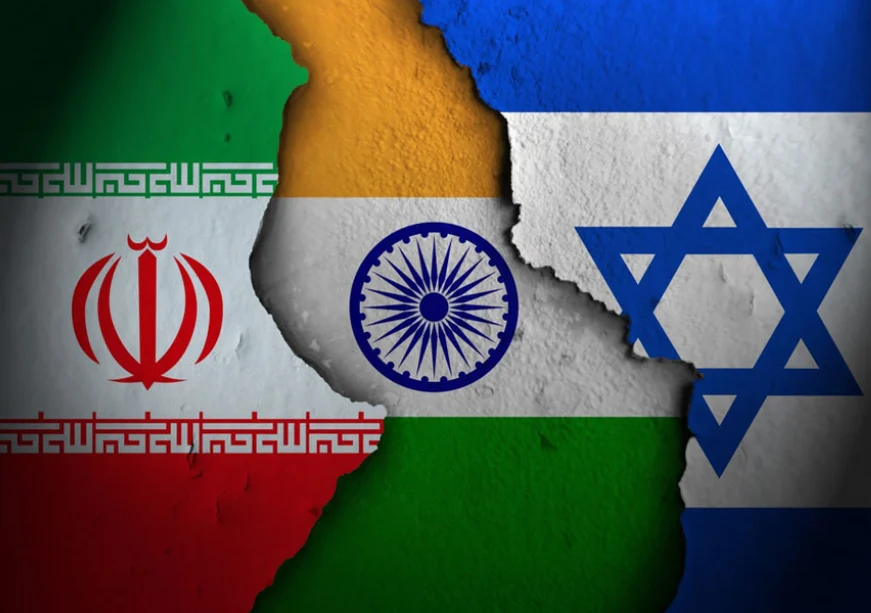
In an era defined by sharpening geopolitical fault lines, India’s West Asia policy stands at a delicate crossroads. Prime Minister Narendra Modi’s recent high-profile engagement with Israel—amid intensifying violence in Gaza and regional polarization—has renewed debate over whether India is recalibrating its historically balanced approach toward a more overt strategic alignment. The stakes are high. West Asia is not merely a distant theatre of conflict; it is central to India’s energy security, diaspora interests, maritime connectivity ambitions, and emerging trade corridors such as the India-Middle East-Europe Economic Corridor (IMEC). For decades, India carefully balanced solidarity with Palestine and pragmatic engagement with Israel. Yet the current geopolitical environment—shaped by the October 2023 Hamas attacks, Israel’s military response in Gaza, U.S.–Iran tensions, and great-power competition—has intensified scrutiny of India’s diplomatic posture. Is New Delhi abandoning strategic autonomy for strategic partnership? Or is it practicing a refined form of multi-alignment suited to a multipolar world?
This article argues that India is not “taking sides” in the conventional sense. Rather, it is attempting to institutionalize a strategic equilibrium—deepening defense and technology ties with Israel while preserving historical commitments to Palestinian statehood and maintaining robust relations with Arab partners. Understanding this recalibration requires historical grounding, geopolitical analysis, and attention to recent diplomatic initiatives.
Historical Foundations: From Non-Alignment to Calibrated Engagement
India’s calibrated approach toward Israel and Palestine must be understood not merely as diplomatic maneuvering, but as part of a broader civilizational and strategic worldview that evolved across distinct geopolitical phases. In the early decades after independence, India’s support for Palestine was embedded within its anti-colonial identity and leadership role in the Global South. Jawaharlal Nehru viewed the Palestinian struggle through the prism of decolonization, drawing parallels with India’s own freedom movement. This normative positioning was reinforced by India’s central role in the Non-Aligned Movement (NAM), where solidarity with Arab nations strengthened New Delhi’s moral stature among postcolonial states. Energy interdependence further deepened this alignment. By the 1970s, West Asia had become indispensable to India’s oil security. Simultaneously, the migration of millions of Indian workers to the Gulf created socio-economic linkages that made political goodwill with Arab governments a strategic necessity. Support for the Palestinian cause thus aligned moral principle with pragmatic economic calculation.
The end of the Cold War, however, marked a structural inflection point. The collapse of the Soviet Union deprived India of a key strategic partner, while economic liberalization compelled integration with global technology and defense markets. Establishing full diplomatic relations with Israel in 1992 was therefore less an ideological shift and more a recalibration to emerging systemic realities. Israel’s advanced defense technologies, agricultural innovations, and intelligence capabilities complemented India’s modernization needs. The 1999 Kargil conflict became a pivotal moment, reportedly accelerating defense cooperation and fostering operational trust. Over the following decades, ties expanded into counterterrorism, cyber security, water management, and innovation ecosystems. Prime Minister Narendra Modi’s 2017 visit to Israel symbolically marked the institutionalization of this partnership, while India simultaneously maintained high-level engagement with Palestine, including development assistance and budgetary support.
This historical trajectory reveals continuity within change. India’s West Asia diplomacy has consistently combined normative commitments with strategic pragmatism. Rather than oscillating between ideological poles, New Delhi has pursued strategic autonomy—seeking to preserve flexibility in an increasingly polarized region. The present moment, shaped by renewed conflict and shifting regional alignments, represents not a rupture but the latest phase in this long pattern of calibrated engagement.
The Strategic Deepening of India–Israel Ties
What began as a cautious and politically sensitive engagement has evolved into one of India’s most strategically significant partnerships in West Asia. Today, Israel stands among India’s leading defense collaborators, supplying advanced missile systems such as the jointly developed Barak-8 (MR-SAM/LR-SAM), unmanned aerial vehicles including the Heron platform, precision-guided munitions, and sophisticated border surveillance technologies. Over the past decade, the relationship has moved beyond a traditional buyer–seller framework toward co-development and joint innovation under India’s “Make in India” initiative. Institutional mechanisms such as the India–Israel Industrial R&D and Technological Innovation Fund (I4F) have fostered collaboration in defense-adjacent technologies and civilian high-tech sectors. Cooperation now extends into cybersecurity architecture, counterterrorism intelligence-sharing, and homeland security frameworks—areas that gained renewed urgency following the October 7, 2023 Hamas attacks and Israel’s subsequent military operations in Gaza.
Beyond defense, the partnership has entered a technologically transformative phase. Bilateral engagement increasingly centers on artificial intelligence, quantum communication, semiconductor design, space collaboration between ISRO and the Israel Space Agency, water desalination systems, and climate-resilient agriculture. Recent discussions have focused on semiconductor ecosystem cooperation, aligning India’s production-linked incentive schemes with Israel’s strengths in chip design and deep-tech innovation. The operationalization of labor mobility agreements in 2024—facilitating employment opportunities for thousands of Indian workers in Israel’s construction and caregiving sectors—adds a new societal dimension to what was once an elite strategic partnership. Trade diversification, fintech collaboration, renewable energy projects, and academic exchanges further embed the relationship within long-term developmental frameworks.
Geopolitically, India–Israel ties are now nested within broader minilateral and connectivity initiatives. The I2U2 grouping (India, Israel, UAE, United States) and the proposed India–Middle East–Europe Economic Corridor (IMEC), announced during the 2023 G20 Summit in New Delhi, position Israel within a larger geo-economic architecture linking South Asia to Europe via the Gulf. While regional instability has complicated implementation timelines, these frameworks underscore Israel’s strategic relevance to India’s supply-chain diversification and technological sovereignty goals. As scholars such as Efraim Inbar argue, Israel views India as a civilizational partner and stabilizing Asian power, while Indian analysts like C. Raja Mohan interpret the relationship as central to India’s pursuit of multipolar strategic autonomy. In an era of geopolitical volatility and technological competition, the India–Israel partnership has matured into a multidimensional alliance—simultaneously strategic, technological, and geo-economic in scope.
Palestine, Arab Partnerships, and Strategic Balancing
India’s West Asia calculus extends far beyond Israel; it is anchored in deep structural interdependence with the Arab world. The Gulf region supplies more than half of India’s crude oil requirements and an increasing share of its liquefied natural gas imports, making energy security inseparable from regional stability. Moreover, over eight million Indian expatriates reside across the Gulf monarchies, forming one of the largest overseas communities. Their remittances—amounting to tens of billions of dollars annually—constitute a stabilizing pillar of India’s external finances. Any diplomatic miscalculation in West Asia therefore carries immediate economic and social consequences.
Over the past decade, India’s relations with the United Arab Emirates and Saudi Arabia have undergone a qualitative transformation. The 2022 India–UAE Comprehensive Economic Partnership Agreement significantly expanded non-oil trade, fintech collaboration, logistics integration, and investment flows. The UAE has emerged as a critical partner in infrastructure, renewable energy, and sovereign wealth investments in India. Saudi Arabia, under its Vision 2030 reforms, has deepened cooperation in energy transition, petrochemicals, and strategic investments, while institutionalizing a Strategic Partnership Council with India. Simultaneously, negotiations with the Gulf Cooperation Council aim to embed economic integration at a bloc level, signaling long-term institutional convergence rather than episodic engagement.
India’s balancing strategy also includes sustained developmental assistance to Palestine, including budgetary support, capacity-building initiatives, and infrastructure projects in the West Bank. In multilateral platforms such as the United Nations, India continues to endorse a two-state solution and has supported humanitarian ceasefire resolutions during periods of escalated violence. Prime Minister Modi’s outreach to Ramallah in 2018—conducted independently of an Israel visit—symbolized the operationalization of de-hyphenation: engagement with Israel and Palestine as parallel, not mutually exclusive, tracks.
The emergence of minilateral arrangements such as I2U2 and the India–Middle East–Europe Economic Corridor (IMEC), announced during the 2023 G20 Summit in New Delhi, reflects India’s preference for issue-based coalitions over rigid alliances. IMEC, in particular, envisions multimodal connectivity linking Indian ports to the Gulf and onward to Europe through Israel, integrating logistics, energy grids, and digital infrastructure. Crucially, this initiative does not replace India’s Arab partnerships but rather incorporates them into a broader geo-economic framework. India’s West Asia strategy, therefore, is not a zero-sum alignment but a layered equilibrium—simultaneously safeguarding energy security, diaspora welfare, technological access, and normative commitments to Palestinian statehood.
Navigating Fault Lines: Strategic Autonomy Amid West Asia’s Geopolitical Crosscurrents
India’s contemporary West Asia policy sits at the intersection of intensifying geopolitical rivalries, ideological contestations, and shifting regional alignments. Scholars remain divided in their interpretation of New Delhi’s trajectory. Some strategic analysts argue that deepening defense cooperation with Israel and expanding engagement with the United States signal a gradual tilt toward a quasi-alignment structure embedded within the Indo-Pacific and broader Western security architecture. Others counter that India is practicing an advanced form of multi-alignment—simultaneously strengthening ties with Israel while sustaining robust partnerships with the United Arab Emirates, Saudi Arabia, and even Iran. This interpretation frames India not as a camp follower but as a system-shaping actor leveraging overlapping networks of cooperation. The revival of connectivity negotiations with the Gulf Cooperation Council, continued high-level exchanges with Arab capitals, and participation in flexible groupings such as I2U2 illustrate a strategy anchored in issue-based coalitions rather than bloc politics.
The Iran dimension introduces an additional layer of complexity. India’s investment in the strategic Chabahar Port project reflects its long-standing objective of securing overland access to Afghanistan and Central Asia, thereby bypassing Pakistan. However, U.S. sanctions regimes and escalating U.S.–Iran tensions complicate financial flows, insurance mechanisms, and long-term infrastructure planning. Any regional escalation risks disrupting maritime trade routes in the Strait of Hormuz, through which a substantial portion of India’s energy imports transit. Simultaneously, Iran’s evolving alignment with Russia and China adds another geopolitical variable. For Indian policymakers, managing this triangle—Washington, Tehran, and Tel Aviv—requires calibrated signaling and diplomatic agility. The challenge is not merely bilateral but systemic: preserving strategic space in an increasingly polarized international order.
The Gaza conflict has further amplified the stakes. As civilian casualties mounted and global protests intensified, Western European states such as Germany, France, and the United Kingdom faced scrutiny over their diplomatic positions. India, positioning itself as a leading voice of the Global South—particularly after hosting the 2023 G20 Summit—must reconcile moral expectations with material interests. From a realist lens, India’s approach reflects interest maximization: safeguarding defense supply chains, protecting energy security, and ensuring diaspora stability. From a constructivist perspective, however, India must balance its historical identity as a champion of anti-colonial solidarity with its emerging image as a technological and strategic power integrated into advanced security networks. Recent diplomatic messaging—unequivocally condemning terrorism while advocating humanitarian pauses and reiterating support for a two-state solution—captures this delicate equilibrium. In an era defined by hardened binaries, India’s strategy is less about choosing sides and more about sustaining maneuverability within contested geopolitical terrain.
Conclusion
India’s engagement in West Asia today is neither accidental nor reactionary; it is the outcome of a long-evolving doctrine rooted in strategic autonomy and calibrated pragmatism. Far from abandoning its historical commitments, New Delhi is attempting to reconcile legacy principles with contemporary power realities. Its expanding partnership with Israel reflects hard security and technological imperatives in an era defined by defense modernization, supply-chain resilience, and innovation-driven growth. Simultaneously, its sustained political support for Palestinian statehood and deepening economic interdependence with Gulf Arab states underscore that India’s regional calculus remains multidimensional. The logic is not alignment but equilibrium.
The volatility unleashed by the October 2023 Hamas attacks and the subsequent Gaza conflict has sharpened global polarization, compelling states to clarify their positions. Yet India’s diplomatic messaging—condemning terrorism while urging humanitarian restraint and reaffirming support for a two-state solution—demonstrates an effort to preserve maneuverability. This balancing act is not without risks. Energy security, diaspora welfare, maritime stability in the Strait of Hormuz, and emerging trade corridors such as the India–Middle East–Europe Economic Corridor intersect in a region prone to escalation. However, India’s layered engagement—spanning defense innovation, development assistance, connectivity initiatives, and minilateral frameworks—suggests institutional depth rather than ad hoc positioning.
Ultimately, India’s West Asia strategy reveals a broader transformation in its foreign policy identity. It is no longer merely a postcolonial moral voice, nor solely a rising security consumer; it is an aspiring system-shaping power seeking influence across overlapping geopolitical theatres. Strategic equilibrium, therefore, is not a temporary adjustment to crisis but an evolving doctrine suited to a multipolar world. In navigating between Israel and Palestine, between Washington and Tehran, and between principle and pragmatism, India is not choosing sides—it is shaping space.

About the Author
Khushbu Ahlawat is a research analyst with a strong academic background in International Relations and Political Science. She has undertaken research projects at Jawaharlal Nehru University, contributing to analytical work on international and regional security issues. Alongside her research experience, she has professional exposure to Human Resources, with involvement in talent acquisition and organizational operations. She holds a Master’s degree in International Relations from Christ University, Bangalore, and a Bachelor’s degree in Political Science from the University of Delhi.



