
By: Khushbu Ahlawat, Consulting Editor, GSDN
Introduction
Regionalism in Asia presents a paradox of uneven outcomes. While ASEAN has evolved into a resilient platform for cooperation, SAARC remains institutionally stagnant. This article compares their origins, structures, and political contexts to explain how institutional design, power asymmetry, and conflict management shape the success or failure of regional cooperation.
South Asian Association for Regional Cooperation (SAARC)
The South Asian Association for Regional Cooperation (SAARC), established with the signing of the SAARC Charter in Dhaka on 8 December 1985, was conceived as a regional mechanism to promote economic growth, social development, and collective self-reliance among its eight member states. Despite its broad mandate and institutional framework, SAARC’s effectiveness has been persistently undermined by structural constraints—most notably unanimity-based decision-making and the exclusion of bilateral disputes—which have paralysed summit-level engagement. Enduring geopolitical tensions, particularly between India and Pakistan, have stalled regional cooperation, resulting in minimal intra-regional trade and weak policy coordination. Although recent sectoral initiatives, anniversary statements, and calls for revival—especially from Bangladesh and smaller member states—suggest limited residual relevance, the growing shift toward sub-regional arrangements such as BIMSTEC and BBIN reflects SAARC’s declining centrality in South Asian regionalism in the absence of political consensus and institutional reform.
Association of Southeast Asian Nations (ASEAN)
The Association of Southeast Asian Nations (ASEAN) was founded on 8 August 1967 in Bangkok with the signing of the ASEAN (Bangkok) Declaration by Indonesia, Malaysia, the Philippines, Singapore, and Thailand, later expanding to include Brunei (1984), Vietnam (1995), Laos and Myanmar (1997), and Cambodia (1999), forming the ten-member bloc it is today. ASEAN’s Charter, launched in 2008 in Jakarta, transformed the organization into a legal entity and set the foundation for an “EU-style community” aiming at deeper regional integration, economic cooperation, and collective engagement in global affairs. Since then, ASEAN has pursued ambitious goals in trade liberalization, political cooperation, and social development. In recent years, the bloc has taken significant steps in strengthening its regional role: at the 47th ASEAN Summit in Kuala Lumpur (October 2025), leaders welcomed Timor-Leste as the bloc’s 11th member and endorsed the Kuala Lumpur Peace Accord to de-escalate the Cambodia-Thailand border crisis, demonstrating ASEAN’s capacity to mediate regional disputes. ASEAN also articulated a five-year strategic plan (2026-2030) to accelerate economic integration, enhance digital infrastructure, and promote sustainable development amid shifting geopolitical currents. Concurrently, ASEAN initiatives have advanced cooperation on education transformation, higher education resilience, and environment protection, while the bloc continues grappling with complex challenges such as implementing its peace plan in Myanmar and navigating the strategic interests of external powers in the Indo-Pacific. These developments reflect ASEAN’s evolving role as a central platform for multilateral cooperation in Southeast Asia, even as it contends with structural challenges and external geopolitical pressures.
Formation and Conceptual Foundations of SAARC
The idea of South Asian regional cooperation predates the establishment of SAARC by several decades, evident in early initiatives such as the Asian Relations Conference (1947), the Baguio Conference (1950), and the Colombo Powers Conference (1954). These efforts reflected post-colonial aspirations for solidarity, economic cooperation, and collective self-reliance among newly independent states. However, they failed to evolve into formal institutions due to deep political mistrust, unresolved bilateral disputes, and the constraining influence of Cold War alignments. A decisive shift occurred in 1979 following the Soviet invasion of Afghanistan, which destabilized South Asia and heightened awareness of the region’s vulnerability to external powers. This security shock accelerated efforts toward regional institutionalization, culminating in the establishment of SAARC in 1985. Significantly, SAARC was designed as a non-political and non-security-oriented forum, deliberately excluding bilateral disputes from its agenda—an institutional compromise shaped by prevailing mutual suspicions among member states.
India–Pakistan Divergences and Institutional Design
India and Pakistan’s initial skepticism played a central role in shaping SAARC’s institutional architecture. India’s reservations stemmed from its regional primacy as the largest political and economic actor in South Asia. New Delhi feared that a multilateral framework might enable smaller neighbours to internationalize bilateral disputes, particularly Kashmir, form balancing coalitions against India, and constrain its strategic autonomy. Consequently, India insisted on principles of sovereign equality, non-interference, and the exclusion of security matters from SAARC’s mandate. Pakistan, in contrast, viewed SAARC through the prism of strategic rivalry and economic asymmetry. It feared that regional cooperation would consolidate India’s economic dominance, marginalize Pakistan diplomatically, and allow India to bypass core political disputes while projecting regional leadership. This mutual distrust resulted in a deliberately weak institutional structure, consensus-based decision-making, and an avoidance of contentious political issues—features that have continued to limit SAARC’s effectiveness.
Institutionalization, Expansion, and Contested Regional Identity
Despite these constraints, SAARC’s formal establishment was made possible through diplomatic leadership by Bangladesh. Between 1979 and 1980, consultations among South Asian UN representatives in New York led Bangladesh to draft a working paper that provided the basis for intergovernmental discussions. These efforts culminated in the first SAARC Summit held in Dhaka on 7–8 December 1985, symbolizing cautious collective commitment to regional cooperation. SAARC’s expansion with Afghanistan’s accession further exposed conceptual ambiguities regarding South Asian identity. Afghanistan’s application in 2005 generated intense debate, as it occupies a geopolitical crossroads between South Asia, Central Asia, and the Middle East. While the requirement to hold democratic elections prior to accession reflected SAARC’s normative aspirations, Afghanistan’s inclusion in 2007 also underscored the organization’s limited capacity to manage internal instability. The presence of numerous observer states—including China, the United States, Japan, and the European Union—highlighted SAARC’s strategic importance, even as meaningful regional integration remained elusive.
Contemporary Relevance and Persistent Stagnation
The structural weaknesses embedded at SAARC’s inception are clearly reflected in contemporary developments. The cancellation of the 19th SAARC Summit in Islamabad following the 2016 Uri terrorist attack marked a critical rupture, as India, Bangladesh, Bhutan, and Afghanistan jointly boycotted the meeting, leading to institutional paralysis. Since then, no SAARC summit has been convened, with India increasingly prioritizing alternative regional and sub-regional frameworks such as BIMSTEC and broader Indo-Pacific partnerships. Although the COVID-19 SAARC Emergency Fund initiative in 2020 briefly revived engagement, disagreements over leadership and management revealed enduring trust deficits, particularly between India and Pakistan. Moreover, Afghanistan’s political transformation after the Taliban’s return to power in 2021 has further complicated SAARC’s revival. Despite encompassing 21% of the world’s population and over 5% of global GDP, SAARC continues to function largely as a declaratory forum rather than an operational regional organization, constrained by unresolved security dilemmas, contested regional identity, and entrenched power asymmetries.
Origins and Formation of ASEAN
The Association of Southeast Asian Nations (ASEAN) evolved from earlier attempts at regional cooperation, most notably the Association of Southeast Asia (ASA), established on 31 July 1961 by Thailand, the Philippines, and the Federation of Malaya. While ASA reflected early regionalist aspirations, its limited membership and weak institutional base constrained its effectiveness. A more comprehensive and enduring framework emerged on 8 August 1967 with the signing of the ASEAN Declaration by the foreign ministers of Indonesia, Malaysia, the Philippines, Singapore, and Thailand. The Declaration articulated ASEAN’s core objectives: accelerating economic growth, promoting social progress and cultural development, fostering regional peace and stability, encouraging mutual assistance in training and research, enhancing cooperation in agriculture and industry, and maintaining constructive relations with international organizations. From its inception, ASEAN was envisioned as a pragmatic and flexible institution grounded in cooperation rather than formal supranationalism.
Cold War Context and Early Consolidation
ASEAN’s creation was strongly shaped by Cold War dynamics, particularly the desire of Southeast Asian states to contain the spread of communism and insulate the region from great-power rivalries. This shared security concern provided early cohesion among member states, which was further strengthened in the mid-1970s following major geopolitical shifts, including the fall of Saigon, the end of the Vietnam War in 1975, and the dissolution of the Southeast Asia Treaty Organization (SEATO). ASEAN’s first summit, held in Bali in 1976, marked a significant step toward institutional consolidation with the signing of the Treaty of Amity and Cooperation and the Declaration of ASEAN Concord. These agreements formalized principles of non-interference, peaceful dispute resolution, and regional solidarity, laying the normative foundation for ASEAN’s long-term stability and cooperation.
Post–Cold War Expansion and Functional Cooperation
The end of the Cold War enabled ASEAN to exercise greater regional political autonomy and expand its functional scope. During the 1990s, ASEAN emerged as a key regional actor in trade liberalization and security dialogue, positioning itself as a central platform for regional multilateralism. The signing of the Southeast Asian Nuclear-Weapon-Free Zone Treaty in 1995 further underscored ASEAN’s collective commitment to regional peace and security. Beyond strategic considerations, ASEAN’s cohesion has been reinforced by shared historical and cultural linkages, as Southeast Asia has long functioned as a crossroads between East Asia and South Asia, influenced by Islamic, Persian, and later European interactions. This combination of strategic pragmatism and cultural interconnectedness has enabled ASEAN to deepen cooperation while accommodating political diversity among its members.
Contemporary Dynamics and Institutional Adaptability
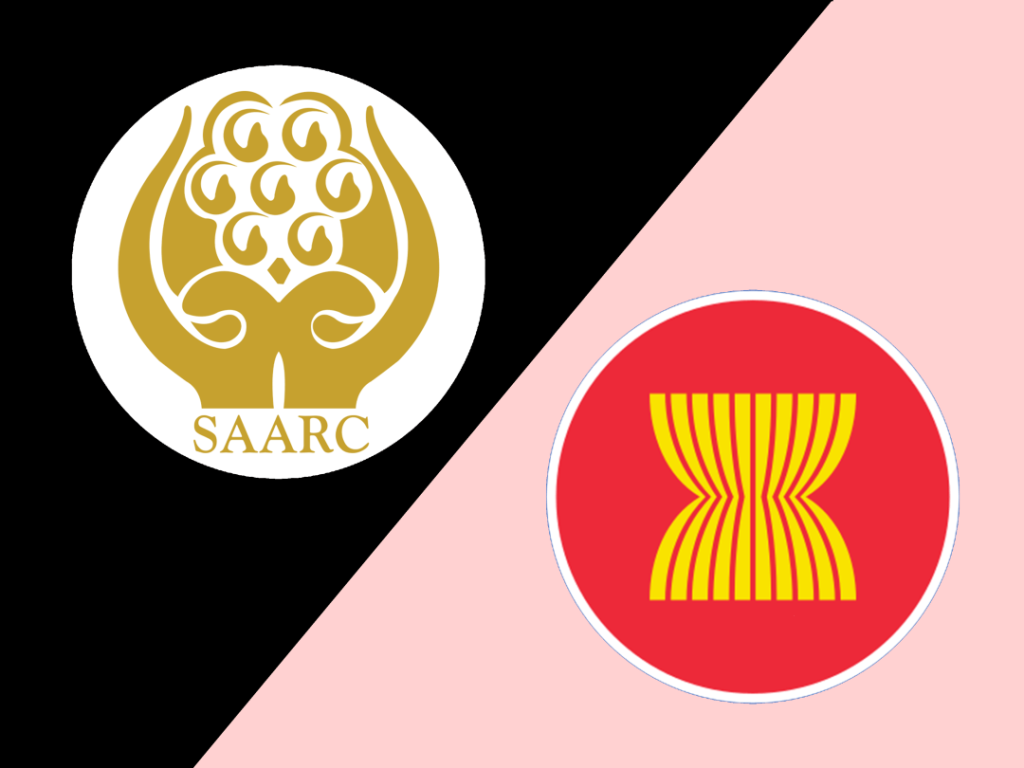
Today, ASEAN comprises ten member states with a total area of over 4.5 million square kilometres and an estimated population of approximately 668 million. Symbolically, the ten stalks of rice in the ASEAN flag represent unity and shared prosperity among its members. ASEAN has also made tangible progress in people-to-people connectivity, particularly through the institutionalization of visa-free travel, which has significantly increased intra-ASEAN tourism—by 2010, nearly half of all tourists within ASEAN originated from member states themselves. At the same time, ASEAN has faced unprecedented challenges, notably Myanmar’s political crisis since 2017, which has tested the organization’s principles of non-interference and consensus-based decision-making. ASEAN’s evolving response to Myanmar reflects a gradual but significant shift in its institutional character, highlighting its capacity for adaptation while striving to preserve unity and regional credibility.
Why ASEAN Worked Where SAARC Stalled: A Comparative Transition
From the perspective of new regionalism, ASEAN’s relative success can be attributed to its ability to evolve beyond narrow state-centric cooperation toward a multidimensional regional project encompassing economic integration, political dialogue, and societal connectivity. New regionalism emphasizes openness, flexibility, and functional diversification, all of which are evident in ASEAN’s post–Cold War evolution—from trade liberalization and people-to-people mobility to crisis coordination during the COVID-19 pandemic. In contrast, SAARC has remained trapped within a traditional, state-centric framework, heavily constrained by sovereignty concerns and elite-level mistrust. Its limited engagement beyond formal diplomacy and weak societal embeddedness have prevented the emergence of a shared South Asian regional identity, reinforcing institutional stagnation.
Institutionalist explanations further illuminate the divergence. ASEAN developed durable norms and practices—often described as the “ASEAN Way”—that, despite being informal and consensus-based, are reinforced through frequent summits, dense networks of ministerial meetings, and institutional continuity. These mechanisms have enabled ASEAN to adapt incrementally to crises, as seen in its collective response to Myanmar’s post-2021 political turmoil and its coordination under frameworks such as the ASEAN Comprehensive Recovery Framework. SAARC, by contrast, suffers from weak institutional density, infrequent high-level engagement, and an absence of enforcement or dispute-resolution mechanisms. Its consensus rule, combined with low institutionalization, amplifies veto power and renders the organization highly susceptible to political shocks, as demonstrated by its paralysis since the 2016 Uri crisis.
From a realist perspective, power asymmetry and threat perception are central to explaining SAARC’s stagnation. South Asia is characterized by a clear regional hegemon—India—whose economic and military dominance generates persistent fears of marginalization among smaller states and balancing behavior from Pakistan. This asymmetry has prevented the development of trust-based cooperation and encouraged zero-sum calculations, particularly in the security domain. In Southeast Asia, by contrast, the absence of a single overwhelming regional power has allowed ASEAN to function as a collective balancing platform amid intensifying US–China rivalry. ASEAN’s centrality in regional security architecture, through forums such as the ASEAN Regional Forum and the East Asia Summit, reflects its ability to manage external power competition without internal paralysis.
Taken together, these theoretical perspectives highlight that ASEAN’s effectiveness lies not in the absence of conflict but in its capacity to institutionalize cooperation amid diversity and tension. SAARC’s failure, conversely, reflects the limitations of depoliticized regionalism in a conflict-prone environment. Without mechanisms to manage power asymmetry, address security externalities, or foster functional interdependence, SAARC has remained a fragile and reactive institution. This theoretical contrast reinforces why ASEAN has emerged as a resilient model of regionalism, while SAARC continues to struggle with relevance in an increasingly interconnected and competitive regional order.
SAARC and ASEAN: Divergent Outcomes of Regionalism in Asia
South Asia today faces multiple overlapping challenges, including refugee and migration crises, unresolved territorial disputes, ethnic and cultural tensions, weak infrastructure connectivity, and fragile political trust among states. These challenges have directly constrained the effectiveness of SAARC, whose foundational objective of fostering regional cooperation remains unfulfilled. Persistent mutual suspicion—particularly between India and Pakistan—has prevented SAARC from evolving beyond a symbolic forum. In contrast, Southeast Asia’s regional mechanism, ASEAN, despite having a smaller population and territorial size, has successfully fostered a relatively stable regional order, deepened economic interdependence, and institutionalized cooperation in trade, connectivity, and security dialogue. This contrast has led many scholars to characterize the experience succinctly: SAARC has stagnated, while ASEAN has consolidated.
Conflict Management and Institutional Adaptability: ASEAN’s Advantage
Conflicts are not unique to South Asia; they are inherent to all regional systems. What distinguishes ASEAN is not the absence of conflict but its ability to manage tensions without institutional breakdown. During its first decade, ASEAN prioritized regional stability amid communist insurgencies and Cold War turbulence, reinforcing unity through shared threat perception. The 1976 Treaty of Amity and Cooperation (TAC), signed at the Bali Summit, marked a turning point by formally incorporating security concerns, dispute settlement mechanisms, and norms of peaceful coexistence. In recent years, ASEAN has demonstrated institutional adaptability, particularly in response to Myanmar’s political crisis following the 2021 military coup. By excluding Myanmar’s junta from high-level summits and adopting the Five-Point Consensus, ASEAN signaled a willingness to reinterpret its non-interference principle to preserve regional credibility—something SAARC has been unable to do in comparable crises.
Economic Integration and Trade Performance: ASEAN’s Structural Depth
ASEAN’s political stability enabled sustained economic integration. From the late 1970s onward, ASEAN leveraged institutional continuity to expand trade and investment cooperation. Its cumulative GDP growth between 1976 and 1982—averaging nearly 15% annually—laid the foundation for deeper economic frameworks such as the ASEAN Free Trade Area (AFTA) in 1992 and the ASEAN Economic Community (AEC) in 2015. Today, intra-ASEAN trade accounts for nearly 50% of total exports, supported by integrated supply chains and manufacturing networks. ASEAN’s central role in the Regional Comprehensive Economic Partnership (RCEP), signed in 2020, further reinforces its position as the hub of Asia-Pacific economic architecture. By contrast, SAARC’s economic instruments—SAPTA (1993) and SAFTA (2004)—have delivered limited outcomes, with intra-regional trade stagnating at around 7%, reflecting weak industrial complementarities and poor trade facilitation.
SAARC’s Structural Constraints and Persistent Underperformance
SAARC’s failure to generate meaningful regional integration is deeply rooted in its origins and structural design. Indo–Pakistan rivalry, extreme power asymmetry favoring India, and the colonial legacy of contested borders have repeatedly undermined trust. Unlike ASEAN, SAARC deliberately excluded security issues from its mandate, leaving no institutional mechanism to manage conflicts when they inevitably arise. Recent examples reinforce this weakness: the cancellation of the 19th SAARC Summit after the 2016 Uri attack, the paralysis following India–Pakistan tensions, and Afghanistan’s political uncertainty after the Taliban’s return to power in 2021. Even economically, SAARC remains one of the least connected regions globally; World Bank studies highlight excessive documentation, delays, and logistical barriers—such as the requirement of over 50 signatures and multiple days for cross-border cargo movement between India and Bangladesh. Large-scale regional projects like the TAPI gas pipeline remain stalled due to security and political distrust, illustrating the region’s inability to convert economic interdependence into cooperation.
Comparative Assessment: Why ASEAN Succeeds and SAARC Struggles
The contrast between ASEAN and SAARC highlights three critical differences. First, ASEAN evolved as a problem-managing organization, while SAARC remains a problem-avoiding forum. Second, ASEAN’s relatively balanced power structure enabled collective leadership, whereas SAARC’s India-centric asymmetry fostered fears of hegemony and counter-balancing behavior. Third, ASEAN successfully integrated economic incentives with political dialogue, creating a virtuous cycle of stability and growth. South Asia, despite housing nearly a quarter of the global population, remains dependent on extra-regional trade partners, with nearly 60% of SAARC trade occurring outside Asia. This dependence, combined with weak industrial diversification and low foreign direct investment, further marginalizes SAARC in global economic governance.
Pathways for Revitalizing SAARC in a Changing Regional Order
For SAARC to regain relevance, incremental and pragmatic reforms are essential. Strengthening conflict-resolution mechanisms, expanding cross-border energy cooperation, simplifying trade procedures, and enhancing people-to-people connectivity are necessary first steps. In a region increasingly shaped by Chinese infrastructure investment and geopolitical competition, SAARC could serve as a collective platform to negotiate sustainable development terms, protect labor mobility interests, and assert South Asia’s shared cultural and historical identity. Ultimately, SAARC’s survival depends on allowing regionalism to evolve organically—supported not only by state elites but also by societal engagement—so that South Asia’s immense human and material potential can be translated into lasting regional cooperation.
Conclusion
The divergent trajectories of ASEAN and SAARC underscore that regional cooperation depends not merely on shared geography but on adaptive institutions, balanced power relations, and conflict-management mechanisms. ASEAN’s pragmatic regionalism contrasts sharply with SAARC’s structural rigidity, offering important lessons for revitalizing South Asian cooperation in an increasingly interconnected regional order.

About the Author
Khushbu Ahlawat is a research analyst with a strong academic background in International Relations and Political Science. She has undertaken research projects at Jawaharlal Nehru University, contributing to analytical work on international and regional security issues. Alongside her research experience, she has professional exposure to Human Resources, with involvement in talent acquisition and organizational operations. She holds a Master’s degree in International Relations from Christ University, Bangalore, and a Bachelor’s degree in Political Science from the University of Delhi.



