
By: Prof. ML Meena & Ravi D. Bishnoi
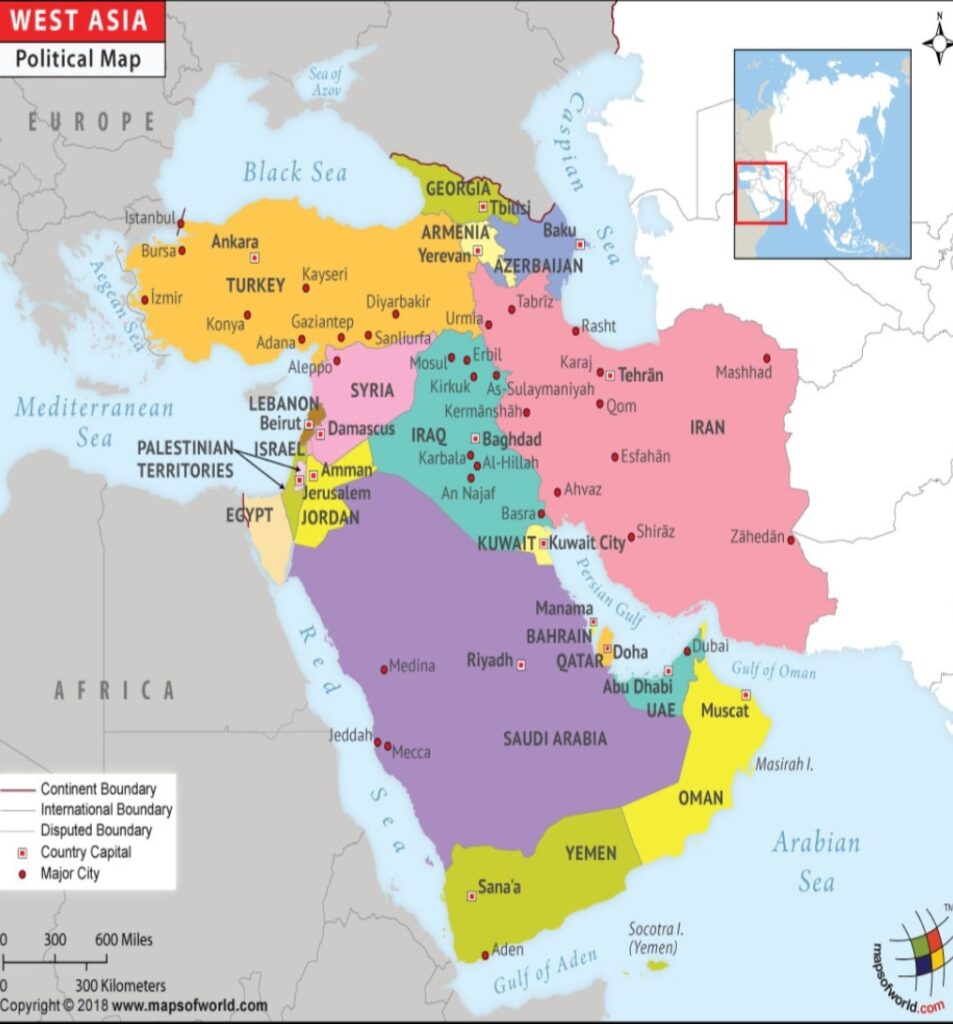
The direct confrontation between Iran, Israel, and the United States that began in the last week of February has brought West Asia to a strategic turning point where regional war, missile technology, proxy networks and global power competition are appearing together. This conflict is no longer just a military clash between two or three countries; rather, it is gradually becoming an important dimension of a broader geostrategic restructuring. The conflict began when the United States and Israel launched joint air operations under the name operation epic fury and lion’s Roar against several Iranian military and security installations. These attacks targeted military command centers in Tehran, defense production structures in Isfahan and certain missile infrastructures. The objective was to weaken Iran’s long-range missile capability and damage the military structures associated with its nuclear program. In the initial phase, therefore, the attacks were mainly focused on military and strategic structures.
Immediately after these attacks, the way Iran responded took the conflict to a new stage. Moving beyond limited retaliation, Iran targeted the American and Israeli military network spread across the Middle East. In its retaliatory strikes, Iran used Fateh-110, Zolfaghar, Qiam-1, and Shahab series ballistic missiles, along with Soumar and Ya-Ali cruise missiles and long-range attack drones. In fact, the strike range of these missile systems is said to extend from several hundred kilometers to more than two thousand kilometers, which makes them fully capable of targeting Israel and American military bases located in the Gulf region. This strength increases further when the Dastvareh barracks in northwest Tehran geographically manages a wider network very effectively. In reality, such attacks are part of Iran’s well-considered asymmetric deterrence military strategy, in which it knows well how to balance a much stronger opponent through missiles and drones despite limited resources. As a result, the pace with which the United States was advancing through USS Gerald R. Ford (CVN-78) and USS Abraham Lincoln (CVN-72) had to be adjusted as Iran’s missile strike capability forced them to move out of its range.
In this context, it is also necessary to understand that in modern warfare it is no longer only the traditional army or air force that is decisive. Low-cost drones, mobile missile systems, and artificial intelligence are also changing the direction of war. Over the past two decades, Iran has invested heavily in its missile and drone capabilities, and this is why, despite relatively limited resources, it has been able to challenge powerful countries such as the United States and Israel.
The most important aspect of Iran’s strategy was that it targeted those bases that are considered the main centers of American military presence in the Middle East. Al-Udeid Air Base in Qatar, Naval Support Activity Bahrain in Bahrain, Al Dhafra Air Base in the United Arab Emirates, Ali Al-Salem Air Base in Kuwait, Muwaffaq Al-Salti Air Base in Jordan, and Ain Al-Asad and Erbil Air Bases in Iraq came within the potential range of Iranian missile and drone strikes. These bases were selected not only because of their strategic importance but also because they are key centers for America’s regional air operations, surveillance missions, and logistics networks. From a geopolitical perspective, it must be remembered clearly that if the operational capacity of these bases is affected, the regional military capability of the United States could be directly limited.
The second dimension of Iran’s attacks appears through its proxy network. Several militia groups active in Iraq, Syria, and Lebanon intensified attacks on American and Israeli targets. In Iraq, a Shia militia organization claimed a drone attack on a US military facility near Baghdad airport. Similarly, attempts were made to target American soldiers in the Erbil region. Hezbollah in Lebanon, which has rocket reach toward northern Israel, and Iraqi militias attacking US bases made it clear through their activity that this regional conflict is gradually turning into a multi-front proxy war.
To understand this entire conflict, its historical context is also important. Since the Iranian Islamic Revolution of 1979, relations between Iran and Israel have remained deeply antagonistic. Before the revolution, Iran under the Shah maintained relatively cooperative strategic and economic ties with both Israel and the United States. However, the revolution brought a major ideological transformation. The new Islamic Republic under Ruhollah Khomeini severed diplomatic relations with Israel, closed its embassy in Tehran, and adopted a strongly anti-Zionist position. At the same time, Iran-U.S. relations sharply deteriorated following the Iran hostage crisis, which entrenched decades of hostility. Since then, Iran has increasingly relied on regional proxy networks and ideological resistance to challenge Israeli and American influence in West Asia. Over the past four decades, the two countries have experienced several indirect confrontations, which are often described as shadow wars. In these shadow wars, cyber attacks, covert military operations, and the use of proxy organizations have been key strategies. For example, the Stuxnet cyber-attack that affected Iran’s nuclear energy program and the periodic Israeli air strikes in Syria are considered part of this shadow conflict. However, in the present era another important dimension of this war is connected with maritime geopolitics, or more specifically maritime chokepoint geopolitics. The Strait of Hormuz in West Asia is one of the most important routes for global energy supply. Nearly one-fifth of the world’s total seaborne oil trade passes through this route. If military tension in this region continues to increase or if naval confrontation occurs, it will have a direct impact on the global energy market. This is why the United States decided to further strengthen its naval presence in the Gulf region and reinforce the deployment of aircraft carriers. From the initial attacks to the current confrontation, this naval presence has been actively used.
Within this emerging trend of missile-centric warfare, several possible scenarios appear regarding the future direction of the conflict. The first scenario is that diplomatic pressure may gradually limit the conflict to restricted military actions. This would happen only if Iran’s military capacity becomes extremely weak, or if it compromises its sovereignty, or if civil unrest begins there. However, current trends suggest that this scenario may no longer be effective, especially if, after the death of Khamenei, the population has emotionally united. It now appears more likely that Iran may continue strong resistance in direct confrontation, and even if it suffers military damage, the possibility of surrender seems low; in such a situation the conflict may even shift from conventional war to guerrilla warfare. The second scenario is that the war may spread across the entire Middle East and countries such as Lebanon, Iraq, and the Gulf states may become fully involved. In such a case, if the conflict becomes more complex than expected, the United States may itself prefer that a third party or mediator appeal for a ceasefire. The third and more complicated scenario is that the conflict becomes part of global power competition, in which countries such as the United States, Russia, and China become indirectly involved. In that case, the war could continue for a long time without any clear decisive result, and instability may persist throughout the region. This would have wide-ranging effects on the security of West Asia as well as on maritime routes.
In this context, the role of the Indian Ocean region and India also becomes important. If American military bases in the Middle East remain under constant threat or their operational capacity becomes limited, the United States may need alternative logistical and strategic support in the Indian Ocean region. In such a situation, the possibility of cooperation from India could also be discussed. However, India’s foreign policy has long been based on strategic autonomy, and therefore India will need to maintain its diplomatic balance in any such situation. Under the current circumstances, India needs to adopt a realistic and far-sighted diplomatic approach instead of an overly generous or unclear position. Current developments indicate that Iran’s position appears stronger than expected, and the limited war strategy with which the United States moved forward now seems to be turning into a partially incorrect assessment. This may also be the reason why the United States has not formally declared it as a war so far.
In the coming years, this conflict will significantly affect not only the regional balance of power but also the direction of global geopolitics. As a result, a geographical pressure arc will emerge in West Asia. This will be a pressure arc in which energy routes, military bases, and great power competition will converge to create a new geopolitical reality. Considering all these possibilities, India must determine its diplomatic position carefully. If India continues to maintain an unclear or excessively neutral stance, it may weaken its strategic credibility and leadership capacity at the international level. Therefore, it is necessary for India to give balanced but clear diplomatic signals so that its national interests remain protected while its global role also remains strong.



