
By: Sonalika Singh, Consulting Editor, GSDN
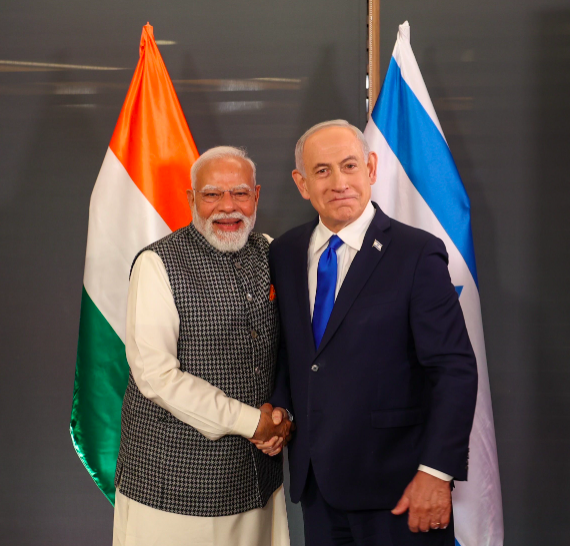
Prime Minister Narendra Modi’s recent two-day state visit to Israel his first since the landmark 2017 trip that made him the first Indian prime minister to set foot on Israeli soil marks a pivotal moment in India’s evolving West Asia policy. Framed as a step toward a “special strategic partnership,” the visit underscores the steady expansion of India–Israel relations across defense, technology, trade, and innovation. Yet, taking place amid the continuing devastation in Gaza and heightened regional tensions, the visit also raises complex moral, diplomatic, and geopolitical questions. Its implications for peace in the Middle East extend beyond bilateral cooperation, touching upon India’s credibility as a balancing power, its commitment to international norms, and its potential role in fostering long-term regional stability.
India’s relationship with Israel has undergone a profound transformation over the past three decades. Although India recognized Israel in 1950, full diplomatic relations were established only in 1992, reflecting Cold War alignments, domestic political sensitivities, and strong ties with Arab states. Historically, India championed the Palestinian cause, becoming one of the first non-Arab countries to recognize the State of Palestine in 1988. Over time, however, shared concerns about terrorism, technological complementarities, and defense requirements drew New Delhi and Tel Aviv closer. Modi’s 2017 visit symbolized the “de-hyphenation” of India’s Israel and Palestine policies engaging Israel on its own merits while maintaining rhetorical support for Palestinian statehood. His current visit consolidates that trajectory, signaling that India’s Middle East engagement is now guided primarily by strategic pragmatism.
At the core of the visit lies a robust and expanding defense partnership. Israel has emerged as one of India’s top suppliers of advanced military technology, including drones, missile systems, radar platforms, and surveillance tools. According to data from the Stockholm International Peace Research Institute, India accounted for a significant share of Israeli defense exports in recent years, highlighting the depth of this strategic alignment. Discussions during the visit reportedly include joint development of ballistic missile defense systems, laser weapons, and next-generation drones. For India, such cooperation enhances deterrence capabilities and strengthens national security. For Israel, partnership with a major democracy provides a stable market and opportunities to scale production. However, critics argue that these technologies are not abstract innovations, but tools deployed in contested environments, raising ethical concerns about their use in contexts of occupation and civilian control.
The security dimension of India–Israel ties is closely linked to counterterrorism cooperation. Both nations face threats from extremist violence and cross-border militancy, fostering collaboration in intelligence sharing, cybersecurity, and homeland security. Proponents contend that such cooperation contributes to regional stability by strengthening state capacity against non-state actors. Yet detractors caution that framing security cooperation solely through the lens of counterterrorism risks obscuring the broader political realities of occupation and asymmetrical conflict in the Palestinian territories. This tension underscores the broader dilemma facing India how to pursue legitimate security interests without appearing indifferent to humanitarian concerns.
Beyond defense, the visit emphasizes expanding economic and technological collaboration. Bilateral trade has grown steadily, reaching approximately $4 billion in 2024, with negotiations underway for a comprehensive free trade agreement. Cooperation spans agriculture, water management, desalination, waste treatment, artificial intelligence, quantum technologies, and cybersecurity. Israel’s expertise in drip irrigation and desert agriculture aligns with India’s development priorities and offers solutions applicable across arid regions of the Middle East. Such initiatives have the potential to address resource scarcity one of the underlying drivers of conflict thereby contributing indirectly to regional peace. At the same time, dual-use technologies in AI and surveillance raise concerns about their potential deployment in security infrastructures that restrict civilian freedoms.
The visit also reflects broader geopolitical realignments in West Asia. Israel’s normalization agreements with several Arab states have shifted regional dynamics from ideological confrontation toward pragmatic cooperation. India’s engagement with Israel complements its deepening ties with Gulf countries such as the United Arab Emirates and Saudi Arabia, as well as its longstanding relationship with Iran. This multi-vector diplomacy positions India as a potential bridge among rival blocs. However, the optics of Modi’s visit particularly his address to the Knesset and visible camaraderie with Israeli leadership may be interpreted by some regional actors as a tilt toward Israel, complicating India’s carefully cultivated image of strategic autonomy.
The humanitarian crisis in Gaza forms the most contentious backdrop to the visit. Ongoing military operations, large-scale displacement, and civilian casualties have prompted global calls for ceasefire and accountability. Critics within India, including opposition leaders and civil society voices, argue that deepening ties with Israel at such a moment undermines India’s historical support for Palestinian rights and weakens its moral standing. Statements by political figures such as Jairam Ramesh, Priyanka Gandhi Vadra, and M. A. Baby reflect domestic unease, framing the visit as inconsistent with India’s anti-colonial legacy and long-standing advocacy for self-determination. A parliamentary panel led by Shashi Tharoor has also warned that the timing and symbolism of the visit could affect India’s global image, underscoring the importance of foreign policy messaging.
India maintains that its support for a two-state solution remains unchanged. Yet critics contend that rhetorical commitment appears hollow when accompanied by expanding defense and intelligence cooperation with Israel. This perceived inconsistency is compounded by India’s voting patterns at the United Nations, where it has sometimes abstained on resolutions critical of Israel while supporting others condemning settlement expansions. Such oscillations have drawn domestic and international scrutiny, raising questions about whether strategic interests are overshadowing normative commitments. For India to play a credible role in promoting peace, it must reconcile these tensions and articulate a coherent policy that aligns actions with principles.
From Israel’s perspective, Modi’s visit carries significant diplomatic value. Prime Minister Benjamin Netanyahu, facing domestic political pressures and international criticism, can present the visit as evidence that Israel is not isolated and retains strong partnerships with major global actors. The personal rapport between Modi and Netanyahu, often highlighted through public displays of warmth, reinforces this narrative. For Israel, engagement with India enhances its legitimacy and expands its diplomatic network, particularly in the Global South. However, this dynamic also underscores the asymmetry of perceptions: while Israel views the partnership as a strategic breakthrough, India must balance its bilateral gains against broader regional sensitivities.
The visit also intersects with emerging multilateral frameworks such as the I2U2 grouping comprising India, Israel, the United States, and the United Arab Emirates and the India–Middle East–Europe Economic Corridor (IMEEC). These initiatives aim to promote economic connectivity, infrastructure development, and food security, fostering interdependence among regional actors. By participating in such frameworks, India contributes to a cooperative architecture that could reduce incentives for conflict. Economic integration and shared development projects create mutual stakes in stability, offering a pathway toward peace that complements traditional diplomacy.
Iran’s role in the regional equation further complicates the implications of Modi’s visit. India’s strategic investments in Iran’s Chabahar Port and its historical energy ties underscore Tehran’s importance in India’s extended neighborhood. Balancing relations with Israel and Iran require careful diplomacy, particularly amid tensions surrounding Iran’s nuclear program. Analysts suggest that India prefers a negotiated diplomatic solution to regional disputes, reflecting its broader commitment to stability. However, visible alignment with Israel could strain perceptionsin Tehran, illustrating the delicate balancing act inherent in India’s West Asia policy.
The broader question raised by Modi’s visit concerns the moral compass of foreign policy. Can strategic partnerships and technological cooperation justify engagement with a state facing serious allegations of human rights violations? For India, a nation that has historically championed anti-colonialism and self-determination, this question carries resonance. The pursuit of national interests is an inevitable aspect of foreign policy, yet moral credibility remains a vital component of global leadership. India’s ability to reconcile strategic pragmatism with ethical consistency will shape its international reputation and influence.
Despite these challenges, the visit also presents opportunities for India to contribute constructively to Middle East peace. India’s development partnerships in agriculture, water management, healthcare, and digital infrastructure can address root causes of instability, including poverty, resource scarcity, and economic inequality. By sharing scalable, cost-effective solutions tailored to developing contexts, India can support regional resilience and foster conditions conducive to peace. Moreover, India’s longstanding ties with both Israel and Arab states position it uniquely to facilitate dialogue and confidence-building measures, even if it does not serve as a formal mediator.
India’s concept of strategic autonomy remains central to its approach. Rather than aligning exclusively with any bloc, India seeks to maintain balanced relations across the region, guided by national interests and global responsibilities. Modi’s visit to Israel must therefore be understood within this broader framework. While the optics may suggest alignment, India continues to engage actively with Palestine, Gulf states, and Iran, emphasizing that its partnerships are not zero-sum. The challenge lies in ensuring that this balanced approach is perceived as credible and consistent by all stakeholders.
In conclusion, Prime Minister Narendra Modi’s visit to Israel represents a complex and consequential moment in India’s foreign policy. It consolidates a multifaceted strategic partnership encompassing defense, technology, trade, and innovation, while also raising profound questions about ethics, diplomacy, and regional stability. The visit highlights India’s emergence as a significant actor in Middle Eastern geopolitics, capable of influencing regional dynamics through development partnerships and multilateral engagement. Yet its implications for peace in the Middle East depend on India’s ability to balance strategic interests with moral responsibility, maintain credibility as a supporter of Palestinian rights, and leverage its unique position to promote dialogue and cooperation.
As West Asia navigates a period of volatility and transformation, India’s role will be shaped not only by its partnerships but by the principles guiding its engagement. Modi’s visit underscores both the opportunities and the dilemmas inherent in this role. If India can align its strategic ambitions with a consistent commitment to justice, human dignity, and inclusive development, it may yet contribute meaningfully to a more stable and peaceful Middle East.

About the Author
Sonalika Singh began her journey as an UPSC aspirant and has since transitioned into a full-time professional working with various organizations, including NCERT, in the governance and policy sector. She holds a master’s degree in political science and, over the years, has developed a strong interest in international relations, security studies, and geopolitics. Alongside this, she has cultivated a deep passion for research, analysis, and writing. Her work reflects a sustained commitment to rigorous inquiry and making meaningful contributions to the field of public affairs.



