
By: Harshit Tokas, Research Analyst, GSDN
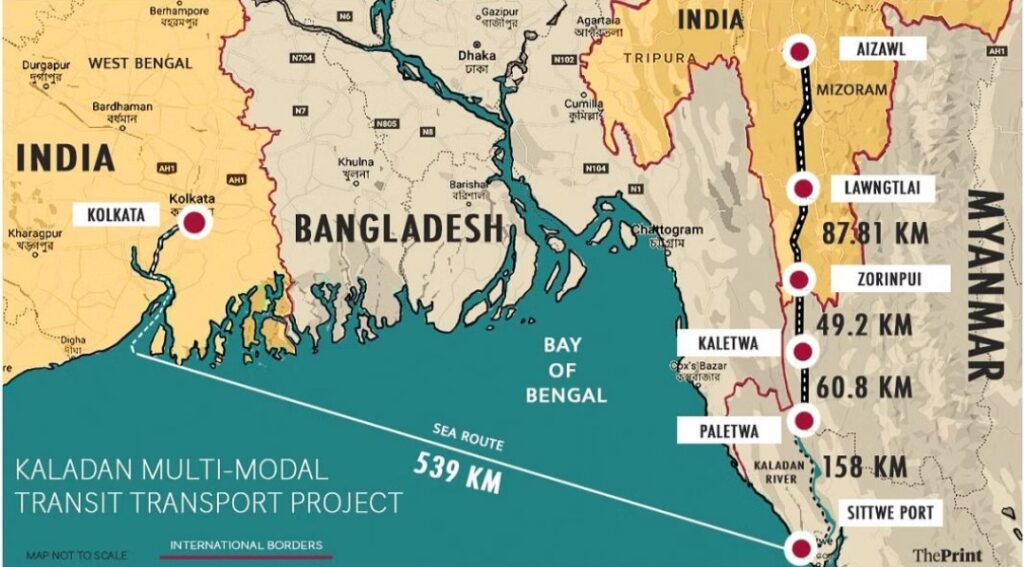
The Government of India’s strategic engagement with its neighboring countries, particularly those in the eastern region, reflects a proactive approach towards fostering both economic and political ties. At the center of this approach is the “Act East Policy,” aimed at establishing robust trade links with nations in the Far East. The Kaladan Multimodal Transport Project, a pivotal component of this policy, seeks to leverage the Kaladan River as a trade route, connecting Mizoram in India to the port city of Sittwe in Myanmar.
Economically, Mizoram, a state of India, has embarked on a transformative journey propelled by initiatives such as the New Land Use Policy (NLUP), strategically crafted to foster inclusive growth and alleviate poverty. The NLUP, gaining momentum with time, stands as a testament to the government’s commitment to strengthening monitoring systems, enhancing stakeholder training, and ensuring the efficient supply of inputs. Recognizing the pivotal role played by farmers and agricultural workers, the government has implemented various measures for their welfare, including the provision of agricultural machinery at subsidized rates. These efforts underscore Mizoram’s proactive stance in empowering its workforce and fostering sustainable economic development.
The Kaladan River, traversing along the Indo-Myanmar border in the northeastern region of India, presents a promising avenue for inland waterway transportation. Under this project, goods can be transported via inland waterway up to navigable points, with road transport filling in where navigation is impractical. This multimodal approach, integrating sea, inland water, road, and rail transport, is envisioned to facilitate efficient trade with eastern countries, particularly by easing the movement of goods to and from Mizoram and other northeastern states.
Recognizing the inadequacies in the transportation infrastructure and its crucial role in driving economic growth, the Government of India has accorded high priority to the development of the transportation sector. An agreement between the Governments of India and Myanmar underscores their commitment to developing a multimodal trade route, combining inland waterways and road transport, to enhance bilateral trade and regional connectivity.
The Kaladan Multimodal Transport Project encompasses two main segments: the inland waterway route from Sittwe to Kaletwa in Myanmar and the road link from Kaletwa to Lawngtlai town on NH-54 in Mizoram, India. The road segment within Mizoram, spanning approximately 99.830 kilometers, forms an integral part of this trade route. Notably, this project builds upon existing border trading points between India and Myanmar, facilitating the exchange of various commodities and contributing to the substantial growth in bilateral trade volumes.
Human resource development remains a key focus area for the government, as evidenced by initiatives such as the establishment of polytechnic institutes across various districts. By nurturing skilled talent and fostering a conducive learning environment, Mizoram is poised to harness its human capital effectively. Moreover, the Autonomous District Councils in Mizoram have played a pivotal role in resource mobilization and addressing the unique needs of their respective areas. The government’s sensitivity to these requirements underscores its commitment to inclusive development and decentralized governance.
Furthermore, India’s commitment to bolstering border trade with Myanmar is evidenced by its support for infrastructure development projects in Myanmar, including road communication, hydroelectric power, and hydrocarbon sector initiatives. These efforts underscore India’s broader objective of enhancing regional connectivity and fostering mutually beneficial cooperation with its neighbors.
The feasibility study conducted by RITES Ltd. highlights the navigability of the Kaladan River up to Kaletwa in Myanmar, beyond which road transport becomes imperative due to shallow waters and frequent rapids. The proposed road link from Kaletwa to Lawngtlai in Mizoram is integral to the development of this multimodal trade route, serving as a vital artery for economic integration and regional trade facilitation.
Governor Purushothaman’s expression of gratitude to stakeholders for their contributions to peace, harmony, and development encapsulates Mizoram’s collective ethos. As the state marches forward, it remains cognizant of the need to integrate with the national mainstream while safeguarding its distinct identity and interests. The Kaladan Multi Modal Transit Transport Project, in particular, holds the promise of not only enhancing connectivity within Mizoram but also fostering regional integration and economic growth.
In conclusion, the Kaladan Multimodal Transport Project represents a significant milestone in India’s efforts to deepen its engagement with neighboring countries and tap into the economic potential of the region. By leveraging multimodal transportation infrastructure, India aims to enhance trade flows, promote socio-economic development, and strengthen regional cooperation, thereby contributing to overall peace and prosperity in the region.



