
By: Dr. Abhishek Karmakar
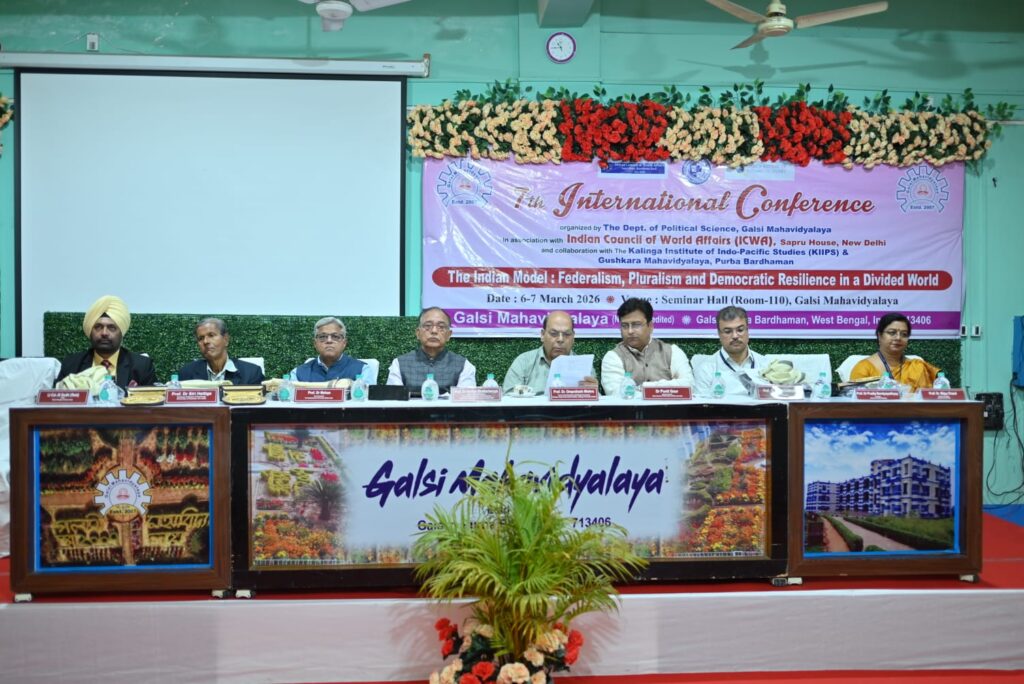
The Department of Political Science of Galsi Mahavidyalaya successfully organized the Seventh International Seminar on 6–7 March at the college seminar hall. The conference was financially supported by the Indian Council of World Affairs, New Delhi, and was jointly organised in collaboration with Guskara Mahavidyalaya and the Kalinga Institute of Indo-Pacific Studies. The two-day international academic event focused on India’s federal model, pluralist character, and democratic governance in the contemporary global context.
The seminar sought to examine how India has managed to sustain unity amid enormous diversity in religion, language, culture, and ethnicity through its federal democratic structure. At a time when many parts of the world are witnessing crises of democracy, multicultural tensions, and declining political tolerance, the conference highlighted how the Indian federal system continues to integrate diverse communities while maintaining democratic stability.
The seminar witnessed the participation of eminent scholars, diplomats, and researchers from India and abroad. Among the distinguished speakers were Siri Hettige, Emeritus Professor of Sociology at the University of Colombo, Sri Lanka; Harihar Bhattacharyya, renowned scholar of federalism and former Professor of Political Science at the University of Burdwan; Former Professor Shibranjan Chatterjee, Omprakash Mishra, former Vice-Chancellor of North Bengal University and currently a Professor Jadavpur University; Arvind Kumar of Jawaharlal Nehru University; and Chintamani Mahapatra, former Professor at JNU. Other distinguished speakers included Lt. Col. J S Sodhi, Professor Jared Sonnicksen from Aachen University, Germany, Dr. Jhumpa Mukherjee of St. Xavier’s College, Kolkata; Professor Biswanath Chakraborty of Rabindra Bharati University; and Dr. Debasish Nandy of Kazi Nazrul University.
Delivering the keynote address, Professor Harihar Bhattacharyya presented a comprehensive analysis of Indian federalism and highlighted how the federal structure has evolved as a mechanism to manage diversity while maintaining national unity. He emphasised that Indian federalism represents a dynamic system that balances central authority with regional autonomy. Professor Omprakash Mishra discussed the complexities of centre–state relations in India, explaining how cooperative federalism and institutional negotiations have contributed to political stability and democratic continuity. Professor Biswanath Chakraborty provided an insightful analysis of the proposed “One Nation One Election” (ONOE) system and its implications for democratic governance and the federal balance.
Dr. Jhumpa Mukherjee elaborated on the federal provisions of the Constitution of India, explaining how constitutional safeguards ensure both national unity and regional autonomy. Dr. Debasish Nandy highlighted the role of India’s border states in shaping federal policies, particularly in the context of foreign policy formulation and regional diplomacy.
Professor Siri Hettige, Emiratus Professor from Sri Lanka delivered an important comparative lecture on pluralist constitutionalism in Sri Lanka and India, discussing how both countries have attempted to manage ethnic and cultural diversity through democratic frameworks.
Lt. Col. J. S. Sodhi delivered two significant lectures during the seminar. On the first day, he spoke on “Why Unity in Diversity is Important in India in View of External Challenges,” emphasising that India’s social cohesion and pluralistic identity are critical for national security in an increasingly complex geopolitical environment. On the second day, he presented another lecture titled “India’s Biggest Challenge since 1947: The 3.5-Front War Threat,” where he analysed emerging strategic challenges for India, including external security threats and internal vulnerabilities.
Professor Arvind Kumar delivered a historically grounded lecture on the evolution and functioning of Indian federalism, tracing its development from colonial constitutional arrangements to the contemporary democratic system. Professor Chintamani Mahapatra highlighted why the Indian model of federalism and democracy holds global relevance, explaining how India has managed to sustain democratic governance despite extraordinary social diversity.
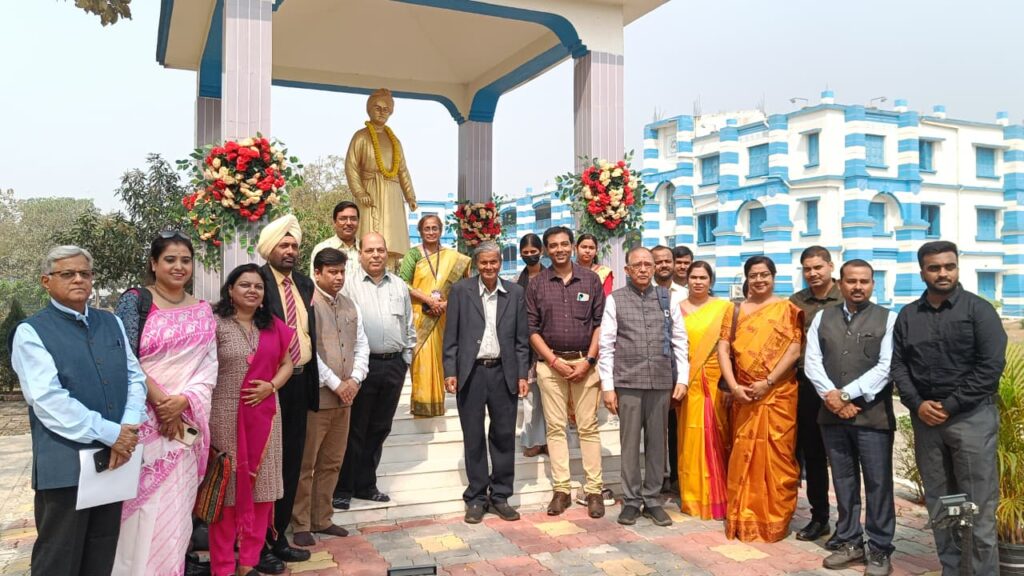
The seminar began with an introductory address by Dr. Abhisek Karmakar, Associate Professor of Political Science, Convener of the seminar, and IQAC Coordinator of the college. In his remarks, Dr. Karmakar argued that the Indian model of federalism and democracy is fundamentally distinct from many Western theoretical frameworks, as it has evolved through the accommodation of deep social diversity and cultural pluralism. He stressed the need for more academic discussions and scholarly initiatives to decolonize political science discourse and interpret Indian democracy from indigenous perspectives.
The conference also featured several parallel technical sessions where scholars and researchers from various universities and colleges presented their research papers. The sessions were chaired by distinguished academics including Dr. Prasenjit Pal of Diamond Harbour University, Dr. Shilpa Nandy of Khudiram Bose Central College, Dr. Swagata Bhattacharyya of Vivekananda Mission College, Dr. Amrita Banerjee of Bidhan Chandra College, Asansol, Dr. Sabina Begum of Guskara Mahavidyalaya, Dr. Bibhuti Bhusan Biswas of the Central University of Jharkhand, and Dr. Debatanu Maji of Bidhan Chandra College, Rishra, among others.
To encourage young scholars, Best Paper Awards were presented to several participants for their outstanding research presentations. Among the awardees were Subhra Debnath, Rahul Halder, Parna Ganguli, Binni Kumari, Puja Kumari, Shivam Kharel, and several others.
College Principal Dr. Amit Tiwary stated that organising such international seminars has become an integral part of the academic culture of the institution. He also mentioned that another international seminar had been organised by the department earlier in January this year. The President of the Governing Body, Mr. Partha Mondal, was present and played an important role in ensuring the success of the event.
Dr. Sudip Chatterjee, Principal of Guskara Mahavidyalaya and a joint organiser of the seminar, remained present throughout the two-day programme and contributed significantly to its success. Principals of several colleges associated with Galsi Mahavidyalaya through MoU collaborations were also invited, including Dr. Bijoy Chand of Raj College, Burdwan, and Dr. Pradip Banerjee of Vivekananda Mahavidyalaya.
The sessions were skillfully moderated by Dr. Shukla Barman of the Department of English, Galsi Mahavidyalaya. Over the two days, the seminar provided a vibrant intellectual platform for scholars and students to discuss India’s federal model, democratic resilience, and pluralist character in the context of contemporary global challenges.
About the Author
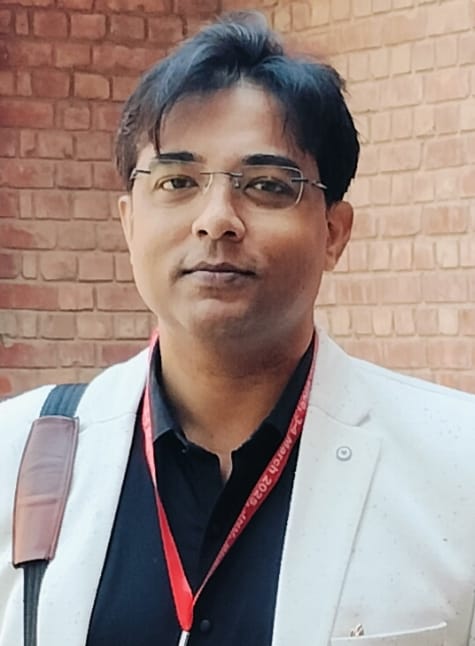
Dr Abhisek Karmakar is an Associate Professor in the Department of Political Science at Galsi Mahavidyalaya, West Bengal, India. He also teaches in Rabindra Bharati University as an ad-hoc faculty. He completed his MPhil and PhD at the University of Burdwan. His book, Making of a Democratic Intellectual Tradition in India, was published in 2019 from Germany and Mauritius. He has authored over 41 articles in international and national journals including UGC CARE listed journals. In 2025, his co-authored book Federal Thought, is set to be published as it is signed by Routledge. He edited Challenges to Democracy in South Asia (2021) and has co-edited three additional books. A regular contributor to major English dailies, Dr. Karmakar has participated in international conferences in Germany, Italy, South Korea and Bangladesh. He is a life member of several academic associations and frequently appears in electronic media as a political analyst.



