
By: Sanskriti Singh
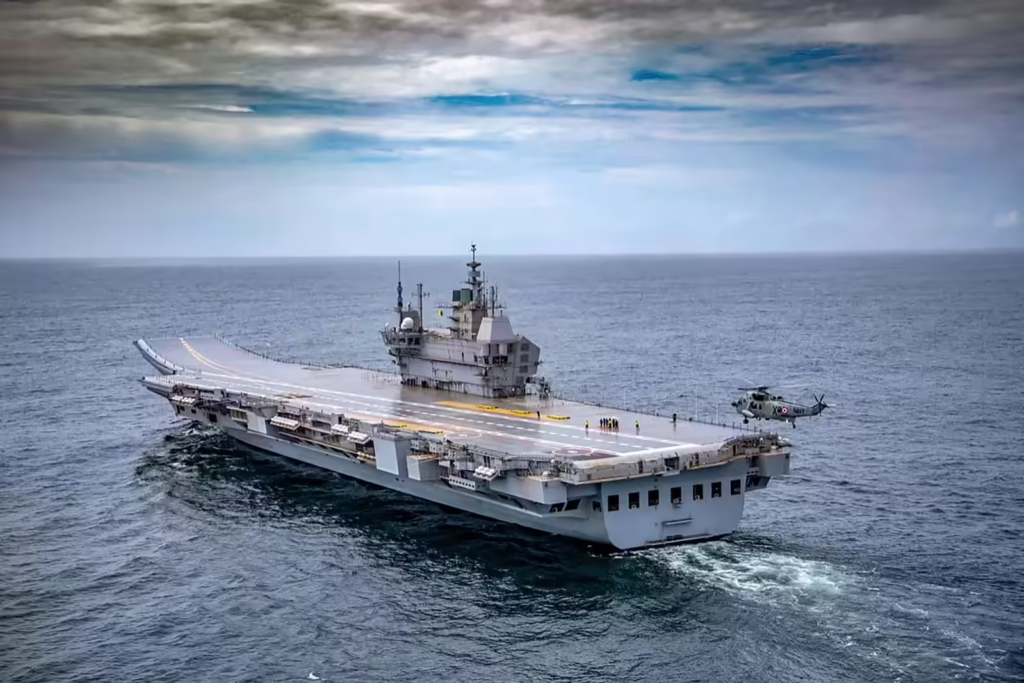
India is becoming a power on the sea in the twenty first century. This is because India is getting better at building its navy and making its own defence equipment. One big thing that happened was when India got its first home made aircraft carrier, which is called INS Vikrant on September 2 2022. This made Indias navy stronger. It also showed the world that India is good at technology and industry.
As it becomes more important to keep the sea safe in the Indian Ocean Region INS Vikrant is very important for India to protect its interests. INS Vikrant is a deal for Indias defence plan and it affects how safe the region and the world are. This article is, about how important INS Vikrant’s what role it plays in India’s defence strategy and what it means for the region and the world.
Background and Development of INS Vikrant
INS Vikrant, also known as Indigenous Aircraft Carrier 1, was designed and built by Cochin Shipyard Limited under the supervision of the Indian Navy. The project reflects India’s long-term commitment to achieving self-reliance in defence manufacturing under the “Atmanirbhar Bharat” initiative.
The construction of INS Vikrant began in 2009, and the vessel underwent extensive sea trials before its official commissioning. The aircraft carrier weighs approximately 45,000 tonnes and is capable of operating a diverse range of aircraft, including fighter jets and helicopters.
The successful completion of this project places India among a select group of countries capable of designing and constructing aircraft carriers domestically. This achievement significantly reduces India’s dependence on foreign suppliers and enhances its strategic autonomy.
Technical Capabilities and Features
INS Vikrant has lots of technologies that make it work better and fight better. It uses a system called Short Take-Off But Arrested Recovery. This system lets fighter planes take off from a ramp and land using wires that catch them.
The ship can carry 30 planes, like the MiG-29K fighter jets and some helicopters, including the Kamov-31 and MH-60R. These planes help the ship do lots of things such as defend itself from the air fight against submarines and watch out for things.
INS Vikrant is powered by four gas turbines and can go as fast as 28 knots. It can travel 7,500 nautical miles, which means it can work well in the whole Indian Ocean Region.
INS Vikrant also has some important things to help keep it safe. It has radar systems, special electronic warfare tools and close-in weapon systems to protect itself from missiles and attacks, from the air.
Strategic Importance in the Indian Ocean Region
Indian Ocean Region is considered to be one of the most important regions in the world in terms of maritime strategy and trade. The geographical location of India provides it with a competitive advantage in dominating this region, but it is also facing stiff competition from other regional powers, including China.
INS Vikrant will provide India with greater power projection capabilities in the Indian Ocean region and will also help in countering emerging threats in this region. The aircraft carrier will provide India with air supremacy in this region, even at a distance from the mainland.
The deployment of INS Vikrant will also provide India with greater deterrence capabilities. The deployment of this aircraft carrier will showcase India’s military prowess to other regional powers.
Economic and Industrial Impact
The construction of INS Vikrant has also been significant in terms of its economic and industrial impact. This project required more than 500 Indian companies to participate in its construction.
This has also resulted in the development of a strong defense industrial ecosystem in India and provided employment opportunities in different sectors. The success of INS Vikrant is also likely to give a boost to India’s defense exports.
The focus on indigenous production also fits in with India’s larger economic agenda.
Challenges and Future Prospects
However, India’s aircraft carrier development program is not without challenges. The first challenge is the high cost of building and maintaining aircraft carriers. Estimates indicate that future aircraft carriers could cost more than 8 billion dollars, making them a costly venture.
Moreover, the changing dynamics of war, including the development of missile technology and cyber warfare, pose a challenge. India will need to keep investing in modern defense technologies and innovative strategies to keep pace.
In the future, India is contemplating the development of a third aircraft carrier, which will further boost its naval power. The experience from the INS Vikrant development program will be crucial for future projects.
Conclusion
INS Vikrant represents a landmark achievement in India’s defence and technological journey. As the country continues to navigate a complex and evolving security environment, the aircraft carrier serves as a symbol of strength, self-reliance, and strategic ambition.
By enhancing its naval capabilities and investing in indigenous production, India is positioning itself as a key player in the Indian Ocean Region and beyond. INS Vikrant not only strengthens India’s defence posture but also reinforces its commitment to maintaining peace and stability in the region.



