
By: Sonalika Singh , Consulting Editor , GSDN
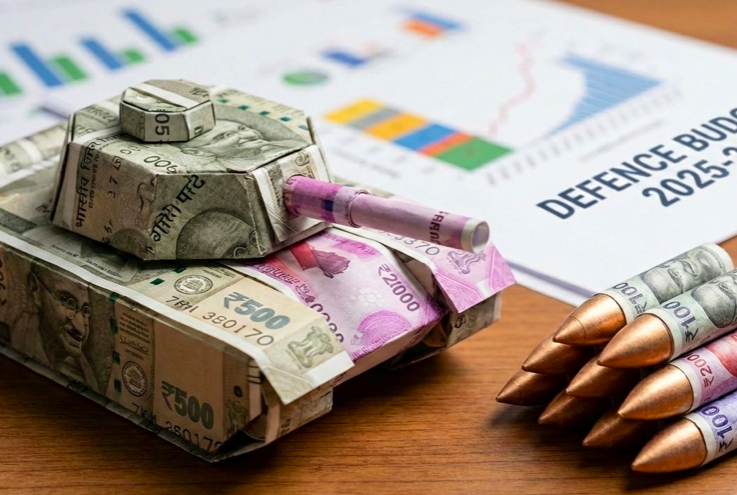
The Union Budget 2026–27 has accorded an unprecedented priority to national defence, allocating a historic ₹7.85 lakh crore (approximately US$93.5 billion) to the Ministry of Defence(MoD). This represents a 15.19 per cent increase over the previous year’s Budget Estimates (BE) of ₹6.81 lakh crore and accounts for nearly 14.67 per cent of total Union expenditure, the largest share commanded by any ministry. Since 2014, when defence allocations stood at roughly ₹2.29 lakh crore, India’s defence outlay has more than tripled, reflecting the Modi government’s sustained emphasis on military preparedness and strategic autonomy.
Yet the significance of this year’s budget extends beyond headline figures. The 2026–27 allocation is framed by the political leadership as a “post–Operation Sindoor” consolidation push. Operation Sindoor, described by the government as a historic military success, appears to have validated specific tactical investments particularly in airpower and precision-strike capabilities. At the same time, it exposed enduring structural weaknesses, including gaps in long-term force readiness, slow procurement cycles, and the persistent drag of manpower-heavy expenditure.
This budget must therefore be understood not merely as an accounting exercise but as a strategic document offering insight into India’s evolving threat perceptions and preparedness in an increasingly volatile neighbourhood. The notion of “collusive threats” from China and Pakistan has moved from theoretical planning to operational reality, demanding rapid capability accretion across multiple domains. Against this backdrop, a critical analysis of the defence budget reveals persistent tension between ambitious modernisation goals and unresolved structural constraints.
At an aggregate level, India’s defence expenditure remains anchored at approximately 2 per cent of GDP. While this marks a recovery from earlier declines, it continues to fall short of the 2.5–3 per cent benchmark repeatedly recommended by the Standing Committee on Defence and several Defence Secretary–led expert committees. In the aftermath of a major military operation, the inability or unwillingness to cross this threshold raises questions about the depth of India’s fiscal commitment to long-term military transformation.
The internal composition of the defence budget further highlights enduring challenges. Pay and allowances account for around 26.4 per cent of total allocations, while defence pensions consume another 21.84 per cent, amounting to ₹1.71 lakh crore. Combined, these heads absorb nearly half of overall defence spending, significantly constraining fiscal space for modernisation. Civil organisations under the MoD receive 3.64 per cent, leaving capital and operational expenditure to compete within a tightly bounded envelope.
Although capital expenditure has grown substantially, the broader structure continues to reflect a manpower-intensive force model inherited from earlier decades. Without deeper reformsparticularly in pension liabilities, the budgetary system risks perpetuating a cycle in which modernisation gains remain incremental rather than transformational.
The most consequential feature of the 2026–27 defence budget is the sharp rise in capital expenditure, which stands at ₹2,19,306.47 crore with an increase of 21.83 per cent over the previous year’s BE of ₹1,80,000 crore. Capital spending now accounts for roughly 27.95 per cent of the total defence allocation, underscoring the government’s intent to prioritise capability development over mere force sustenance.
A granular examination of capital outlay reveals a deliberate tilt towards technology-intensive force multipliers rather than platform-heavy expansion. The largest share continues to be allocated to “Other Equipment,” which has risen from ₹63,099.03 crore in the 2025–26 BE to ₹82,217.82 crore in 2026–27, an increase of over 30 per cent. This head covers a wide spectrum of assets, including electronic warfare systems, radars, drones, loitering munitions, and digitisation tools critical for network-centric warfare.
Spending on aircraft and aeroengines has also witnessed a significant increase, rising to ₹63,733.94 crore from ₹48,614.06 crore in the previous BE an increase of nearly 31 per cent. Although the 2025–26 revised estimates had temporarily pushed spending beyond ₹72,000 crore, the 2026–27 BE establishes a high and stable baseline for sustained airpower modernisation. This allocation is crucial for maintaining operational readiness following Operation Sindoor and for advancing long-pending acquisition programmes such as the 114 Multi-Role Fighter Aircraft (MRFA).
Naval modernisation, while steady, appears comparatively restrained. The Navy has allocated ₹25,023.63 crore for fleet modernisation, marginally higher than the ₹24,390.95 crore in the previous BE. While modest in absolute terms, this funding remains strategically significant given India’s expanding maritime responsibilities and the growing presence of adversarial naval assets in the Indian Ocean Region.
Research and Development (R&D) has received ₹17,250.25 crore under the capital head, up from ₹14,923.82 crore in the 2025–26 BE. In addition, the Defence Research and Development Organisation (DRDO) has been allocated a total budget of ₹29,100 crore, with ₹17,200 crore earmarked for capital expenditure. This sustained increase reinforces the government’s emphasis on indigenous technology development under the Atmanirbhar Bharat initiative.
The allocation patterns in the 2026–27 budget reflect direct lessons drawn from recent operational experience. The sharp increase in aircraft and aero-engine funding signals recognition of the decisive role played by air superiority, electronic warfare, and standoff-strike capabilities during Operation Sindoor. Investments in airborne early warning systems, beyond-visual-range missiles, and advanced electronic warfare suites aim to preserve escalation of dominance in future contingencies.
Similarly, the emphasis on “Other Equipment” underscores the military’s shift towards digitisation and enhanced situational awareness. Drones, battlefield sensors, and integrated command-and-control systems are increasingly central to operations across high-altitude, desert, and maritime environments. For the Army, these investments are particularly relevant in addressing challenges along the northern borders, where terrain and logistics impose severe operational constraints.
Maritime deterrence remains another key concern. Although the Navy’s capital allocation has risen only marginally, it supports critical long-term projects such as Project 75(I), which aims to induct six advanced submarines equipped with air-independent propulsion systems. In an environment marked by China’s expanding naval footprint and growing undersea activity in the Indian Ocean, these capabilities are essential for maintaining credible deterrence.
A defining feature of the 2026–27 budget is its attempt to energise India’s defence industrial ecosystem, particularly through enhanced participation by domestic firms. Approximately 75 per cent of the capital acquisition budget around ₹1.64 lakh crore has been earmarked for procurement from Indian companies, including private sector entities. This reflects a sustained policy commitment to indigenisation and reduced import dependence.
The imminent signing of the ₹70,000 crore-plus Project 75(I) submarine contract with Germany’s ThyssenKrupp Marine Systems exemplifies this approach. While the project involves foreign collaboration, it mandates indigenous content levels starting at 45 per cent and rising to 60 per cent over time. Indian shipyards such as Mazagon Dock Shipbuilders Limited stand to benefit, along with hundreds of MSMEs integrated into global supply chains for sensors, spares, and sub-systems.
In aerospace, customs-duty exemptions on raw materials for aircraft Maintenance, Repair, and Overhaul (MRO) represent a strategically significant reform. As the Indian Air Force’s fleet expands particularly with the induction of new fighter platforms domestic MRO capacity becomes critical for reducing downtime during crises. Collaborations such as Safran’s proposed MRO facility for M88 engines in Hyderabad signal growing confidence in India’s aerospace ecosystem.
Emerging technologies also feature prominently. The induction of weaponised unmanned interceptor craft developed by private firms under the iDEX framework highlights the growing role of start-ups in addressing niche operational requirements, particularly in coastal and maritime security.
Despite the scale of India’s defence budget, comparative analysis underscores the severity of its strategic challenge. China’s estimated defence spending of approximately US$374 billionnearly four times India’s translates into significantly greater acquisition power, particularly in advanced technologies such as hypersonic weapons, space systems, and artificial intelligence. Pakistan, while far behind in absolute terms, continues to offset asymmetries through targeted acquisitions, including Turkish drones and Chinese aircraft.
India’s challenge, therefore, is not merely to outspend individual adversaries but to balance resources across two geographically distinct theatres. This reality stretches procurement priorities thin and places a premium on efficient allocation, technological leverage, and rapid decision-making.
Six years after its introduction, the Defence Acquisition Procedure (DAP) 2020 presents a mixed record. While it has successfully prioritised domestic procurement and reduced outright imports, it has also revealed significant inefficiencies.
The prolonged gestation of Project 75(I) illustrates these shortcomings. Conceived over two decades ago, the project took nearly six years under DAP 2020 to reach the contract-signing stage. In an era characterised by rapid technological change, procurement cycles spanning 15–20 years risk delivering platforms that are operationally dated upon induction.
Moreover, the emphasis on negative import lists has occasionally resulted in capability gaps, where foreign options are excluded before indigenous alternatives are fully mature. While programmes such as the Light Combat Helicopter and the Advanced Medium Combat Aircraft are strategically vital, over-reliance on future indigenous deliveries carries near-term operational risks.
Export promotion remains another weak link. Although domestic manufacturing capacity has expanded, explicit budgetary support for defence exports remains opaque. To emulate countries such as Turkey whose drone exports have reshaped regional power balances India must provide stronger incentives for private-sector R&D and faster certification pathways.
A critical imbalance persists in the allocation of resources between public sector undertakings and private industry. Investment in Defence Public Sector Undertakings remains at ₹1,494 crore, while combined assistance for prototype development under “Make” procedures for the Army and Air Force stands at just ₹1,707.81 crore. This disparity limits the private sector’s ability to undertake long-term, high-risk R&D.
For India’s defence industrial ecosystem to mature, private firms must be treated as strategic partners rather than peripheral vendors. This entails sharing R&D risk, offering stable long-term contracts, and rewarding innovation and speed rather than procedural compliance. Rationalising revenue expenditure particularly pensions would further free fiscal space for technology-driven solutions where private industry excels.
The Union Budget 2026–27 represents a calibrated effort to consolidate military gains following Operation Sindoor while addressing select capability gaps in airpower, maritime deterrence, and battlefield digitisation. The sharp rise in capital expenditure and the emphasis on indigenous procurement signal a clear strategic intent to modernise India’s armed forces.
However, the budget stops short of the structural transformation required to fully align India’s military posture with its strategic ambitions. Persistent manpower costs, slow procurement cycles, and limited private sector incentivisation continue to constrain modernisation outcomes. With defence spending hovering around 2 per cent of GDP, India risks pursuing a “more with less” approach in an era where adversaries are rapidly scaling technological capabilities.
Ultimately, state-funded capital expenditure alone cannot deliver the military transformation India seeks. Without decisive reforms to pension liabilities, procurement processes, and private-sector participation, India may continue to punch below its weight in the global hard-power equation, despite impressive headline numbers. Yet the trajectory is not without a promise. The steady rise in capital allocations, growing confidence in indigenous platforms, and the gradual opening of the defence ecosystem to private industry indicate that the foundations for long-term transformation are being laid. If complemented by sustained fiscal commitment, procurement reform, and deeper public–private collaboration, India is well positioned to translate its economic strength and technological ambition into credible, multidomain military power in the decade ahead.

About the Author
Sonalika Singh began her journey as an UPSC aspirant and has since transitioned into a full-time professional working with various organizations, including NCERT, in the governance and policy sector. She holds a master’s degree in political science and, over the years, has developed a strong interest in international relations, security studies, and geopolitics. Alongside this, she has cultivated a deep passion for research, analysis, and writing. Her work reflects a sustained commitment to rigorous inquiry and making meaningful contributions to the field of public affairs.



