
By: Khushbu Ahlawat, Consulting Editor, GSDN
Introduction
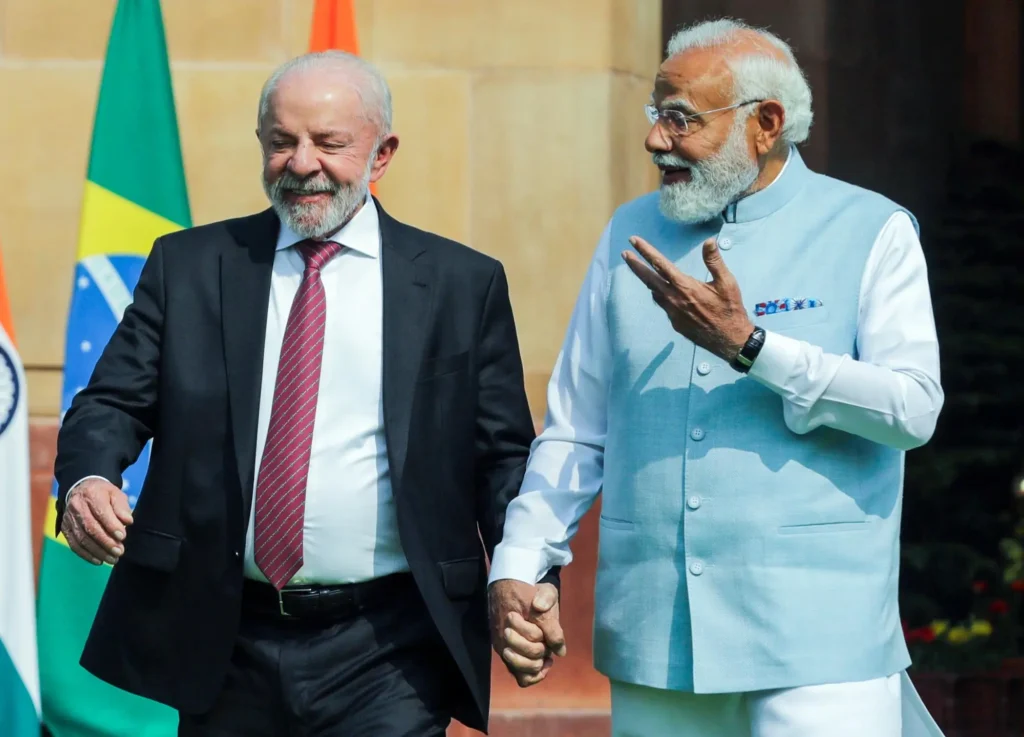
Brazilian President Luiz Inácio Lula da Silva’s recent remarks during his visit to India have reignited a fundamental debate about global trade governance, power asymmetry, and the future of the Global South. At a time when protectionism is resurfacing in major economies and unilateral tariff measures are increasingly deployed as instruments of geopolitical leverage, Lula’s statement that “small countries negotiating individually with bigger ones always lose” captures a widening frustration among developing nations. His call for collective bargaining rather than fragmented negotiations is not merely rhetorical; it signals a deeper structural realignment underway in global economic diplomacy.
The context of Lula’s intervention is critical. The resurgence of tariff wars—particularly linked to U.S. protectionist cycles—has reshaped global supply chains and injected uncertainty into trade regimes. For countries such as Brazil and India, which are major emerging economies yet remain vulnerable to shifts in Western policy, tariff escalation presents both economic and political risks. Lula’s proposal that nations of the Global South act together in negotiations reflects an attempt to rebalance global trade power dynamics through coalition-building platforms such as BRICS, G20, and expanded South-South cooperation frameworks.
This article examines the strategic meaning behind Lula’s position, situating it within Brazil’s trade diplomacy, India–Brazil relations, BRICS politics, U.S.–Global South tensions, and the broader transformation of multilateral trade governance. It argues that Lula’s stance is not a tactical reaction to immediate economic pressures but part of a deeper recalibration of Brazil’s foreign policy identity in an era of geopolitical fragmentation. By privileging coalition-based engagement over bilateral vulnerability, Brazil seeks to expand its negotiating leverage while safeguarding developmental policy space.
The article also explores how Lula’s approach intersects with India’s own advocacy of strategic autonomy and reform of global institutions, highlighting areas of convergence and friction within BRICS. Furthermore, it situates Brazil’s posture within escalating U.S.–Global South tensions over tariffs, sanctions, and supply-chain security, demonstrating how trade has become increasingly securitized. Ultimately, the article contends that Lula’s trade philosophy reflects a broader shift from liberal globalization toward contested, multipolar economic governance—where middle powers leverage collective platforms to reshape the rules rather than merely comply with them.
Lula’s Trade Philosophy: Collective Bargaining over Bilateral Vulnerability
Lula’s trade philosophy is deeply rooted in both his personal political evolution and Brazil’s long-standing diplomatic tradition of strategic autonomy. Emerging from the labor movements that challenged Brazil’s military regime, Lula developed a worldview shaped by resistance to inequality and external dependency. During his first presidency (2003–2010), he strengthened South–South cooperation, expanded Brazil’s engagement with Africa and Asia, and helped institutionalize BRICS as a platform for emerging power coordination. The commodities boom of that era reinforced the belief that collective action among developing economies could rebalance global governance structures historically dominated by Western powers. For Lula, multilateralism is not ideological symbolism but a strategic instrument to amplify bargaining capacity and protect national development priorities.
Drawing lessons from the Latin American debt crisis and more recent U.S. tariff measures on Brazilian steel and aluminum, Lula argues that bilateral negotiations with economic superpowers expose mid-sized economies to structural asymmetry. His current approach prioritizes bloc-based engagement through BRICS and similar coalitions to reduce vulnerability to unilateral trade pressures and the securitization of economic policy. By promoting alternative financial mechanisms, local currency trade settlements, and diversified partnerships, Lula seeks to redefine economic sovereignty as diversified interdependence rather than isolation. In an era marked by great-power rivalry and economic weaponization, his philosophy positions collective bargaining as both a pragmatic shield against volatility and a pathway toward a more multipolar and inclusive global economic order.
India–Brazil Convergence: Strategic Partnership in an Uncertain Trade Environment
India–Brazil convergence is not a recent phenomenon but the product of two decades of structured engagement. Diplomatic relations between the two countries date back to 1948, yet the partnership gained strategic momentum in the early 2000s. During the leadership of Prime Minister Atal Bihari Vajpayee and President Lula’s first term (2003–2010), both sides institutionalized cooperation through the creation of the IBSA Dialogue Forum in 2003 and later through BRICS in 2009. These platforms were designed to amplify the collective voice of major democracies from the Global South, particularly in trade negotiations and development financing debates. The shared experience of navigating post-Cold War globalization—while managing domestic development imperatives—fostered a natural alignment in multilateral forums.
Over time, economic complementarities strengthened the political foundation. Bilateral trade, which was modest in the 1990s, expanded significantly during the commodities boom of the 2000s, laying the groundwork for today’s $15–16 billion trade relationship. Both countries faced similar challenges during episodes of global financial instability—most notably the 2008 financial crisis—reinforcing the importance of diversified trade partnerships and South–South economic resilience. Cooperation within the G20, especially during the global economic downturn, further consolidated coordination on financial regulation reform and development-oriented growth strategies.
In recent years, collaboration has broadened into new domains such as renewable energy, biofuels, climate governance, and digital public infrastructure. Brazil’s global leadership in ethanol production aligns with India’s push for cleaner energy transitions, while India’s digital public goods model—particularly in financial inclusion and identity systems—has generated interest in Brazil. Defense and space cooperation discussions reflect both countries’ desire to diversify partnerships beyond traditional Western suppliers and enhance strategic autonomy. In this broader historical arc, Lula’s visit symbolizes continuity in a partnership that blends developmental pragmatism with geopolitical ambition, positioning India and Brazil as coordinated voices in an increasingly fragmented global trade order.
BRICS and the Architecture of Economic Counterbalance
Lula’s call for collective bargaining is deeply intertwined with the evolution of BRICS as a geopolitical and economic platform. Originally coined as “BRIC” in 2001 by Goldman Sachs economist Jim O’Neill to describe high-growth emerging economies, the grouping became institutionalized with its first leaders’ summit in Yekaterinburg in 2009 and expanded to include South Africa in 2010, transforming it into BRICS. From the outset, BRICS reflected dissatisfaction with Western dominance over global financial governance, particularly the IMF and World Bank, whose quota and voting structures were widely criticized as misaligned with contemporary economic realities. The aftermath of the 2008 global financial crisis strengthened this perception, as emerging economies bore spillover costs from instability originating in advanced markets. The creation of the New Development Bank (NDB) in 2014 and the Contingent Reserve Arrangement (CRA) marked concrete efforts to build alternative financial safety nets and development financing channels with fewer political conditionalities. Over time, annual summits expanded cooperation into areas such as health, digital economy, counterterrorism, and energy security. The bloc’s recent expansion to include Saudi Arabia, Iran, Egypt, Ethiopia, and the UAE significantly enhances its demographic, energy, and geopolitical weight, strengthening its claim to represent a broader Global South constituency and increasing its leverage in debates over trade and development governance.
In trade diplomacy, BRICS increasingly functions as a coordination platform against unilateral tariff pressures and financial coercion. Debates over local currency trade settlements and reduced reliance on the U.S. dollar gained traction following sanctions episodes on Russia and secondary sanctions affecting other economies, which exposed vulnerabilities in dollar-centric systems and cross-border payment networks such as SWIFT. Finance ministers and central bank governors within BRICS have intensified consultations on payment connectivity, credit rating alternatives, and development finance expansion. While internal divergences—particularly between India and China—limit full cohesion, and economic asymmetries persist between commodity exporters and manufacturing powerhouses, members share an interest in resisting securitized trade policies framed under national security justifications. Lula’s emphasis on collective negotiation aligns with this trajectory: tariff disputes are framed not as isolated bilateral tensions but as structural imbalances in global economic governance that require coordinated institutional responses. Despite challenges of asymmetry, geopolitical rivalry, and policy divergence within the bloc, BRICS remains a strategic hedge—an evolving architecture through which emerging economies seek greater bargaining power, financial resilience, and a more multipolar trade order.
U.S. Protectionism and the Reshaping of Trade Diplomacy
The resurgence of tariff politics in the United States—visible across successive administrations—has fundamentally altered global trade calculations. Beginning with the imposition of tariffs on steel and aluminum under Section 232 of the Trade Expansion Act and extending into broader strategic trade restrictions on China in sectors such as semiconductors, clean energy technologies, and advanced manufacturing, U.S. policy has increasingly linked trade to national security and domestic industrial revival. Even as rhetoric shifts between administrations, the structural emphasis on reshoring critical industries, reducing strategic dependencies, and protecting domestic employment has endured. Legislative measures such as the Inflation Reduction Act and the CHIPS and Science Act further institutionalized industrial policy tools, combining subsidies with trade preferences to incentivize domestic production. For emerging economies, this continuity signals that protectionism is no longer episodic but embedded within American economic statecraft. As a result, global markets face heightened unpredictability, with trade flows shaped not solely by comparative advantage but by geopolitical alignment and strategic competition.
For countries such as Brazil and India, the implications are significant. Export-dependent industries—from agriculture and steel to pharmaceuticals and technology components—can be exposed to sudden tariff barriers or regulatory restrictions. Supply chains are increasingly reorganized through “friend-shoring” and “near-shoring,” privileging political alliances over cost efficiency, thereby narrowing opportunities for non-aligned economies. Moreover, retaliatory cycles risk disadvantaging middle powers that lack the economic scale to impose equivalent countermeasures, particularly when disputes spill into multilateral forums such as the WTO, whose dispute resolution mechanisms have weakened in recent years. Lula’s critique therefore addresses structural asymmetry rather than individual administrations: smaller economies negotiating alone with a major power face inherent leverage deficits. Yet Brazil and India must pursue calibrated hedging rather than confrontation, deepening Global South coordination through BRICS and the G20 while preserving diversified trade engagement with the United States and Europe to avoid strategic isolation and economic retaliation.
Conclusion
President Luiz Inácio Lula da Silva’s intervention during his India visit ultimately reflects more than a critique of tariff politics—it signals a structural shift in how middle powers interpret sovereignty, vulnerability, and leverage in the 21st-century global economy. His assertion that smaller countries lose when negotiating individually with larger powers distills a central dilemma of contemporary trade governance: asymmetry has become embedded not only in market size but in the ability to weaponize finance, technology, and supply chains. In this context, coalition-building is not a rhetorical flourish of South–South solidarity but a strategic recalibration aimed at redistributing negotiating power in an era of securitized interdependence.
The transformation underway is not a simple binary between protectionism and free trade. Rather, it marks the erosion of the liberal multilateral consensus that characterized the post-Cold War decades. As tariff measures, export controls, and industrial policy instruments proliferate, trade diplomacy increasingly overlaps with strategic competition. Institutions designed to mediate disputes and preserve predictability face credibility challenges, while national security exemptions expand the policy space of major powers. For countries such as Brazil and India, whose developmental trajectories depend on external markets yet whose autonomy remains politically non-negotiable, this environment demands calibrated adaptation rather than ideological alignment. Within this shifting terrain, platforms like BRICS emerge as instruments of hedging. They do not replace engagement with Western economies, nor do they constitute a cohesive counter-bloc. Instead, they provide negotiating ballast—mechanisms through which emerging powers can diversify financial channels, coordinate responses to trade pressures, and incrementally influence rule-setting debates. The strategic logic is clear: collective weight mitigates bilateral vulnerability. Yet the effectiveness of such coordination will depend on internal coherence, the management of intra-bloc rivalries, and the capacity to translate political signaling into institutional innovation.
For India–Brazil relations, Lula’s articulation of collective bargaining reinforces an evolving partnership anchored in shared developmental priorities and strategic autonomy. Both states seek reform, not rupture—greater voice within existing institutions alongside parallel efforts to strengthen alternative platforms. The challenge lies in sustaining equilibrium: balancing Global South coordination with continued integration into Western markets and value chains.
Ultimately, Lula’s trade philosophy encapsulates a broader inflection point in global governance. As globalization fragments into competing spheres of influence and economic nationalism gains legitimacy, middle powers are redefining agency through coalition diplomacy. Whether this recalibration produces a more equitable multipolar order or merely a more complex arena of contestation will depend on how effectively these coalitions convert shared grievances into durable institutional reforms. In that uncertainty lies both the risk and the promise of the emerging trade order.

About the Author
Khushbu Ahlawat is a research analyst with a strong academic background in International Relations and Political Science. She has undertaken research projects at Jawaharlal Nehru University, contributing to analytical work on international and regional security issues. Alongside her research experience, she has professional exposure to Human Resources, with involvement in talent acquisition and organizational operations. She holds a Master’s degree in International Relations from Christ University, Bangalore, and a Bachelor’s degree in Political Science from the University of Delhi.



