
By:Sonalika Singh, Consulting Editor, GSDN
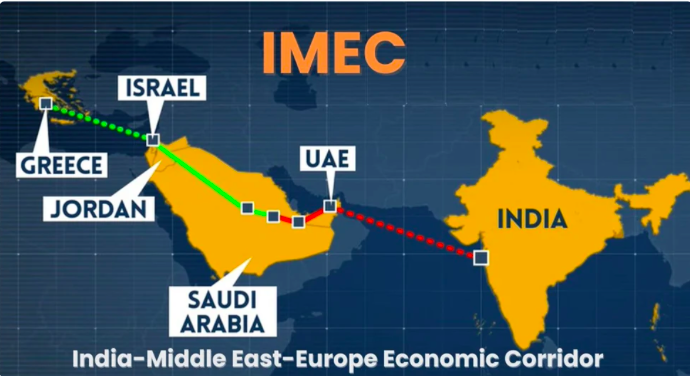
The India–Middle East–Europe Economic Corridor (IMEC), unveiled during the G20 Summit in New Delhi in September 2023, was envisioned as a transformative transcontinental initiative designed to reshape global trade, connectivity, and economic cooperation. Conceived as a multi-modal network integrating ports, railways, shipping lanes, energy pipelines, and digital infrastructure, IMEC aimed to connect India with Europe via the Gulf region, offering a faster, more efficient, and strategically diversified alternative to traditional maritime routes such as the Suez Canal. Nearly three years since its announcement, the corridor remains one of the most ambitious infrastructure projects of the 21st century, yet its progress reflects a complex interplay of geopolitical realities, economic constraints, and evolving strategic priorities. The status of IMEC is best understood as a project in transition neither stalled nor fully operational, but gradually evolving through phased development, regional leadership, and adaptive strategies.
At its core, IMEC represents a convergence of strategic interests among its founding members India, the United States, Saudi Arabia, the United Arab Emirates, France, Germany, Italy, and the European Union. The corridor is structured around two principal segments: the Eastern Corridor linking India to the Gulf, and the Northern Corridor connecting the Gulf to Europe via rail and maritime networks. The initiative is embedded within the broader framework of the Partnership for Global Infrastructure and Investment (PGII), a G7-led effort aimed at addressing global infrastructure gaps through sustainable and transparent financing mechanisms. From the outset, IMEC was positioned not merely as a connectivity project but as a geopolitical and economic statement an alternative model to existing infrastructure paradigms, particularly China’s Belt and Road Initiative.
However, the trajectory of IMEC since its launch has been shaped significantly by external disruptions. The most immediate and consequential setback emerged from the escalation of conflict in West Asia, particularly the Israel–Hamas war beginning in late 2023. This conflict directly affected the viability of the Northern Corridor, which relies on political stability and cooperation across countries such as Saudi Arabia, Jordan, and Israel. The deterioration of diplomatic normalization efforts in the region, which had been a foundational assumption for IMEC’s design, introduced uncertainty into project timelines and investor confidence. As a result, progress on key segments of the corridor slowed, and the project entered a phase of strategic recalibration.
Despite these challenges, IMEC has not lost momentum entirely. Instead, its development has become more regionally concentrated and incrementally structured. One of the most notable areas of progress has been the strengthening of bilateral and trilateral frameworks among key stakeholders, particularly between India and the United Arab Emirates. The signing of the Intergovernmental Framework Agreement (IGFA) between these two countries marked a significant step toward operationalizing elements of the corridor. This agreement focuses on building a joint logistics platform, enhancing digital connectivity, and streamlining supply chain processes. It reflects a pragmatic approach to IMEC’s implementation, prioritizing segments that are politically stable and economically viable while deferring to more complex components.
Parallel to diplomatic efforts, there have been tangible developments in infrastructure planning and early-stage construction. By 2025, groundwork had begun on select components of the corridor, including port upgrades, logistics hubs, and preliminary rail link planning in the Gulf region. These developments are closely aligned with national economic strategies of Gulf countries, particularly Saudi Arabia’s Vision 2030 and the UAE’s Operation 300bn. Both countries have leveraged IMEC as an extension of their domestic transformation agendas, investing heavily in port modernization, industrial zones, and digital infrastructure. This alignment has effectively positioned the Gulf region as the operational nucleus of IMEC, even as broader geopolitical uncertainties persist.
The role of Gulf economies in sustaining IMEC’s progress cannot be overstated. The UAE and Saudi Arabia, situated at the geographic center of the corridor, have emerged as key drivers of its development. Their sovereign wealth funds, including entities such as Mubadala, ADQ, and the Public Investment Fund, have increased investments in logistics, energy, and technology sectors that are integral to IMEC’s vision. These investments are not merely preparatory but transformative, aiming to convert the region from a transit hub into a production and innovation ecosystem. Industrial zones such as Khalifa Industrial Zone Abu Dhabi (KIZAD) and King Abdullah Economic City are being developed as integrated nodes that combine manufacturing, logistics, and digital capabilities, thereby embedding IMEC within broader economic diversification strategies.
Another critical dimension of IMEC’s status is the advancement of its digital and energy components. Unlike physical infrastructure, which is more susceptible to geopolitical disruptions, digital connectivity projects have progressed with relatively fewer constraints. Plans for undersea data cables, cross-border data centers, and digital trade platforms are moving forward, supported by the Gulf’s investments in artificial intelligence and cloud infrastructure. Similarly, the corridor’s energy ambitions, particularly in green hydrogen and renewable energy, have gained traction. Projects aimed at linking renewable energy grids and facilitating cross-border energy trade are being explored, with initiatives such as the proposed India-UAE undersea electricity interconnector reflecting the corridor’s long-term vision of sustainable energy integration.
Financial considerations remain a central challenge in IMEC’s implementation. The corridor is estimated to require substantial investment, with broader PGII targets aiming to mobilize up to $600 billion by 2027. However, the absence of a clearly defined financial roadmap and cost-sharing mechanism among participating countries has slowed progress. High global interest rates, economic uncertainty, and competing investment priorities have further complicated funding efforts. In response, there has been a growing emphasis on leveraging public-private partnerships, sovereign wealth funds, and multilateral development banks to bridge financing gaps. The involvement of institutions such as the World Bank and the European Union’s Global Gateway initiative is expected to play a crucial role in mobilizing resources and ensuring project viability.
The interplay between geopolitical dynamics and economic considerations continues to shape IMEC’s trajectory. Trade tensions, particularly between India and the United States, have introduced additional complexities. The imposition of tariffs and shifts in trade policy have affected investor sentiment and delayed certain collaborative initiatives. At the same time, strategic cooperation in areas such as defense and technology has remainedintact, highlighting the nuanced nature of bilateral relationships within the corridor’s framework. This duality underscores the importance of selective cooperation and targeted policy adjustments in sustaining IMEC’s progress.
From a broader perspective, IMEC’s status reflects a shift from a grand, unified vision to a more modular and adaptive approach. Instead of pursuing simultaneous development across all segments, stakeholders are focusing on achievable milestones that build credibility and momentum. This phased strategy involves prioritizing politically stable routes, advancing digital and energy projects, and gradually expanding the corridor’s scope as conditions improve. The emphasis on incremental progress is not a retreat from ambition but a recognition of the complexities inherent in transnational infrastructure projects.
The competitive landscape also influences IMEC’s development. Established trade routes such as the Suez Canal continue to dominate global shipping due to their reliability and cost-effectiveness. While IMEC promises significant reductions in transit time and logistics costs, these benefits remain contingent on full operationalization. In the interim, the corridor is being positioned as a complementary route rather than a direct replacement, offering diversification and resilience in global supply chains. This strategic positioning is particularly relevant in the context of recent disruptions, such as the Suez Canal blockage in 2021 and ongoing instability in maritime routes, which have highlighted the need for alternative pathways.
Institutional mechanisms and governance structures are emerging as critical components of IMEC’s implementation. Discussions around establishing a dedicated IMEC Secretariat, sector-specific task forces, and a global corridor forum indicate a growing recognition of the need for coordinated planning and execution. Think tanks, financial institutions, and industry stakeholders are increasingly being involved in shaping the corridorroadmap, conducting feasibility studies, and addressing regulatory challenges. These efforts aim to create a cohesive framework that aligns diverse national interests while ensuring operational efficiency.
Looking ahead, the timeline for IMEC’s full realization remains uncertain but not indefinite. Analysts suggest a phased recovery and development trajectory spanning the latter half of the decade. The period between 2025 and 2026 is expected to focus on stabilization and foundational investments, particularly in the India-Gulf segment. The subsequent phase, extending to 2028, may see expanded multilateral participation and the scaling of logistics and energy projects. By the end of the decade, IMEC could evolve into a partially operational corridor, integrating physical, digital, and energy networks into a cohesive system.
Therefore, the status of the India–Middle East–Europe Economic Corridor reflects both the promise and the complexity of large-scale international infrastructure initiatives. While geopolitical disruptions and financial uncertainties have slowed down its initial momentum, the project continues to advance through targeted investments, regional leadership, and adaptive strategies. The Gulf region has emerged as the central engine driving progress, supported by evolving partnerships and incremental implementation. IMEC’s journey underscores the importance of resilience, flexibility, and sustained cooperation in navigating the challenges of global connectivity projects. As the corridor continues to take shape, its ultimate success will depend on the ability of its stakeholders to align strategic interests, mobilize resources, and maintain a long-term commitment to a shared vision of economic integration and sustainable development.

About the Author
Sonalika Singh began her journey as an UPSC aspirant and has since transitioned into a full-time professional working with various organizations, including NCERT, in the governance and policy sector. She holds a master’s degree in political science and, over the years, has developed a strong interest in international relations, security studies, and geopolitics. Alongside this, she has cultivated a deep passion for research, analysis, and writing. Her work reflects a sustained commitment to rigorous inquiry and making meaningful contributions to the field of public affairs.



