
By: Khushbu Ahlawat, Consulting Editor, GSDN
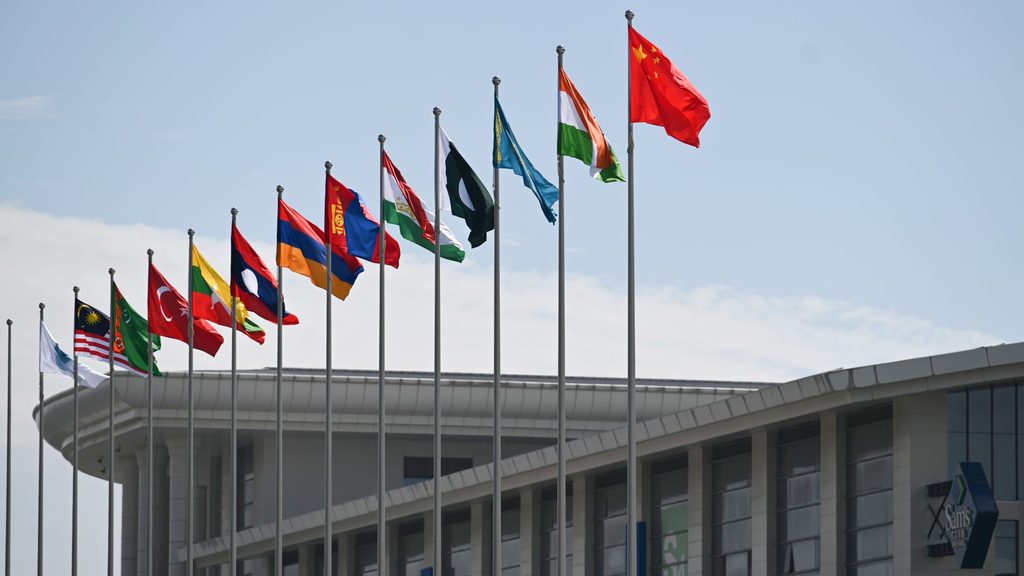
As the Shanghai Cooperation Organisation marks a quarter-century, its expanding security architecture and connectivity ambitions sit uneasily alongside an unresolved question: what, exactly, is the SCO for?
On paper, the numbers tell a story of an organisation in confident expansion. Ten full member states, a partner network stretching from the Gulf to Southeast Asia, three new security centres unveiled in a single year, and leaders publicly sketching agendas that run out to 2030 and beyond. When the Shanghai Cooperation Organisation convened its 26th Council of Heads of State meeting in Bishkek, Kyrgyzstan, on August 31 and September 1, 2026 — the summit marking the bloc’s 25th anniversary — the assembled leaders had every institutional reason to project momentum. What the summit could not paper over, however, was the organisation’s oldest and most persistent problem: an SCO that is very good at building new structures and considerably less good at getting its members to agree on what those structures should actually do.
A Smaller Room, A Bigger Agenda
The Bishkek summit was, by design and by necessity, a more modest gathering than the previous year’s leaders’ meeting in Tianjin, China — itself a lavish affair that had drawn extensive international attention. Eighteen heads of state and seven representatives of international organisations made the trip to Kyrgyzstan, a respectable turnout but a noticeably thinner one when set against the SCO’s own stated ambition of positioning itself as a central pillar of Eurasian multilateralism. The gap was most visible among the bloc’s “SCO Plus” partners — the loosely affiliated states from the Middle East, South Asia and Southeast Asia that engage with the organisation without committing to full membership obligations. A dozen of these partner states opted to skip Bishkek altogether. Notably, five of the six Gulf Cooperation Council monarchies holding SCO partner status — Bahrain, Kuwait, Qatar, Saudi Arabia and the UAE — sent no delegation at all, a telling signal that for Gulf capitals already managing their regional interests through the GCC and bilateral ties with Beijing, the SCO offers limited additional value, particularly with Iran now a full member and the Middle East itself gripped by continuing instability.
Prime Minister Narendra Modi led India’s delegation to Bishkek as part of a four-day visit to Central Asia that also took him to Uzbekistan, and used his address to reiterate a framework he had first articulated at the previous year’s Tianjin summit: a three-pillar approach built around Security, Connectivity and Opportunity. Where the 2025 iteration of this formula had been largely aspirational, Modi’s 2026 remarks pushed for the bloc to move “beyond vision towards concrete outcomes,” framing the anniversary as a moment to convert 25 years of dialogue into tangible deliverables for the next 25. His speech leaned heavily into counterterrorism messaging — a near-constant in India’s SCO interventions since the Pahalgam terror attack sharpened New Delhi’s insistence that the organisation abandon what it calls double standards in confronting cross-border terrorism — while also spotlighting technology, startups, youth engagement and civilisational dialogue as newer areas where India wants the grouping to build tangible programming. Concretely, India secured backing in the Bishkek Declaration for initiatives it had championed, including the formal adoption of English as an official SCO Charter language, a Civilisational Dialogue Forum, a Young Scientist Forum, and a Young Author’s Conclave — modest wins, but ones that expand India’s institutional footprint within a bloc historically dominated by the Russia-China axis.
Building Out the Security Architecture
If there is one domain where the SCO continues to institutionalise with real momentum, it is security — though even here, “institutionalise” is doing more work than “unify.” The Bishkek summit built on groundwork laid during China’s and Kazakhstan’s earlier chairships and formally unveiled three new security structures, each reflecting the organisation’s preference for a decentralised model in which specialised centres, spread across Central Asian capitals, handle discrete threat categories while notionally coordinating with one another.
The most significant of these is the Universal Centre for Countering Security Threats and Challenges, to be headquartered in Tashkent. It effectively absorbs and broadens the mandate of the SCO’s long-standing Regional Anti-Terrorist Structure, extending coverage beyond conventional terrorism into cyber threats, online radicalisation, and biological risk — an acknowledgment that the security threats Central Asian and South Asian states now face have outgrown the organisation’s original, narrower counter-terrorism remit from the early 2000s. Complementing it is a Centre for Combating Organised Crime in Bishkek, intended to coordinate law-enforcement cooperation across member states, and a dedicated Anti-Drug Centre in Dushanbe, targeting the narcotics trafficking routes that run through Afghanistan and into Central Asia and beyond. The throughline across all three is a coordination-without-centralisation model: each hub retains a specific mandate while, in theory, feeding operational intelligence into a shared network. Whether that theory survives contact with the SCO’s chronic difficulty in achieving consensus on what actually constitutes a shared threat remains, as with most SCO security initiatives, an open question.
Economic Ambition, Institutional Drift
Where the security track shows at least the appearance of forward motion, the SCO’s economic agenda tells a more halting story. The proposal for an SCO Development Bank — an idea that gathered visible momentum during the Tianjin summit and received another mention in the Bishkek Declaration — remains stuck in essentially the same place it was a year earlier. Fundamental questions of membership, capital contribution and governance structure remain unresolved, even as both Kyrgyzstan and Kazakhstan have separately signalled interest in hosting the eventual institution, adding a competitive wrinkle to an already slow-moving negotiation. For an organisation whose members include economies as disparate as China, India, Russia and some of the world’s smaller Central Asian states, agreeing on capital shares and lending priorities for a joint development bank was never going to be simple — but the repeated deferral suggests the political will to resolve those technical questions has not yet matched the rhetorical enthusiasm.
Artificial intelligence has emerged as a newer, and similarly contested, frontier of SCO economic cooperation. China has positioned itself as the driving force here, having hosted a major AI forum during its own 2025 chairship and now pushing member states to engage with the Shanghai-based World AI Cooperation Organization, which was formally established in July 2026 as a China-anchored platform for international AI governance. India’s response has been notably cautious. Rather than aligning with the Chinese-led initiative outright, New Delhi has articulated its own set of priorities for AI cooperation within the SCO framework — emphasising human capital development, broad-based access for social empowerment, system trustworthiness and energy efficiency, AI applications in scientific research, and the democratisation of AI resources for inclusive economic growth. The gap between Beijing’s institution-building instinct and India’s more principles-first, deliberately non-committal posture is emblematic of a wider pattern: even where SCO members agree a new domain deserves attention, they frequently diverge sharply on whose institutional architecture should host that cooperation.
Connectivity remains the SCO’s longest-running economic theme, and also its most geopolitically loaded. Kazakhstan’s President Kassym-Jomart Tokayev used the Bishkek platform to propose a Strategy for SCO Transport Connectivity extending to 2035, centred on digitalising cross-border transit through a unified platform that would harmonise customs procedures, transport documentation and information systems across member states — a genuinely ambitious piece of regional infrastructure diplomacy. But the strategy’s success depends on reconciling competing corridor visions that the SCO has never actually reconciled: China’s Belt and Road Initiative, Russia’s Middle Corridor interests, and the India-backed International North-South Transport Corridor all compete, rather than complement, in several of the same geographies. For New Delhi in particular, any push to fold these corridors into a single integrated Eurasian transport vision runs directly into India’s consistent objection to the Belt and Road Initiative’s China-Pakistan Economic Corridor component, which passes through Pakistan-administered Kashmir and which India regards as a violation of its territorial sovereignty — a redline India has restated at essentially every SCO gathering since it joined the bloc as a full member in 2017.
The Pakistan Factor and India’s Widening Calculus
Two developments from the Bishkek summit period deserve particular attention from an Indian strategic vantage point. First, the SCO chairmanship for the coming year passes from Kyrgyzstan to Pakistan, meaning Islamabad will host the 27th SCO summit and will, in that capacity, shape the organisation’s agenda-setting for 2027. For India, this raises a sensitivity that goes beyond the optics of Indian officials attending events on Pakistani soil; it extends to close scrutiny of how Islamabad frames security narratives — on terrorism, on Kashmir, on regional connectivity — while sitting in the chair’s seat. Given the unresolved and often acrimonious state of India-Pakistan relations, most recently strained further by the Pahalgam attack that Modi referenced in his own Bishkek remarks, the organisation’s internal cohesion is widely expected to face a renewed stress test through 2027.
Second, Pakistan has been actively courting Central Asian states as an alternative transit and trade partner, a push that has accelerated on the sidelines of SCO diplomacy itself. During bilateral talks held alongside the Bishkek summit, Pakistani Prime Minister Shehbaz Sharif offered Kyrgyz President Sadyr Japarov access to the ports of Karachi and Gwadar for landlocked Kyrgyzstan’s trade — with both sides notably acknowledging China’s “key role” in developing the regional transport corridors that would make such access viable. Earlier in 2026, Pakistan and Uzbekistan had separately agreed to expand transit trade routed through Chinese territory, explicitly aimed at reducing dependence on transit through Afghanistan. The strategic logic for Islamabad is twofold: position Pakistani ports as a rival gateway to the India-backed Chabahar port project in Iran, which New Delhi has championed precisely as a route into Central Asia and Afghanistan that bypasses Pakistan; and simultaneously squeeze the Taliban regime’s economic leverage by rerouting Central Asian trade away from Afghan territory. For India, which has invested diplomatic and financial capital in Chabahar and the International North-South Transport Corridor as strategic hedges against Pakistan-dependent routes, this quiet contest for Central Asian transit allegiance is arguably as consequential as anything discussed in the summit’s formal sessions.
Conclusion: An Organisation Still Searching for Its Centre of Gravity
Twenty-five years after its founding as a grouping focused narrowly on border security and counter-terrorism cooperation among China, Russia and the Central Asian republics, the SCO now finds itself administering an agenda that spans cyber security, organised crime, narcotics interdiction, artificial intelligence governance, continental transport corridors and civilisational dialogue forums — an extraordinary expansion in institutional scope for an organisation that still cannot fully resolve basic questions like who will capitalise its proposed development bank. The Bishkek Declaration’s own framing of the SCO entering “a new stage of its evolution” captures the ambition accurately; what it elides is that evolution, for this organisation, has consistently meant adding new structures faster than it resolves the underlying divergences between members — divergences that run from India’s redlines on the Belt and Road Initiative to the Gulf partners’ ambivalence about deeper involvement to the always-present strategic asymmetry between China’s institutional weight and everyone else’s.
For India specifically, the SCO functions less as a vehicle for consensus-driven regional integration and more as one arena among several — alongside BRICS, the G20, and its bilateral relationships — in which to advance a distinct set of priorities: counterterrorism accountability without double standards, connectivity built around routes like Chabahar and the INSTC rather than the BRI, and a cautious, values-based approach to emerging technology governance that resists simply adopting China’s institutional templates. As Pakistan prepares to assume the chair and Islamabad’s Central Asian courtship intensifies, the SCO’s next year is unlikely to resolve the tension between expanding ambition and persistent divergence that has defined its first quarter-century. If anything, 2027 may test that tension more severely than any summit since India and Pakistan both joined the bloc.



