
By: Sonalika Singh, Consulting Editor, GSDN
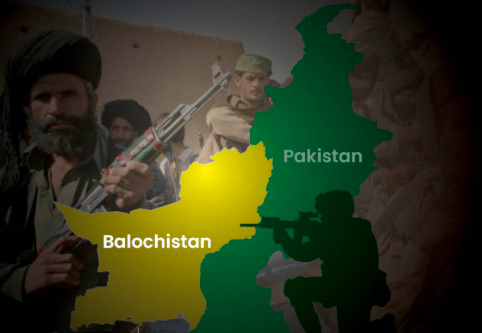
Balochistan, the largest yet least developed province of Pakistan, has once again emerged as the epicentre of violent unrest and political instability, raising a pressing question that, why is Balochistan “boiling” and what does it mean for Pakistan’s future? The province’s turmoil is not a sudden development but the culmination of decades of political marginalisation, economic exploitation, cultural anxieties, and militarised governance. Recent attacks, including the deadly bombing at Quetta Railway Station and the dramatic hijacking of the Jaffar Express, illustrate how deeply entrenched grievances have evolved into a persistent insurgency that challenges the authority of the Pakistani state. These incidents are not isolated acts of violence, but manifestations of a long-simmering conflict rooted in history, identity, and the struggle over resources.
On a cold winter morning in November 2024, nearly 100 passengers gathered at Quetta Railway Station to board the Jaffar Express bound for Rawalpindi. At approximately 8:25 a.m., a powerful explosion ripped through the station, killing 32 people and injuring around 60 others, most of whom were security personnel returning home on leave. Pakistani officials attributed the attack to a suicide bomber, and responsibility was later claimed by the Balochistan Liberation Army (BLA), an armed separatist group engaged in a protracted conflict with the Pakistani establishment. The attack formed part of a broader pattern of violence that has plagued the province for decades. Soon after, insurgents carried out a daring hijacking of the Jaffar Express in Balochistan’s mountainous terrain, taking nearly 400 passengers’ hostage, again including many security personnel. Although the Pakistan Army managed to secure the release of many hostages and later rescued about 190 individuals while killing all 33 insurgents, the militants executed 21 passengers. These incidents underscore the volatility of the region and the escalating sophistication of insurgent tactics.
To understand the roots of this unrest, one must examine Balochistan’s geography and historical evolution. Strategically located with Iran to the west and Afghanistan to the north, and boasting a 770-kilometre coastline along the Arabian Sea, Balochistan accounts for approximately 44 percent of Pakistan’s landmass. Despite its vast size and abundant natural resources, it remains sparsely populated and economically underdeveloped. The province is endowed with significant reserves of natural gas, coal, copper, gold, and other minerals that contribute substantially to Pakistan’s economy. Yet the local population continues to face poverty, inadequate infrastructure, and limited access to education and healthcare. This paradox immense wealth beneath the soil but persistent deprivation above it lies at the heart of Baloch grievances.
Ethnically, Balochistan is home to three major groups, the Balochs, the Brahuis, and the Pashtuns. The Balochs and Brahuis, often considered a single cultural grouping, form the largest ethnic bloc and lend the province its name. The people of Balochistan possess a strong cultural identity rooted in tribal traditions, literature, and a history of resistance and valor dating back centuries. Prior to colonisation, the region comprised numerous tribes frequently in conflict with one another. It was not until the eighteenth century that Nasir Khan, the sixth Khan of Kalat, unified these tribes under a central authority, establishing a unified army and administrative system that brought relative stability and prosperity to the region. The province then consisted of four princely states Kalat, Makran, Kharan, and Las Bela with Kalat as the largest and most influential.
This fragile unity was disrupted during British colonial rule, which employed a divide-and-rule strategy by weakening the authority of the Khan of Kalat and empowering tribal chiefs with financial and political incentives. This policy ensured that tribal divisions persisted, preventing unified resistance and enabling British control. When British India was partitioned in 1947, the princely state of Kalat initially declared independence under Mir Ahmad Yar Khan, reflecting widespread Baloch fears of political and cultural marginalisation within a Punjabi-dominated Pakistan. However, in 1948, the Pakistan Army marched into Kalat, compelling the Khan to sign the instrument of accession. His brother, Prince Karim, rejected this decision and launched an armed revolt, marking the first of several major conflicts between Baloch nationalists and the Pakistani state.
Since then, Balochistan has witnessed recurring insurgencies, each driven by demands for autonomy, equitable resource distribution, and cultural recognition. The conflict is fundamentally ethno-nationalist rather than religious, distinguishing it from other militant movements in Pakistan. Baloch fears extend beyond cultural erosion; they are acutely aware that their land contains vast natural resources capable of transforming Pakistan’s economy. This awareness has made resources control the focal point of conflict. Baloch leaders argue that the federal government extracts wealth from the province while investing little in local development, fostering a sense of internal colonialism.
The discovery of natural gas at Sui in 1953 exemplifies this grievance. Gas from Sui began supplying cities in Punjab, including Multan and Rawalpindi, in 1964, yet Quetta, the capital of Balochistan, did not receive gas until 1986. Such disparities reinforced perceptions that the province’s resources were being exploited for the benefit of other regions. Today, Balochistan’suntapped oil and gas reserves, along with its mineral wealth, continue to attract federal and international interest, intensifying local fears of displacement and marginalisation.
These anxieties have deepened with the development of Gwadar Port under the China–Pakistan Economic Corridor (CPEC), a flagship project of China’s Belt and Road Initiative. While initially welcomed as a potential catalyst for economic growth, CPEC has generated apprehension among locals due to land acquisitions, the establishment of military bases, and the influx of non-Baloch workers. Many residents fear becoming a minority in their own homeland, a demographic shift that could dilute their cultural identity and political influence. Insurgent groups, particularly the BLA, have capitalised on these fears, portraying CPEC as an exploitative venture that benefits outsiders at the expense of indigenous communities.
Founded in 2000, the Balochistan Liberation Army has emerged as the most prominent separatist organisation, advocating independence and accusing the Pakistani state of resource exploitation and political repression. The death of nationalist leader Nawab Akbar Bugti in 2006, coupled with the group’s designation as a terrorist organisation, served as a catalyst for intensified insurgent activity. Since then, the BLA has targeted military personnel, infrastructure, and Chinese-funded projects. In the past year alone, the group reportedly carried out more than 150 attacks, including the Quetta Railway Station bombing. The hijacking of the Jaffar Express marked a significant escalation, demonstrating enhanced coordination and tactical sophistication.
Experts warn that this escalation may indicate growing collaboration between Baloch insurgents, Sindhi militant organisations, and the Tehrik-i-Taliban Pakistan (TTP), raising the spectre of a broader militant nexus. The convergence of ethno-nationalist and Islamist militancy poses a complex security challenge for Pakistan, stretching military resources and complicating counterinsurgency efforts. The involvement of educated middle-class professionals and women in the insurgency further signals a shift from tribal resistance to a broader social movement, reflecting widespread frustration across different segments of society.
Human rights concerns have further inflamed tensions. Allegations of enforced disappearances, extrajudicial killings, and collective punishment by security forces are frequently reported by activists and families of missing persons. Protests in Quetta and other cities highlight demands for accountability and transparency. While the state denies systematic abuses, the lack of credible investigations fuels mistrust and reinforces the insurgents’ narrative of repression.
Socioeconomic underdevelopment remains a critical driver of unrest. Balochistan records Pakistan’s lowest literacy rates, highest infant mortality, and weakest infrastructure. Large areas lack basic amenities such as clean water, electricity, and paved roads. Youth unemployment is widespread, creating fertile ground for militant recruitment. Development projects often fail to deliver tangible benefits to local communities, reinforcing perceptions of exclusion and neglect.
Geopolitically, Balochistan occupies a strategic crossroads bordering Iran and Afghanistan and overlooking vital maritime routes near the Strait of Hormuz. Its location and resources attract international interest, particularly from China. Pakistan has accused foreign actors of supporting Baloch separatists, though such claims remain contested. Regardless of external influences, the internal drivers of unrest political exclusion, economic inequality, and heavy-handed security policies are widely acknowledged as the primary causes of instability.
Pakistan’s broader political and economic crises exacerbate the situation. Civil-military tensions, declining public trust in institutions, and economic distress limit the state’s capacity to address multiple security challenges. Instability in Balochistan threatens key economic assets, including energy projects and CPEC infrastructure, potentially undermining investor confidence and straining relations with China. Attacks on Chinese personnel have already raised concerns about the security of foreign investments.
The growing participation of women and urban youth in the insurgency underscores a profound social transformation. Once dominated by tribal fighters, the movement now reflects broader societal grievances. Female suicide bombers and student activists symbolise the depth of alienation and the widening appeal of resistance narratives. This evolution indicates that the conflict is no longer confined to remote tribal areas but has become a wider struggle over rights, identity, and resource control.
Despite repeated military operations, a purely coercive approach has failed to resolve the conflict. While security forces have neutralised militant leaders and disrupted networks, underlying grievances remain unaddressed. Each cycle of violence deepens mistrust and fuels further recruitment. Experts emphasise that sustainable peace requires political dialogue, equitable resource sharing, respect for human rights, and genuine provincial autonomy.
Balochistan’s instability also carries regional implications. Ethnic ties with Iran’s Sistan-Baluchestan province raise the risk of cross-border unrest, while insecurity along the Arabian Sea affects global energy routes. As great-power competition intensifies in the Indo-Pacific, the province’s stability will influence regional connectivity and strategic dynamics.
Ultimately, Balochistan is “boiling” because it encapsulates Pakistan’s structural contradictions, a resource-rich region plagued by poverty, a centralised state confronting demands for autonomy, and a security-first approach confronting political grievances. The persistence of insurgency reflects not only local discontent but also systemic governance failures. Without meaningful reforms, greater provincial autonomy, inclusive development, fair distribution of resource revenues, and accountability for human rights abuses, the cycle of violence is likely to continue.
For Pakistan, the stakes are extraordinarily high. Stability in Balochistan is essential for national integration, economic recovery, and regional credibility. Failure to address the province’s grievances risks entrenching insurgency, undermining strategic projects, and deepening political fragmentation. As Pakistan navigates economic challenges and political uncertainty, Balochistan stands as both a warning and a test, a warning of the consequences of exclusion and exploitation, and a test of whether the state can transform coercion into consensus and conflict into cooperation.

About the Author
Sonalika Singh began her journey as an UPSC aspirant and has since transitioned into a full-time professional working with various organizations, including NCERT, in the governance and policy sector. She holds a master’s degree in political science and, over the years, has developed a strong interest in international relations, security studies, and geopolitics. Alongside this, she has cultivated a deep passion for research, analysis, and writing. Her work reflects a sustained commitment to rigorous inquiry and making meaningful contributions to the field of public affairs.
Author



