
By: Prof. (Dr.) ML Meena and Ravi D. Bishnoi
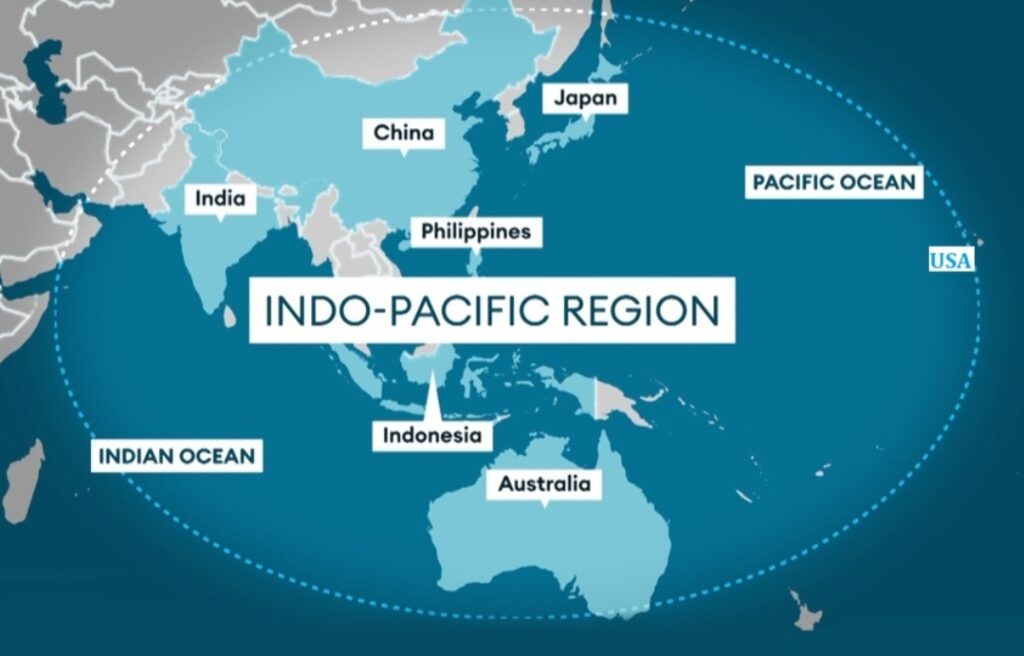
In recent years, geopolitical analysts have frequently framed the Indo-Pacific as a compelling geopolitical imagination shaping contemporary global strategy. You may have often heard about certain geopolitical imaginations that gradually become strategic realities, such as the idea at dawn in the South China Sea, naval vessels move silently across contested waters. Submarines glide beneath shipping lanes that carry trillions of dollars in global trade. Fighter jets conduct patrols near Taiwan. Undersea cables hum with digital traffic linking financial markets across continents. No formal war has been declared. Yet the Indo-Pacific feels increasingly like the front line of a slow, calculated strategic contest, because of Indo-Pacific is not just a map in contemporary global geopolitics. It became a new paradigm-based strategic idea.
This is the geopolitical setting in which the Quadrilateral Security Dialogue (QUAD) has re-emerged, not as a symbolic diplomatic forum, but as a maritime coordination mechanism responding to structural shifts in global power.
Now, it is important to understand that the Indo-Pacific is not simply a geographic label. It is a geopolitical construct born from strategic necessity. Geopolitics tells us that regions are not discovered randomly; they are imagined, framed or institutionalized. The Indo-Pacific is one such “strategic imagination.” It connects the Indian and Pacific Oceans into a single security continuum. This framing itself is a geopolitical act. It widens India’s security horizon to the east and extends the US strategic focus to the west. It places Southeast Asia at the centre of a new maritime arc.
Why did this framing become urgent?
Because power at sea has returned as the primary language of great power politics.
In the last decade, Chinese naval expansion has accelerated dramatically in this region. The People’s Liberation Army Navy (PLAN) now operates one of the world’s largest fleets. Artificial islands in the South China Sea have been equipped with airstrips, radar systems, and missile installations. Freedom of Navigation Operations by the United States continue regularly. Taiwan Strait tensions have intensified through frequent air and naval maneuvers. These developments have produced what International Relations scholars describe as a “security dilemma spiral”, where defensive moves by one actor are perceived as offensive threats by another.
In this environment, the QUAD’s revival in 2017 marked a strategic recalibration. Initially formed in 2007 and then fading into diplomatic silence, QUAD was once dismissed as fragile. Today, however, it has institutional momentum. Leader-level summits have become regular. Ministerial meetings are structured, and working groups address cybersecurity, critical technologies and maritime domain awareness. This shift from ad hoc dialogue to sustained coordination reflects a deeper geopolitical reality means Indo-Pacific competition is structural, not temporary.
Recent events reinforce this point. Last year, Exercise Malabar expanded its anti-submarine warfare components, reflecting growing undersea competition in the Indian and Western Pacific Oceans. We understand that Submarines are no longer peripheral assets only; they are central to deterrence strategy. Quiet propulsion systems, seabed sensors and anti-submarine patrol aircraft define the new maritime chessboard in this region. So, some geopolitical analysts increasingly speak of Undersea Geopolitics as the next frontier.
Simultaneously, the Indo-Pacific Partnership for Maritime Domain Awareness (IPMDA) has strengthened surveillance cooperation. Through satellite-based tracking, small island states can now monitor illegal fishing and suspicious maritime activity. This may appear non-military, but in strategic terms, it enhances transparency deterrence because when activities are visible, coercion becomes costlier.
The technological dimension is equally significant. When we see the recent techno-based phase, we have seen QUAD discussions expand into critical technology supply chains, semiconductor security, artificial intelligence governance and cyber resilience. Defence is no longer limited to ships and aircraft. It includes digital networks and data flows. In modern geopolitics, control over sea lanes must be matched by resilience in information lanes. This fusion represents a Techno-Maritime Convergence.
In parallel with QUAD, the AUKUS pact continues to reshape Indo-Pacific deterrence. Australia’s planned acquisition of nuclear-powered submarines increases the region’s undersea complexity. AUKUS focuses on hard military capability, while QUAD operates as a broader strategic coordination platform. Together, they create layered balancing, describe this as networked deterrence geopolitical imagination, where security is distributed across overlapping frameworks rather than concentrated in a single alliance.
India’s position within QUAD is particularly nuanced. Unlike treaty-bound allies, India preserves strategic autonomy. Its participation reflects balancing without alignment in the traditional Cold War sense. India’s naval modernization reinforces this posture. INS Vikrant’s operational status, expanded maritime patrol aircraft deployments, and enhanced logistics agreements with the United States and Australia extend India’s operational radius. These developments strengthen India’s capacity in the Indian Ocean Region, where extra-regional naval activity has increased steadily.
Classic geopolitician such as Alfred Thayer Mahan emphasized sea power as the foundation of national strength. Later, Nicholas Spykman’s Rimland theory argued that control over coastal fringes determines global balance. The Indo-Pacific today resembles a modern Rimland theatre, where maritime corridors determine economic and strategic influence. QUAD can thus be understood as a Rimland coordination mechanism responding to continental-maritime tension.
Yet the QUAD does not function as NATO. It has no mutual defence clause. It relies on voluntary convergence rather than treaty obligation. This flexibility is deliberate because it reduces escalation risks while preserving cooperation. Some critics argue that this loose structure limits credibility. Others counter that formalization would provoke sharper confrontation and alienate ASEAN states wary of bloc politics.
The economic dimension complicates matters further. China remains a major trading partner for many QUAD members. Supply chains are deeply intertwined. This interdependence produces Complex Interdependence, means economic ties reduce war probability but increase vulnerability. In this context, QUAD’s efforts to diversify supply chains represent strategic hedging rather than economic decoupling.
Recent developments highlight this hedging strategy. We see, Japan has increased defence spending and adopted counterstrike capabilities under its revised security strategy. Australia has strengthened its northern military infrastructure to host allied forces. The United States continues Freedom of Navigation patrols and expands access to basing in the Indo-Pacific. India deepens defence partnerships with Southeast Asian states while maintaining independent diplomatic engagement with major powers. Each state adapts within its own strategic culture, but alignment emerges through shared concern over maritime stability.
Looking ahead, three trends are likely to shape QUAD’s evolution. First, intensified undersea competition. Submarine fleets will grow. Seabed infrastructure protection will become central. Artificial intelligence-enabled sonar detection systems may transform anti-submarine warfare. This domain is quiet but decisive. Second, defence technology integration. AI-driven maritime surveillance, autonomous vessels, and cyber-maritime coordination will define next-generation deterrence. QUAD’s technology working groups may gradually evolve into defence innovation hubs. Third, distributed deterrence networks. Instead of relying solely on US dominance, regional powers will share surveillance burdens and operational readiness. This reduces over-dependence on any single actor while increasing collective resilience.
However, risks remain. Escalation in the Taiwan Strait would test QUAD cohesion. Economic retaliation strategies could strain domestic politics. Divergent threat perceptions among members may create hesitation in crisis scenarios. The absence of a binding military commitment means responses will depend on real-time political calculation.
Yet perhaps this ambiguity is part of the design. In an era of Managed Rivalry, overt alliances can harden divisions. Flexible coordination allows adaptation. The Indo-Pacific today is not divided into rigid blocs. It is shaped by overlapping alignments and cautious balancing. QUAD embodies this hybrid structure.
The larger question is whether QUAD stabilises or de-stabilises the region. From one perspective, coordinated deterrence reduces the likelihood of unilateral dominance. It reassures smaller states. It increases transparency. From another perspective, military exercises and strategic signaling may deepen the security dilemma. Politico-geo-realism reminds us that space is never neutral. Oceans are political spaces shaped by power projection and institutional frameworks. The Indo-Pacific has become the primary maritime theatre for negotiating global order.
In this unfolding contest, QUAD has moved beyond symbolism. It represents a maritime security arc linking the eastern coast of Africa to the Western Pacific. It does not promise automatic defence. QUAD’s trajectory suggests that maritime geopolitics has returned to the centre of global politics. The Indo-Pacific is the arena where great power competition is managed, calibrated, and constantly renegotiated, and in that arena, QUAD stands not as a rigid alliance but as a flexible instrument of balance in an age defined by uncertainty at sea.
Author



