
By: Rudraksh Saklani, Research Analyst, GSDN
The geopolitical discourse surrounding the eastern part of Europe has been nothing short of a roller coaster ride that our global village hadn’t signed up for. However, what’s also an equally stark piece of undeniable reality is that a faithful student and observer of international relations could see it coming through all along. The era of “Cold War 2.0” that has been obsessively centered around the tariff war between United States (U.S.) and China off late has a historical dimension that affects it greatly. The answer, like always, traces its roots in the events and reflections of the past. Within the background context of the Warsaw Pact that once shaped how the region came together and the fundamental subtext of the erstwhile Union of Soviet Socialist Republics (USSR), the region has had modern-day manifestations expressing themselves through various shifts in policy and practice.
Introductory perspective
As soon as the world was beginning to adjust to the post-Covid realities and making a pivot to the Orient, the latent European whirlwind of undercurrents resurfaced when Russia began what it calls its “special military operation” in Ukraine on February 24, 2022. Foreign affairs’ academics and analysts who were relying on the Minsk Agreement holding up and who viewed the Russian annexation of Crimea in 2014 as an aberration were confronted with the suddenness of the supply chain disruptions, oil politics and absolute worldwide chaos in the geo-economic scheme of things, that Europe in particular and the world in general had to begrudgingly brace for.
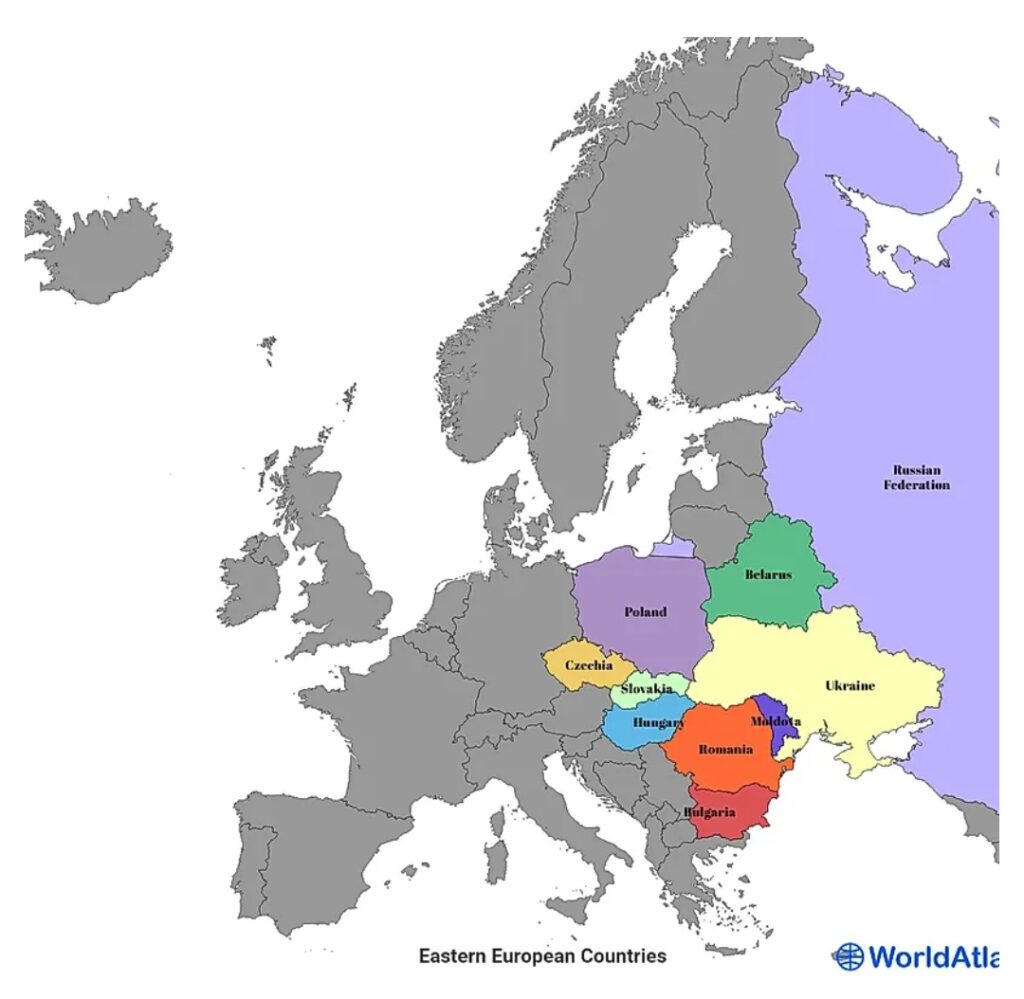
According to the United Nations’ (UN) definition, Eastern European countries entail Belarus, Bulgaria, Czechia, Hungary, Moldova, Poland, Romania, Russia, Slovakia, and Ukraine. Sometimes, for academic purposes, the Baltic Republics and the Balkan states are also considered as part of the region.
Another aspect that I would like to underscore is considering how in these polarising times, thanks to social media and newer ways and forms of misinformation, disinformation and information warfare, the Russian aggression in Ukraine has exposed the hypocrisy of the West and the vulnerability of the East, also raising alarm bells with reference to the Russian military’s supposed infallibility and Ukraine’s resilience. As the world, especially the Global South, finds itself in the middle of strict binaries, burdened with the obligation to pick a side, the Indian stance of strategic autonomy has come up differently and effectively, so to speak.
Historical backdrop
The geopolitical importance of Eastern Europe is rooted in the ground reality of it being the fluctuating frontier between empires and ideologies. It has existed for many centuries between the Germanic empire to its west and the realms of the Russians, Ottomans, and Byzantines to its east and south. The area faced almost constant invasions, partitions, and buffer zone political power games – from the Austro-Hungarian ruling setup and Ottoman periods all the way up until the two World Wars.
During the Cold War, it became the Socialist Second world-countries bloc, or more popularly known as the “Eastern Bloc” under Soviet sphere of influence, the frontline in the ideological battle against the West. Its transformation into democratic, market-oriented nations after 1991 ever since the disintegration of the USSR has turned it into a crucial bridge connecting Europe with Eurasia, energy routes, and access to the Black Sea.
Regional dynamics and their impact on rest of the world
As NATO enhances its eastern defense with “Operation Eastern Sentry,” bolstering Poland against Russia, Romania invests in a gunpowder factory reflecting its growing defense role, Bulgaria suspects Russian GPS interference, while Hungary issues a veto threat against Ukraine’s EU membership and Slovakia faces energy disputes post-Russian gas transit agreement expiration, the region has been experiencing such indicative developments one after the other.
There is a commonly felt urgency, now more than ever before, in the conversations all across the board regarding this need for an alternative world order not dominated and dictated by the whims and fancies of the West and also the subsequent de-dollarisation that is being actively considered by many after the weaponisation of dollar through sanctions and freezing of funds by the West. Not to forget, the number of civilian casualties that Ukraine has had to endure (for instance, the Bakhmut meat grinder) for a bone of contention that could have otherwise been averted through dialogue and discussion, had all the stakeholders cooperated transparently and behaved responsibly; not antagonizing.
It is equally important to not get too ahead of ourselves and remind ourselves that Eastern Europe’s geostrategic relevance goes beyond the Russia-Ukraine conflict, as much as many would want it that way, to get their military industrial complexes going. There are other countries in the region with equally complex concerns, aspirations, areas of convergence and discord too, and they deserve to be heard and their issues be discussed in multilateral forums. The limitations of North Atlantic Treaty Organization (NATO) & European Union (EU) have also opened up avenues and opportunities for a reset in these power balances, definitions of morality, limited wars, deterrence and nuclear thresholds.
Russia and Eastern Europe – historical ties, defining interventions or interference
The involvement of Russia in Eastern Europe has been indispensable and highly contentious. Historically, Russia has considered the region to be its strategic buffer zone – a domain vital for its security and cultural influence. Due to common Slavic, Orthodox, and linguistic connections, it has maintained close cultural, economic, and military relations with states like Belarus and the Balkans. The energy exports by Russia, infrastructural projects, and military alliances previously gave it great influence in most parts of the region. It was also a counterbalance to Western dominance, proffering another system of governance and regional cooperation, for example, Central Security Treaty Organization (CSTO) and Eurasian Economic Union.
However, Russia’s policy has often been viewed by many as rather overbearing and opportunistic, undermining its soft power. The annexation of Crimea in 2014, military intervention in Ukraine in 2022, and hybrid tactics such as cyber-attacks, propaganda, and energy blackmail have alienated the majority in Eastern Europe, as considered by various Western scholars. These actions accelerated NATO and EU expansion, rallying countries like Poland, Romania, and the Baltic states against Moscow. Continuous efforts by Russia to dictate its influence rather than negotiate have sapped confidence in its long-term strategic position.
Consequently, though Russia is vital to the geopolitical makeup of Eastern Europe, it now paradoxically represents the historical base of Eastern Europe but has also become the source of its contemporary insecurity and strategic switch to the West.
North Atlantic Treaty Organization (NATO) and European Union (EU)
NATO’s expansion to the east following the Cold War made Eastern Europe the bedrock of Euro-Atlantic security. Deployments by NATO, missile defenses, and operations aimed at deterring Russian aggression have been reported by many. The 2022 Ukraine conflict highlighted NATO’s strategic focus on strengthening its eastern front through troop rotations, air defense measures, and the building up of infrastructure. The military and logistical significance of Eastern Europe is accentuated by its geography, bordering Russia, the Black Sea, and the Caucasus. NATO not only defends these countries but also shows that Eastern Europe has become fundamental to global security talks, deterrence methods, and transatlantic political cohesion.
Meanwhile, the European Union’s eastward expansion made Eastern Europe a geopolitical bridge between Western Europe and Eurasia. The processes of EU membership and accession – like in the case of Poland and Romania, but also for candidate countries like Moldova and Ukraine provide support for democratic values, economic transformation, and market integration. The area’s infrastructure, trade routes, and energy pathways connect Europe with the Black Sea and beyond, therefore enhancing its strategic importance. Moreover, the Eastern Partnership policy of the EU underlines how Brussels exerts soft power via aid, regulation, and political alignment.
Role of USA and China in Eastern Europe – flawed yet compelling relationships
For the United States of America, Eastern Europe is key to maintaining the transatlantic security framework and containing Russian influence. Washington’s strategic presence-anchored around NATO installations, military aid, and intelligence sharing consolidates American primacy in the region. The United States simultaneously supports democratic transformations and anti-corruption reforms to embolden pro-Western governance, often accused of engineering-coloured revolutions and regime change operations by its critics. At its core, Eastern Europe reflects America’s geostrategic importance as Europe’s primary security guarantor and a counterbalance to both Russian aggression and China’s growing economic influence in the continent’s east.
China, on the other hand, looks at Eastern Europe as an economic and strategic extension of its Belt and Road Initiative (BRI). Under the “China–Central and Eastern Europe Cooperation” framework, 16+1 (now 14+1), Beijing has pursued investment partnerships and infrastructure projects. However, its influence has faced pushback due to debt trap concerns and limited trade reciprocity. Certain countries, like Serbia and Hungary, remain receptive, while others, like Lithuania and Czechia, have reduced contact.
Rail freight traffic via the China-Europe “Middle Corridor,” crossing areas of Eastern Europe, went down in the first half of 2025. Shifts in trade patterns highlight Eastern Europe’s position along crucial Eurasian supply-chain paths; disturbances in this region have far-reaching effects. China seeks to balance all this as it tries to gain considerable ground in the economic and political environment of a region traditionally dominated by the EU, Russia, and the United States.
India and Eastern Europe – strategic partners, mutually beneficial engagement, Global South’s role
India’s meaningful engagement with Eastern Europe is embedded in realism and duly pragmatic, driven by the imperative of trade diversification, defense cooperation, and diplomatic balance. Poland, Hungary, and Romania are the entry points for India into the European market and potential partners in technology and manufacturing. India values Eastern Europe’s neutrality in international politics and garners its support in multilateral forums. New Delhi leverages the goodwill built during the Non-Aligned era to improve cultural and economic relations. Thus, India’s relationship with Eastern Europe reflects its broader objective of reaching out to various poles beyond traditional allies.
The linkages between the Global South, with India as the voice of the Global South, and Eastern Europe rests on shared histories of colonial impact, economic shifts, and political variation. During the Cold War, many Eastern European countries supported liberation movements going on in Asia, Africa, and Latin America in the name of socialist solidarity. Eastern Europe, particularly non-EU countries, interacts with the Global South through trade, energy cooperation, and technology sharing. Simultaneously, the Global South looks to Eastern Europe’s post-Communist transition as a model for economic transformation. This emerging partnership represents shared aspirations. With the India-Middle East-European Economic Corridor (IMEC), the benefits of interdependence shall be reaped by all, in a rules-based world order.
Environmental, economic, and trade dimensions of Eastern Europe
Eastern Europe connects Western Europe, Russia, and Asia in terms of environmental, economic, and trade-related concerns and opportunities. Ecologically, it is crucial for the environmental balance in Europe and its energy transition, as it boasts of expansive woodlands, productive lowlands, and river networks, like the Danube and Dniester; thereby supporting farming and transport in different countries.
The Black Sea and Carpathian Basin represent important ecosystems related to climate regulation and sea trade, yet the region has environmental challenges – manufacturing pollution, forest depletion, and coal dependence – that also affect the EU’s climate policy and cross-border green financing as Europe pursues renewable energy sources and decarbonization.
Economically, it has developed from a post-Soviet periphery to a vital hub of manufacturing and logistics. Attracted by competitive wages, skilled labor, and developing digital sectors, it has become an investment destination of Western Europe, the U.S., and lately, Asia. With countries like Poland, Czechia, and Romania becoming vital links in European value chains, especially in the automotive and defense industries, as well as IT services, the region provides important transportation routes for energy and goods coming from Russia, Central Asia, and the Middle East.
According to the EBRD, the economies of its region, especially in Eastern Europe, are projected to grow by 3% in 2025, as it lowered the forecast on the grounds of rising trade and policy uncertainties. A modest growth rate therefore indicates that the region, although still important economically, is quite susceptible to global disruptions and dependent on trade. Eastern Europe is, in true commercial terms, Europe’s gateway to Eurasia. The Baltic, Danube, and Black Sea routes form important trade corridors linking the EU to external markets. Control over these routes has implications for global supply chains, energy supplies, and strategic autonomy.
Way ahead
The period, after the conflict in Ukraine ends, is likely to provide significant opportunities for Eastern Europe’s revitalization and strategic development. The region has the potential of becoming the sought-after spot of Europe’s security and defense architecture, with substantial NATO financing, defense production, and infrastructure development. Reconstruction and economic integration with Ukraine will yield wide opportunities for trade, logistics, and energy transit, positioning countries like the Baltics as entry points for post-war recovery.
Among other opportunities, Eastern Europe can benefit from the EU’s Green and Digital transition: by attracting investments in renewable energies, technologies, and transport development. The handling and subsequent reduction of dependency (through diversification) on Russian energy allows for regional cooperation regarding gas interconnectors, nuclear energy, and renewables. Finally, in the light of changes in the global equilibrium of power, the region can reposition itself within diplomatic frameworks of the EU and across the ocean to shape policies on security and connectivity and ultimately emerge from its reputation as a geopolitical buffer zone to a driver of European renewal and revival.

About the Author
Rudraksh Saklani is postgraduate in History from the University of Delhi with graduation in the same discipline. He possesses solid analytical and communication skills honed through intense academic training and has diverse internship experience, including with the Ministry of Panchayati Raj, Government of India. His research internship experience at The Indian Journal for Research in Law and Management has allowed him familiarization with law and management-related contemporary themes and case studies. He is an alumnus of The Army Public School, Dhaula Kuan, New Delhi where he scored perfect 10 CGPA in Class X and 92% in Class XII and was the Head Boy of the school.



