
By: Bhaskar Jha, Research Analyst, GSDN
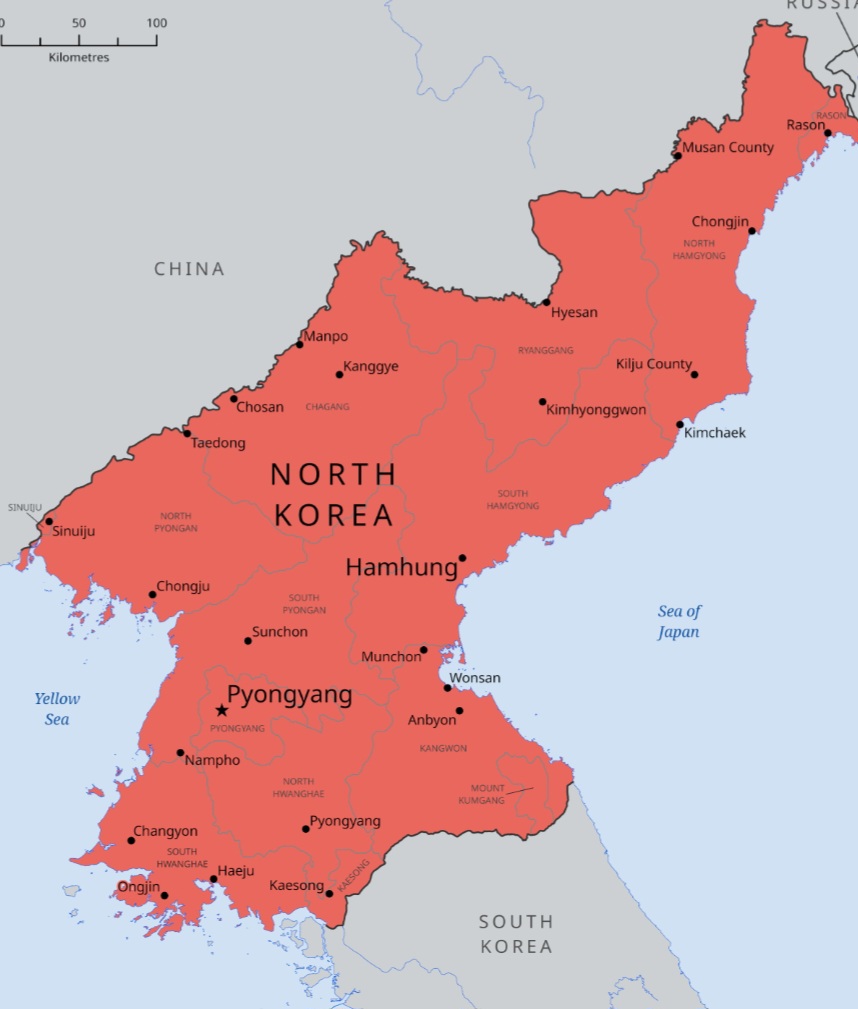
The relations between U.S. and the Democratic People’s Republic of Korea have continuously revolved between diplomatic manoeuvres and aggravated military tensions in the last few decades, fuelled by the traditional structures and ideological differences. President Donald Trump swearing into his second term raised speculations about high level meetings, based on the precedent set in the first term where Trump held the Singapore and Hanoi Summit. A dichotomous approach taken by the U.S. has led their relations with DPRK. While Donald Trump continuously talks about his desire to hold high-level meetings and improve geopolitical relations based on the good rapport that he banks on, with the Supreme Leader Kim Jong Un, the U.S. policy still asserts a permanent and verifiable denuclearization of the Korean Peninsula, evident from the statements passed during Trump’s meet with the President of Republic of Korea lee Jae Myung in 2025.
The DPRK’s Ninth Party Congress held in the last week of February, highlighted the dual approach employed by DPRK. Kim Jong Un hints at both the countries getting along well, if the U.S. mends its policies towards DPRK’s nuclearization. He also confirms an expansion in his nuclear arsenal in the upcoming years, coupled with the tactical weapons including Intercontinental Ballistic Missiles, as it declares South Korea as its primary rival, rejecting any peaceful resolution between the two nations. This stance has been provided with a promptly phased military preparation, incorporating various ballistic and cruise missile tests in 2025, followed by provocations in early 2026.
North Korea has also worked on ties with Russia, evident from the deployment of more than 15000 soldiers of the DPRK in the Russia-Ukraine confrontation, and inviting the Russian leaders to the 80th Worker’s Party Celebration, and scoring a major draw of efficient combat techniques and latest technology in the bargain. DPRK has also enhanced relations with China which has emboldened its stance in the broader hegemonic contention. One of the recent instances of the same can be the stance on the recent tensions in the middle east where North Korea offers support to Iran and justifies its arsenal of nuclear weapons.
However, these conditions are still not enough for a display of American aggression against North Korea and the following would require an extreme circumstance like a conventional or nuclear attack on one of the U.S. allies, namely South Korea and Japan, an intercontinental ballistic missile test which directly threatens the land of United States or a non-traditional threats incorporating situations like an unstable regime leaving the nuclear elements up for grabs, major technology transfer to jeopardising non-state actors, escalations during annual military exercises or Cyber and Kinetic threats can catalyse a firm retaliation. Through this article we will look at how even after continuous provocations and an alarmingly opposite stance taken by DPRK, deterrence and diplomatic procedures is the more favourable option for the United States of America.
The Nuclear Threat
North Korea has gradually built a strong and alarming nuclear framework even after hindrances created at every step through international pressure and economic sanctions. The Democratic People’s Republic of Korea conducted its primary nuclear tests on October 9, 2006, transitioning to its most significant test after a decade on September 3, 2017, of the Hydrogen bomb. North Korea has said to have assembled an estimate of 50 Nuclear warheads with fissile material for up to 90 weapons. The state has also worked towards enhancing the delivery systems as it makes advancements like the Hwasong-18 solid-fuel variant, which has been tested many times in the last couple of years, along with short range systems, with the calibre of hitting targets all across South Korea and Japan. These developments have provided North Korea with a second-strike option, forcing the U.S. to speculate any military action.
Any pre-emptive U.S. strike can lead to a vehement nuclear retaliation afflicting the U.S. territories or its allies, namely, Japan and South Korea. DPRK will also consider the nuclear option on the battlefield, as it has publicly abandoned its no-first-use policy. Moreover, attacking the North Korean nuclear facilities can lead to a radiological release or even an extensive nuclear exchange.
Therefore, while the U.S. has a stronger nuclear arsenal, North Korea commands an artillery, enough to survive the hegemonic battle, as the stakes are extreme and unreasonable, which means any partial success can act as a catalyst for a catastrophic battle.
The Threat to South Korea and other Regional Allies
Apart from its nuclear arsenal, the Democratic People’s Republic of Korea has also amassed a strong traditional force which poses an imminent risk on the Republic of Korea, which is a significant U.S. ally with a population of more than 50 million. North Korea maintains an army of more than 1.2 million active personnel with more than half of them deployed in Demilitarised Zone (DMZ). This coupled with more than 5000 artillery systems with South Korean cities with massive population in range, encompassing more than 900-long range missiles capable of reaching Seoul, with a population over 10 million, located less than 40 miles from DMZ.
Pentagon reports have also estimated the scale of damage in-case of a full-scale conflict, with projections going up to 3,00,000 South Korean and American casualties, with civilian deaths up to 20,000 per day, from military exchanges. There are more conservative estimates that consider an hour of military barrage enough to inflict thousands of casualties, before a potential counter-strike tackles the situation.
The United Stations has also stationed 28,500 troops in South Korea under the Mutual Defence Treaty, signed in 1953. These troops and major bases in Japan, will immediately be exposed to any kinds of huge-scale confrontation. While North Korean missiles have overflown Japanese territory innumerable times, a broader war would afflict the U.S. allies and infrastructure. The South Korean Miracle of the Han, has its foundation in the technological and infrastructural development in its metropolitan cities, which would face severe damage with global supply chains of semiconductors and electronic goods disrupting triggering an economic collapse.
A Potential Russian and Chinese Involvement
Any kind of aggression portrayed through a U.S. military stance will also face a potential backlash from the People’s Republic of China as well, which has been an ally of the Democratic People’s Republic of Korea since The Cold War Era, bound by agreements like the Treaty of Friendship since 1961. The People’s Republic of China also intervened significantly in the Korean War, leading to the Armistice Agreement in 1953, which still majorly governs the region.
China has also expressed its views on how it looks at Pyongyang as a strategic buffer and would retaliate against any kind of assertion or attempt made at changing the regime. Moreover, any kind of U.S. aggression can trigger a massive refugee influx into China, which can lead to a direct confrontation between the two major hegemonic contenders. China has also supported the DPRK diplomatically as it vetoes harsh UNSC decisions, and continues to maintain relations even after strong international pressure.
North Korea has also strengthened relation with Russia, especially in the last couple of years, evident from the mutual defence commitments and the weapons trade. Russian leaders were also a part of the celebration for the 80th Anniversary of the Worker’s Party. North Korea has also supported Russia in its confrontation with Ukraine, sending more than 15,000 troops. This relationship complicates the scenario for U.S. even further as a direct confrontation with North Korea can lead to a greater battle, detrimental for the United States.
Economic and Global Implications
Any direct confrontation between North Korea and the U.S or one of its allies can afflict the global supply chains distinctly. Bloomberg Economics in one of its reports predicted how a full-scale war between the two nuclear nations can cause damages potentially worth more than 4 trillion USD (3.9% of the total world GDP). South Korea and Japan, whose economy significantly relies on semiconductors and automobiles exports, could see a major contraction in their sales, with estimates ranging up to 40%, leading to major shortages at a world scale
Moreover, any kind of reparations post a catastrophic war would cost both the U.S. and its allies trillions of dollars, encompassing property damages, afflicted productivity, and global supply chain disruptions. The U.S. will also have to bear the military expenditure, worth billions of dollars, while taking an indirect hit because of a volatile market, stupendous energy prices, and a recessionary pressure. The global trade routes passing through the Northeast Asian region would be disrupted, heavily impacting both U.S. and its allies. This also takes a heavy toll on the U.S. considering the confrontation that it is going through with Iran and the heavy toll on the economy due to the recent tariffs.
Humanitarian Challenges
The humanitarian aspect of a direct confrontation between two nuclear nations can be catastrophic, causing thousands of civilian and military casualties. A conflict between the two nations and its allied countries can also displace millions of people, cause famine, disease outbreaks, environmental contamination making the place inhabitable, etc. The nuclear sites of North Korea, if struck without precision can cause radioactive leaks that can afflict the upcoming generations in the nearby cities. The stabilisation process after the conflict would also require a huge occupation force, with thousands of troops, to secure loose nuclear materials, manage refugees, rebuilding the state amid potential resistance from guerilla forces.
From a militaristic perspective, North Korea’s underground facilities due to its mobile and dispersed nature are impossible to denuclearise completely through air strikes. Intelligence gaps would sustain and retaliatory strikes would escalate the situation without complete elimination. To pursue a full regime change, U.S. will have to turn to ground operations without a clear exit strategy.
Political and Diplomatic Restraints
A U.S. strike without significant threat would face strong condemnation and also strain the alliances on an international scale. While South Korea and Japan do perceive North Korea as a threat and root for firm deterrence, both the nations have consistently taken a stance of avoiding confrontations that would afflict their territory. The United States’ foreign policy has itself emphasised the significance of diplomacy and deliberation, which are ideals considered foundational in developing their soft power.
The public opinion of the people of the U.S. also shows a hesitation and in some cases resistance to conflicts including threats of high-casualty. Moreover, any kind of authorisation from the Congress would face serious contention, and a threat of thousands of deaths will make the action prohibitive.
Conclusion
The factors that restrain the U.S. from striking DPRK, form a firm interlocking barrier. Nuclear Threats, potential backlash for the allies, humanitarian disaster, economic devastation and practical impossibilities, make any strategic gain counter-productive. Thus, different U.S. administrations have worked on firm alliances, advanced missile defence systems like the Terminal High Altitude Area Défense (THAAD) systems, targeted sanctions and diplomatic engagements.
However, as North Korea, continues to strengthen its capabilities, including developments from its recent party congress, U.S. and its allies need to maintain credible deterrence while also indulging in dialogues. The current status might be sceptical, but prevent a large-scale humanitarian disaster. A path of sustained international cooperation, diplomacy and recognition that military action in the particular situation is counter-productive is the only way to reach to a resolution that is sustainable.



