
By: Khushbu Ahlawat, Consulting Editor, GSDN
Introduction
Federalism has long been one of the foundational pillars of the constitutional and political architecture of India. Designed as a union of states with a strong central authority, India’s federal framework attempts to balance national unity with regional autonomy. The Constitution distributes legislative, administrative, and fiscal powers between the Union and the states through the Union List, State List, and Concurrent List. This institutional arrangement was created to accommodate India’s immense diversity—linguistic, cultural, and economic—while maintaining a cohesive national governance structure. Over the decades, federalism has allowed state governments to pursue region-specific policies while remaining part of a unified national political system.
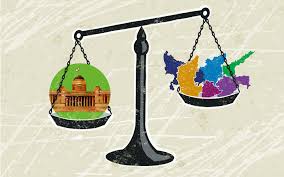
In recent years, however, debates surrounding the future of Indian federalism have intensified as political centralization has become more visible in policy and governance. Conflicts over fiscal transfers, policy autonomy, and institutional roles have sharpened tensions between the Union government and several opposition-ruled states. For instance, multiple states have raised concerns over delays in financial transfers and the increasing use of cesses and surcharges by the Union government, which are not shared with states through the constitutional revenue-sharing formula. These developments have sparked renewed debates about whether India is witnessing a shift from cooperative federalism toward a more centralized model of governance.
Historical Foundations of Indian Federalism
India’s federal structure emerged from the political and administrative challenges faced during the transition from colonial rule to independence. The framers of the Constitution sought to construct a system that would preserve national unity while granting states meaningful autonomy in governance. Unlike classical federations such as the United States, India adopted what scholars often describe as a “quasi-federal” system. In this framework, the central government retains significant powers, including residuary legislative authority and the ability to intervene in state governance during emergencies. The intention behind this design was to prevent political fragmentation in a newly independent nation with deep social and regional diversity.
The functioning of Indian federalism has evolved significantly over time. During the early decades after independence, the dominance of a single political party across the Union and most states created a relatively harmonious federal system. Political scientist Rajni Kothari famously described this phase as the “Congress System,” where disputes between the centre and states were often resolved within party forums rather than through institutional confrontation. However, the rise of regional political parties since the late twentieth century has transformed the federal landscape. Today, states governed by different political parties often challenge central policies more assertively. Recent examples include calls by several southern states for a “federal reset” to recalibrate Union–state relations, reflecting growing concerns over centralization and demands for greater state autonomy.
Fiscal Federalism and the Politics of Resource Distribution
Fiscal federalism represents one of the most critical dimensions of centre–state relations in India. While states are responsible for delivering many public services—such as healthcare, education, agriculture, and infrastructure—their revenue-raising powers are relatively limited. As a result, states depend heavily on financial transfers from the Union government through mechanisms such as the Finance Commission of India, centrally sponsored schemes, and tax devolution. This structural imbalance has become a central issue in contemporary debates on federalism, particularly as states shoulder increasing responsibilities in welfare delivery, infrastructure development, and economic management. The design of India’s fiscal framework therefore plays a crucial role in determining how effectively states can meet their developmental obligations while maintaining fiscal stability.
Recent developments have intensified these tensions. The introduction of the Goods and Services Tax Council framework through the Goods and Services Tax (GST) created a unified national market but also reduced the independent taxation powers of states, increasing their dependence on central transfers. At the same time, the rising use of cesses and surcharges by the Union government has reduced the share of tax revenue available to states because these levies are excluded from the divisible tax pool. Fiscal disputes have become particularly visible in recent negotiations surrounding the Finance Commission and GST compensation mechanisms. Several state governments, including those of Tamil Nadu and Kerala, have expressed concerns that the growing reliance on such levies undermines the spirit of fiscal federalism by effectively shrinking the pool of revenues shared with states.
Another point of contention relates to the evolving criteria used by the Finance Commission for distributing tax revenues among states. Factors such as population, income distance, and fiscal discipline influence the allocation formula, often generating debate among states with differing economic capacities. For example, some southern states have argued that the use of population-based criteria disproportionately benefits more populous states while penalizing those that have successfully implemented population control measures. These debates illustrate the inherent complexity of designing a fiscal framework that balances equity with efficiency. As India continues to pursue ambitious development goals and expand social welfare programs, ensuring a transparent and equitable system of fiscal federalism will remain essential for sustaining cooperative centre–state relations and preserving the broader legitimacy of the federal structure.
Institutional Tensions: Governors, Agencies, and Political Authority
Institutional conflicts have also become a prominent feature of contemporary centre–state relations in India. One of the most debated issues concerns the role of governors, who are appointed by the Union government but serve as constitutional heads of states. In theory, governors are expected to function as neutral constitutional authorities who safeguard the Constitution and facilitate the smooth functioning of democratic institutions. In practice, however, several state governments have accused governors of interfering in legislative processes, delaying assent to bills, or influencing administrative decisions. These disputes have raised broader questions about whether the office of governor has increasingly become politicized, thereby affecting the balance between state autonomy and central authority within the federal system.
A prominent recent example occurred in the southern state of Tamil Nadu, where tensions between the state government and the governor led to repeated disputes over legislative procedures and university appointments. The governor withheld several bills passed by the state assembly, triggering political confrontation and legal intervention. Eventually, the Supreme Court of India ruled that governors cannot indefinitely delay decisions on bills passed by elected legislatures, reinforcing constitutional limits on gubernatorial discretion. The controversy intensified political debate across the country, with several regional leaders demanding reforms to clarify the powers and responsibilities of governors. Such disputes illustrate how constitutional offices can become arenas of political contestation, complicating the functioning of federal institutions.
Beyond gubernatorial disputes, tensions have also emerged around the role of central investigative and regulatory agencies operating within states. Institutions such as the Enforcement Directorate and the Central Bureau of Investigation have increasingly become part of political debates, particularly when investigations involve opposition leaders or state-level officials. Several state governments—including those in West Bengal and Punjab—have withdrawn general consent for CBI investigations, arguing that federal investigative powers are sometimes used in ways that undermine state autonomy. These developments have sparked broader discussions about institutional neutrality and accountability within India’s federal structure.
At the same time, disputes have also arisen over the functioning of administrative bodies that regulate sectors such as education, policing, and law and order. For instance, disagreements over control of university appointments and state-level bureaucratic authority have surfaced in states like Kerala and Delhi. In Delhi’s case, the long-running institutional struggle between the elected government and the Lieutenant Governor eventually required constitutional clarification by the Supreme Court regarding the division of powers within the National Capital Territory. Collectively, these developments demonstrate that institutional tensions are not merely procedural disputes but reflect deeper political struggles over authority, accountability, and the evolving nature of federal governance in India.
Welfare Policies, Governance, and the Politics of Central Schemes
Another dimension of centre–state tensions relates to the design and implementation of welfare policies in India. Many social welfare programs are implemented through centrally sponsored schemes, where both the Union government and the states share financial and administrative responsibilities. Programs such as Pradhan Mantri Awas Yojana, Pradhan Mantri Kisan Samman Nidhi, and Ayushman Bharat illustrate how national initiatives seek to provide uniform welfare coverage across the country. While these programs aim to reduce regional disparities and expand social protection, states sometimes argue that centrally designed schemes limit their flexibility to tailor policies according to local economic and social conditions. As a result, the governance of welfare programs has increasingly become an arena where questions of administrative autonomy and political credit intersect.
Disputes over welfare programs and policy design have become increasingly visible in recent years. Several states have criticized the Union government for imposing policy changes without sufficient consultation, particularly in areas such as employment programs and social welfare funding. Fiscal pressures on states have intensified these concerns, as rising welfare commitments and borrowing limits restrict their ability to finance development initiatives. For instance, financial stress faced by smaller states has prompted requests for additional central support; the chief minister of Himachal Pradesh recently sought a special financial package to offset fiscal deficits and declining central grants. Such cases highlight how fiscal constraints and policy design intersect with political dynamics in shaping centre–state relations.
Another recurring source of tension involves the allocation of financial responsibility within centrally sponsored schemes. Many states argue that the required state contribution has increased over time, placing additional strain on their budgets. This issue has been particularly visible in the implementation of programs like Mahatma Gandhi National Rural Employment Guarantee Act, where delays in wage reimbursements or disputes over funding shares have generated friction between state administrations and the Union government. State governments have often argued that delayed payments or administrative conditions attached to central funding complicate the implementation of welfare programs at the grassroots level.
Political competition also shapes how welfare policies are presented and implemented. In several instances, states have sought to rebrand or supplement centrally sponsored programs with their own initiatives to maintain political visibility and policy ownership. For example, governments in states such as West Bengal and Telangana have introduced parallel welfare schemes that emphasize regional priorities while operating alongside central programs. These dynamics illustrate that welfare governance in India is not only an administrative process but also a political negotiation over authority, accountability, and recognition. As welfare policies remain central to electoral politics and development strategies, the relationship between national initiatives and state-level governance will continue to shape the evolving balance of India’s federal system.
Regional Political Assertion and the Revival of Federal Debates
The growing tensions between the Union government and several state administrations have revived debates about the future of federalism in India. Regional political leaders increasingly emphasize the need to protect state autonomy while maintaining national cohesion within the constitutional framework. These discussions are particularly significant because India’s political system has historically relied on a balance between a strong central government and empowered states capable of addressing diverse regional needs. As political competition has intensified across states, many regional leaders have argued that preserving federal principles is essential not only for governance but also for sustaining democratic representation across India’s vast and diverse society.
Recent political developments illustrate this trend clearly. Several state governments have advocated the creation of new institutional forums to strengthen intergovernmental dialogue and ensure that states have greater influence in national policymaking. For instance, the chief minister of Tamil Nadu has repeatedly called for broader consultations through bodies such as the Inter-State Council, arguing that federal institutions should play a more active role in resolving disputes between the centre and states. Similarly, leaders in Telangana and West Bengal have advocated greater fiscal autonomy and policy flexibility in areas such as welfare spending and industrial development. These demands reflect a broader trend in which regional political actors seek to redefine the contours of federal governance.
At the same time, competition between states for investment and economic development has intensified what scholars describe as “competitive federalism.” In this framework, states attempt to attract domestic and international investment through policy innovation, regulatory reforms, and infrastructure development. States such as Gujarat, Karnataka, and Maharashtra have actively pursued investment summits and industrial policies designed to strengthen their economic competitiveness. This environment has encouraged states to experiment with governance models while simultaneously negotiating fiscal and regulatory autonomy from the centre. The resulting dynamic—characterized by both cooperation and competition—continues to shape the evolving trajectory of India’s federal political system and the broader debate about the balance of power within the country’s democratic framework.
The Future of Indian Federalism
The future of Indian federalism will depend largely on how effectively the political system manages the evolving balance between central authority and state autonomy. As India pursues ambitious national goals—ranging from economic growth and digital transformation to climate action and social welfare expansion—coordination between the Union and the states will become even more important. However, maintaining the legitimacy of this coordination requires ensuring that states retain meaningful policy autonomy and fiscal capacity. Strengthening institutions such as the GST Council and the Inter-State Council could provide platforms for dialogue and consensus-building, helping reduce political friction between different levels of government.
At the same time, the sustainability of India’s federal structure will depend on rebuilding trust between the centre and the states. Transparent fiscal transfers, consultation in policymaking, and respect for constitutional institutions are essential for preserving the spirit of cooperative federalism envisioned by the framers of the Constitution. The ongoing debates over centralization and autonomy should therefore not be viewed merely as political conflict but as part of the dynamic evolution of Indian democracy. If managed constructively, these debates could ultimately strengthen India’s federal framework—ensuring that national unity and regional diversity continue to coexist within one of the world’s most complex democratic systems.

About the Author
Khushbu Ahlawat is a research analyst with a strong academic background in International Relations and Political Science. She has undertaken research projects at Jawaharlal Nehru University, contributing to analytical work on international and regional security issues. Alongside her research experience, she has professional exposure to Human Resources, with involvement in talent acquisition and organizational operations. She holds a Master’s degree in International Relations from Christ University, Bangalore, and a Bachelor’s degree in Political Science from the University of Delhi.



