
By: Jaiwant Singh Jhala
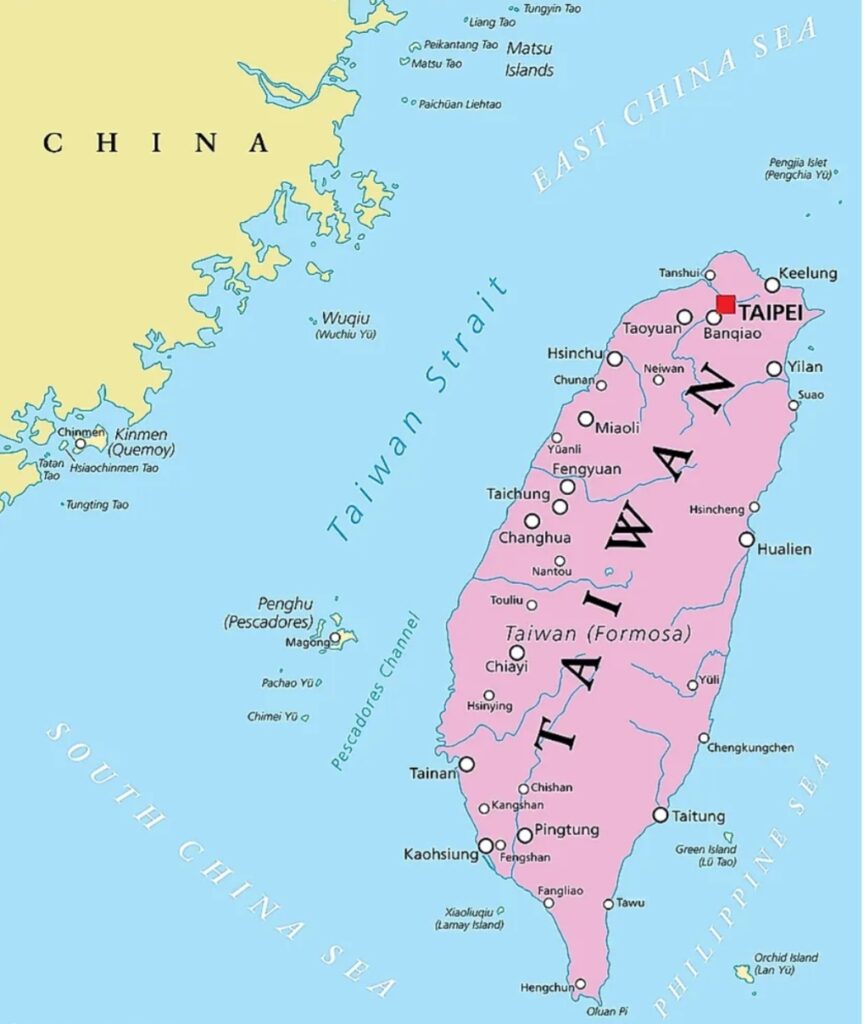
China and Taiwan have been involved in the conflict dating back to the Chinese civil war which ended in 1949. Peoples’ Republic of China (PRC) claimed its sovereignty over the self-governed, democratic island of Taiwan. With its One-China policy, China views Taiwan as a breakaway province that must be reunified with the mainland, by force if necessary. Taiwan considers itself a sovereign, independent country with its own constitution and democratically elected government. The ruling Democratic Progressive Party (DPP), led by President William Lai, maintains that a formal declaration of independence is unnecessary as the Republic of China (ROC) is already a sovereign state. Most Taiwanese citizens support maintaining the current status quo. China has increased its military activity towards Taiwan. It has significantly ramped up military pressure through “grey zone” tactics, frequent incursions into Taiwan’s Air Defence Identification Zone (ADIZ) and conducting large scale military drills simulating blockades or invasions. The question is- WHY?
Why does China want Taiwan? Historical claims, significant geostrategic advantages, and critical economic interests in Taiwan’s high-tech industries are the main reasons responsible for China’s assertiveness. For the Chinese Communist Party (CCP), reclaiming the island is a matter of national pride and political legitimacy. The Chinese civil war never concluded with a peace treaty, the communists took over the whole of China and the nationalists retreated to Taiwan. According to PRC’s belief, it is the successor to the ROC, hence, the whole territory of China including Taiwan should be under their jurisdiction.
Taiwan is located at a strategically vital position. Having control of Taiwan would help China control the western pacific routes and its navy more efficiently which is a major security concern for the US and its regional allies.
Taiwan is a powerhouse in the technology sector, especially in semiconductor manufacturing. The Taiwan Semiconductor Manufacturing Company (TSMC) is the world’s most valuable chip-making company and controls a majority of the global market share for advanced semiconductors, which are crucial for electronics, phones, and cars worldwide. Taking over Taiwan’s economy would significantly bolster China’s tech industry and reduce its dependence on foreign technology.
General Secretary Xi Jinping has made the goal of integrating Taiwan a fundamental part of his political narrative because failure to bring Taiwan under Chinese control could be perceived as a weakness and a significant loss of face for the CCP leadership.
China insists on peaceful reunification but has been quite straightforward in stating that it may use force, if necessary, in order to prevent Taiwan from formally declaring independence.
Taiwan’s Military Preparation-
Taiwan is enhancing its military preparedness by resorting to an “asymmetric warfare” strategy, acquiring mobile, hard-to-target weapons, increasing its defence budget, and strengthening international partnerships. Taiwan’s core defence strategy is the ‘porcupine approach’. This aims to prevent a Chinese invasion by making the potential cost of an attack prohibitively high. It focuses on asymmetric capabilities such as using smaller, mobile, and cost-effective weapon systems that can survive an initial Chinese missile barrage and disrupt amphibious landings. Examples include anti-ship missiles (Hsiung Feng II/III), mobile missile launchers, sea mines, and drone swarms. It has started to emphasize on cyber or electronic warfare and guerilla-style tactics for urban defence, preparing for prolonged resistance. This strategy mirrors Ukraine’s defence model, focusing on denial rather than outright victory.
Taiwan’s doctrine emphasizes denial and attrition. The aim is to make any attempted cross-strait seizure physically and politically costly by inflicting losses on invading forces, disrupting sustainment, and prolonging resistance so as to complicate China’s political objectives. Exercises increasingly focus on distributed operations, small-unit anti-landing tactics, joint sensor-to-shooter linkages, and operations under degraded communications. Importantly, Taiwan recognizes that asymmetric defences work only if they are backed by credible logistics, robust command and control, and a trained reserve force that can execute follow-on operations after initial PLA strikes.
Taiwan has increased its defence budget. Taiwanese government has steadily increased the country’s military expenditure and is close to $20.25 billion in 2025 which is approximately 2.45% of its Gross Domestic Product (GDP). President Lai Ching-te announced an additional $40 billion investment over eight years. It aims to raise its defence spending to 5% of its GDP by 2030. Funds are directed toward advanced missile systems, cyber defence, and indigenous weapons development.
Taiwan is enhancing its grip on land, water and air. It has developed long range precision missiles which enhance deterrence by threatening Chinese bases. Taiwan’s defence ministries and private firms have adapted commercial drones for military use, and procurement plans include hundreds of small drones to provide real-time targeting data and augment artillery and missile effectiveness. Taiwan has also upgraded its domestic weaponry. Its investments include indigenous submarines and modern frigates. Taiwan is upgrading 141 older F-16A/B jets to the advanced F-16V and purchasing 66 new F-16Vs. These jets feature improved avionics and radars, designed to counter China’s J-20 stealth fighters. It has installed a multi-layered air defence systems like the new T-Dome and Patriot PAC-3 interceptors to protect critical assets and counter China’s air and missile threats.
The Taiwanese armed forces have expanded the length and frequency of their annual ‘Han Kuang’ military exercises, covering land, sea, and air operations to improve combat readiness. It runs extensive defence drills simulating Chinese attacks. Taiwanese government has also included civilians in order to keep everyone alert and ready for any situation. In 2025, these defence drills were the largest mobilization of reservists in history, involving civilians across cities and towns. Recognizing that Taiwan’s small active force cannot sustain prolonged high-intensity combat against the Peoples’ Liberation Army (PLA), It has invested in reserve reforms like reducing the active service gap, increasing training frequency, and improving the equipment and integration of reserve units so they can be a credible second line of defence. President Lai’s government has proposed supplementary defence budgets aimed at strengthening reserve readiness and broadening civil defence capabilities. Taiwanese armed forces and government have integrated civil and military. Exercises extend beyond bases and are held at train stations, supermarkets, schools and other public places reflecting Taiwan’s ‘whole-of-society’ defence approach. Citizens are taught survival skills, first aid, and emergency response. Schools and communities have integrated defence awareness into daily life, fostering unity. The government is preparing the civilian population for potential conflict through civil defence handbooks and developing communication backup networks to ensure societal resilience under attack.
Taiwan’s preparedness strategy depends heavily on international relationships, both in terms of material support and deterrence signalling. While Taiwan lacks formal diplomatic recognition from most countries, it enjoys substantive security ties with the United States and cooperation with like-minded partners. US arms sales, training, intelligence sharing, and political support are central pillars. Recent US approvals of missile defence and other packages underscore continuing US willingness to help Taiwan modernize its air-defence and sustainment capabilities. NATO and Pacific partners’ transits through the Taiwan Strait and statements of concern over coercive actions also create a broader international attention that China must account for during crisis decision-making. United States remains Taiwan’s primary arms supplier, providing advanced fighter jets, missile systems and training. Taiwan also has good relations with Japan and other Indo-Pacific allies and increasing cooperation with these countries is beneficial for Taiwan for a stronger control over the region. Domestic arms production is also essential to reduce foreign dependence to a certain extent and ensuring sustainability during conflict.
Challenges and Limitations for Taiwan
The PLA’s numerical advantage in aircraft, missiles, amphibious lift and sustainment remains daunting. Even a well-designed asymmetric defence can be stressed by a high-intensity, multi-axis campaign that combines cyber, missile strikes and amphibious landings. Taiwan faces demographic decline, reducing available recruits. It lacks manpower in comparison with China. Opposition parties sometimes resist large defence budgets, questioning sustainability. China’s economic and diplomatic coercion complicates Taiwan’s ability to secure enough international support. Modernization programs take years, while China’s military capabilities grow rapidly. Taiwan’s ability to sustain prolonged operations hinges on dispersal of logistics, redundant C2 and assured fuel and munitions stocks. Building these quickly is expensive and politically sensitive. Mobilization requires not only hardware but also a population ready and willing to endure disruptions. Taiwan has made strides in reserve and civil defence reforms, but full societal resilience is an ongoing challenge.



