
By: Khushbu Ahlawat, Consulting Editor, GSDN
Introduction
In contemporary political landscapes, where visibility, perception, and symbolism are central to leadership, clothing emerges as a powerful yet underexplored medium of political communication. Far from being a superficial or aesthetic concern, dress functions as a semiotic system through which identities are constructed, ideologies are signaled, and power is negotiated. Political leaders across the world—from Mahatma Gandhi’s minimalist khadi to Margaret Thatcher’s structured suits—have historically utilized clothing to convey authority, relatability, resistance, or cultural rootedness. These sartorial choices operate within a broader framework of semiotics, where the visible elements of attire (signifiers) communicate deeper meanings (signified) shaped by cultural, historical, and political contexts.
This article seeks to interrogate whether political dressing is an exercise of power or an act of conformity. By situating clothing within theoretical discourses on identity, communication, and performativity, the study bridges the gap between abstract semiotic theory and its practical manifestations in political life. Through global and Indian case studies, it examines how attire becomes a strategic tool in shaping public perception, mobilizing support, and reinforcing ideological narratives. Ultimately, the article argues that political dress exists in a dynamic space where agency and structure intersect, making it a crucial lens for understanding contemporary politics.
Clothing as Political Language: A Semiotic Framework of Power
Clothing in political life operates as a complex semiotic system through which power, identity, and ideology are communicated in subtle yet profound ways. Drawing on semiotic theory, particularly the relationship between the signifier (the visible garment) and the signified (the meaning it conveys), attire becomes a powerful non-verbal language that precedes and shapes verbal discourse. Political leaders, as embodied symbols of authority, deploy clothing not merely as personal expression but as a calculated communicative act that signals legitimacy, cultural affiliation, and ideological alignment. This aligns with Leeds-Hurwitz’s assertion that communication extends beyond linguistic forms to include material objects, positioning clothing as a central medium through which political meaning is constructed and interpreted. The ambiguity inherent in clothing further enhances its communicative potential, allowing multiple interpretations to coexist and enabling leaders to address diverse audiences simultaneously.
This semiotic framework is particularly evident in the case of Hamid Karzai, whose deliberate choice of multi-ethnic attire during his presidency symbolized national unity in a fragmented society. By combining elements associated with different ethnic groups, Karzai crafted an inclusive political identity that transcended sectarian divides. Similarly, global leaders often adopt culturally resonant attire during diplomatic visits to signal respect and foster goodwill, demonstrating how clothing operates as a tool of soft power. The semiotics of clothing also intersects with the politics of visibility, where the constant media gaze transforms attire into a site of surveillance and judgment. In this context, clothing becomes both a means of asserting agency and a mechanism through which power is negotiated, contested, and reproduced.
From Symbol to Strategy: Historical Evolution of Political Dress
The historical evolution of political dress reveals its transformation from a spontaneous expression of identity to a strategic instrument of political communication. During the French Revolution, clothing became a visible marker of ideological allegiance, with the rejection of aristocratic fashion symbolizing the emergence of egalitarian values. Similarly, in colonial contexts, dress functioned as a form of resistance against imperial domination. In India, the adoption of khadi during the independence movement exemplified how clothing could embody political ideology, serving as a symbol of self-reliance, economic nationalism, and collective identity. These historical examples illustrate how clothing has been used to challenge existing power structures and articulate alternative visions of society.
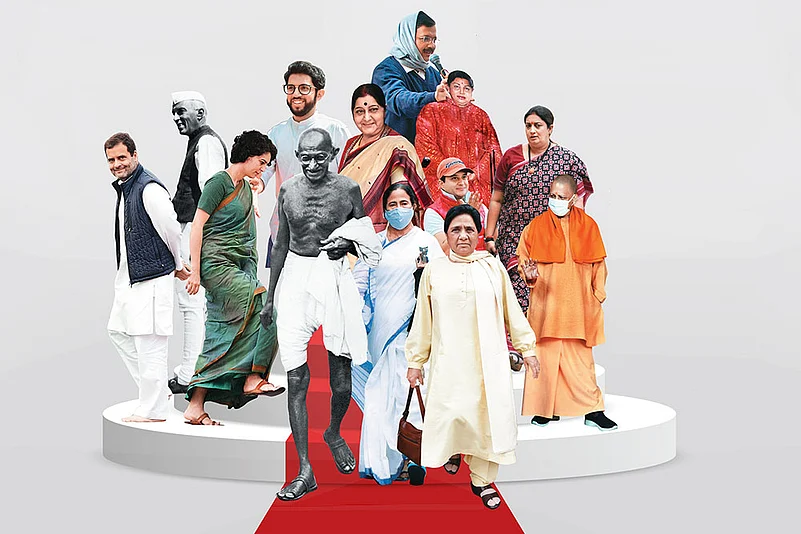
In the modern era, however, the symbolic dimension of clothing has evolved into a calculated strategy, reflecting the increasing professionalization and mediatization of politics. A key example is Mahatma Gandhi, whose adoption of the loincloth was not merely a personal choice but a deliberate political act aimed at aligning with India’s rural masses and rejecting colonial norms of respectability. This strategic use of clothing has been further amplified in contemporary politics, where leaders carefully curate their public image to resonate with specific constituencies. The persistence of symbolic attire, such as white clothing in Indian politics, demonstrates how historical meanings are sustained and repurposed, even as they are adapted to new political contexts. Thus, the evolution from symbol to strategy underscores the dynamic and adaptive nature of sartorial politics.
Gender, Identity, and Media: The Politics of Visibility
The semiotics of political dress is deeply gendered, reflecting broader dynamics of power and representation within society. Women leaders are subjected to heightened scrutiny regarding their appearance, with their clothing often interpreted as a reflection of their competence, ideology, and personal identity. Feminist theorists such as Simone de Beauvoir have emphasized how women’s bodies are socially regulated, a dynamic that extends to their sartorial choices in political contexts. Unlike men, whose standardized attire often renders their clothing invisible, women’s dress becomes hyper-visible, attracting media attention and public commentary. This creates a paradox where women must conform to normative expectations while simultaneously using clothing as a tool to assert authority and individuality.
Case studies of leaders such as Margaret Thatcher and Hillary Clinton illustrate how women navigate this complex terrain. Thatcher’s structured suits and symbolic use of color enabled her to project authority within a male-dominated political environment, while Clinton’s pantsuits became emblematic of professional competence and gender equality. Similarly, Michelle Obama leveraged fashion to communicate inclusivity and support for emerging designers, subtly reinforcing political narratives of diversity and opportunity. However, the role of media in shaping these interpretations cannot be overstated. Media coverage often oscillates between trivialization and amplification, reducing women’s political identities to their appearance while simultaneously recognizing the strategic significance of their sartorial choices. This interplay highlights the dual nature of clothing as both a constraint and a resource in the politics of visibility.
Media, Digital Culture, and the Amplification of Sartorial Politics
In the contemporary digital era, the semiotics of political dress has been significantly amplified by the pervasive influence of media and networked communication platforms. Unlike earlier periods where sartorial messages were mediated through limited visual exposure, today’s political imagery circulates instantaneously across global audiences, transforming clothing into a highly visible and contested site of meaning production. The rise of social media platforms such as Twitter (now X) and Instagram has intensified the scrutiny of political appearances, where every garment, accessory, or color choice is dissected, memefied, and reinterpreted in real time. This immediacy collapses the distance between political actors and citizens, enabling direct engagement while simultaneously exposing leaders to unprecedented levels of surveillance and critique.
A significant case study illustrating this phenomenon is Volodymyr Zelenskyy, whose consistent choice of military-style olive-green T-shirts during the Russia-Ukraine conflict became a powerful symbol of wartime leadership and solidarity. His deliberate rejection of formal suits in favor of utilitarian attire communicated resilience, urgency, and alignment with soldiers on the ground, reinforcing his image as a leader actively embedded within the crisis. Similarly, Justin Trudeau’s frequent use of culturally symbolic attire during international visits—though intended as gestures of inclusivity—has sparked debates about authenticity versus performative multiculturalism, demonstrating how digital audiences actively negotiate and contest sartorial meanings.
Moreover, digital culture has transformed citizens from passive observers into active participants in the semiotic process. Online communities reinterpret political dress through satire, hashtags, and viral imagery, often reshaping or even subverting the intended message. This participatory dynamic aligns with Roland Barthes’ notion of the “death of the author,” where meaning is no longer controlled by the creator but is co-produced by audiences. In this context, political clothing becomes a fluid sign, continuously re-signified through digital interactions. Consequently, the power of sartorial politics now lies not only in the intention behind clothing choices but also in their reception and circulation within digital ecosystems. This transformation underscores the need to analyze political dress within the broader framework of media ecology, where visibility, virality, and interpretation collectively shape the politics of appearance in the twenty-first century.
Indian Sartorial Politics: Populism, Nationalism, and Cultural Semiotics
India’s political landscape provides a uniquely rich context for analyzing the semiotics of clothing, given its deep-rooted cultural diversity and history of colonial resistance. Political dress in India is not merely a matter of personal style but a reflection of broader socio-political dynamics, including nationalism, populism, and identity politics. Leaders such as Indira Gandhi utilized the sari as a powerful political symbol, blending tradition with modernity to craft a distinctive leadership identity. Her sartorial choices communicated both cultural continuity and political authority, reinforcing her position within a postcolonial nation-state. Similarly, Sushma Swaraj employed traditional attire to project Indianness on global platforms, using clothing as a means of diplomatic communication and cultural representation.
In contemporary politics, Narendra Modi exemplifies the strategic use of sartorial symbolism in constructing a populist political identity. His deliberate choice of region-specific attire during public appearances serves to establish emotional connections with diverse constituencies, reinforcing narratives of unity and cultural pride. For instance, his use of traditional headgear during national events signals respect for regional identities while simultaneously consolidating a pan-Indian image. This approach aligns with broader political initiatives such as “Make in India” and “Vocal for Local,” integrating clothing into economic and nationalist discourse. However, this strategic deployment also raises questions about authenticity, as traditional symbols are mobilized to construct political legitimacy in a highly mediatized environment. Thus, Indian sartorial politics reflects the intricate interplay between cultural heritage and contemporary political strategy.
Between Power and Conformity: Interpreting the Political Body
The dichotomy between power and conformity lies at the heart of political dressing, revealing the complex interplay between individual agency and structural constraints. On one hand, clothing enables political actors to assert identity, communicate ideology, and challenge established norms. It serves as a tool of empowerment, allowing leaders to craft their public persona and connect with their audience. On the other hand, sartorial choices are shaped by cultural expectations, institutional norms, and media scrutiny, often compelling leaders to conform to established codes of appearance. This tension highlights the paradox of political dress, where the act of choosing what to wear is both a personal expression and a socially conditioned practice.
A compelling contemporary case study is Alexandria Ocasio-Cortez, whose sartorial choices, such as wearing politically charged garments, demonstrate how clothing can function as a form of resistance and messaging. At the same time, her choices have been subject to intense media scrutiny, illustrating the constraints imposed by public visibility. Similarly, the continued use of white clothing in Indian politics reflects a form of conformity to established norms, even as leaders attempt to reinterpret its meaning. These examples underscore the fluid and contested nature of sartorial politics, where clothing operates in a liminal space between power and conformity. Ultimately, the semiotics of political dress reveals that clothing is not merely an accessory to politics but a central component of its performative and symbolic dimensions.
Conclusion
The analysis of political dress reveals that clothing is far more than a passive reflection of identity; it is an active instrument in the construction and communication of power. Across historical and contemporary contexts, leaders—from Indira Gandhi to Narendra Modi—have strategically employed sartorial choices to craft narratives of legitimacy, cultural belonging, and political intent. At the same time, these choices are deeply embedded within social norms, cultural expectations, and media scrutiny, which often constrain and shape the meanings they produce. This duality underscores the central argument of the paper: political dressing cannot be reduced to either power or conformity, but must be understood as a negotiation between the two.
Furthermore, the semiotics of clothing highlights the performative nature of politics itself, where the body becomes a site of representation and contestation. In an era of heightened media visibility and digital engagement, the interpretive scope of political dress has expanded, allowing garments to carry layered and sometimes contradictory meanings. As such, clothing operates as both a strategic resource and a contested symbol within political discourse. Future research must continue to explore this intersection, particularly in non-Western contexts, to develop a more nuanced understanding of how visual culture shapes political authority and public imagination.

About the Author
Khushbu Ahlawat is a research analyst with a strong academic background in International Relations and Political Science. She has undertaken research projects at Jawaharlal Nehru University, contributing to analytical work on international and regional security issues. Alongside her research experience, she has professional exposure to Human Resources, with involvement in talent acquisition and organizational operations. She holds a Master’s degree in International Relations from Christ University, Bangalore, and a Bachelor’s degree in Political Science from the University of Delhi.



