
By : Sonalika Singh, Consulting Editor, GSDN
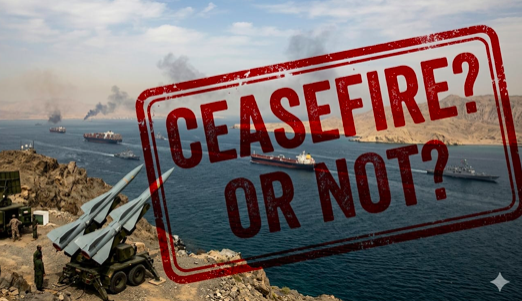
The prospect of a ceasefire in the Middle East, particularly amid the intensifying confrontation involving Iran, Israel, and the United States, remains both urgent and uncertain. As the conflict enters a prolonged and increasingly complex phase, diplomatic signals, military developments, and geopolitical calculations collectively suggest that while pathways to de-escalation exist, they are fragile, contested, and contingent on a convergence of interests that has yet to fully materialize.
At the heart of the current crisis lies a dangerous cycle of escalation. The war has expanded beyond direct hostilities between principal actors to encompass regional proxies, critical infrastructure, and vital global trade routes. The effective disruption of the Strait of Hormuz, one of the world’s most important energy chokepoints, has amplified by the global consequences of the conflict. Energy markets have reacted sharply, with rising fuel prices underscoring how regional instability can rapidly translate into worldwide economic strain. This interdependence has heightened international urgency for a ceasefire, not only as a humanitarian imperative but as an economic necessity.
Despite the intensity of the conflict, there are emerging, albeit tentative, indications of diplomatic movement. The circulation of peace proposals, including multi-point frameworks aimed at curbing nuclear ambitions and restoring freedom of navigation, reflects a recognition among global powers that a purely military resolution is neither sustainable nor desirable. However, these proposals are constrained by deep mistrust. Public rhetoric from key actors continues to emphasize strength and resolve, often overshadowing quieter, back-channel communications that hint at a willingness to negotiate. This duality public defiance paired with private opennessillustrates the complexity of achieving a ceasefire in a highly polarized environment.
One of the principal obstacles to a ceasefire is asymmetry in stated objectives. For some actors, the goal is immediate de-escalation and stabilization, while for others, it extends to broader strategic outcomes such as dismantling military capabilities, securing long-term deterrence, or redefining regional power balances. This divergence complicates negotiations, as a ceasefire is not merely a pause in hostilities but a reflection of underlying political compromises. Without alignment on what a ceasefire is meant to achieve, even temporary agreements risk collapsing under the weight of unmet expectations.
The role of external actors further complicates the situation. European nations, alongside other global stakeholders, have begun to articulate frameworks aimed at ensuring maritime security and preventing further escalation. These efforts signal a shift toward multilateral crisis management, recognizing that the consequences of the conflict extend far beyond the immediate region. Proposals to establish international coalitions focused on safeguarding energy flows and facilitating negotiations represent a pragmatic approach to de-escalation. However, the effectiveness of such coalitions depends on inclusivity and credibility. Excluding key stakeholders risks undermining legitimacy, while over-inclusion may dilute strategic coherence.
Regional dynamics also play a critical role in shaping the prospects for a ceasefire. Countries across the Middle East, many of which have direct economic and security stakes in the conflict, are navigating a delicate balance between alignment and neutrality. Their involvement in mediation efforts reflects both self-interest and a broader desire to prevent the conflict from spiraling into a wider regional war. At the same time, the participation of non-regional powers introduces additional layers of strategic competition, as global rivalries intersect with local conflicts.
Humanitarian considerations add another dimension to the urgency of a ceasefire. The conflict has already resulted in significant civilian casualties, displacement, and infrastructure destruction. In parallel, ongoing tensions in Gaza and the West Bank highlight the interconnected nature of Middle Eastern conflicts, where developments in one arena can influence dynamics in another. Efforts to secure humanitarian corridors, facilitate aid delivery, and protect civilian populations are often seen as precursors to broader ceasefire agreements. These measures, while limited in scope, can build confidence and create momentum for more comprehensive negotiations.
Economic pressures are also shaping the trajectory of the conflict. The disruption of energy supplies, combined with broader market instability, has created incentives for de-escalation. Governments facing domestic economic challenges may be more inclined to pursue diplomatic solutions, particularly as the costs of prolonged conflict become increasingly apparent. However, economic considerations alone are unlikely to override strategic and ideological priorities, especially in contexts where national security narratives dominate political discourse.
Another critical factor influencing the likelihood of a ceasefire is the internal political landscape of the involved states. Leadership decisions are often shaped by domestic considerations, including public opinion, political legitimacy, and institutional constraints. In some cases, adopting a hardline stance may be politically advantageous, even if it complicates diplomatic efforts. Conversely, the pursuit of negotiations may be framed as a sign of weakness, limiting leaders’ willingness to engage openly in peace processes. Understanding these internal dynamics is essential for assessing the feasibility of a ceasefire.
The role of international organizations and multilateral frameworks cannot be overlooked. United Nations-led initiatives, as well as resolutions aimed at conflict resolution and post-conflict reconstruction, provide institutional pathways for peacebuilding. The establishment of transitional governance structures, stabilization forces, and reconstruction mechanisms in conflict-affected areas demonstrates the potential for coordinated international action. However, the success of these initiatives depends on sustained political will and cooperation among major powers, which has often been lacking in recent years.
In assessing whether a ceasefire is on the horizon, it is important to distinguish between short-term pauses and long-term resolutions. Temporary ceasefires, often driven by immediate pressures such as humanitarian concerns or tactical recalibrations, are more achievable but inherently unstable. They can provide critical relief and create opportunities for dialogue, but without addressing underlying grievances, they risk becoming merely interluded in a continuing cycle of conflict. A durable ceasefire, by contrast, requires a comprehensive approach that integrates security arrangements, political negotiations, and economic reconstruction.
Confidence-building measures could play a pivotal role in bridging the gap between these two forms of ceasefire. Initiatives such as prisoner exchanges, phased withdrawals, and joint monitoring mechanisms can help reduce tensions and build trust among conflicting parties. Additionally, third-party mediation, particularly by actors perceived as neutral or balanced, can facilitate communication and reduce the risk of miscalculation. The involvement of countries with established diplomatic channels to both sides may be particularly valuable in this regard.
Looking ahead, several scenarios are possible. One scenario involves a gradual de-escalation driven by a combination of diplomatic pressure, economic incentives, and strategic recalibration. In this case, a ceasefire could emerge as part of a broader negotiated settlement, potentially linked to issues such as nuclear oversight, regional security arrangements, and economic cooperation. Another scenario involves continued escalation, with intermittent pauses that fail to translate into lasting peace. This outcome would likely exacerbate humanitarian suffering and increase the risk of a wider regional conflict.
A third, more complex scenario involves a hybrid approach, where limited ceasefires coexist with ongoing low-intensity conflict. This pattern, which has been observed in other regions, reflects the difficulty of achieving comprehensive peace in deeply entrenched conflicts. While not ideal, such an arrangement may provide a degree of stability and create space for incremental progress.
Eventually, the question of whether a ceasefire is on the horizon depends on the interplay of multiple factors the willingness of key actors to compromise, the effectiveness of diplomatic initiatives, the impact of economic pressures, and the broader geopolitical context. While there are reasons for cautious optimism, particularly considering ongoing diplomatic efforts, significant challenges remain.
The path to a ceasefire in the Middle East is neither linear nor guaranteed. It requires not only the cessation of hostilities but also reimagining regional relationships and security frameworks. Achieving this will demand sustained engagement, strategic patience, and recognition that peace is not a singular event but a continuous process. As the conflict continues to evolve, the international community faces a critical test of its ability to navigate complexity, balance competing interests, and prioritize long-term stability over short-term gains. Therefore, the horizon of a ceasefire is visible but distant, shaped by both the urgency of the present and the uncertainties of the future.

About the Author
Sonalika Singh began her journey as an UPSC aspirant and has since transitioned into a full-time professional working with various organizations, including NCERT, in the governance and policy sector. She holds a master’s degree in political science and, over the years, has developed a strong interest in international relations, security studies, and geopolitics. Alongside this, she has cultivated a deep passion for research, analysis, and writing. Her work reflects a sustained commitment to rigorous inquiry and making meaningful contributions to the field of public affairs.



