
By: Trishnakhi Parashar, Research Analyst, GSDN
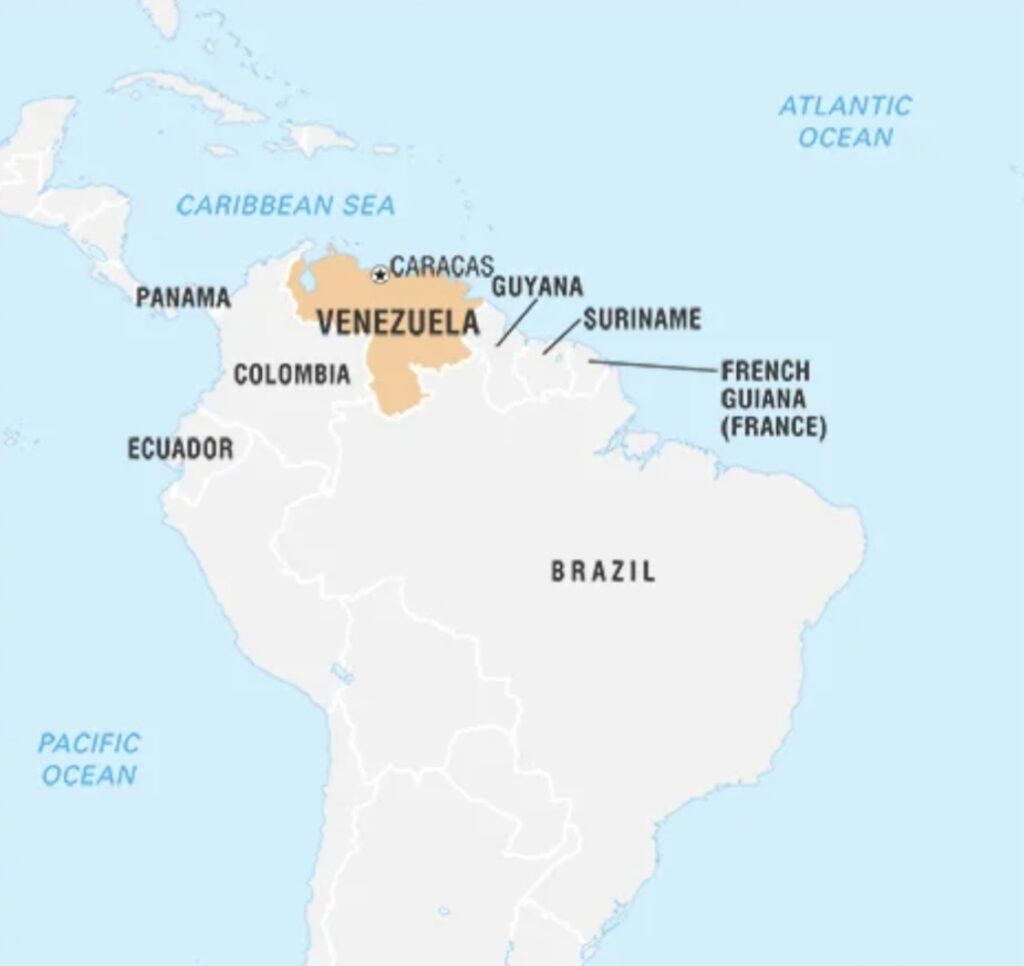
On January 3, 2026, the United States of America conducted a military operation in Venezuela, reigniting debates far beyond the American continents, reaching the Taiwan Strait. Operation Absolute Resolve — that resulted in the detention of Venezuelan President Nicolás Maduro along with his wife. Capturing him was the outcome of a long-term information gathering, planning and preparation that includes special operations forces in the ground. However, the US is no stranger to conducting such operations. 150 aircraft conducted these large-scale strikes on several targets in Venezuelan capital city, Caracas. Following the operation, the US President Donald Trump announced that, “We’re going to run the country until such time as we can do a safe, proper and judicious transition”, signalling its active role in managing Venezuela’s political shift.
In September 2025, tensions between Trump and Maduro deteriorated when the US forces targeted vessels off the coast of Venezuela, leaving more than 100 people dead. However, that was not the only incident. From then on, the US carried out numerous strikes on vessels that it believed were carrying drugs into the country. The US administration accused Venezuela of being involved in drug smuggling, which Maduro’s government had clearly denied. According to AP news media report, “Maduro faces federal charges in the Southern District of New York dating back to March 2020: narco-terrorism conspiracy, conspiracy to import cocaine into the United States, and weapons offenses related to machineguns and destructive devices.” Notably, Maduro stated in a past interview that “the US wants to force a government change in Venezuela and gain access to its vast oil reserves” and the drug-smuggling narrative is just a pretext for intervention. Venezuela was ready to negotiate with the US on combating drug-trafficking, but the US administration had already made up its mind about how to handle the situation.
While the US interpreted launching its operation against Nicolás Maduro as necessary for the US security and regional stability, its strategic implications have been perceived differently worldwide. Uruguay and Chile voiced their concern. Brazil’s President Lula criticized the US intervention, posting on social media that “attacking countries, in flagrant violation of international law, is the first step toward a world of violence, chaos, and instability.” However, it immediately recognized Rodríguez as Venezuela’s new leader. Cuba characterized it as a “criminal assault.” Moreover, American civil society has been polarized, with people supporting the strike while others criticizing its own government. China and Russia, both the countries were critical of the US operation and shocked by the scale of the strikes.
Both Russia and China were among the largest foreign partners leveraging Venezuela’s oil sector. This growing dependence had raised concerns in Washington. Beyond the notion of “seeking greater leverage over its oil,” the US was also concerned about the deepening presence of China, Russia, and other outside powers in Venezuelan soil. Now, with the US strikes, however, the strategic equation has shifted.
Venezuela’s ambassador to the UN, Samuel Moncada stated that, “If the kidnapping of a head of state, the bombing of a sovereign country, and the open threat of further armed actions are tolerated or downplayed, the message sent to the world is devastating: namely, that the law is optional and that force is the true arbiter of international relations.” He also said that “other countries cannot afford to look the other way” and “accepting that logic would mean opening the door to a profoundly unstable world.”
The question now circulating among policy circles is whether this demonstration of the US power and influence has unintentionally created a strategic opening for China to re-think its policies toward Taiwan.
But are the situations in Venezuela and Taiwan truly comparable?
According to experts, the two situations are fundamentally incomparable. To begin with, Venezuela is a sovereign state. It faces internal political crisis, economic breakdown, and struggle for leadership, leaving it exposed to external pressure. These internal challenges have not only weakened state institutions but also limit Caracas’s ability to safeguard its sovereignty. As a result, external actors have found a fertile ground to intervene under the justification of security or stability concerns.
On the other hand, Taiwan’s situation is different, not to mention being far more complex. Although it is governed independently as the Republic of China (ROC), with its own democratic institutions, military, and effective control over its territory, but does not hold widespread diplomatic recognition needed to be considered as a separate state. China does not evaluate Taiwan through the same lens that many international commentators have used in the Venezuelan case. China sees Taiwan as an inseparable part of Chinese territory; hence, it is more like an internal matter and that cannot be compared to Venezuela. This framing places the issue of Taiwan within the realm of its sovereignty and territorial integrity rather than an external intervention. Because of this, Beijing views any external involvement in Taiwan as an interference in its domestic affairs, rather than a similar to regime change or security operations conducted abroad.
What would happen if China attempted a similar move against Taiwan?
China has officially condemned the US operation. However, on Chinese social media, narratives has been spreading on recovering Taiwan. Users went on to suggest using the same process as the US to recover Taiwan. Somewhat unexpectedly, the US operation on Venezuela has turned into a model of intervention. Moreover, some statements made by certain Chinese military experts indicate that segments of the security establishment view military options against Taiwan as increasingly achievable under specific conditions. One such Chinese military affairs expert, Fu Qianshao, commented that “Taiwan must consider whether it could evade a similar operation by the Chinese military”, adding that the short distance between Taiwan and China would give Taiwanese forces less response time than Venezuela had. Nevertheless, these views coexist with significant caution within China’s leadership. China does not require a US operation against a foreign state as a precedent to act on a territory that it considers as its own. The political, economic, and escalation risks of such an operation remain a crucial point to Beijing’s strategic decision-making. Taiwan is well within China’s military reach, but capability is not the same as the cost. Taiwan has a modern military, a politically mobilized population, and strong domestic legitimacy rooted in democratic governance with the aim to strengthening resilience and deterrence. Only last year, Chiu Chui-cheng, the cabinet-ranked head of Taiwan’s Mainland Affairs Council, warned that “if Taiwan were to be taken over by China by force, it will trigger a domino effect, undermine the regional balance of power, and directly threaten the security and prosperity of the United States.” In a way, Taiwan is counting on support from the current US administration.
Hypothetically, if China were ever to attempt a similar operation against Taiwan, the consequences would be severe and largely predictable. Immediately after such an operation, it would trigger a regional and international response, including swift diplomatic backlash from many Western nations, as well as neighbouring states like India, Japan and other Indo-Pacific partners. There is intentional ambiguity surrounding the US policy in such a situation, making its actions difficult to predict. Nonetheless, Beijing would face almost certain economic retaliation in the form of sanctions. This is particularly evident given the risks of export controls, disruptions to trade and financial markets, especially in light of Taiwan’s central role in global semiconductor supply chains. Any escalation in the Taiwan or the wide surrounding maritime passages would severely disrupt global trade and financial markets to a large extent. While the US operation in Venezuela disrupted energy markets, a similar operation in Taiwan would not only disrupt semiconductor supply chains but potentially disturb trade and finance, as well as technology markets worldwide.
Hypothetically or not, the international community would certainly react, at the very least. But the US and China apparently do not hold the same kind of international weight and reputation, nor do any two countries. Both are undoubtedly global powers with different forms and levels of influence. The US has the most capable military power, with a global network of alliances, multiple overseas bases, and the ability to project force frequently across regions. Over the past two decades, it has used military operations repeatedly beyond its borders and removed leaders. Yet, it has rarely faced sanctions and has largely retained its status with significant international legitimacy. In contrast, China’s influence is mostly economic, driven by its role as a major trading partner for many countries.
Viewed through this angle, the US operation in Venezuela does not dramatically “open a pathway” for China to attack on Taiwan. There is no doubt that it has sharpened debates and rhetorical comparisons. However, rather than serving as a model or blueprint, the operation explicitly emphasizes how power projection is interpreted differently depending on context, legitimacy, and consequences. For China, Taiwan remains governed by its own strategic realm, not by precedents set elsewhere. The real takeaway is that such actions do not invite replication, but potentially send worldwide signals about the balance of power and how international law is, perhaps selectively overlooked in practice by dominant states.

About the Author
Trishnakhi Parashar is an enthusiastic and dedicated learner with a Master’s degree in International Relations/Politics from Sikkim Central University. Her academic journey is further enriched by a certification in Human Rights and Duties, a Postgraduate Diploma in Human Resource Management from Tezpur University, and a Diploma in International Affairs and Diplomacy from Indian Institute of Governance and Leadership.
Having begun her career at Tech Mahindra, Trishnakhi transitioned into the research field to pursue her deep-rooted passion for international affairs. She is currently interning at Global Strategic and Defence News, where she continues to refine her analytical skills. Her core interests include international relations, terrorism, diplomacy, and geopolitics—fields she explores with rigor and critical insight. Trishnakhi is committed to meticulous research and driven by a determination to contribute meaningfully to global discourse. With a vision to carve out her own niche, she aspires to leave a lasting impact on contemporary international issues.


