
By: Khushbu Ahlawat, Consulting Editor, GSDN
Introduction
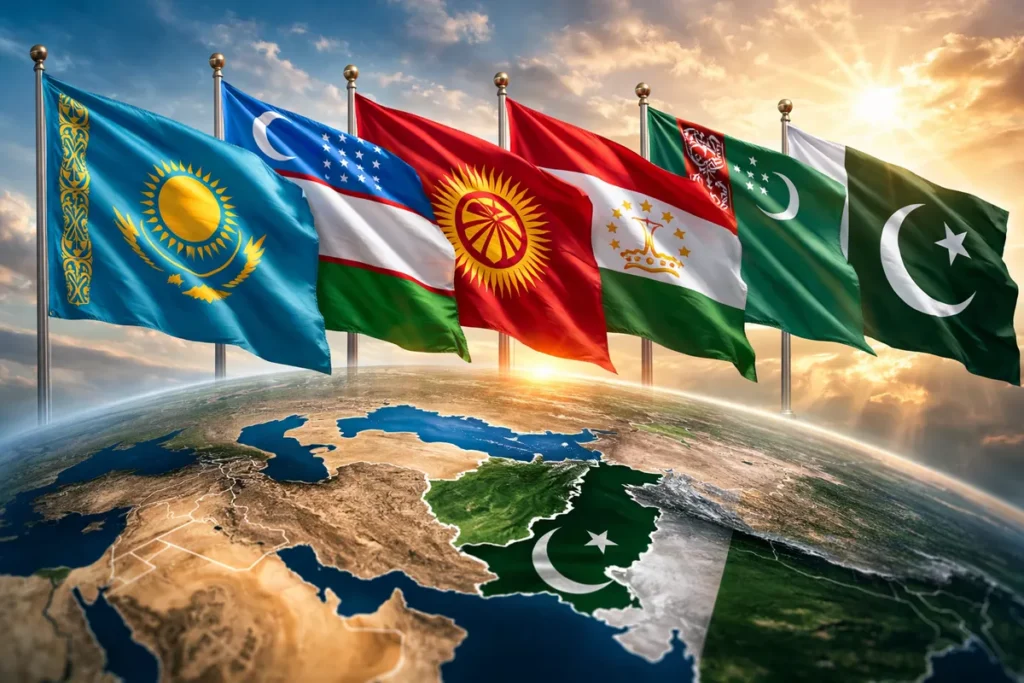
The geopolitics of connectivity has re-emerged as the defining axis of Eurasian power competition. As supply chains fragment, sanctions proliferate, and traditional transit corridors face disruption, landlocked Central Asian republics are recalibrating their external partnerships. Within this evolving matrix, Pakistan is positioning itself as a potential gateway to the Indian Ocean—an ambition rooted as much in geoeconomics as in strategic recalibration.
Yet this ambition is not new. The idea of linking Central Asia to the Arabian Sea through the territories that now constitute Pakistan dates back centuries to the Silk Road networks that connected Bukhara and Samarkand with ports along the Makran coast. During the colonial era, British strategic thinking viewed the north-western frontier as the hinge between South and Central Asia, shaped by the 19th-century “Great Game” rivalry between the British and Russian empires. After the Soviet collapse in 1991, Pakistan once again saw an opening: newly independent Central Asian republics required external access routes, and Islamabad envisioned itself as their natural southern outlet. However, civil war in Afghanistan during the 1990s, regional instability, and limited infrastructure capacity stalled these ambitions.
In the early 2000s, post-9/11 geopolitics briefly revived prospects for regional connectivity. Projects such as TAPI (Turkmenistan–Afghanistan–Pakistan–India) and CASA-1000 were conceived to bind energy-rich Central Asia with energy-deficient South Asia. Yet persistent insecurity in Afghanistan, India–Pakistan tensions, and inconsistent political commitment prevented these initiatives from reaching transformative scale. The launch of the China-Pakistan Economic Corridor in 2015 once again repositioned Pakistan within Eurasian connectivity debates, integrating its transport infrastructure with the broader Belt and Road Initiative framework.
Recent high-level diplomatic engagements underscore this renewed push. In February 2026, Kazakhstan’s President Kassym-Jomart Tokayev undertook the first state visit to Islamabad in over two decades, followed by Uzbek President Shavkat Mirziyoyev. Both leaders were conferred the Nishan-e-Pakistan, Islamabad’s highest civilian award, reflecting the symbolic and strategic weight attached to these ties. These visits signal not merely diplomatic warmth, but a structural attempt to rewire regional connectivity patterns amid shifting global alignments.
Thus, Pakistan’s contemporary outreach must be understood as part of a longer historical continuum—one shaped by imperial rivalries, post-Soviet transition, the Afghan conflict cycle, and now great-power competition in a fragmented Eurasian order.
Pakistan’s Vision Central Asia: From Rhetoric to Roadmaps
Islamabad’s 2021 “Vision Central Asia” strategy laid out five pillars—political, economic, energy, connectivity, and defence cooperation. While the document formalised Pakistan’s contemporary outreach, its intellectual roots stretch back to the early post-Soviet years. Following the dissolution of the USSR in 1991, Pakistan was among the first countries to recognise the independence of the Central Asian republics. At the time, Islamabad envisioned cultural affinity, shared Islamic heritage, and geographic proximity as natural foundations for partnership. However, the Afghan civil war of the 1990s, limited infrastructure, and competing regional priorities curtailed meaningful engagement.
The early 2000s saw renewed optimism. Energy diplomacy initiatives such as the Turkmenistan–Afghanistan–Pakistan–India (TAPI) pipeline and the CASA-1000 electricity transmission project were conceived to link resource-rich Central Asia with energy-deficient South Asia. Yet persistent instability in Afghanistan and strained India–Pakistan relations prevented these initiatives from achieving transformative impact. Connectivity remained aspirational rather than operational.
It is against this historical backdrop that the 2021 Vision Central Asia must be understood—not as a sudden pivot, but as a structured revival of a long-standing strategic objective. Since its articulation, Pakistan’s leadership has institutionalised summit diplomacy and pursued ambitious trade targets. Agreements with Kazakhstan and Uzbekistan aim to increase bilateral trade to US$1–2 billion, supported by dozens of MOUs spanning logistics, energy, geosciences, education, and industrial cooperation. High-level exchanges have sought to convert symbolic goodwill into measurable economic outcomes.
A key pillar of this renewed engagement is multimodal connectivity. The Uzbekistan–Afghanistan–Pakistan (UAP) railway project, estimated at US$4.8 billion, has been repeatedly described as a “game changer.” If operationalised, it would connect Tashkent to Pakistani ports via Mazar-i-Sharif and Kabul, significantly reducing transit time to the Arabian Sea. The logic mirrors earlier connectivity visions but with greater infrastructural ambition. Kazakhstan’s commitment of US$500 million toward extending rail lines to Herat and Kandahar similarly reflects a regional consensus that Afghanistan remains the linchpin of Eurasian integration—just as it has historically served as both bridge and battleground between South and Central Asia.
Pakistan’s contemporary push is further reinforced by infrastructure upgrades under the China-Pakistan Economic Corridor, which integrates road, rail, and port networks within the broader Belt and Road Initiative architecture. Unlike earlier decades, Islamabad now seeks to embed Central Asian connectivity within a larger Eurasian logistics ecosystem backed by Chinese capital and strategic intent.
For Pakistan, the logic is clear: as global trade corridors reconfigure under geopolitical stress—particularly after disruptions linked to the Russia–Ukraine conflict and sanctions regimes—geography must be converted into leverage. Access to Karachi, Port Qasim, and particularly Gwadar Port offers Central Asia a potential alternative maritime outlet, especially amid uncertainty surrounding Iranian transit routes.
Yet history tempers optimism. Past attempts at southward integration faltered due to insecurity, political mistrust, and implementation deficits. The present moment therefore represents not merely an opportunity, but a test of continuity: whether Pakistan can finally translate decades-old connectivity aspirations into durable economic corridors, or whether structural constraints will once again confine ambition to rhetoric.
Afghanistan: The Fulcrum of Connectivity
No connectivity architecture linking Pakistan and Central Asia can bypass Afghanistan. Historically, Afghanistan has served as the civilisational bridge between South and Central Asia—facilitating Silk Road commerce, imperial campaigns, and cultural exchange. Yet it has equally functioned as a geopolitical fault line, from the 19th-century Anglo-Russian rivalry to the Soviet intervention in 1979 and the post-9/11 US-led intervention. Each phase of instability has disrupted regional trade arteries, reinforcing Afghanistan’s dual identity as connector and disruptor.
Since the Taliban’s return to power in 2021, regional states have adopted a pragmatic approach, prioritising calibrated engagement over isolation. Kazakhstan, Turkmenistan, and Uzbekistan have expanded commercial ties with Kabul. In 2025–26, Uzbekistan reopened negotiations on electricity exports to Afghanistan and resumed discussions on railway feasibility studies, while Kazakhstan expanded humanitarian grain shipments under a stabilisation framework.
At the same time, Pakistan–Taliban tensions have sharpened. Cross-border strikes and renewed fencing disputes in 2025–26 have further complicated transit reliability. The sharp rise in TTP-linked violence in Khyber Pakhtunkhwa has forced Pakistan to allocate additional security divisions to protect CPEC and proposed rail corridors, increasing the operational cost of regional projects. Thus, while Afghanistan remains indispensable to connectivity, its evolving internal and external dynamics continue to inject uncertainty into long-term corridor planning.
The Iran Variable and the Chabahar Setback
For decades, Iran has provided Central Asia with its most viable southern maritime outlet. During the 1990s, Tehran invested in rail links connecting the Caspian region to the Persian Gulf, allowing Turkmen and Kazakh exports to bypass Russian routes.
India’s strategic investment in Chabahar Port was designed to operationalise the INSTC and secure direct access to Afghanistan and Central Asia. However, renewed US sanctions enforcement in 2025, coupled with heightened tensions in the Gulf following strikes on Iranian facilities, created fresh uncertainty around long-term shipping insurance and banking transactions. In 2026, several Central Asian logistics firms reportedly began exploring parallel insurance arrangements for alternative corridors, including Pakistani ports, reflecting a hedging response rather than a wholesale pivot away from Iran. Additionally, delays in INSTC cargo volumes reaching projected capacity have raised questions about scalability. This environment provides Pakistan with diplomatic space—but not automatic advantage.
Gwadar, BRI, and the China Factor
The deep-sea Gwadar Port, developed under the China-Pakistan Economic Corridor, represents the maritime anchor of Pakistan’s connectivity ambitions. Integrated into the broader Belt and Road Initiative, Gwadar is projected as a logistics hub linking western China, Afghanistan, and Central Asia.
In 2025–26, Pakistan accelerated Phase II development of Gwadar’s Free Zone and expanded digital customs clearance systems to attract regional cargo. China also signalled renewed financial support under a restructured CPEC framework focusing on industrial cooperation and energy optimisation. However, security incidents in Balochistan—including targeted attacks on Chinese engineers in 2025—have reinforced investor caution. Pakistan responded by establishing a dedicated maritime security task force and increasing surveillance around Gwadar. While these measures demonstrate state commitment, they simultaneously underline the persistent fragility of the operating environment. Gwadar’s strategic promise therefore remains conditional on durable internal stability.
Russia–Ukraine War and the Northern Corridor Disruption
Central Asia’s trade architecture has historically been oriented northward through Russia, a legacy of Soviet integration. The Russia–Ukraine conflict disrupted established rail freight routes and complicated financial settlements under Western sanctions.
In 2025–26, Kazakhstan expanded shipments via the Trans-Caspian International Transport Route (TITR), while Uzbekistan increased engagement with Azerbaijan and Georgia to reduce northern dependency. Freight volumes along the Middle Corridor reportedly rose significantly compared to pre-war levels. Simultaneously, Moscow’s reduced economic bandwidth limited new infrastructure investments in Central Asia, creating a strategic opening for alternative partners. Pakistan has sought to position itself within this recalibrated environment, but its corridor proposals must compete with already expanding westward alternatives. Thus, while the northern corridor’s disruption creates opportunity, it does not guarantee southward realignment.
The Middle Corridor and Turkic Consolidation
The Middle Corridor, institutionalised under the Organisation of Turkic States, has gained renewed traction as a trans-Caspian route linking China to Europe via Türkiye and the South Caucasus.
In 2025–26, Türkiye hosted high-level transport coordination meetings to streamline customs harmonisation among member states, while Kazakhstan and Azerbaijan expanded port capacity at Aktau and Baku respectively. The European Union also signalled financial interest in supporting non-Russian transit routes as part of its Global Gateway initiative. These developments illustrate that Central Asia’s connectivity diversification is multidirectional. Pakistan’s proposed corridors must therefore compete not only with Iran and Russia-linked routes, but also with increasingly institutionalised westward networks. Its advantage lies in maritime proximity—but only if inland transit risks are mitigated.
India’s Strategic Calculus
India’s Central Asia engagement has historically combined energy diplomacy, security cooperation, and connectivity initiatives. The INSTC and Chabahar formed key pillars of this approach.
However, since 2023–24, India’s continental strategy has had to adjust to sanctions volatility and Indo-Pacific prioritisation. In 2025–26, New Delhi renewed diplomatic outreach through ministerial dialogues and energy cooperation frameworks, while exploring limited trilateral formats involving Central Asian states and Gulf partners. India has also expanded digital and fintech cooperation with Kazakhstan and Uzbekistan, signalling a shift from purely physical connectivity to hybrid economic integration models.
If Pakistan consolidates transit routes under BRI-linked structures, India may face relative strategic compression. Yet New Delhi’s diversified partnerships and technological diplomacy provide alternative avenues for sustained engagement.
Economic Realities and Structural Constraints
Pakistan’s connectivity ambitions intersect with recurring macroeconomic vulnerabilities. Following IMF stabilisation packages in recent years, Islamabad has pursued fiscal reforms and export diversification, yet foreign exchange pressures persist.
In 2025–26, Pakistan introduced special investment facilitation mechanisms to accelerate Gulf and Chinese capital inflows into logistics and infrastructure. However, credit rating constraints and debt sustainability concerns continue to shape investor perceptions. Moreover, regional banking connectivity between Pakistan and Central Asia remains underdeveloped. Discussions on currency swap arrangements and digital trade facilitation platforms are ongoing but not yet institutionalised. Connectivity success will therefore depend as much on financial architecture and regulatory coherence as on rail tracks and ports.
Central Asia’s Strategic Dilemma
Since independence, Central Asian states have pursued multi-vector diplomacy—balancing Russia, China, the West, Türkiye, and regional partners. In 2025–26, Kazakhstan expanded energy dialogues with the European Union, Uzbekistan deepened industrial cooperation with South Korea, and Turkmenistan revived gas export discussions with Gulf investors. These parallel engagements underscore a deliberate diversification strategy.
Engagement with Pakistan fits within this broader hedging logic. It offers potential access to the Arabian Sea, but without displacing other partnerships. Central Asia’s strategic culture favours equilibrium over alignment. Thus, Pakistan’s outreach strengthens its profile—but whether it becomes a primary corridor or merely one of several supplementary options will depend on sustained stability, institutional reform, and geopolitical moderation.
Conclusion
Pakistan’s renewed outreach to Central Asia unfolds at a moment of profound Eurasian transition. The disruption of northern trade corridors due to the Russia–Ukraine conflict, renewed sanctions volatility surrounding Iran, and the steady institutionalisation of China’s continental infrastructure networks have collectively reshaped the strategic geography of connectivity. In this fluid environment, Islamabad’s effort to position itself as a southern gateway to the Indian Ocean is neither accidental nor isolated—it is structurally embedded in broader shifts redefining Eurasian power alignments.
Historically, Pakistan’s connectivity ambitions toward Central Asia have oscillated between aspiration and constraint. From post-Soviet optimism in the 1990s to energy diplomacy initiatives such as TAPI in the early 2000s, geography consistently promised strategic leverage. Yet insecurity in Afghanistan, domestic political volatility, and implementation deficits repeatedly curtailed momentum. The contemporary phase—anchored in the China-Pakistan Economic Corridor and linked to the broader Belt and Road Initiative—represents the most structurally supported attempt thus far to operationalise that vision.
Nevertheless, geography alone does not guarantee geoeconomic transformation. Afghanistan remains the decisive variable—simultaneously indispensable and destabilising. Gwadar’s maritime promise is tempered by insurgency in Balochistan. Macroeconomic fragility constrains Pakistan’s ability to independently underwrite large-scale projects, reinforcing reliance on Chinese capital and external financing. Connectivity corridors require more than infrastructure; they demand regulatory harmonisation, security credibility, financial integration, and sustained political coherence.
For Central Asian republics, engagement with Pakistan reflects strategic pragmatism rather than alignment. Since independence in 1991, these states have perfected multi-vector diplomacy—leveraging competition among major powers to maximise autonomy. Southern access through Pakistan diversifies transit options, particularly amid uncertainty surrounding Iranian routes and Russian bandwidth constraints. Yet it complements rather than replaces westward expansion via the Middle Corridor or continued engagement with China, Türkiye, and the European Union.
For India, the evolution of Pakistan–Central Asia connectivity introduces new competitive dynamics within the extended neighbourhood. The strategic recalibration of Chabahar and the INSTC under sanctions pressure underscores the fragility of corridor politics. However, structural vulnerabilities within Pakistan—security risks, fiscal constraints, and regional mistrust—limit the immediacy of strategic displacement. The contest is incremental, not decisive.
Ultimately, the question is not whether Pakistan can momentarily enhance its connectivity profile, but whether it can institutionalise stability over time. Eurasian integration rewards predictability. Corridors flourish where political risk is low, regulatory frameworks are coherent, and infrastructure is insulated from insurgency. If Islamabad succeeds in stabilising its western frontier, managing civil-military coherence in economic governance, and embedding connectivity within inclusive domestic development, it could gradually translate geography into durable influence.
If not, history may repeat itself—where ambition outruns implementation, and strategic opportunity dissipates amid internal fragility.
In the evolving Eurasian chessboard, Pakistan stands at a crossroads between promise and precedent. Whether it emerges as a bridge between Central and South Asia, or remains constrained by structural turbulence, will define not only its regional standing but also the future geometry of connectivity across the heart of Eurasia.

About the Author
Khushbu Ahlawat is a research analyst with a strong academic background in International Relations and Political Science. She has undertaken research projects at Jawaharlal Nehru University, contributing to analytical work on international and regional security issues. Alongside her research experience, she has professional exposure to Human Resources, with involvement in talent acquisition and organizational operations. She holds a Master’s degree in International Relations from Christ University, Bangalore, and a Bachelor’s degree in Political Science from the University of Delhi.



