
By: Khushbu Ahlawat, Consulting Editor, GSDN
Introduction
India–Armenia relations have entered a decisive phase of strategic consolidation, shaped by intensifying geopolitical competition in the South Caucasus and the emergence of a Pakistan–Türkiye–Azerbaijan alignment. What was once a historically rooted diplomatic partnership has evolved into a security-driven strategic alignment. The four-day official visit of Anil Chauhan to Armenia on 1 February 2026 symbolised this transformation. The visit, which included meetings with Suren Papikyan, an address at the National Defence Research University (NDRU), and the inauguration of an IT laboratory and distance-learning centre at the Vazgen Sargsyan Military Academy, underscored a deepening commitment to defence industrial collaboration, training exchanges, and technological modernisation.
Driven by shared geopolitical and geostrategic interests, India and Armenia are recalibrating their defence partnership in response to shifting power balances in Eurasia. The relationship today reflects not merely arms transactions but a broader aspiration for multipolarity, strategic autonomy, and regional balance in the face of emerging trilateral pressures.
This transformation must also be situated within the broader churn in Eurasian geopolitics. The South Caucasus has re-emerged as a corridor of strategic consequence, linking Europe, Russia, Central Asia, and West Asia through critical energy routes and transit networks. The aftermath of the 2020 Nagorno-Karabakh war, coupled with Russia’s preoccupation elsewhere, has unsettled traditional security arrangements and encouraged regional states to diversify partnerships. For India, engagement with Armenia aligns with its expanding defence diplomacy and export ambitions, reinforcing its image as a responsible security provider. For Armenia, partnership with India offers technological diversification and diplomatic balance. Together, both states are crafting a pragmatic alignment anchored not in bloc politics but in calibrated cooperation, sovereign choice, and long-term strategic convergence.
Historical Foundations: From Diplomatic Recognition to Strategic Depth
India and Armenia established diplomatic relations in 1992, shortly after Armenia’s independence following the dissolution of the Soviet Union. However, cultural and civilisational linkages predate formal diplomacy, with Armenian merchant communities historically present in India, particularly in Kolkata, Chennai, and Mumbai. The Armenian Church in Kolkata and archival records of Armenian trade networks stand as enduring symbols of this early connectivity. For decades, bilateral engagement remained modest, focused largely on cultural exchange, educational cooperation, and coordination in multilateral forums such as the United Nations. High-level political exchanges were limited but cordial, laying a foundation of trust without immediate strategic intensity.
The turning point emerged in the aftermath of the 2020 Nagorno-Karabakh conflict between Armenia and Azerbaijan. During the 44-day war, Türkiye provided active military and logistical support to Azerbaijan, while Pakistan extended diplomatic and strategic backing to Baku. Armenian sources alleged the involvement of Pakistani military personnel during combat operations, though these claims remain contested internationally. The conflict exposed Armenia’s heavy dependence on Russian arms supplies—Moscow accounted for nearly 94 percent of Armenia’s arms imports between 2011 and 2020. However, Russia’s subsequent engagement in Ukraine constrained its ability to meet Armenian defence requirements, prompting Yerevan to diversify its suppliers. This strategic vacuum created an opportunity for India. As both Armenia and India historically operated Russian-origin military platforms, compatibility in training and logistics facilitated defence cooperation. India emerged as a reliable partner capable of supplying advanced yet cost-effective military systems while supporting Armenia’s security modernisation.
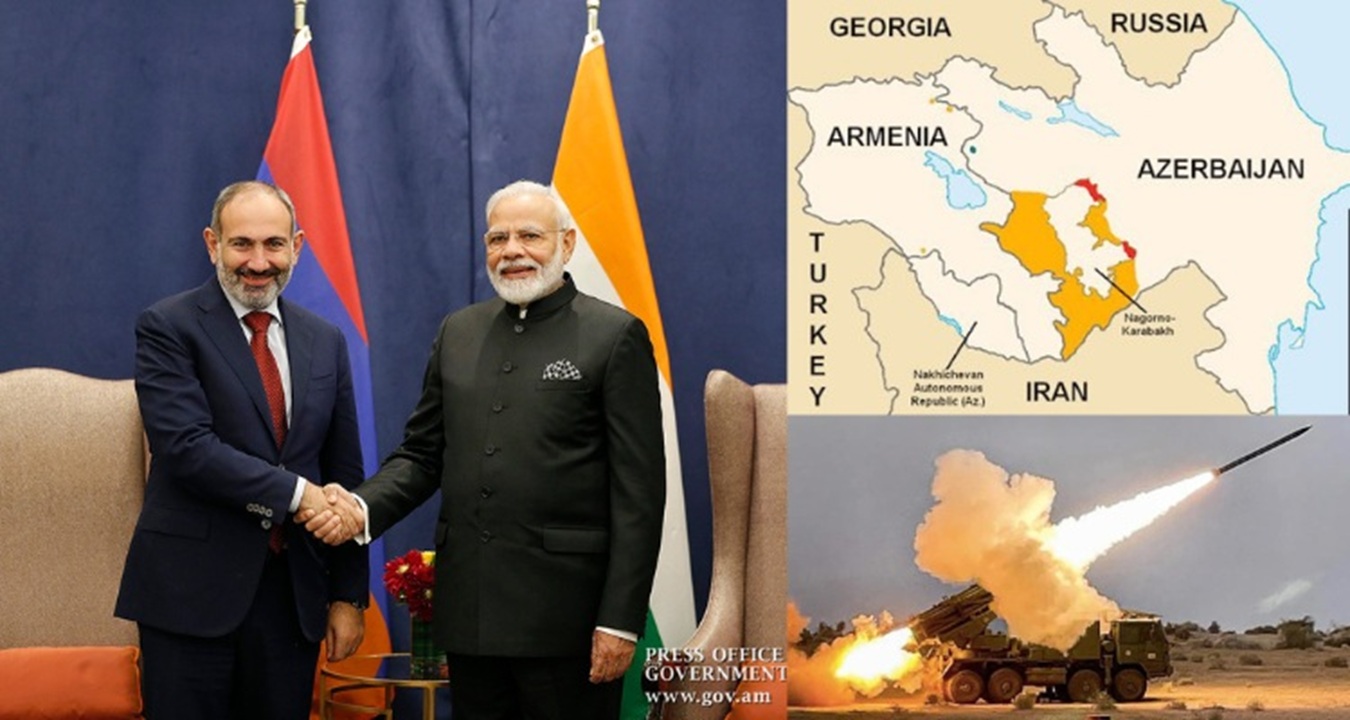
Concrete defence agreements soon followed like In 2022, Armenia signed a contract to procure the Pinaka multi-barrel rocket launcher system from India, marking New Delhi’s first major arms export to the South Caucasus. This was followed by the acquisition of the Swathi Weapon Locating Radar system, enhancing Armenia’s counter-battery capabilities. Reports also indicated discussions on the supply of Akash air defence systems, reflecting Armenia’s priority to strengthen layered air defence after the 2020 conflict. High-level visits reinforced this trajectory. The visit of Suren Papikyan to India in 2022 and subsequent defence consultations institutionalised cooperation. More recently, the February 2026 visit of Anil Chauhan to Yerevan underscored a transition from transactional arms sales to structured military-to-military engagement, including training exchanges, defence industrial dialogue, and technology transfer discussions. Collectively, these developments signal a gradual but unmistakable shift—from diplomatic recognition to strategic depth grounded in security convergence.
Expansion of Defence Engagements: Deals, Deliveries, and Industrial Cooperation
India’s defence engagement with Armenia began to take concrete shape in 2020 with a US$40 million contract for Swathi Weapon-Locating Radars. Developed by the Defence Research and Development Organisation (DRDO), the Swathi system detects and tracks enemy artillery within a 50-kilometre range. Armenian defence authorities reportedly assessed the indigenously developed system as superior to competing Russian and Polish alternatives. The deal aligned with the Make in India initiative under Narendra Modi, reinforcing India’s ambition to expand defence exports.
The partnership expanded significantly in 2022 when Armenia became the first foreign buyer of the Akash surface-to-air missile system, placing an order worth approximately US$720 million for 15 units. Designed by DRDO and produced by Bharat Dynamics Limited, the Akash system provides air defence against fighter aircraft, cruise missiles, and drones. Deliveries began in 2024, substantially enhancing Armenia’s air defence capabilities. To counter the growing threat posed by unmanned aerial vehicles, India also supplied advanced anti-drone systems capable of detection, tracking, and neutralisation.
Further strengthening this trajectory, Armenia finalised agreements to procure Pinaka multi-barrel rocket launcher systems, with initial deliveries commencing in July 2023 and an additional consignment dispatched from Nagpur in January 2026. The upgraded Pinaka variants extend operational range to 75 kilometres, significantly improving Armenia’s strike capabilities. Between 2020 and 2024, Armenia emerged as the principal recipient of Indian defence exports, with total contracts estimated at approximately US$2 billion. Yerevan has also expressed interest in acquiring 8 to 12 Su-30MKI multirole fighter jets, valued at nearly US$3 billion. This potential acquisition follows Azerbaijan’s reported US$4.6 billion deal with Pakistan for JF-17 Thunder fighter jets. Although negotiations remain exploratory, the interest signals Armenia’s intention to rebalance its air power capabilities through diversified procurement.
For Armenia, the Su-30MKI offers long-range strike capability, advanced avionics, and compatibility with a range of air-to-air and air-to-ground munitions, potentially strengthening deterrence and airspace control. The platform’s integration into Armenia’s existing Russian-origin inventory would also ease training and maintenance transitions. From India’s perspective, such a deal would mark a landmark high-value export of a frontline combat aircraft, elevating its defence export profile globally. If realised, the agreement would not merely alter the regional air balance but symbolise a new level of strategic trust and technological partnership between New Delhi and Yerevan.
The Strategic Calculus: Countering the Pakistan–Türkiye–Azerbaijan Axis
The deepening India–Armenia partnership must be viewed against the backdrop of a consolidating Pakistan–Türkiye–Azerbaijan alignment. This trilateral cooperation spans joint military exercises such as “Three Brothers,” defence-industrial collaboration—particularly in drone warfare and precision munitions—and coordinated diplomatic messaging on issues ranging from Kashmir to Nagorno-Karabakh. For India, which faces enduring security tensions with Pakistan, Azerbaijan’s growing defence ties with Islamabad and Ankara represent an expansion of strategic competition into Eurasia. Ankara’s active support to Baku during the 2020 war and subsequent defence-industrial integration have altered the regional balance, compelling New Delhi to factor the South Caucasus into its extended security calculus.
India’s defence exports to Armenia serve multiple objectives. First, they secure a strategic foothold in the South Caucasus, a region historically influenced by Russia but increasingly contested by regional and global actors including the European Union and Iran. Second, they counterbalance the growing influence of Türkiye and Pakistan in the region. Third, they project India as a dependable defence exporter capable of delivering advanced systems without overt political conditionality.
Importantly, Indian policymakers have framed these exports as instruments of balance rather than escalation. By enhancing Armenia’s defensive capabilities—through systems such as the Swathi, Akash, and Pinaka—New Delhi contributes to preserving equilibrium rather than altering territorial realities. Scholars at the Observer Research Foundation argue that India’s outreach to Armenia reflects a broader pattern of “defence diplomacy 2.0,” where calibrated arms transfers complement geopolitical signalling. Analysts such as Harsh V. Pant suggest that India’s expanding defence exports are not merely commercial ventures but instruments of strategic statecraft aimed at shaping regional balances without direct military deployment.
Further, Armenia’s growing engagement with Western institutions—evident in enhanced EU monitoring missions and political outreach—has diversified its external partnerships, creating diplomatic space for India’s deeper involvement. The cumulative value of defence agreements since 2020, estimated at nearly US$2 billion, underscores the scale of this transformation. Between 2020 and 2024, Armenia reportedly became the largest recipient of Indian defence exports, signalling both trust and strategic convergence.
Military Training, Technology Integration, and Joint Production Prospects
Beyond hardware transfers, India and Armenia are investing in institutional capacity-building. During his February 2026 visit, Anil Chauhan emphasised joint exercises, professional training, and technology integration in modern warfare. Armenian officers are increasingly exposed to Indian doctrines of mountain warfare, cyber-enabled operations, integrated air defence management, and drone countermeasures. Given Armenia’s mountainous terrain and evolving threat environment, India’s operational experience along high-altitude frontiers offers practical relevance. Structured training exchanges, staff-level dialogues, and expanded slots in Indian military academies are gradually institutionalising defence cooperation at the doctrinal level. Such engagement modernises Armenia’s operational approach while fostering long-term interoperability and professional familiarity between the two armed forces.
Technology integration forms a second pillar of this partnership. The induction of systems such as the Akash, Pinaka, and Swathi requires not only procurement but also sustained training, maintenance ecosystems, and digital command integration. Indian technical teams and defence firms have reportedly supported capacity-building in maintenance and lifecycle management, ensuring operational sustainability rather than one-time delivery.
Armenia’s pursuit of joint production and research initiatives reflects its desire to reduce reliance on a single foreign supplier. India, advancing its defence indigenisation agenda, benefits from collaborative ventures that expand production networks and demonstrate export viability. Discussions around co-development of ammunition, surveillance technologies, and potential local assembly facilities suggest movement beyond a traditional buyer–seller dynamic toward shared industrial participation.
This evolution underscores India’s broader ambition to position itself as a credible defence exporter in a multipolar world. By supporting Armenia’s security architecture through training, technology transfer, and institutional linkages, New Delhi demonstrates its capacity to contribute to stability beyond South Asia. The defence relationship thus acquires geopolitical resonance, linking South Asia and the South Caucasus within a durable and strategically embedded framework of cooperation.
India–Armenia as a Strategic Balancer in Eurasia
The transformation of India–Armenia relations from a historically cordial partnership to a comprehensive defence alignment reflects changing realities in Eurasia. Driven by shared security concerns and evolving trilateral pressures from the Pakistan–Türkiye–Azerbaijan axis, both countries have recalibrated their engagement toward strategic depth.
Highlighted milestones—including the US$40 million Swathi radar deal (2020), the US$720 million Akash missile contract (2022), the Pinaka rocket system deliveries (2023–2026), and the February 2026 defence visit of Anil Chauhan—illustrate the rapid expansion of defence cooperation. Between 2020 and 2024, Armenia became the largest recipient of Indian defence exports, with agreements totalling approximately US$2 billion. Prospective fighter aircraft discussions, expanded air-defence integration, and joint production initiatives further reinforce this trajectory, signalling long-term strategic intent rather than episodic transactions.
For Armenia, diversification of arms suppliers reduces structural overdependence on Russia and strengthens credible deterrence amid an uncertain regional order. For India, engagement with Yerevan secures a strategic presence in the South Caucasus, reinforces its defence export credentials, and demonstrates its capacity to operate as a responsible security partner beyond South Asia. More importantly, this partnership reflects a subtle yet significant shift in India’s grand strategy—from a traditionally reactive posture in extended geographies to a proactive balancing role in emerging theatres of competition.
In a geopolitical landscape marked by renewed great-power rivalry, fractured supply chains, and fluid alignments, India–Armenia security cooperation represents calibrated statecraft. It avoids overt bloc formation while shaping regional equations through capability enhancement and institutional trust. As the South Caucasus becomes an increasingly contested crossroads of power politics, New Delhi and Yerevan are constructing a partnership that blends defence industrial cooperation, doctrinal exchange, and technological modernisation.
Ultimately, India–Armenia ties exemplify how middle powers can leverage strategic convergence to reinforce multipolarity. Anchored in sovereignty, balance, and strategic autonomy, their evolving alignment signals not only a bilateral strengthening but a broader reconfiguration of Eurasian security architecture—measured, pragmatic, and forward-looking.

About the Author
Khushbu Ahlawat is a research analyst with a strong academic background in International Relations and Political Science. She has undertaken research projects at Jawaharlal Nehru University, contributing to analytical work on international and regional security issues. Alongside her research experience, she has professional exposure to Human Resources, with involvement in talent acquisition and organizational operations. She holds a Master’s degree in International Relations from Christ University, Bangalore, and a Bachelor’s degree in Political Science from the University of Delhi.



