
By: Sonalika Singh, Consulting Editor, GSDN
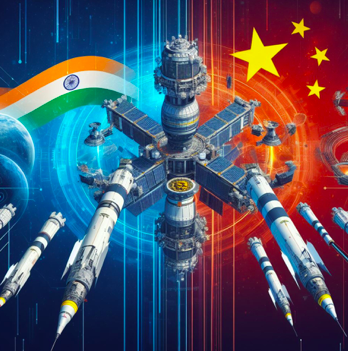
In the twenty-first century, outer space has evolved from a largely scientific and exploratory domain into a critical arena of economic activity, technological innovation, and strategic competition. The number of operational satellites has increased dramatically from roughly 800 in 2002 to more than 7,000 by 2022 owned by over 80 countries. This exponential growth reflects the centrality of space-based assets in communications, navigation, weather forecasting, financial systems, and military operations. Projections suggest that the global space economy could reach nearly US$1.8 trillion by 2035, driven by commercial mega-constellations, satellite internet services, and dual-use technologies. Yet this rapid commercialization has unfolded alongside the steady militarization of outer space. Amid intensifying great-power rivalry, space is increasingly viewed as a warfighting domain, and the competition between India and China illustrates how space capabilities are reshaping strategic stability in the Indo-Pacific.
The militarization of space is closely linked to the growing dependence of modern armed forces on satellites for intelligence, surveillance, reconnaissance (ISR), communications, navigation, and precision targeting. As a result, counterspace capabilities designed to disrupt, degrade, or destroy adversary space assets have become central to military planning. Anti-satellite (ASAT) weapons, electronic warfare systems, cyber tools, and directed-energy technologies are now integral components of national security strategies. The India–China dyad is particularly significant in this context, as both countries are rising space powers with unresolved territorial disputes, expanding military capabilities, and increasing reliance on space-based infrastructure.
China’s space warfare capabilities are the product of decades of sustained investment, strategic planning, and civil-military integration. Since its first ASAT test in 2007, when it destroyed the Fengyun-1C weather satellite at an altitude of over 800 kilometers, China has demonstrated a comprehensive approach to counterspace operations. The test generated thousands of debris fragments, drawing international criticism, but it also confirmed China’s ability to hold satellites in low Earth orbit (LEO) at risk. Subsequent assessments by the United States Department of Defense suggested that China was developing capabilities to target satellites in higher orbits, including medium Earth orbit (MEO) and geostationary orbit (GEO), thereby expanding the scope of its counterspace reach.
Beyond kinetic ASAT weapons, China has invested heavily in non-kinetic counterspace capabilities. These include electronic warfare systems capable of jamming satellite communications, directed-energy weapons such as lasers designed to dazzle or blind optical sensors, and cyber capabilities targeting satellite ground stations and data links. Reports indicate that China deployed jamming systems in the South China Sea and near the Arunachal Pradesh border during the 2020 India–China standoff in Ladakh, demonstrating the operational integration of counterspace tools into regional military contingencies. The growing sophistication of China’s cyber capabilities further enhances its ability to disrupt satellite networks without creating debris, offering a less escalatory yet highly effective means of space denial.
China’s counterspace strategy is supported by a vast and rapidly expanding satellite constellation. The Yaogan series of reconnaissance satellites provides near-continuous surveillance across the South China Sea, the Western Pacific, the Indian Ocean, and sensitive border regions such as Tibet. The BeiDou navigation system, consisting of more than 35 satellites, offers global positioning services comparable to GPS and supports precision-guided munitions and network-centric warfare. China is also planning mega-constellations of tens of thousands of satellites to provide broadband connectivity, which would enhance resilience and redundancy while complicating adversaries’ targeting efforts. The scale of China’s space architecture ensures that even if some satellites are disabled, overall functionality can be maintained.
India’s space programme, in contrast, originated in a developmental paradigm focused on socioeconomic applications such as tele-education, disaster management, meteorology, and resource mapping. Over time, however, India has expanded its space capabilities to support national security objectives. Since the early 2000s, India has launched a series of military and dual-use satellites under programmes such as CARTOSAT and RISAT, providing high-resolution imagery and all-weather surveillance capabilities. The Space-Based Surveillance (SBS) programme, initiated in 2001 and expanded in subsequent phases, aims to deploy a constellation of satellites for maritime domain awareness, border monitoring, and strategic reconnaissance. The planned launch of dozens of additional satellites over the next decade reflects India’s recognition of the importance of persistent coverage, faster revisit rates, and redundancy.
India’s dedicated military communication satellites represent another important milestone in the militarization of its space capabilities. The Indian Navy and Air Force already operatededicated communication satellites, enabling secure and reliable connectivity for network-centric operations. The Indian Army is expected to receive its own satellite by 2026, completing a tri-service space-based communications architecture. These developments demonstrate India’s transition toward integrated space support for joint military operations.
A major turning point in India’s counterspace capabilities occurred in March 2019, when India conducted an ASAT test known as Mission Shakti. By destroying a satellite in low Earth orbit at an altitude of approximately 300 kilometers, India became the fourth country after the United States, Russia, and China to demonstrate kinetic ASAT capability. Indian officials emphasized that the test was conducted at a relatively low altitude to minimize long-term debris risks, reflecting sensitivity to international concerns about space sustainability. Mission Shakti was framed domestically as a symbol of technological achievement and strategic deterrence, signaling India’s arrival as a credible space power.
Despite this milestone, India’s counterspace capabilities remain in a nascent stage compared with China’s comprehensive portfolio. India has explored technologies such as directed-energy weapons, electromagnetic pulse (EMP) systems, electronic warfare, and co-orbital capabilities, but these remain under development. While India possesses jamming and electronic warfare capabilities, their effectiveness against sophisticated satellite systems is uncertain. The absence of mature non-kinetic counterspace tools limits India’s options for calibrated responses in a crisis, potentially forcing reliance on kinetic measures that carry higher escalation risks.
The asymmetry between India and China’s space warfare capabilities has significant implications for strategic stability in the Indo-Pacific. China’s diverse counterspace toolkit providesmultiple escalation options, ranging from reversible electronic interference to destructive kinetic strikes. India’s more limited capabilities constrain its response spectrum. In a conflict scenario, China could employ non-kinetic means to disrupt Indian satellites, achieving tactical advantages without crossing thresholds associated with debris-generating attacks. If India were to respond with kinetic force, the escalation dynamics could intensify rapidly, potentially drawing international condemnation and expanding the conflict domain.
Resilience and redundancy further accentuate this asymmetry. China’s large satellite constellations and plans for mega-constellations enhance its ability to absorb losses and maintainoperational continuity. India, by contrast, relies on a smaller number of high-value satellites, making its space architecture more vulnerable to targeted attacks. The loss of a few critical satellites could significantly degrade India’s ISR, communications, and navigation capabilities. This vulnerability creates incentives for China to consider space-domain escalation in a crisis, particularly if it seeks to neutralize India’s military advantages without engaging in large-scale terrestrial conflict.
The strategic implications extend beyond bilateral dynamics. India operates space monitoring stations in countries such as Vietnam, Indonesia, and Mauritius, which support space situational awareness and maritime surveillance. China may perceive these dual-use facilities as legitimate targets in a conflict, potentially employing cyber or electronic warfare measures against them. Conversely, India might view Chinese space-related assets in Pakistan as legitimate targets if they support Chinese military operations. Such actions would expand the geographic scope of conflict, drawing additional states into the strategic calculus, and increasing regional instability.
China’s advantage is also evident in launch capacity and heavy-lift capabilities. In 2021, China conducted 55 orbital launches, placing more than 100 spacecraft into orbit with a total payload exceeding 190 metric tons. By comparison, India conducted only a handful of launches during the same period. China’s Long March 5 rocket can carry significantly heavier payloads than India’s GSLV Mk III, and Beijing is developing heavy-lift rockets capable of placing 50 tons or more into orbit. This launch capacity enables rapid constellation deployment, replenishment, and technological experimentation, reinforcing China’s strategic edge.
Navigation systems further illustrate disparity. China’s BeiDou constellation provides global coverage and supports military operations worldwide. India’s NAVIC system, while technologically sophisticated, offers regional coverage focused on South Asia and the Indian Ocean. Although NAVIC serves India’s strategic needs, its limited scope underscores the broader asymmetry in global reach and operational flexibility.
Nevertheless, India possesses important strengths that could mitigate this imbalance over time. India’s private space sector is expanding rapidly, fostering innovation, cost efficiency, and new launch capabilities. Initiatives such as the Network for Space Object Tracking and Analysis (NETRA), the Defence Space Agency, and the Directorate of Space Situational Awareness and Management reflect institutional progress toward integrated space security. India’s emphasis on small satellite constellations, redundancy, and resilient architectures could enhance its defensive posture. Moreover, India’s strategic partnerships with countries such as the United States, Japan, and Australia provide opportunities for technology sharing, interoperability, and collective space security initiatives.
The evolution of space warfare capabilities in the India–China context also raises broader questions about deterrence and escalation. Traditional strategic stability rests on mutual vulnerability and the ability to retaliate credibly. In the space domain, however, asymmetries in capabilities and vulnerabilities complicate deterrence dynamics. China’s relative advantage reduces its vulnerability, while India’s dependence on a smaller number of satellites increases its exposure. This imbalance may weaken deterrence and increase the risk of miscalculation.
At the same time, escalation in space could trigger cross-domain responses. India’s activation of naval forces during the 2020 border standoff illustrates its willingness to expand the conflict domain. If space assets were targeted, India might respond in the maritime domain, leveraging its strategic position in the Indian Ocean. Such cross-domain escalation would transform a localized conflict into a multi-theatre confrontation with far-reaching consequences for regional and global security.
The future trajectory of India–China competition in space will be shaped by technological innovation, strategic choices, and emerging norms. Efforts to promote responsible behavior in space, including commitments to avoid debris-generating ASAT tests, represent important steps toward sustainability. However, the persistence of strategic rivalry and the perceived military value of counterspace capabilities suggest that competition will continue.
In conclusion, the comparison of India and China’s space warfare capabilities reveals a complex interplay of technological advancement, strategic ambition, and geopolitical rivalry. China’s comprehensive counterspace portfolio, expansive satellite constellations, and robust launch capacity provides it with significant advantages in space warfare. India, while making notable progress particularly with Mission Shakti and its expanding military satellite programmes continues to face capability gaps, especially in non-kinetic counterspace tools and constellation resilience. These asymmetries have profound implications for strategic stability in the Indo-Pacific, increasing the risks of escalation and conflict expansion. As space becomes ever more central to national power and military effectiveness, managing competition and fostering norms for responsible behavior will be essential to preserving stability in this critical domain.

About the Author
Sonalika Singh began her journey as an UPSC aspirant and has since transitioned into a full-time professional working with various organizations, including NCERT, in the governance and policy sector. She holds a master’s degree in political science and, over the years, has developed a strong interest in international relations, security studies, and geopolitics. Alongside this, she has cultivated a deep passion for research, analysis, and writing. Her work reflects a sustained commitment to rigorous inquiry and making meaningful contributions to the field of public affairs.



