
By: Sanya Singh
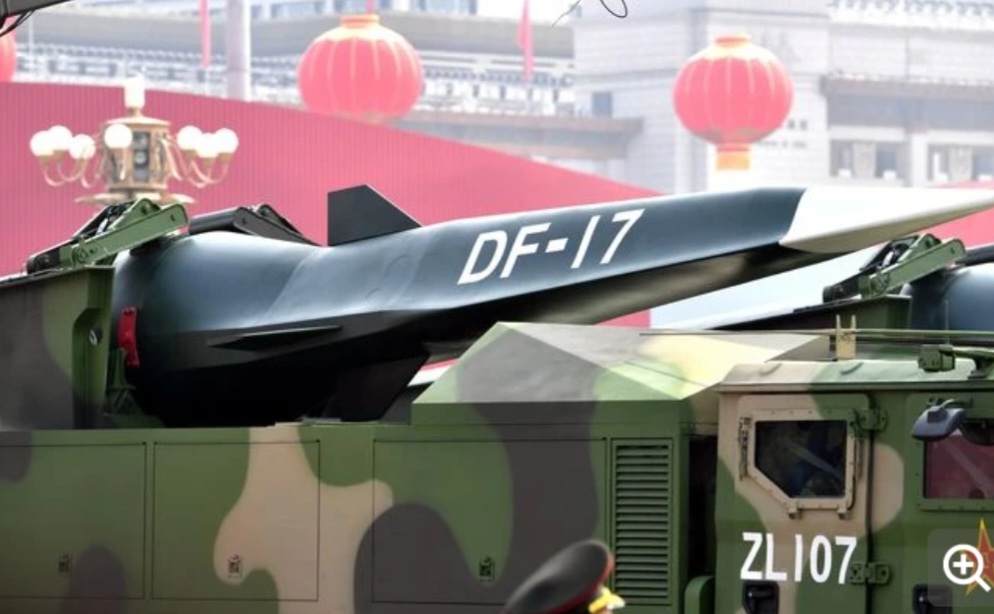
In the past ten years, China’s rapid development of hypersonic missile technology has been among the most consequential in global military affairs. Hypersonic weapons, by definition, are those delivery systems that can move at velocities greater than Mach 5 with manoeuvrability, representing a paradigm shift in the balance of strategic power. Unlike classic ballistic missiles, which have fairly predictable trajectories, hypersonic vehicles are able to change course during a flight, making their detection and possible interception much more problematic. Such a combination of speed and precision, with a huge element of unpredictability, endangers deep concern among military planners worldwide and in rapidly reshaping doctrines of national defence, deterrence, and power projection.
China’s hypersonic surge cannot be viewed in isolation. It is the result of long-term investments in science and technology, the transformation of the People’s Liberation Army into a modern fighting force, and Beijing’s growing ambition to assert itself as a leading global power. As the United States, Russia, and China enter an era of renewed great-power rivalry, hypersonic weapons have become emblematic of technological competition and strategic signalling. This article examines the nature of China’s hypersonic missile program, the motivations driving its expansion, and the implications for regional security architectures and global stability.
Understanding Hypersonic Weapons
The two main classes of hypersonic weapons are cruise missiles. Hypersonic glide vehicles are normally launched on ballistic missiles into space at high altitudes, then separate and glide at extreme speeds toward their targets along flattened trajectories. Hypersonic cruise missiles are powered during flight by advanced scramjet engines that can sustain hypersonic speeds within the atmosphere.
The key characteristic of such systems is the ability to avoid traditional missile defences. Existing radar networks and interceptor missiles are optimized either for tracking traditional ballistic trajectories or for cruise missiles flying at low altitudes and much slower. Hypersonic weapons operate in a regime that bridges these two categories, usually too low for ballistic missile sensors and too fast for effective interception by existing air defence systems. Operationally, this creates a compressed decision-making window, reducing the time available to detect, identify, and respond. As a result, hypersonic systems undermine long-standing assumptions about strategic stability that have underpinned nuclear deterrence for decades.
Evolution of China’s Hypersonic Program
Interest in hypersonic technology on the part of China extends as far back as the early years of the 2000s, when research institutions began their work related to high-speed aerodynamics and advanced propulsion. These have, over time, been coalesced into national defence imperatives through heavy funding and state-guided industrial coordination. A major milestone came on January 15, 2014, when it was reported that China conducted one of its first acknowledged tests of a hypersonic glide vehicle, an indication of seriousness in the race against established military powers in this field.
The following years saw a ramping up of the pace of testing, as Chinese laboratories worked to perfect advanced materials that could sustain temperatures generated by hypersonic flight and to upgrade guidance systems to ensure accuracy through turbulence in the atmosphere. Undoubtedly, China’s civil-military fusion strategy has played a decisive role in this progress, coordinating academic institutions, state-owned enterprises, and private technology firms in a common national objective. Investments in artificial intelligence, big data analytics, and advanced manufacturing have further strengthened ecosystems.
Attention spiked after reports of a test of a fractional orbital bombardment system on August 27, 2021, placed a significant international spotlight on China. While Chinese authorities referred to the incident as a regular spacecraft experiment, analysts interpreted it as proof of a system able to launch a hypersonic vehicle into low-orbit trajectories before de-orbiting toward a target. This system, fully operational, would challenge existing missile defence concepts by enabling unexpected approach vectors and global strike capability.
Strategic Motives Behind the Surge
China’s pursuit of hypersonic weapons reflects defensive and offensive motivations. On one hand, Beijing seeks to counter the missile defence networks deployed by the United States and its allies in East Asia. Systems such as land-based interceptors and fleet-based missile defences are perceived by Chinese strategists as undermining the credibility of China’s nuclear deterrent. Hypersonic weapons promise to restore the ability to defeat defensive shields and thereby ensure survivable second-strike capabilities.
On the other hand, hypersonic systems also function as tools of power projection. The capability to attack high-value targets with minimal warning strengthens China’s ability to deter intervention in regional conflicts-particularly in contingencies relating to Taiwan or contested maritime territories in the South China Sea. Hypersonic weapons reinforce Beijing’s anti-access and area-denial strategy through complicating the operational planning of adversaries, as well as increasing the costs of military intervention in China’s near seas.
There are also psychological and political layers that are as important as any other. Demonstrations of advanced weapons build and reinforce domestic narratives of scientific progress and national rejuvenation. Internationally, they are a signal of China’s emergence as a peer competitor to the United States and Russia. In a strategic environment where perception often rivals capability, hypersonic breakthroughs carry prestige and signalling value in a world where perception is as important as capability and become symbols of technological prowess.
Regional Implications in the Indo-Pacific
The Indo-Pacific sits at the heart, or in other words, the epicentre of the fallout from China’s hypersonic surge. Nations such as Japan, South Korea, and Australia are reassessing their defence postures, as with every passing day, intercepting hypersonic threats is becoming harder. Long-established missile defences that were considered robust now seem rather vulnerable, prompting new bets and investments on early warning systems, space-based sensors, and next-generation interceptors.
For India, China’s hypersonic progress has implications not only along the disputed Himalayan border but also around the Indian Ocean region. While direct deployment of hypersonic systems in a continental conflict is inconclusive, the broader technological imbalance caused by China’s advancements puts pressure on Indian strategic planners to hasten indigenous research and deepen cooperation with technologically advanced partners. It is this evolving recognition that hypersonic technology will be a defining element of future warfare that underpins India’s involvement in the international security framework.
Taiwan holds a particularly precarious position. Hypersonic missiles would further shrink their response time in the case of a dispute and make it difficult to protect key infrastructure. It means Taiwan would rely more strongly on asymmetric defence solutions and raises related arguments for diversified international support. Along with increasing capabilities, China has less room for miscalculations in the cross-strait relations, raising the stakes of political and military decisions.
Global Security and Arms-Control Challenges
China’s hypersonic surge poses serious challenges to existing arms control regimes. Traditional treaties regulating missiles and nuclear weapons were designed in an era when delivery systems were either ballistic or cruise in nature. Hypersonic weapons blur this distinction, making classification and verification far more complex. Without clear definitions and monitoring mechanisms, the risk of unchecked proliferation intensifies.
The complete lack of comprehensive international agreements on hypersonic technology creates a very uncertain environment. States may feel the need to pursue their own hypersonic programs as a hedge against vulnerability, fuelling an arms race reminiscent of Cold War dynamics. Yet this competition unfolds in a far more technologically sophisticated environment, where advancements occur rapidly and transparency is limited.
But perhaps the most disquieting consequence of all is the erosion of strategic stability. By compressing response times, hypersonic weapons ratchet up the pressure on decision-makers during crises. The risk of escalation due to misinterpretation or technical malfunction accordingly grows. For a nuclear-armed world, even the slightest amplification of uncertainty comes with potentially catastrophic consequences.
Responses from major players
The United States has responded to China’s hypersonic progress by expanding its research and development programs. A steady increase in investments into defensive and offensive technologies of hypersonic technologies is noted, with layered missile defence systems and space-based detectors. Integration of artificial intelligence into early-warning frameworks continues in an effort to cut down reaction times and enhance the quality of threat assessment.
Russia, itself a frontrunner in the deployment of hypersonic missiles, looks at China’s rise with a complicated mix of partnership and rivalry. The strategic cooperation between Moscow and Beijing has deepened of late, but their parallel drive for hypersonic leadership now accentuates fundamental competition for influence. Europe, on the other hand, has reacted more cautiously, caught between ambition for technological sovereignty and the pressures of alliance solidarity.
Smaller states are increasingly being drawn into this competition as suppliers, testing grounds, or diplomatic stakeholders. Hypersonic proliferation runs the risk of spreading this gap between technologically advanced powers and militarily weaker states, further exacerbating the existing inequalities within the international system.
Economic and Technological Dimensions
The development of hypersonic weapons requires huge investment, sometimes running into billions of US dollars, depending on research infrastructure, materials science, and advanced computing. China’s state-driven economic model allows this large-scale funding without the political constraints that sometimes rein in defence spending in democratic systems. It is this financial flexibility that accelerates innovation and allows for sustained experimentation.
Beyond military use, research in hypersonic spills over into civilian industries. Advances in propulsion, thermal protection systems, and high-speed aerodynamics have greater relevance in wider technological ecosystems, including aerospace engineering and space exploration. China’s dual-use approach ensures that military and civil innovations reinforce each other, amplifying the return on investment.
But this economic burden is not without cost: the vast resources devoted to developing weapons could be spent in other ways, such as social programs or economic reform. The opportunity cost of sustained militarization constitutes a long-term challenge that may become more daunting should technological competition escalate into an arms race with minimal diminishing returns in actual security.
Future Outlook
China’s path of hypersonic development indicates acceleration. As testing becomes more frequent and deployment more sophisticated, the international community will face growing pressure to respond either through arms control initiatives or technological countermeasures. Adaptation seems unavoidable.
One promising avenue lies in the pursuit of multilateral dialogue. Indeed, setting norms related to hypersonic weapons, even when no formal treaties are likely to be adopted, could reduce uncertainty and favour transparency. CBMs, such as test notifications or information exchanges, though limited, would represent an important step toward stability.
Technological innovation in defence might also restore a degree of balance. Breakthroughs in directed energy weapons, advanced interception techniques, and space-based surveillance may one day undermine hypersonic advantages. But, history suggests that defensive systems are often behind those for offense, underscoring a need for diplomatic engagement alongside technological measures.
Conclusion
The frenetic pace of hypersonic missile development in China signals a new turning point in modern warfare. These weapons complicate established defensive frameworks, compress timelines for decision-making, and alter perceptions of vulnerability among great and middle powers alike. In the Indo-Pacific, hypersonic technology increasingly reconfigures regional calculations, while it fuels strategic uncertainty and complicates arms control globally. The stakes do not end at military balance. Hypersonic weapons symbolize a broader transformation characterised by rapid technological change and intensifying geopolitical rivalry. How states respond to this transformation will shape.



