
By: Sonalika Singh, Consulting Editor, GSDN
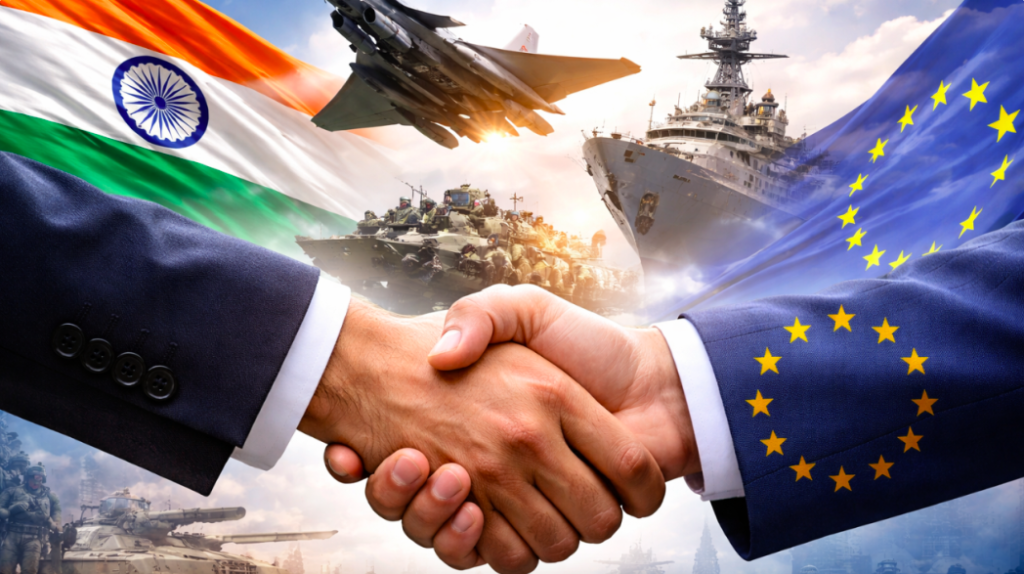
The India–European Union Free Trade Agreement (FTA), often described by policymakers on both sides as the “mother of all deals,” marks a decisive shift in the trajectory of India–EU relations. While public discussion has largely focused on its commercial dimensions of tariff reductions on automobiles, wines, textiles, chemicals, and pharmaceuticals, the agreement’s true strategic significance lies elsewhere. Embedded within the FTA is an unprecedented security and defence framework that elevates defence cooperation from a peripheral concern to a central pillar of the partnership. For India’s defence manufacturing ecosystem, this development represents not merely an incremental gain, but a potentially transformative opportunity.
Trade agreements traditionally revolve around market access, customs schedules, and regulatory harmonisation. The India–EU FTA departs from this template by explicitly recognisingdefence as a strategic sector in a volatile global order. By institutionalising defence and security cooperation alongside economic integration, the agreement reflects a broader convergence of geopolitical interests between two democratic actors navigating an era of intensifying great-power competition, supply-chain disruptions, and strategic uncertainty.
At the heart of this shift is the India–EU Security and Defence Partnership (SDP), signed by India’s Defence Minister Rajnath Singh and the EU’s High Representative for Foreign Affairs and Security Policy, Kaja Kallas. This framework elevates defence cooperation to an institutionalised, long-term engagement rather than a series of ad hoc procurement decisions. Notably, India becomes only the third Asian country after Japan and South Korea to conclude such a partnership with the European Union, underscoring New Delhi’s growing strategic weight in European thinking.
The inclusion of defence within the broader FTA signals a recognition that economic resilience and security preparedness are increasingly intertwined. In a world marked by armed conflict in Europe, instability in the Indo-Pacific, and disruptions to global supply chains, defence manufacturing has emerged as both an economic and strategic asset. For India, this marks a once-in-a-generation opening to integrate its defence industry into advanced global value chains.
India and the European Union arrive at this agreement from distinct historical and strategic contexts, yet their needs increasingly converge. Over the past decade, India has pursued an ambitious defence indigenisation agenda under the banner of Aatmanirbhar Bharat. Import bans, production-linked incentives, streamlined procurement processes, and a strong emphasis on defence exports have reshaped what was once a heavily import-dependent ecosystem.
Today, Indian firms manufacture a wide spectrum of defence equipment, ranging from artillery systems and armoured vehicles to missiles, drones, radars, electronic warfare systems, and ammunition. Defence exports have risen sharply, credibility has improved, and the sector’s ambitions have expanded beyond domestic self-sufficiency toward global competitiveness. Yet critical gaps remain. India still lacks the scale, sustained foreign investment, advanced technology absorption, and assured access to large, stable markets necessary to transition from an emerging supplier to a major defence manufacturing hub.
Europe, meanwhile, confronts a different set of pressures. The war in Ukraine has severely depleted European defence stockpiles and exposed structural weaknesses in production capacity and supply chains. At the same time, growing uncertainty over long-term US security guarantees exacerbated by domestic political volatility in Washington has sharpened European calls for strategic autonomy. As a result, European governments are increasing defence spending at an unprecedented pace while seeking to diversify suppliers and rebuild industrial resilience.
This convergence of Indian capacity and European demand creates a natural alignment. As Rajnath Singh noted following the FTA’s announcement, India’s defence industry can play a “meaningful role” in the EU’s ReArm Europe initiative, particularly as Europe seeks to de-risk dependencies and diversify its industrial base.
Historically, India–EU defence ties have followed a familiar pattern Europe sold advanced platforms and systems; India bought them. France, Germany, Italy, and Spain have long been among India’s most important defence suppliers. While this relationship brought access to advanced capabilities, it also reinforced dependency and limited domestic value addition.
That dynamic is now beginning to shift. In recent years, Indian ammunition, explosives, and select defence components have found European buyers as stockpiles ran low. The new FTA seeks to institutionalise this transition, moving the relationship from transactional procurement to industrial partnership.
Indian and European leaders have repeatedly emphasised the need for defence industries on both sides to “synergise” their efforts. Such collaboration aligns India’s pursuit of self-reliance with Europe’s quest for strategic autonomy, creating a framework where co-development, co-production, and supply-chain integration replace one-sided sales.
What distinguishes this moment from previous declarations of intent is the institutional machinery being put in place. The proposed India–EU Defence Industry Forum will bring together companies from both sides to identify concrete opportunities in manufacturing, innovation, and technology. Crucially, governments are envisaged as facilitators rather than gatekeepers, enabling industry-led collaboration.
Supply-chain integration is another central pillar of the partnership. By linking Indian manufacturers to European defence ecosystems, the agreement aims to build trusted, resilient production networks capable of meeting long-term security requirements. Indian participation in European defence programmes further deepens this integration, offering access to advanced standards, certification regimes, and collaborative R&D frameworks.
On the European side, Kaja Kallas has described the Security and Defence Partnership as a milestone that opens the door to deeper cooperation, both bilaterally and in multilateral forums. The framework institutionalises annual security and defence dialogues, expands cooperation in maritime security, cyber defence, counterterrorism, and space security, and establishescontinuity and oversight mechanisms essential for sustained engagement.
Timing is a critical factor in the agreement’s significance. Europe is rebuilding its defence posture at speed. It requires production capacity, cost efficiency, and reliable partners beyond the traditional transatlantic axis. India offers all three, along with political alignment and strategic autonomy of its own.
The scale of India’s defence manufacturing growth underscores this readiness. Domestic defence production reached approximately ₹1.50–1.51 lakh crore in FY 2024–25, representingnearly 90 per cent growth since 2019–20. Defence exports have climbed to around ₹24,000–25,000 crore, up from less than ₹1,000 crore a decade ago. Government targets of ₹3 lakh crore in production and ₹50,000 crore in exports by 2029 now appear achievable rather than aspirational.
What India lacks is the next growth engine to sustain this trajectory. The European Union, with its large and stable market, advanced technological base, and expanding defence budgets, can provide that engine.
Access to European markets, joint development programmes, co-production arrangements, and defence-related foreign direct investment would allow Indian firms to move up the value chain from component suppliers to system integrators and platform exporters. For Europe, India offers manufacturing depth, resilience, and a trusted partner as it modernises its armed forces.
One of the least discussed but potentially most consequential aspects of the partnership lies in defence financing. The Security and Defence Partnership may allow India to access the EU’s Security Action for Europe (SAFE) mechanism, including a €150 billion loan facility designed to support European defence requirements.
If realised, this access would embed Indian industry even more deeply into Europe’s defence ecosystem, providing long-term financial support for capacity expansion and technological upgrading. For India, this aligns directly with the objectives of Aatmanirbhar Bharat, while for Europe it enhances industrial resilience without over-reliance on domestic capacity alone.
The EU’s ReArm Europe initiative, which aims to mobilise up to €800 billion in defence spending by 2030, further strengthens the case for partnership. With €150 billion earmarked for joint procurement and an overarching goal of reducing dependence on US suppliers, the initiative creates strong incentives for collaboration with reliable external partners.
India’s defence industry is well positioned to integrate into this framework. Liberalised FDI norms allowing up to 74 per cent foreign ownership in defence manufacturing enhance India’s attractiveness as a co-development and production hub. Indian firms already maintain partnerships with European counterparts, laying the groundwork for deeper collaboration.
India–EU defence collaboration is no longer theoretical. India has inducted 36 Rafale fighter jets from France, with additional orders under negotiation that include significant domestic manufacturing. The partnership between SAFRAN, DRDO, and HAL to co-develop a high-thrust engine for India’s Advanced Medium Combat Aircraft represents a shift from licensed production to genuine co-development.
India is also close to finalising submarine manufacturing cooperation with Germany, producing C-295MW transport aircraft with Spain, and procuring advanced naval systems from Italy. Public and private sector firms including HAL, Bharat Electronics, Bharat Dynamics, Larsen & Toubro, Tata Advanced Systems, Mahindra Defence, Garden Reach Shipbuilders, and Mazagon Dock Shipbuilders are well positioned to scale these engagements.
Europe’s extensive military support to Ukraine has created an immediate need to replenish ammunition, missiles, and other systems. Indian manufacturers already produce a wide range of such equipment and export to multiple countries, including European states. The Security and Defence Partnership formalises and expands this pathway, transforming episodic purchases into structured cooperation.
India’s competitive advantage lies not only in cost efficiency but also in demonstrated operational capability. Indigenous platforms and systems showcased during recent military operations have reinforced confidence in Indian manufacturing standards. At the same time, India has been careful to avoid direct involvement in ongoing conflicts, underscoring the need for careful political coordination even as industrial cooperation expands.
Despite its promise, the partnership is not without challenges. Closer defence ties with the EU inevitably draw India closer to NATO-aligned strategic frameworks, potentially complicating relations with Russia a long-standing defence partner. Europe’s security threat perception is shaped heavily by Moscow, and pressure on India to further distance itself from Russian defencecooperation is likely to grow.
Managing this balance will test India’s diplomatic agility and commitment to strategic autonomy. Another critical prerequisite for deeper cooperation is the conclusion of an India–EU Security of Information Agreement, without which sensitive technology sharing will remain constrained. Prioritising this agreement will be essential to unlock the partnership’s full potential.
Beyond defence, the FTA promises significant economic gains across sectors. Implementation is expected from FY 2027, with more pronounced effects from FY 2028 onward. Labour-intensive sectors such as textiles, footwear, marine products, and gems and jewellery gain zero-tariff access to the EU market, enhancing India’s competitiveness against regional rivals.
Pharmaceuticals, medical devices, chemicals, electronics manufacturing, and IT services also stand to benefit from tariff reductions, regulatory cooperation, and improved mobility frameworks. In defence and aerospace, tariff elimination on aircraft and spacecraft imports, coupled with the Defence Industry Forum and programme participation, signals a long-term structural shift. Investor confidence has already responded positively, with defence stocks rising following the SDP announcement as an early indicator of market expectations.
The India–EU Security and Defence Partnership, embedded within the broader Free Trade Agreement and the Joint India–EU Comprehensive Strategic Agenda 2030, represents a qualitative leap in bilateral relations. By aligning strategic imperatives with industrial opportunity, it strengthens India’s defence manufacturing ecosystem while advancing Europe’s pursuit of strategic autonomy.
Although geopolitical balancing particularly regarding Russia will remain a delicate and ongoing challenge, the overall trajectory of the partnership is unmistakably positive. If implemented with consistency and political will, it has the potential to fundamentally reshape defence cooperation, accelerate technological advancement, and generate durable economic and strategic dividends for both India and the European Union. In this trade agreement, defence is not a peripheral add-on; it is the quiet prize and potentially its most consequential outcome.

About the Author
Sonalika Singh began her journey as an UPSC aspirant and has since transitioned into a full-time professional working with various organizations, including NCERT, in the governance and policy sector. She holds a master’s degree in political science and, over the years, has developed a strong interest in international relations, security studies, and geopolitics. Alongside this, she has cultivated a deep passion for research, analysis, and writing. Her work reflects a sustained commitment to rigorous inquiry and making meaningful contributions to the field of public affairs.



