
By: Khushbu Ahlawat, Consulting Editor, GSDN
1. From Non-Alignment to Strategic Autonomy: India’s Post–Cold War Foreign Policy Reorientation
Introduction
The end of the Cold War marked a decisive turning point in India’s foreign policy orientation. During the bipolar era, India’s commitment to non-alignment was rooted in the desire to preserve strategic independence amid superpower rivalry. However, the collapse of the Soviet Union and the emergence of a rapidly globalizing, multipolar international system compelled India to recalibrate its external engagements. Economic liberalization in the early 1990s further accelerated this shift, pushing India to engage more proactively with global institutions, regional groupings, and emerging power centers.
In this evolving geopolitical landscape, India transitioned from the rigid framework of non-alignment to a more flexible doctrine of strategic autonomy, which emphasizes issue-based partnerships, diversified alignments, and pragmatic engagement without formal alliances. Strategic autonomy allows India to pursue its national interests while maintaining freedom of choice across security, economic, and diplomatic domains. This approach has become particularly significant as global power diffuses beyond traditional Western dominance, with China’s rise and renewed great-power competition reshaping international politics.
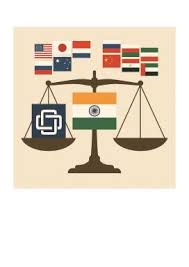
Within this context, India’s engagement with multilateral frameworks such as BRICS and the Quadrilateral Security Dialogue (Quad) reflects a deliberate balancing strategy. While BRICS enables India to cooperate with emerging economies and shape alternative global governance mechanisms, the Quad strengthens India’s position in the Indo-Pacific by enhancing strategic coordination with like-minded democracies. Together, these platforms illustrate how India navigates a multipolar world by leveraging multilateralism to safeguard autonomy, enhance economic resilience, and assert its growing global role.
2. Strategic Autonomy through Multilateral Balancing in a Multipolar World
India’s contemporary foreign policy marks a decisive departure from Cold War–era non-alignment. Rather than maintaining equidistance from rival power blocs, India’s doctrine of strategic autonomy emphasizes multi-alignment—engaging selectively with competing powers while avoiding binding alliances. This approach enables India to preserve strategic flexibility in an increasingly fragmented and competitive international system.
India’s continued defense cooperation with Russia, expanding strategic partnership with the United States, deepening economic engagement with the European Union, and leadership within the Global South collectively illustrate this shift. India’s calibrated response to the Russia–Ukraine conflict exemplifies strategic autonomy in practice. Despite sustained Western pressure, New Delhi refrained from explicit condemnation of Russia, maintained energy and defense ties, and simultaneously deepened cooperation with the US and Europe, underscoring India’s commitment to independent decision-making amid geopolitical polarization.
India’s participation in BRICS reflects its commitment to reforming global governance and amplifying the voice of emerging economies. The grouping provides a platform for South–South cooperation and serves as an alternative to Western-dominated financial institutions. The New Development Bank (NDB) remains BRICS’ most tangible institutional achievement, supporting infrastructure and sustainable development projects in India without political conditionalities.
The 2024 expansion of BRICS to include Saudi Arabia, Iran, and the UAE has enhanced the bloc’s geopolitical and economic relevance. India’s support for expansion—combined with its emphasis on consensus-based governance—reflects its effort to broaden Global South representation while preventing institutional dominance by any single power. India has also used BRICS platforms to promote local currency trade, supply-chain resilience, and digital public infrastructure, projecting its Digital Public Goods model (UPI, Aadhaar, DigiLocker) as a scalable and inclusive development framework.
Parallel to its engagement with BRICS, India’s participation in the Quadrilateral Security Dialogue (Quad) reflects a strategic response to growing security challenges in the Indo-Pacific, particularly after the Galwan Valley crisis of 2020. While remaining cautious of formal military alliances, India views the Quad as a flexible mechanism that enhances deterrence, regional stability, and strategic coordination without undermining autonomy.
Initiatives such as the Indo-Pacific Partnership for Maritime Domain Awareness (IPMDA) have strengthened India’s surveillance capabilities in the Indian Ocean, while Quad-led cooperation in semiconductors, clean energy, vaccines, and disaster resilience reinforces India’s regional leadership without overt militarization.
India’s simultaneous engagement with BRICS and the Quad reflects a strategy of multilateral hedging rather than policy contradiction. While BRICS facilitates dialogue with China within a multilateral framework, the Quad enhances India’s leverage in counterbalancing Chinese assertiveness in the Indo-Pacific. Continued engagement with China through BRICS and the Shanghai Cooperation Organisation (SCO), despite unresolved border tensions, demonstrates India’s preference for institutionalized interaction, while growing defense interoperability with Quad partners strengthens its strategic bargaining position.
India’s multilateral balancing strategy has significantly elevated its global profile, most notably during its G20 Presidency in 2023, where it positioned itself as a bridge between the Global North and the Global South. At the same time, sustaining strategic autonomy presents challenges, including internal divergences within BRICS, the risk of over-securitization of the Quad, and intensifying great-power competition. Nevertheless, India’s ability to engage across ideological and geopolitical divides highlights the adaptability of its foreign policy. Strategic autonomy, anchored in selective and pragmatic multilateralism, remains central to India’s aspiration to emerge as a leading power in a multipolar international order.
3. BRICS as a Pillar of India’s Economic and Diplomatic Multilateralism
BRICS, comprising Brazil, Russia, India, China, and South Africa, represents one of the most influential coalitions of emerging economies in the contemporary international system. Initially conceptualized as “BRIC” by economist Jim O’Neill in 2001 to highlight the growth potential of Brazil, Russia, India, and China, the grouping transitioned from a financial concept into a formal diplomatic platform with the first meeting of BRIC foreign ministers in 2006. The inclusion of South Africa in 2010 expanded the forum’s geographical and political representation, giving rise to BRICS as a voice of the Global South.
Beyond its demographic and economic weight—accounting for approximately 41% of the world’s population, nearly 24% of global GDP, and around 16% of global trade—BRICS has evolved into an institutional mechanism aimed at reforming global governance structures traditionally dominated by Western powers. The grouping seeks to promote a more inclusive and representative international economic order, particularly in institutions such as the IMF, World Bank, and WTO.
A major institutional achievement of BRICS is the establishment of the New Development Bank (NDB) in 2014, which provides development finance for infrastructure and sustainable development projects without the stringent political conditionalities often associated with Western-led financial institutions. India has been a major beneficiary of NDB funding, particularly in sectors such as renewable energy, transport infrastructure, and urban development, reinforcing the economic dimension of its multilateral engagement.
India’s chairmanship of BRICS in 2021 further underscored its commitment to shaping the agenda of emerging economies. During its tenure, India emphasized themes such as BRICS@15: Intra-BRICS Cooperation for Continuity, Consolidation and Consensus, focusing on supply chain resilience, digital public infrastructure, counter-terrorism, and reform of multilateral institutions. India’s promotion of digital public goods—such as UPI and Aadhaar—as scalable development models reflects how BRICS serves as a platform for norm diffusion and soft power projection.
Recent developments have further enhanced BRICS’ strategic relevance. The 2024 expansion of BRICS to include countries such as Saudi Arabia, Iran, the UAE, Egypt, and Ethiopia has significantly increased the bloc’s geopolitical reach, energy influence, and financial clout. India’s support for expansion, while advocating consensus-based decision-making, demonstrates its attempt to balance inclusivity with concerns over excessive Chinese influence within the grouping.
In the context of global economic uncertainty, sanctions politics, and supply chain disruptions, BRICS has increasingly focused on local currency trade, financial cooperation, and discussions around reducing dependence on the US dollar. While India remains cautious about full-scale de-dollarization, its participation in these discussions aligns with its broader goal of strategic autonomy and diversified economic partnerships.
Thus, BRICS functions not merely as an economic grouping but as a strategic multilateral platform through which India amplifies its voice, strengthens South–South cooperation, and contributes to shaping a multipolar world order. By engaging actively within BRICS, India reinforces its position as a leading emerging power while maintaining flexibility in navigating great-power competition.
4. India’s Strategic Leverage within BRICS: Reforming Global Governance amid Divergent Interests
BRICS exercises growing influence in global development and governance, particularly among low- and middle-income countries, by offering an alternative framework to Western-dominated institutions. Its primary objective lies in fostering cooperation among major emerging economies while advocating reforms in global financial and political structures that inadequately represent developing nations. Over time, BRICS has evolved from a consultative forum into a more coordinated platform addressing shared challenges across economic, political, and social domains.
One of BRICS’ central objectives is to enhance economic cooperation and development financing, reflected in the establishment of the New Development Bank (NDB). As of 2024, the NDB has approved over USD 35 billion in projects, with India among the largest recipients. BRICS also advocates reform of the IMF and World Bank, strengthens financial resilience through the Contingent Reserve Arrangement (CRA), and extends influence across Africa, Latin America, and Asia.
India’s strategic objectives within BRICS align with its doctrine of strategic autonomy. It promotes development-centric multilateralism, digital public infrastructure, and consensus-based governance while cautiously managing China’s dominance. India’s engagement with Russia within BRICS reinforces long-standing strategic ties, while institutional dialogue provides space to manage tensions with China post-Galwan.
Despite achievements, BRICS faces structural constraints due to divergent national interests, limited cohesion in trade and technology governance, and unequal gains from global agreements. These challenges constrain India’s policy space and highlight the need for deeper coordination and issue-based cooperation within the grouping.
5. The Quad and India’s Indo-Pacific Strategy: Selective Alignment without Alliance Commitments
India’s evolving stance on the Quadrilateral Security Dialogue (Quad) reflects a strategically calibrated transition rather than a departure from its long-standing commitment to autonomy. Initially hesitant, India viewed the Quad as a consultative mechanism. However, ongoing tensions with China along the Line of Actual Control (LAC) and Beijing’s assertive posture in the Indo-Pacific prompted reassessment.
Today, India perceives the Quad as a flexible, values-based framework to advance a stable, rules-based regional order. Quad cooperation in maritime domain awareness, critical technologies, supply chains, and humanitarian assistance has expanded significantly. Exercises such as Malabar 2024 signal operational coordination without formal alliance obligations.
India’s Indo-Pacific vision—anchored in SAGAR and the Indo-Pacific Oceans Initiative—positions it as a net security provider rather than a hegemon. Enhanced naval deployments, logistics agreements, and joint patrols underscore India’s growing maritime role while preserving strategic autonomy.
6. Multilateral Hedging through BRICS and the Quad: India as a Bridge between Global Orders
India’s engagement within the Quad reflects a conscious effort to contest dominant social knowledge structures shaping the Indo-Pacific order. Rather than fully endorsing a Western-led liberal international order, India promotes pluralism, inclusivity, and strategic autonomy in regional governance. Its reluctance to formalize or institutionalize the Quad stems from concerns over strategic polarization, the risk of alliance entrapment vis-à-vis China, and the imperative of preserving ASEAN centrality in Indo-Pacific architecture. By advocating flexible, issue-based cooperation—such as maritime domain awareness, disaster relief, and technology partnerships—India seeks to shape regional norms without reinforcing bloc politics.
Simultaneously, India’s leadership within BRICS underscores its commitment to reshaping global governance beyond the Indo-Pacific. Institutions such as the New Development Bank, initiatives on local currency trade, and the 2024 BRICS expansion illustrate India’s role in amplifying Global South representation and contesting Western financial dominance. Collectively, India’s engagement across both platforms positions it as a normative bridge between established and emerging global orders, balancing reformist ambitions with strategic restraint.
Conclusion
India’s engagement with BRICS and the Quad reflects a deliberate strategy of multilateral hedging aimed at preserving strategic autonomy in a rapidly evolving multipolar order. Rather than pursuing rigid alignments, India leverages these platforms to balance great-power competition, advance Global South interests, and shape regional and global norms. Through BRICS, India challenges existing financial and governance hierarchies, while its participation in the Quad strengthens a rules-based Indo-Pacific without formal alliance commitments. This calibrated approach highlights India’s growing confidence as a bridge between competing global orders, positioning it as a pivotal actor in shaping an inclusive, pluralistic international system.

About the Author
Khushbu Ahlawat is a research analyst with a strong academic background in International Relations and Political Science. She has undertaken research projects at Jawaharlal Nehru University, contributing to analytical work on international and regional security issues. Alongside her research experience, she has professional exposure to Human Resources, with involvement in talent acquisition and organizational operations. She holds a Master’s degree in International Relations from Christ University, Bangalore, and a Bachelor’s degree in Political Science from the University of Delhi.



