
By: Sanya Singh, Research Analyst, GSDN
The renewed U.S. emphasis on Cuba, following what Washington increasingly interprets as the strategic stabilization of Venezuela, is neither accidental nor merely ideological in nature. For almost twenty years, Venezuela held the central role in American initiatives to counterbalance progressive or leftist administrations and to limit external influence across Latin America. Yet, as U.S. decision-makers adjust their expectations and redefine achievement not in terms of outright regime overthrow, but rather in terms of containment, predictability, and measured engagement, the strategic spotlight has gradually shifted.
Within this shifting geopolitical terrain, Cuba, long regarded as a persistent anomaly rather than an immediate menace, has once again surfaced as a focal concern. This reorientation underscores broader transformations in hemispheric dynamics, the intensification of global power rivalries, and the evident constraints of American coercive diplomacy in an increasingly multipolar international order.
Moreover, this evolution illustrates how Washington’s foreign policy calculus is moving away from binary notions of victory and defeat toward a more pragmatic framework that values stability, predictability, and managed competition. Cuba’s reemergence as a priority is not simply about ideology, but about its symbolic weight, its strategic location in the Caribbean, and its potential role as a partner or spoiler in broader contests involving global actors such as China, Russia, and the European Union.
In essence, the American pivot toward Cuba reflects both the waning centrality of Venezuela and the recognition that enduring anomalies can become pivotal players when the regional balance of power and the limits of unilateral pressure are fully acknowledged.
Reframing the Venezuelan Experience as Strategic Containment
The depiction of Venezuela as a relative American “achievement” does not signify triumph in the traditional sense. Nicolás Maduro continues to retain authority, and the Venezuelan political framework has not experienced a transition into liberal democracy. Yet, from Washington’s vantage point, the Venezuelan state has been substantially diminished in its ability to exercise regional influence. Years of punitive economic measures severely cut oil revenues, restricted diplomatic flexibility, and compelled Caracas into financial reliance on a limited circle of partners. Gradually, Venezuela shifted from being a revolutionary disseminator of anti-U.S. rhetoric into a fractured, crisis-stricken nation preoccupied with domestic survival.
Furthermore, targeted diplomatic outreach enabled the United States to re-establish itself as a gatekeeper to Venezuela’s economic rehabilitation. By linking partial easing of sanctions to electoral stipulations and energy collaboration, Washington illustrated that it still possessed leverage without escalating into direct confrontation. Consequently, Venezuela evolved into a managed challenge, contained, supervised, and partially reintegrated under American parameters.
This strategic adjustment created space for renewed focus on Cuba, a nation that remains ideologically unyielding, diplomatically adaptable, and symbolically disruptive within the broader hemispheric and global context.
Cuba’s Enduring Symbolic Challenge to U.S. Power
Cuba’s importance in U.S. strategic calculations is anchored less in tangible strength than in symbolic weight. Since the 1959 Cuban Revolution, Havana has embodied a direct challenge to American authority within its immediate geographic sphere. In contrast to Venezuela, whose ideological boldness fluctuated with oil revenues, Cuba’s unyielding defiance has remained steady across decades of economic adversity, leadership changes, and diplomatic isolation. This enduring resilience has transformed Cuba from a mere policy challenge into a psychological litmus test for U.S. credibility.
The island’s continuance under one of the most prolonged sanction regimes in contemporary history weakens the perceived effectiveness of American coercive instruments. Each year that Cuba survives without surrender strengthens a narrative of resistance that reverberates throughout the Global South. From Washington’s perspective, permitting Cuba to persist as a viable alternative political experiment, even one beset by difficulties, creates reputational hazards that extend well beyond the Caribbean basin.
Geography and the Logic of Hemispheric Security
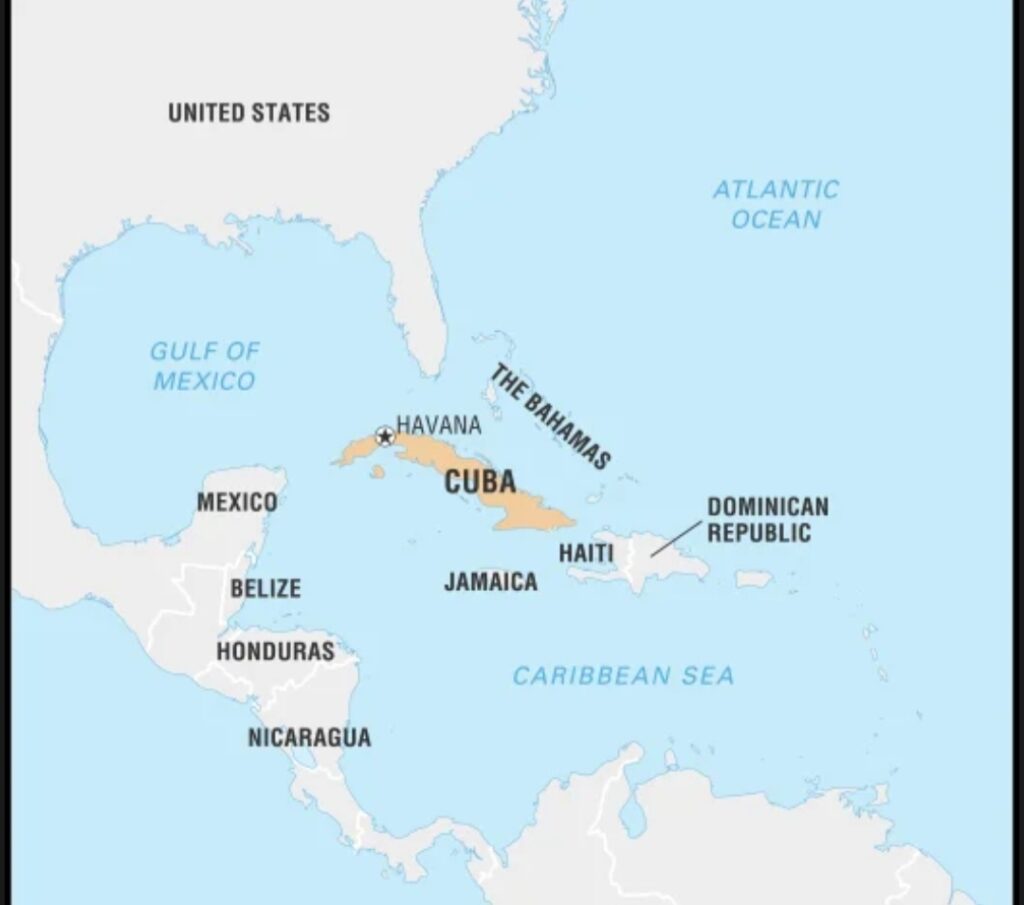
Cuba’s close physical proximity to the United States intensifies perceptions of threat in a manner unmatched by any other left-oriented Latin American nation. Situated scarcely ninety miles from the coast of Florida, Cuba occupies a strategically sensitive position that intersects with enduring American doctrines of hemispheric defence, ranging from the Monroe Doctrine to Cold War containment policies. This nearness transforms Cuba from a remote ideological challenger into a persistent symbol of vulnerability within America’s immediate neighbourhood.
Historically, U.S. officials have regarded the presence of antagonistic powers near national borders as fundamentally intolerable, irrespective of their actual military strength. Within this framework, Cuba’s political alignment is interpreted not simply as an expression of sovereign will but as a potential conduit for external penetration, intelligence activities, and strategic messaging by rival global actors.
Great Power Competition and Cuba’s Renewed Strategic Value
The escalation of U.S.-China and U.S.-Russia competition has profoundly reshaped Cuba’s strategic significance. For Moscow, a renewed engagement with Havana carries both symbolic resonance and practical utility. Against the backdrop of conflict in Ukraine and ongoing disputes over NATO enlargement, Russia’s diplomatic and economic overtures toward Cuba serve as a reminder that American manoeuvres in Eastern Europe can generate reciprocal consequences in the Western Hemisphere. Even modest forms of cooperation, whether cultural, economic, or military, carry psychological weight, rekindling Cold War-era apprehensions within U.S. strategic circles and reinforcing the perception that Cuba remains a sensitive fault line in hemispheric security.
China’s role in Cuba, by contrast, is structural, enduring, and future-oriented. Beijing has steadily expanded its economic presence through infrastructure investment, technological collaboration, and telecommunications initiatives. These projects not only provide Cuba with critical development opportunities but also embed the island more deeply into Chinese economic and technological ecosystems. From Washington’s vantage point, the establishment of Chinese digital infrastructure raises alarms about surveillance potential, intelligence collection, and the possible militarization of ostensibly civilian technologies. In a global environment where data, connectivity, and digital networks are increasingly regarded as strategic assets, Cuba’s integration into Chinese systems is interpreted as a serious security challenge.
Taken together, the dual involvement of Russia and China elevates Cuba from a regional irritant to a symbolically charged and strategically contested space. Russia’s presence underscores the geopolitical reciprocity of great-power rivalry, while China’s footprint highlights the long-term transformation of global competition into technological and infrastructural domains. For the United States, Cuba is no longer merely a neighbouring anomaly but a potential platform for rival powers to project influence, test resilience, and signal defiance. This layered dynamic ensures that Cuba’s relevance in American strategic thought will persist, not because of its material strength, but because of its capacity to embody the broader struggles of a multipolar world.
Cuba as a Hub in Alternative Global Networks
Cuba’s strategic significance also derives from its role in upholding alternative global alignments that contest Western predominance. Havana preserves strong connections with nations facing U.S. sanctions and diplomatic isolation, thereby contributing to the formation of parallel economic and political frameworks intended to circumvent American oversight and influence. These networks, though fragmented and uneven, collectively dilute the potency of sanctions as a universal policy mechanism.
Through its active participation and facilitation of such arrangements, Cuba functions simultaneously as a recipient and a catalyst of resistance to U.S.-centred order. This dual role enhances its weight in Washington’s strategic calculations, especially in an era when sanctions fatigue and non-aligned postures are increasingly gaining traction across the international system.
The Erosion of U.S. Influence in Latin America
American states emphasize political autonomy, diversification of external partnerships, and pragmatic engagement rather than strict ideological alignment with U.S. preferences. This shift reflects a regional recalibration, where sovereignty and flexibility are valued over adherence to a singular geopolitical order.
Against this backdrop, Cuba has reasserted itself as a credible regional participant rather than being relegated to the status of an outcast or pariah state. Its active involvement in multilateral forums, coupled with a persistent diplomatic footprint, directly contests American attempts to marginalize or isolate Havana. By maintaining visibility and relevance in regional dialogues, Cuba demonstrates resilience and underscores its ability to navigate shifting political currents. This transformation highlights how the island has moved beyond symbolic resistance to become a recognized interlocutor in hemispheric affairs.
For Washington, this process of normalization signifies more than a policy setback; it represents a potential precedent for other nations seeking to assert greater independence from U.S. influence. The Cuban case illustrates how endurance under pressure can eventually yield legitimacy, thereby encouraging states to experiment with alternative alignments and challenge the traditional hierarchy of power. In this sense, Cuba’s trajectory is not merely about its own survival, but about the broader implications for American credibility and authority in a region where pluralism, autonomy, and non-alignment are increasingly shaping the strategic landscape.
Domestic Political Drivers of U.S. Policy Toward Cuba
Domestic political dynamics in the United States play a decisive role in maintaining Cuba’s prominence within the foreign policy agenda. The political weight of Cuban American constituencies, especially in electorally pivotal states such as Florida, guarantees that Cuba remains a highly sensitive and contested issue. Adopting hardline stances toward Havana frequently produces domestic political advantages, reinforcing a bipartisan inclination toward caution, scepticism, or outright hostility, even when the broader strategic environment shifts.
Consequently, Cuba emerges as a politically convenient target for projecting toughness and resolve. Unlike direct confrontation with major global powers, exerting pressure on Cuba entails minimal immediate costs while simultaneously providing symbolic reassurance to domestic audiences. This dynamic foster policy inflexibility and complicates attempts at substantive recalibration or reformulation, ensuring that Cuba’s position in American foreign policy remains rigidly entrenched despite evolving international circumstances.
The Limits and Risks of Renewed Pressure
Despite heightened scrutiny and renewed attention, American leverage over Cuba remains sharply constrained. Decades of punitive sanctions and economic restrictions have failed to produce the desired political transformation, leaving the Cuban regime intact. Any further escalation of pressure risks serious humanitarian repercussions for the island’s population and could provoke widespread international criticism. Moreover, intensifying coercion may inadvertently accelerate Cuba’s integration into rival-led networks, thereby deepening the very strategic challenges Washington seeks to mitigate.
This situation illustrates a broader paradox within U.S. foreign policy, the persistent tension between coercive instruments and adaptive strategies. In the Cuban case, the traditional toolkit of sanctions, isolation, and diplomatic pressure has reached a stage of diminishing returns, producing limited tangible outcomes while reinforcing Cuba’s narrative of resilience. Yet, despite this evident stagnation, political imperatives at home and strategic caution abroad continue to discourage meaningful innovation. The result is a policy posture that remains rigid and repetitive, even as circumstances demand greater flexibility.
Ultimately, Cuba embodies the limits of unilateral pressure in a multipolar world. The island’s endurance under decades of sanctions highlights the constraints of coercive diplomacy and raises questions about the sustainability of Washington’s approach. Genuine recalibration would require the United States to balance domestic political pressures with strategic adaptation, exploring avenues beyond exclusion and punishment. However, the reluctance to embrace such change underscores how Cuba functions not only as a foreign policy challenge but also as a mirror reflecting the broader dilemmas of American power and credibility in the twenty-first century.
Conclusion: Cuba as a Measure of American Adaptability
Cuba’s renewed visibility on the American foreign policy radar in the post-Venezuelan context reflects a broader transformation in global politics. As power becomes more diffused and forms of resistance prove more sustainable, states with limited material resources can nonetheless acquire outsized relevance through their symbolic resonance, geographic positioning, and strategic affiliations. In this light, Cuba is no longer simply a lingering Cold War anomaly; it has become a test case for whether U.S. foreign policy can adapt to a multipolar order without relying exclusively on coercion, isolation, and exclusionary practices.
The way Washington chooses to respond to Cuba will serve as a signal of its broader approach to managing relative decline, intensifying geopolitical competition, and ideological diversity within its own hemisphere. If the United States continues to lean on traditional instruments of pressure, it risks reinforcing perceptions of rigidity and diminishing returns. Conversely, a willingness to experiment with engagement, adaptation, and pragmatic coexistence could demonstrate that American strategy is capable of evolving in step with the realities of a pluralistic international system.
In this sense, Cuba is not merely a renewed focal point of attention but a mirror reflecting the evolving boundaries of American influence. Its endurance and defiance highlight the limits of unilateral dominance, while its symbolic role underscores the possibilities of recalibration in the twenty-first century. For Washington, the Cuban question is less about the island itself and more about the credibility of U.S. power in a world where authority must increasingly be negotiated rather than imposed.



