
By: Sk Md Assad Armaan, Research Analyst, GSDN
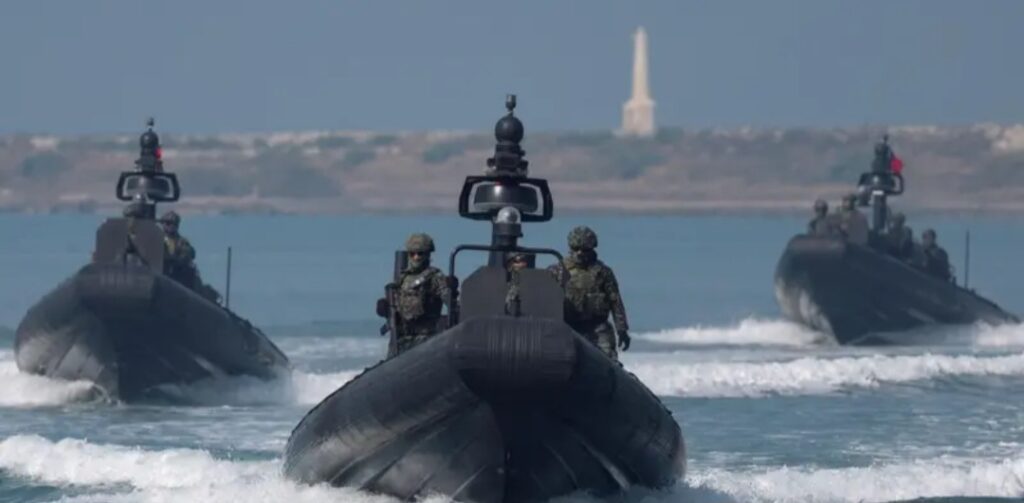
In recent years, China’s military drills around Taiwan have become larger, more frequent, and more complex. Encirclement exercises, missile launches, air and naval sorties crossing the median line, and joint-force simulations have transformed the Taiwan Strait into one of the world’s most militarised flashpoints. Each new drill cycle triggers a familiar question in global media and the world: is war imminent? While the scale and intensity of China’s military signalling have undeniably increased, the answer is more complex than a simple yes or no. China’s drills are less about preparing for immediate invasion and more about shaping the strategic environment testing thresholds, deterring external intervention, and normalising pressure. The danger lies not in an inevitable march to war, but in a prolonged grey-zone strategy in which miscalculation, crisis escalation, or political shocks could abruptly turn signalling into conflict.
China’s military exercises around Taiwan are not episodic reactions; they are embedded within a long-term strategic framework. The People’s Liberation Army (PLA) increasingly treats the Taiwan Strait as an operational training ground rather than a buffer zone. Joint exercises involving the navy, air force, rocket force, and strategic support units reflect Beijing’s emphasis on integrated warfare and rapid escalation control. These drills serve multiple purposes simultaneously. Militarily, they improve readiness for blockade, precision strikes, and joint operations. Politically, they signal resolve to domestic audiences by reinforcing the Chinese Communist Party’s claim over Taiwan as a core national interest. Strategically, they test responses from Taiwan’s armed forces, from the United States, and from regional actors allowing Beijing to refine its coercive playbook without crossing the threshold of open war. Crucially, drills are also about normalisation. Actions that once would have been considered escalatory crossing the median line, conducting missile tests near Taiwanese waters, simulating encirclement are now routine. Over time, this erodes established norms and shifts the baseline of what constitutes crisis behaviour.
Why War Is Not Imminent—Yet
Despite alarming optics, several factors suggest that China is not preparing for immediate war. First, an invasion of Taiwan remains an extraordinarily complex military operation. Amphibious landings, urban warfare, and sustained logistics across the strait would carry enormous risks, including high casualties and uncertain outcomes. Even with growing PLA capabilities, success is far from guaranteed. Second, war would carry severe economic and political costs for China. Taiwan sits at the heart of global semiconductor supply chains. Any conflict would disrupt international markets, trigger sanctions, and potentially isolate China economically at a time when its growth is already under pressure. For a leadership that prioritises regime stability and long-term national rejuvenation, war is a tool of last resort not a reckless gamble. Third, deterrence still functions. The continued presence of the United States in the Indo-Pacific, combined with Taiwan’s own defensive preparations, raises the costs of unilateral action. China’s drills, while aggressive, remain carefully calibrated to avoid triggering a military response that could spiral out of control. In this sense, drills are better understood as coercive diplomacy by military means rather than immediate war preparation.
Grey-Zone Escalation and Miscalculation
If war is not imminent, where does the danger lie? The answer is in escalation dynamics rather than intent. China’s strategy relies on sustained pressure below the threshold of war airspace intrusions, maritime harassment, cyber operations, and legal warfare. The problem with grey-zone strategies is that they compress decision-making time and increase the risk of accidents. A collision at sea, a misinterpreted missile test, or a political crisis such as a sharp shift in Taiwan’s domestic politics could rapidly escalate tensions. As military activities become routine, the margin for error shrinks. Deterrence works not because conflict is impossible, but because leaders believe escalation can be controlled. History suggests this belief is often misplaced. Moreover, repeated drills may create strategic fatigue. Allies and partners may begin to treat crises as background noise, lowering vigilance precisely when it is most needed. In such an environment, miscalculation becomes the greatest threat to peace.
Deterrence without Commitment
China’s drills are also calibrated against the United States. Beijing seeks to probe Washington’s red lines without provoking a direct response. Ambiguity remains central to US policy: deterrence without explicit security guarantees, presence without provocation. This creates a paradox. The more the United States strengthens deterrence through arms sales, military presence, and diplomatic signalling, the more China feels compelled to demonstrate resolve through drills. Each side views its actions as stabilising; each interprets the others as destabilising. Importantly, China studies not just US capabilities but US behaviour. Crisis responses, alliance coordination, and domestic political signals all feed into Beijing’s strategic calculations. Military drills thus function as intelligence-gathering exercises as much as combat rehearsals. For Taiwan, Chinese drills represent psychological and strategic pressure designed to undermine confidence without firing a shot. Constant military presence aims to normalise the idea that resistance is futile and that unification is inevitable. Yet Taiwan has not remained passive. Investments in asymmetric warfare, civil defence, and military modernisation signal a shift toward deterrence by denial. Rather than matching China ship-for-ship or plane-for-plane, Taiwan seeks to raise the costs of invasion to unacceptable levels. The challenge for Taipei is sustaining societal resilience. Grey-zone pressure targets not only military assets but public morale, political unity, and economic confidence. In this sense, the struggle over Taiwan is as much political and psychological as it is military.
Taiwan as an Indo-Pacific Stress Test
China’s military drills around Taiwan do not unfold in isolation. They reverberate across the Indo-Pacific, shaping threat perceptions and alliance calculation far beyond the Taiwan Strait. For regional actors, Taiwan has become a strategic litmus test not only of China’s intentions, but of the credibility of deterrence in Asia. Japan views escalation around Taiwan as a direct security threat. The proximity of Taiwan to the Ryukyu Islands and key US military bases means that any conflict would immediately implicate Japanese territory and airspace. This has driven Tokyo to reinterpret its security posture, increase defence spending, and frame Taiwan’s stability as inseparable from Japan’s own national security. Chinese drills, particularly those simulating blockade or missile strikes, reinforce Japanese concerns that future crises may offer little warning time. For Southeast Asian states, the drills trigger a different anxiety. While many governments seek to avoid taking sides, the militarisation of the Taiwan Strait threatens regional trade routes and economic stability. Persistent tension increases the risk of maritime disruption in one of the world’s busiest commercial corridors. As a result, Chinese signalling around Taiwan quietly pushes regional states toward hedging strategies strengthening ties with the United States and other partners while publicly reaffirming neutrality. India, too, watches Taiwan closely. While geographically distant, Taiwan’s situation mirrors broader concerns about China’s use of military pressure below the threshold of war. The logic of sustained coercion, norm erosion, and escalation control seen in the Taiwan Strait resonates with India’s experience along the Line of Actual Control. In this sense, Taiwan is not an isolated flashpoint but part of a wider pattern in China’s strategic behaviour.
Most importantly, Taiwan has become a credibility test for deterrence itself. If sustained military pressure succeeds in altering political outcomes without war, it may reinforce the effectiveness of grey-zone strategies globally. Conversely, if deterrence holds despite prolonged coercion, it sends a powerful signal about the limits of military intimidation. Other contested regions from the South China Sea to the Himalayas are watching closely. Thus, the question of war is inseparable from the question of precedent. What happens around Taiwan shapes expectations elsewhere. This is why China’s drills matter not only for Taipei or Washington, but for the future conduct of power politics in Asia.
So, Is War Imminent?
The short answer is no but the longer answer is more troubling. China’s military drills do not indicate an inevitable march toward war, but they do signal a permanent state of strategic tension. Peace is being maintained not through stability, but through strategic instability. The risk is not a deliberate decision to invade tomorrow, but a future in which escalation becomes easier than restraint. As drills intensify, norms erode, and grey-zone pressure becomes routine, the threshold between signalling and conflict narrows. China’s military drills around Taiwan are best understood as instruments of long-term coercion rather than countdowns to invasion. They reflect confidence, not desperation; strategy, not panic. Yet they also create a dangerous environment where miscalculation could turn pressure into catastrophe. The Taiwan Strait today is defined by deterrence under stress. War is not imminent, but neither is stability. The question is not whether conflict is inevitable, but whether all actors can manage prolonged tension without allowing crisis, accident, or political shock to push the region beyond the point of control. In an era where signalling replaces warfare and drills replace diplomacy; the real challenge is not predicting war but preventing it.
Author




Welldone researcher. . . It’s an only complete article over internet regarding this global disturbance